
特殊钢

Search documents
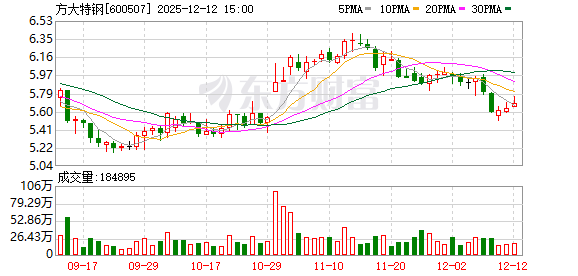
方大特钢:公司坚持普特结合的产品路线,走“低成本、差异化、特色化”的发展道路
Zheng Quan Ri Bao· 2025-12-12 11:06
Core Viewpoint - The company emphasizes a product strategy that combines general and specialized products, focusing on "low cost, differentiation, and specialization" for future development [2] Group 1: Company Strategy - The company plans to align its development with industry trends and strategic layout while consolidating and enhancing its existing products and market presence [2] - There is an intention to expand into emerging fields such as high-end equipment manufacturing and renewable energy [2] - The company aims to actively seek acquisition opportunities in special steel that align with its development strategy to gradually increase the market share of high value-added special steel products [2] Group 2: Product and Market Development - The focus is on optimizing product structure and enhancing profitability through the development of high-end and specialized products [2]


平均每6分钟即可下线1台挖掘机 中联重科跻身国家首批领航级智能工厂
工程机械杂志· 2025-12-04 09:27
Core Viewpoint - The 2025 World Intelligent Manufacturing Conference opened in Nanjing, where 15 leading intelligent factories, including Zoomlion, jointly released an initiative to outline a new blueprint for intelligent manufacturing development. Zoomlion has been recognized for overcoming challenges in the heavy equipment industry and establishing a world-class collaborative intelligent factory cluster for construction machinery, representing the highest level of Chinese manufacturing [1][2]. Group 1: Intelligent Factories - The 15 leading intelligent factories span various industries, including equipment manufacturing, raw materials, electronic information, and consumer goods [2]. - In the equipment manufacturing sector, notable factories include Shanghai Aerospace Equipment Manufacturing Factory, XCMG Heavy Machinery, Weichai, and Zoomlion's excavator sharing manufacturing intelligent factory [2][3]. - Zoomlion's excavator sharing manufacturing intelligent factory boasts an AI technology application rate exceeding 80%, achieving a production cycle of just 6.5 days from steel plate cutting to complete machine delivery, with a production rhythm of one excavator every six minutes, marking the shortest core indicators in the global construction machinery sector [3]. Group 2: Industry Trends - The engineering machinery industry is showing signs of recovery, with improved sales data for excavators and loaders anticipated in 2025 [5][6]. - The industry is transitioning to "National IV" standards starting December 1, indicating regulatory changes that may impact production and sales [5]. - Domestic sales have seen a continuous decline for 13 months, while exports have surged over 70%, suggesting a potential shift in market dynamics [5].

首批15家领航级智能工厂出炉!长三角成智造标杆集聚高地
Guo Ji Jin Rong Bao· 2025-12-03 13:04
Core Insights - The Ministry of Industry and Information Technology, along with five other ministries, has announced the first batch of 15 leading smart factories for 2025, showcasing advancements in key industries such as equipment manufacturing, raw materials, electronic information, and consumer goods [1] - The Yangtze River Delta region, particularly Shanghai, Jiangsu, and Zhejiang, has excelled in this initiative, with Shanghai leading the nation in the number of selected factories [1][3] - The establishment of a tiered cultivation system for smart factories began in 2024, categorizing them into four levels: basic, advanced, excellent, and leading, with the leading level representing the pinnacle of smart manufacturing in China [1][4] Industry Developments - Leading smart factories are demonstrating significant innovation value, with Shanghai Aerospace Equipment Manufacturing Factory achieving a reduction in launch costs through an intelligent full-process chain model [2] - In the raw materials sector, Nanjing Steel has achieved a 98.5% on-time delivery rate for customized steel production using digital twin and AI technologies, while Baosteel has gained a competitive edge through data-driven manufacturing [2] - Hikvision in the electronic information sector has reduced production line changeover time by 50% through self-developed IoT, AI, and big data technologies, providing replicable solutions for the electronics manufacturing industry [2] Regional Performance - Shanghai has cultivated 2 national leading smart factories, 28 national excellent smart factories, and over 300 advanced smart factories, maintaining its position as the top city in China for smart manufacturing [3] - The city plans to focus on a three-pronged development strategy that includes tiered cultivation of smart factories, providing smart manufacturing system solutions, and building a standard framework for smart manufacturing [3] - Leading smart factories serve as demonstration models, promoting innovation and transformation across the supply chain, with modular solutions available for small and medium-sized enterprises to facilitate their own smart upgrades [3] Construction Achievements - As of now, China has established over 35,000 basic smart factories, more than 7,000 advanced smart factories, 230 excellent smart factories, and 15 leading smart factories [4] - Smart factory upgrades have led to an average reduction of 29% in product development cycles, a nearly 22% increase in production efficiency, and a 20% decrease in carbon emissions [4] - Leading smart factories are positioned as integrated platforms for technological innovation, standard output, and industry collaboration, aligning with the core demands of high-quality manufacturing development during the 14th Five-Year Plan [4]

中国四大巨头,加起来比不过日本制铁,凭什么?
虎嗅APP· 2025-08-27 13:37
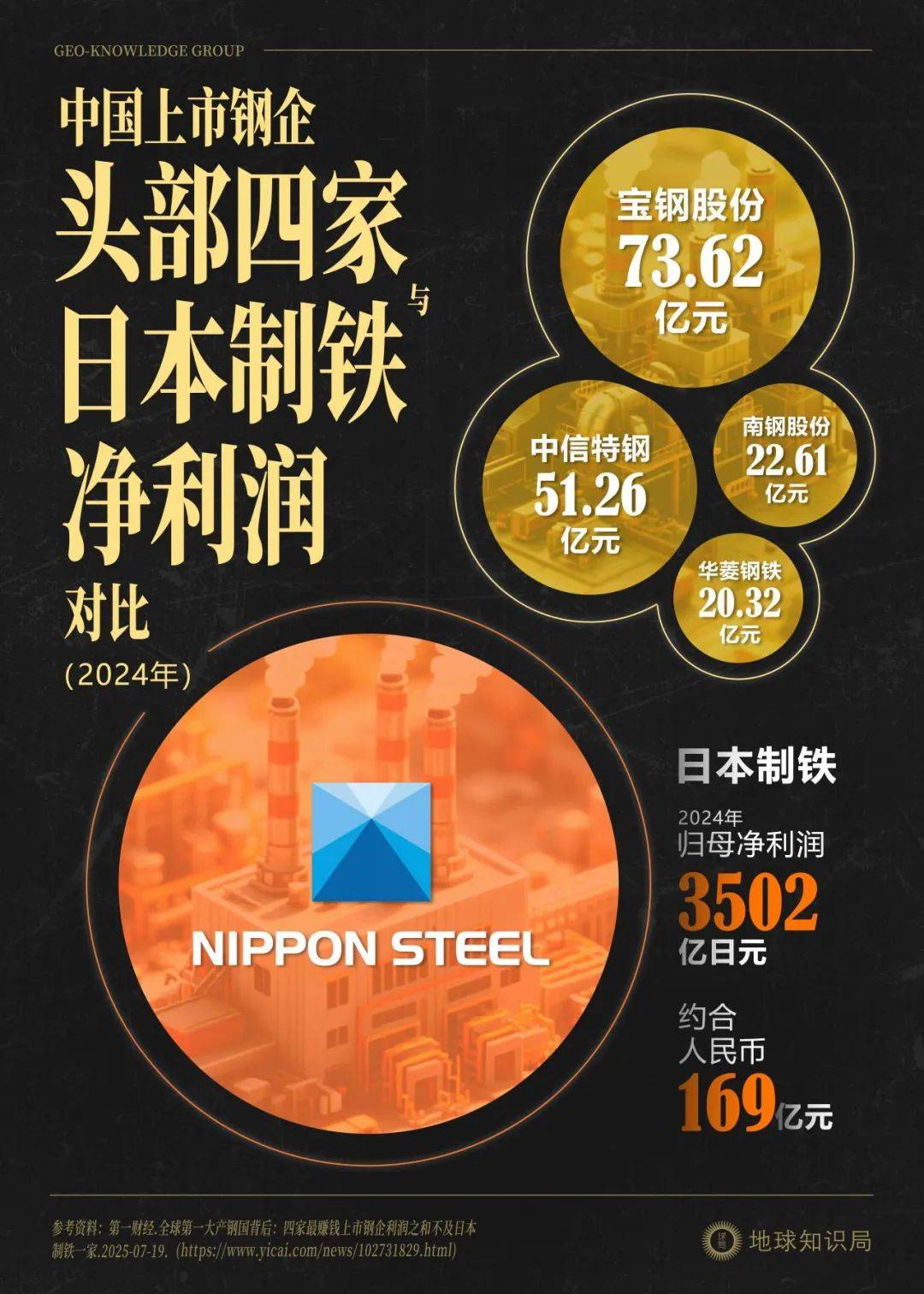
Core Viewpoint - In 2024, China's crude steel production reached 1.005 billion tons, accounting for 53.38% of global output, marking five consecutive years as a billion-ton steel powerhouse. However, Chinese steel companies face challenges of being large but not strong, with high production but low profitability compared to Japan's Nippon Steel [4][29]. Group 1: China's Steel Industry - China's steel industry produced 1.005 billion tons of crude steel in 2024, a year-on-year decrease of 1.7% [29]. - Among the top 10 steel producers globally, six are Chinese companies, highlighting China's dominance in production [4]. - The four most profitable listed steel companies in China (Baowu, CITIC Special Steel, Nanjing Steel, and Huazhong Steel) combined profits still fall short of Japan's Nippon Steel [4][6]. Group 2: Comparison with Japan's Steel Industry - Nippon Steel's net profit for 2024 was approximately 164 billion yuan, surpassing the combined profits of China's top four steel companies [6][7]. - Japan's steel industry has successfully transformed from past overcapacity and losses to profitability through strategic measures, including cost reduction and focusing on high-value products [16][19]. - In 2020, Japan's crude steel production was 83.19 million tons, with special steel accounting for about 20.96% of its output, compared to China's 12.31% [25]. Group 3: Challenges and Opportunities for China - China's steel exports in 2024 reached 110.71 million tons, a year-on-year increase of 22.7%, but the average price per ton decreased, indicating a "volume increase but price drop" trend [31]. - China heavily relies on imported iron ore, with 1.237 billion tons imported in 2024 at an average price of 106.9 USD per ton, making the industry vulnerable to international price fluctuations [31][33]. - The West Simandou iron ore project in Guinea, in which Baowu Steel Group has invested, is expected to improve China's high-grade ore self-sufficiency by 3% to 5% upon production [33].
中国四大巨头,加起来比不过日本制铁,凭什么?
商业洞察· 2025-08-27 09:31
Core Viewpoint - China has maintained its position as the world's largest steel producer, with a crude steel output of 1.005 billion tons in 2024, accounting for 53.38% of global production, despite efforts to reduce excess capacity [3][20]. Group 1: China's Steel Industry - China's steel industry is characterized by high production but low profitability, with the net profits of its top four listed steel companies in 2024 not surpassing that of Japan's Nippon Steel [3][5]. - In 2024, China exported 11.07 million tons of steel, with an average price of $755.4 per ton, indicating a trend of increasing volume but decreasing total revenue [20][22]. - China's reliance on imported iron ore is significant, with imports reaching 1.237 billion tons in 2024 at an average price of $106.9 per ton, making the industry vulnerable to international price fluctuations [23][25]. Group 2: Japan's Steel Industry Recovery - Japan's Nippon Steel faced severe losses in 2019 but implemented a comprehensive reform strategy that included shutting down high-cost production facilities and focusing on high-value products, leading to a turnaround in profitability within a year [14][18]. - The company shifted its focus to producing high-margin products, such as special steel, which accounted for approximately 20.96% of its total crude steel output in 2020, compared to only 12.31% for China [17][20]. - Japan's steel industry has benefited from government policies aimed at eliminating outdated capacity and promoting industry upgrades, which could serve as a model for China's steel sector [12][26]. Group 3: Future Directions for China's Steel Companies - Chinese steel companies are encouraged to learn from Japan's past experiences and focus on producing high-value-added steel products to enhance profitability and competitiveness [26]. - The development of high-quality steel products, such as LNG ship steel and aircraft carrier deck steel, indicates progress in technology and product diversification within China's steel industry [26].

中国钢铁:产量全世界第一,但挣钱能力与日企比,那就差远了
Sou Hu Cai Jing· 2025-08-27 00:07
Group 1 - In 2024, China's crude steel production is projected to reach 1.005 billion tons, accounting for over 50% of global output, solidifying its position as the world's largest producer [1] - Despite high production levels, Chinese steel companies lag significantly in profitability compared to Japanese firms, with the top four Chinese steel companies' net profits combined being less than that of Nippon Steel [3] - Nippon Steel, despite producing only 39.64 million tons of crude steel in 2024, has managed to achieve higher profits than Chinese counterparts, highlighting a stark contrast in profitability [3] Group 2 - Cost control is a critical factor, with iron ore accounting for 40% to 50% of steelmaking costs; Nippon Steel has secured long-term low-price contracts with major miners, while Chinese companies rely heavily on imported iron ore, leading to higher costs [5] - Japanese steel companies focus on high-value specialty steel, with over 20% of Nippon Steel's production being specialty steel, while Chinese companies have only 12.31% of their production in this category, primarily producing lower-margin ordinary steel [5] - Chinese steel companies are making efforts to innovate, with advancements in producing specialized steel products, supported by government initiatives aimed at improving the industry [7] Group 3 - The current situation of "large but weak" and low profits in the Chinese steel industry indicates a need for transformation, emphasizing the importance of profitability over sheer production volume [8] - To compete effectively in the global steel market, Chinese steel companies must learn from Nippon Steel and transition from being "large producers" to "profit-making experts" [8]
中国四大巨头,加起来比不过日本制铁,凭什么?
Hu Xiu· 2025-08-26 13:16
Core Viewpoint - In 2024, China's crude steel production reached 1.005 billion tons, accounting for 53.38% of global output, maintaining its position as the world's largest steel producer for five consecutive years [1] Group 1: Production and Market Position - China dominates the global steel production landscape, with six out of the top ten steel companies being Chinese [1] - Despite the high production volume, Chinese steel companies face challenges such as overcapacity and low profitability [2] Group 2: Profitability Comparison - The combined net profit of China's four most profitable listed steel companies (Baosteel, CITIC Special Steel, Nanjing Steel, and Huazhong Steel) in 2024 is still lower than that of Japan's Nippon Steel [3][8] - Nippon Steel's net profit for 2024 is approximately 110.4 billion yen (around 5.61 billion RMB), significantly higher than the combined profits of the top Chinese steel firms [3][7] Group 3: Historical Context and Lessons - Japan's steel industry faced overcapacity issues in the late 20th century but successfully turned around by focusing on high-value products and strategic resource management [9][22] - Japan's Nippon Steel implemented significant reforms, including shutting down inefficient production lines and focusing on high-margin products, leading to a rapid recovery from losses [30][44] Group 4: Future Directions for Chinese Steel Companies - Chinese steel companies are encouraged to learn from Japan's experience, particularly in enhancing product quality and profitability [58] - The Chinese steel industry is making strides in producing high-value steel products, indicating potential for future growth and competitiveness [59]
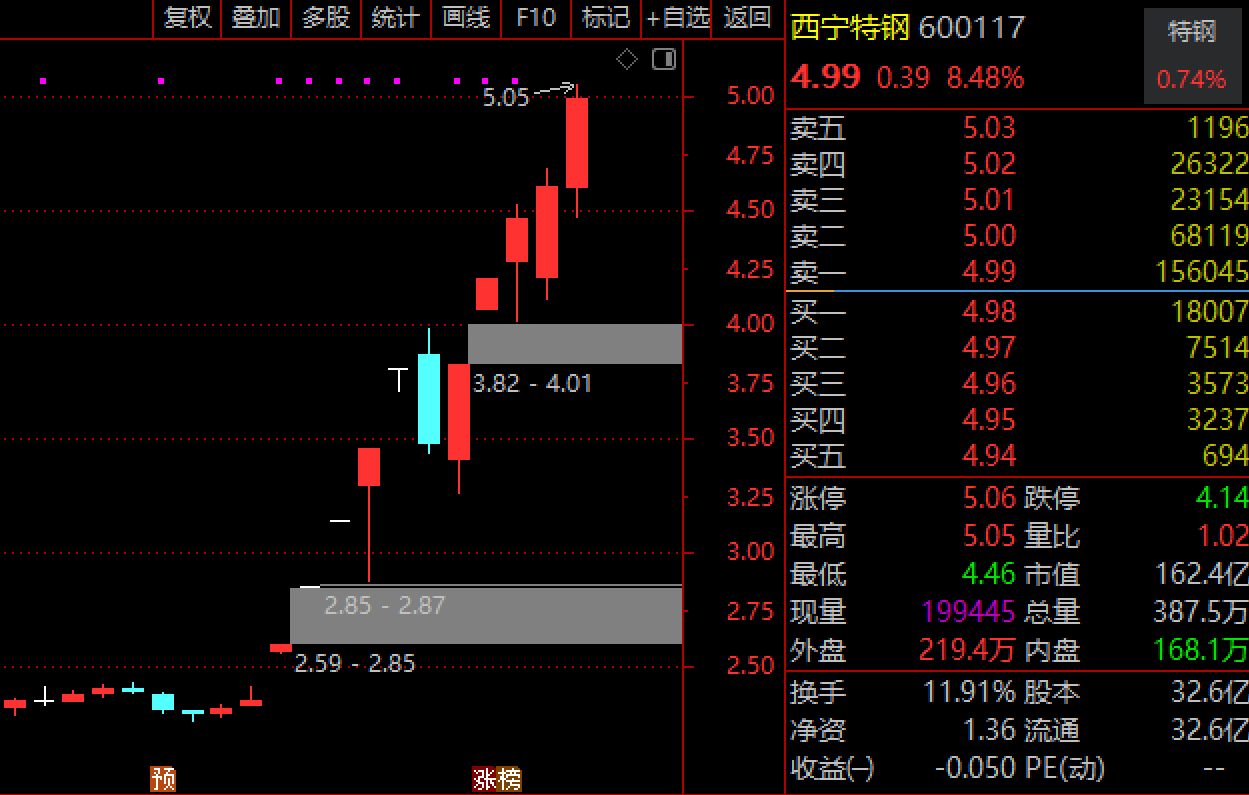
“妖股”直击:西宁特钢11天大涨112%,雅江水电+反内卷双重刺激,但业绩依旧巨亏
Jin Rong Jie· 2025-08-04 09:01
Group 1 - The core viewpoint of the article highlights the significant stock price increase of Xining Special Steel, which closed at 4.99 yuan, up 0.39 yuan or 8.48% on August 4, with a cumulative increase of 112% over 11 trading days since July 21, including 7 days of trading limit [1][3] Group 2 - Xining Special Steel announced on July 30 that there were no undisclosed significant information after self-examination and verification with its controlling shareholder, Tianjin Jianlong Steel Industry Co., Ltd. [3] - The company benefits from the commencement of the Yarlung Tsangpo River Hydropower Station project, having started sales operations in Tibet since 2020, and is recognized as the largest special steel producer in the western region, with products widely used in the automotive and engineering machinery sectors [3] - The steel industry is experiencing a positive shift, with the profit of the black metal smelting and rolling processing industry reaching 46.28 billion yuan in the first half of the year, a year-on-year increase of 1,370%, the highest growth rate among all 31 industrial categories [3] - Companies like Shougang Co. and Guangda Special Materials have reported significant net profit growth in their semi-annual earnings forecasts, with Liugang Co. showing a net profit increase of 530% to 641% [3] Group 3 - Despite the positive industry trends, Xining Special Steel remains in a loss position, with a net profit loss of approximately 247 million yuan in the first half of the year, a year-on-year increase of about 14%, and a loss attributable to shareholders of approximately 234 million yuan, reflecting a year-on-year increase of around 20% [3]

山西太钢不锈钢股份有限公司 2025年半年度业绩预告
Zheng Quan Ri Bao· 2025-07-14 23:29
Group 1 - The company expects an upward trend in performance for the first half of 2025, covering the period from January 1 to June 30, 2025 [1] - The performance forecast is based on preliminary estimates from the company's financial department and has not been audited by an accounting firm [1] - The steel industry is experiencing a reduction in output and structural adjustments, leading to increased supply-demand contradictions and weak steel prices [1] Group 2 - The company has implemented several strategies to enhance performance, including focusing on problem-solving, benchmarking, and cost reduction [1] - There is a strong emphasis on innovation, with increased investment in the research and development of stainless steel and special steel products [1] - The company is transforming its marketing system with a customer-centric approach and integrating operations to improve internal efficiency [1]

太钢不锈: 2025年半年度业绩预告
Zheng Quan Zhi Xing· 2025-07-14 16:05
Performance Forecast - The company expects a net profit of 350 million to 450 million yuan for the first half of 2025, compared to 139 million yuan in the same period last year, indicating an increase of 151.80% to 223.74% [1] - The net profit attributable to shareholders after deducting non-recurring gains and losses is projected to be between 273 million and 373 million yuan, compared to a loss of 57.21 million yuan in the previous year [1] - The basic earnings per share are expected to be between 0.061 yuan and 0.079 yuan, compared to 0.024 yuan in the same period last year [1] Reasons for Performance Change - The company attributes the performance improvement to intensified supply-demand contradictions and weak steel prices, leading to proactive problem-solving and cost reduction measures [1] - The company has focused on innovation, increasing R&D efforts for new stainless steel and special steel products, and has implemented a customer-centric marketing system transformation [1] - Efficiency has been enhanced through the integration of iron-making and steel-making plants, and the company continues to expand its operational dimensions around quality, cost, delivery, variety, and service (QCDVS) [1]