GitHub

Search documents
“逃离GitHub!”开发者接连出走后怒批:前端不友好、体验直线下降、内部工程文化已“烂掉”
猿大侠· 2025-12-03 04:11
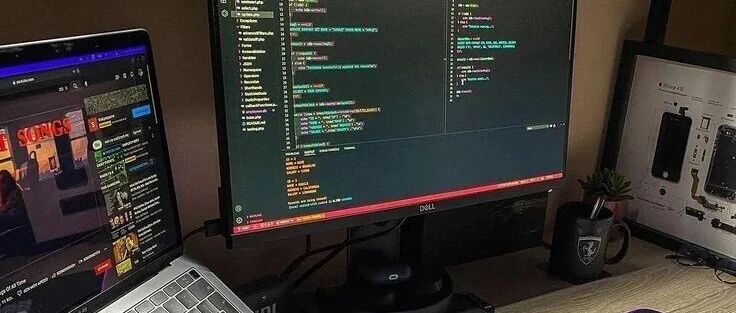
Core Viewpoint - The article discusses the recent migration trend of developers moving their open-source projects from GitHub to alternative platforms like Codeberg, driven by dissatisfaction with GitHub's current management and service quality under Microsoft's ownership [1][2]. Group 1: GitHub's Management Changes - GitHub's CEO Thomas Dohmke announced his resignation, and the platform will no longer have a CEO position, leading to concerns about its future direction [1]. - The migration trend is partly attributed to developers feeling that GitHub's engineering culture and service quality have deteriorated since its acquisition by Microsoft [8][9]. Group 2: Developer Migration Examples - Zig programming language, a significant project, has migrated to Codeberg due to perceived corruption in GitHub's priorities and engineering culture [4][6]. - Andrew Kelley, Zig's main developer, expressed that GitHub's once-effective engineering capabilities have declined, leading to a frustrating user experience [8][9]. - Other projects, such as the lightweight browser Dillo, have also migrated due to similar concerns about GitHub's usability and performance [14][16]. Group 3: Specific Issues with GitHub - Developers have reported that GitHub's interface has become less user-friendly, particularly for those using non-JavaScript environments [16]. - GitHub Actions, a critical feature for continuous integration, has been criticized for its instability and lack of attention from GitHub's management [9]. - Concerns about GitHub's increasing focus on AI solutions have led some developers to protest by migrating their projects [20][21]. Group 4: Community Reactions - The developer community has mixed reactions to the migration trend, with some expressing dissatisfaction with GitHub's performance and AI features, while others view these migrations as individual choices rather than a widespread movement [22][24]. - There is speculation that the open-source community may be entering a phase of decentralization, with developers seeking platforms that better meet their needs for control and collaboration [24].


Why IDEs Won't Die in the Age of AI Coding: Zed Founder Nathan Sobo
Sequoia Capital· 2025-12-02 10:01
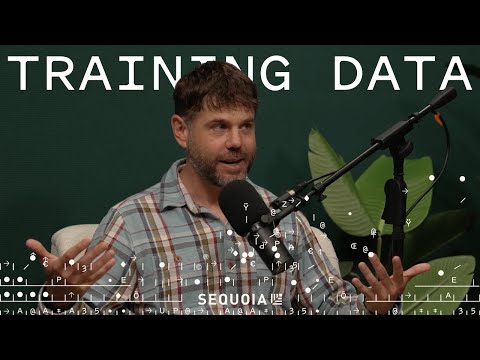
Core Argument - The IDE is not dead; human interaction with source code remains essential, even with AI assistance [1][8][11] - Source code is a language intended for human consumption, requiring visual interfaces for understanding AI agent actions [3][8][9] - The best user interface for code interaction is likely a GUI, optimized for presenting and navigating source code [12][13] Zed's Vision and Strategy - Zed aims to provide the ultimate interface between humans, source code, and AI agents, acting as a "Switzerland" for collaboration [41][40] - Zed is building a vertically integrated environment with fine-grained tracking of code evolution, enabling anchored conversations and interactions [38][39][40] - Zed's architecture prioritizes performance, aiming for zero perceptible lag in keystroke feedback [30][31] - Zed is designed as an inherently collaborative environment for multiple humans and AI agents [81][82] Agent Client Protocol (ACP) - ACP aims to democratize AI agent integration, allowing developers to use various agents with a great UI, similar to the Language Server Protocol [44][46] - ACP facilitates the externalization of agent intelligence, enabling different agents to compete and specialize in particular problems [45][46] AI's Role in Coding - LLMs are good at generating code from well-known knowledge and implementing code from abstract models [71][75] - LLMs are less helpful when the task involves novel problem-solving or when the code is not the primary constraint [72][73][76] - The industry is exploring how to manage multiple conversations with multiple agents and make those conversations more valuable [88] User Base and Adoption of AI - Zed has approximately 170,000 active developers, many of whom are experienced engineers [2][54] - About half of Zed users are using edit prediction, and a quarter are using agentic editing [56] Future IDE Evolution - The IDE will evolve into a collaborative environment where conversations with agents can be shared with human teammates [82] - Codebases will become metadata backbones, with conversations, edits, and context linked directly to the code [83][84] - The IDE interface will evolve to put conversations front and center, potentially modeling conversations as evolving documents [85][89]
大幅降价、无限聊天、编码能力超越人类专家,Claude Opus 4.5重夺最强模型王冠
3 6 Ke· 2025-11-25 01:48
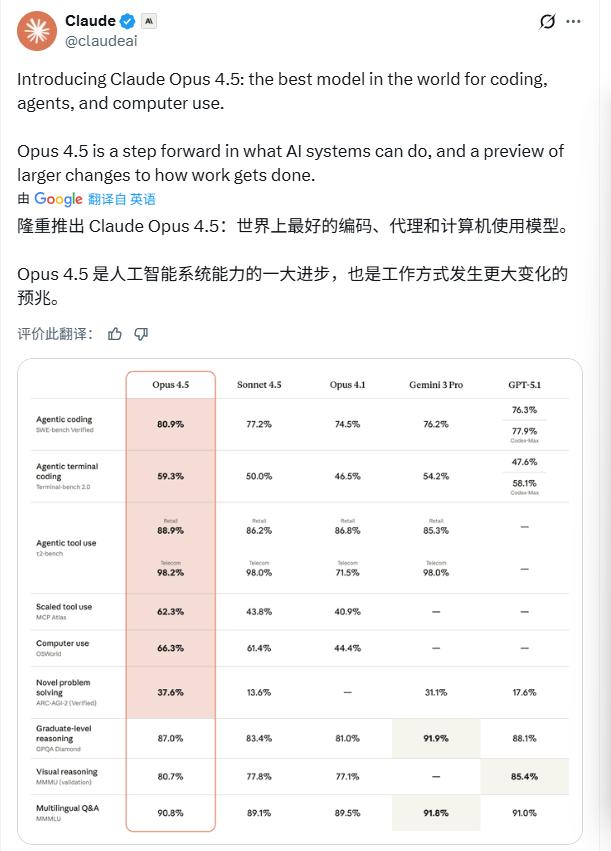
| | Opus 4.5 | Sonnet 4.5 | Opus 4.1 | Gemini 3 Pro | GPT-5.1 | | --- | --- | --- | --- | --- | --- | | Agentic coding | | | | | 76.3% | | SWE-bench Verlfied | 80.9% | 77.2% | 74.5% | 76.2% | 77.9% | | | | | | | Cadea-Max | | Agentic terminal | | | | | 47.6% | | coding | 59.3% | 50.0% | 46.5% | 54.2% | 58.1% | | Terminal-bench 2.0 | | | | | Cochia Max | | | Recal | frisk | lickel | Retal | | | | 88.9% | 86.2% | 86.8% | 85.3% | - | | Agentic tool use | | | | | | | t2-bench | Telecom | Telecore | Telecom | Te ...
Infra that fixes itself, thanks to coding agents — Mahmoud Abdelwahab, Railway
AI Engineer· 2025-11-24 20:16
Infrastructure Monitoring and Issue Detection - The system proactively monitors application infrastructure, including services, resource metrics (CPU, memory), and HTTP metrics (request error rate, failed requests) [5][8][9] - It analyzes metrics against predefined thresholds to identify affected services, moving beyond simple alert-based systems by analyzing a slice of time to reduce noise from spiky workloads [5][10][11] - The system gathers additional context for suspicious services, including project health, logs, and potentially upstream provider status, to avoid false positives due to high usage or external issues [12][13] Automated Issue Resolution - Upon detecting an issue, the system formulates a detailed plan, leveraging AI to analyze the application architecture, performance data, and errors [14][38] - A coding agent then clones the repository, creates a to-do list based on the plan, implements fixes, and generates a pull request [15] - The coding agent uses Open Code, an open-source AI agent, deployed on a server with necessary tools and Git configured, enabling it to open pull requests [22][23][25][26][27] Durable Workflows and Implementation - The system utilizes durable workflows to manage complex logic and ensure reliability, with automatic retries and caching of successful steps [16][18][19][20] - The workflow involves fetching application architecture, resource metrics, and HTTP metrics via API calls [21][31][32][34] - The system formats the collected information and passes it to the coding agent to generate a fix [33][35][37] Demonstration and Results - A demonstration showcases the workflow, starting from issue detection to the opening of a pull request with proposed changes [6][29][30][40] - The pull request includes a summary of changes, analysis, root causes, and fixes, allowing for review and merging [40][41] - The demonstration highlights a scenario where memory usage is high at 3196% GB out of a maximum of 32 GB, triggering the automated fix [33]

X @Avi Chawla
Avi Chawla· 2025-11-23 06:30
Repository Information - GitHub repository link provided for access [1] - Encouragement to star the GitHub repository [1]
杨立昆官宣离职,感谢一圈Meta领导,只字不提亚历山大·王
3 6 Ke· 2025-11-20 01:52
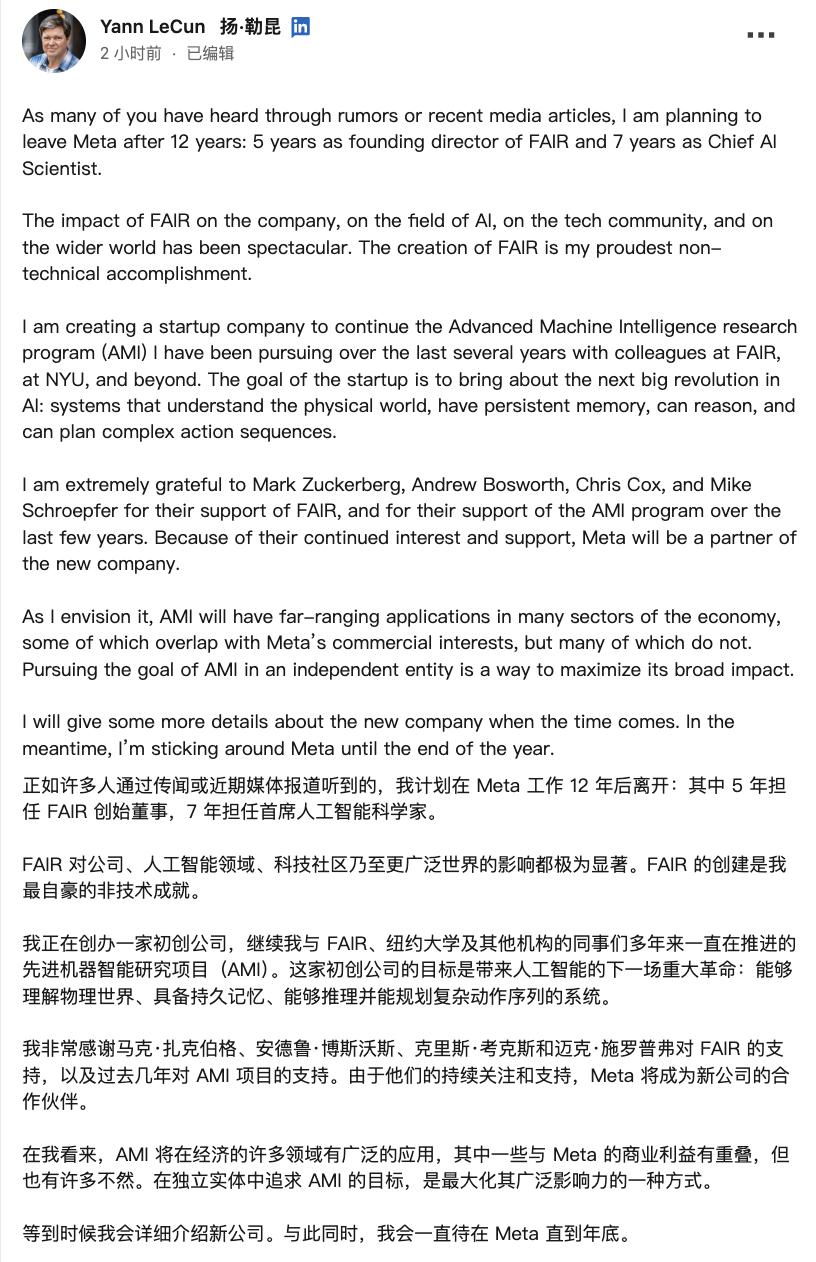
Core Insights - Yang Li-Kun, a Turing Award winner and Chief Scientist at Meta AI, announced his departure from Meta to establish a startup focused on Advanced Machine Intelligence (AMI) by the end of the year [1][3][4] - The new venture aims to create systems that can understand the physical world, possess persistent memory, reason, and plan complex action sequences, with Meta as a partner [1][3] Summary by Sections Departure and New Venture - Yang Li-Kun will leave Meta after 12 years, where he led the foundational AI research lab (FAIR) and contributed significantly to AI long-term research [3][4] - His new startup will analyze information beyond network data to better represent the physical world and its attributes [1][3] Background on AMI - AMI, a concept introduced by Yang, is Meta's internal term for AGI, focusing on understanding the physical world, common sense, persistent memory, reasoning, and planning [3][4] - Yang's departure follows the exit of another key figure, Soumith Chintala, indicating a trend of talent loss at Meta [3][4] Meta's Strategic Shift - Meta has been undergoing significant changes, including layoffs and a shift in focus towards faster model deployment, which may have influenced Yang's decision to leave [12][14] - CEO Mark Zuckerberg's strategy includes hiring top talent from other companies and restructuring the AI division, which contrasts with Yang's vision for AI development [12][14] Future Implications - Yang's new venture may serve as a balance between Meta's current direction and his vision for AI, potentially addressing the ongoing technical route conflicts within the industry [18]

程序员不再写代码,而是靠“感觉”,年度热词Vibe Coding背后的编程革命
3 6 Ke· 2025-11-10 06:53
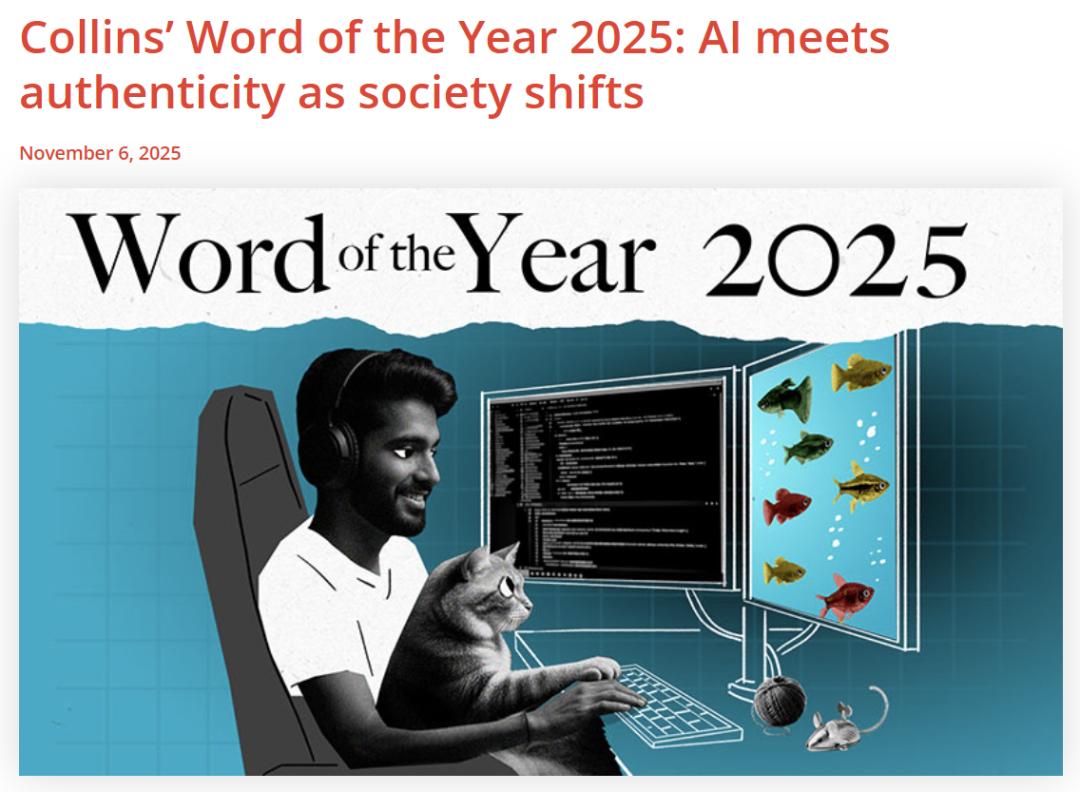
Core Insights - The term "vibe coding" has been officially recognized by Collins Dictionary as the word of the year for 2025, symbolizing a shift in programming from logic-based coding to a more intuitive, feeling-based approach [1][10][24] - This new programming style emphasizes collaboration with AI, where programmers use natural language to describe their needs, allowing AI to assist in code generation and logic completion [5][15][22] Group 1: Evolution of Vibe Coding - "Vibe coding" originated from a humorous tweet by Andrej Karpathy, highlighting a new way of programming that prioritizes intuition over strict coding rules [5][6] - The term quickly gained popularity across various tech forums and social media, becoming a cultural symbol of how AI is reshaping the programming landscape [8][17] - The definition of "vibe coding" has evolved to represent the act of using natural language prompts to have AI assist in writing computer code, marking a significant cultural shift in the tech community [10][20] Group 2: Impact on Programming Practices - AI tools like GitHub Copilot and Replit Ghostwriter are enabling programmers to focus on high-level ideas rather than syntax, transforming the coding process into a more collaborative and intuitive experience [15][16] - The programming environment is shifting towards AI-assisted development, where the emphasis is on setting the tone and intent rather than controlling every line of code [22][23] - This transformation is seen as a paradigm shift in software development, with AI taking a more central role in the coding process [21][24] Group 3: Language and Communication Changes - The rise of "vibe coding" reflects a broader change in how humans communicate with machines, moving from precise technical language to more emotional and intuitive expressions [25][27] - Research indicates that prolonged interaction with AI influences human language habits, leading to a more AI-like style of communication [25][28] - The blending of human emotional expression with machine logic suggests a future where creativity and computation coexist, redefining the boundaries between human and machine interactions [24][29]
X @Balaji
Balaji· 2025-11-04 12:48
Software Development & Problem Solving - Software development addresses problems created by software itself [1] - Fixing bugs on GitHub exemplifies using software to solve software-related issues [1] Engineering & Crisis Management - The idea that engineering cannot solve crises it creates is considered flawed [1]
GitHub 工程师揭底:代码审查常犯这 5 个错,难怪你改到崩溃!网友:差点全中了
程序员的那些事· 2025-11-04 09:09
Core Insights - The article discusses common mistakes engineers make during code reviews, particularly in the context of increasing AI-generated code and the challenges of reviewing it effectively [3][5]. - It emphasizes the importance of understanding the entire codebase rather than just focusing on code differences (diff) and provides practical advice to improve review efficiency [3][5]. Group 1: Common Mistakes in Code Reviews - Engineers often focus solely on the code differences (diff), missing out on significant insights that come from understanding the broader system [6][7]. - Leaving too many comments during a review can overwhelm the reviewer, making it difficult to identify the most critical feedback [8]. - Using personal coding preferences as a standard for reviews can lead to unnecessary comments and conflicts, as there are often multiple valid solutions to a problem [9][11]. Group 2: Recommendations for Effective Code Reviews - Reviewers should prioritize understanding the context of the code changes rather than just the diff, considering what might be missing from the code [18]. - It is advisable to leave a limited number of well-considered comments instead of a large volume of superficial ones [18]. - Clearly marking reviews as "blocking" when there are significant issues helps clarify the status of the review and prevents confusion about whether changes can be merged [12][13]. Group 3: Review Culture and Practices - Most reviews should ideally result in an approval status, especially in fast-paced environments like SaaS, to avoid bottlenecks in development [13][14]. - High rates of blocking reviews may indicate structural issues within teams, such as over-cautiousness or misalignment of goals between teams [14]. - The article suggests that code reviews should also serve as learning opportunities, fostering knowledge sharing and team growth [17][22].