X

Search documents
X @The Economist
The Economist· 2026-01-24 04:00
Since an electoral reverse in 2024, the coalition led by India’s prime minister has had a string of victories. We explain how his government rediscovered its zeal https://t.co/1TFNR7Slx6 ...
X @Elon Musk
Elon Musk· 2026-01-24 02:03
The @xAI team is working on providing For You tabs that are specific to topics.For example, a “For You AI” that is focused only on artificial intelligence with no political rage bait.This would be like automatically generated follow lists with content ranked by quality. ...
X @Tesla Owners Silicon Valley
Tesla Owners Silicon Valley· 2026-01-23 20:00
BREAKING: @xai started rolling out images and infoboxes to Grokipedia! https://t.co/KbYRulBgwH ...
X @Ivan on Tech 🍳📈💰
Ivan on Tech 🍳📈💰· 2026-01-23 18:27
Ivan on Tech watches Europe announce its new X competitor "W" with mandatory ID verification. His take? Whether it's Russia, China, or the EU—same playbook, different branding. "Free speech" with government strings attached isn't free speech at all. https://t.co/tkkSLvtJmY ...
X @Elon Musk
Elon Musk· 2026-01-23 16:26
Because 𝕏 believes in freedom of speech within the bounds of the laws of a countryDr. Simon Goddek (@goddek):Everything I’d like to say about these two insufferable twins would get me instantly banned from this platform, so I’ll just leave this here and let their own words speak. https://t.co/soXKzLhvDs ...
X @Elon Musk
Elon Musk· 2026-01-23 16:13
https://t.co/op5s4ZikGJ enhancedRaman Khatri (@ramankhatri):We've started rolling out images and infoboxes to Grokipedia! https://t.co/g7UoxWJZax ...
马斯克又一大动作!AI教你制造爆款
Sou Hu Cai Jing· 2026-01-23 15:35
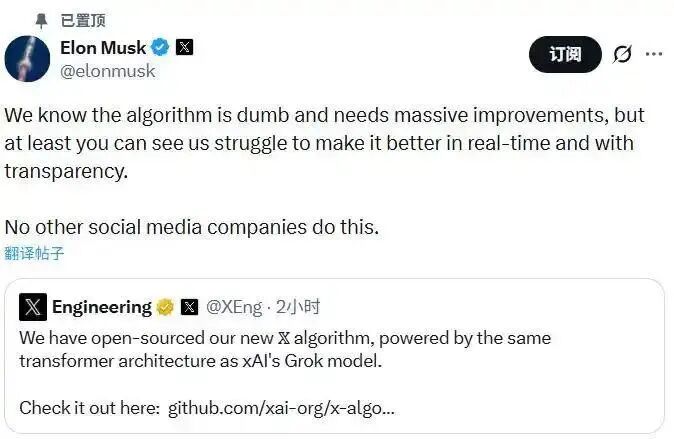
Core Insights - The article discusses the launch of X's new recommendation algorithm, which has transitioned to an AI-driven model, moving away from manual rules and features [2][3][10]. Group 1: Algorithm Overview - The new X recommendation algorithm has been open-sourced, utilizing a Transformer architecture similar to that of xAI's Grok model [2]. - The algorithm removes most manual rules and features, relying instead on AI to learn user preferences based on past interactions [3][4]. - Two main systems drive content delivery: Thunder, which ensures users see updates from accounts they follow, and Phoenix, which predicts content users may like even if they do not follow the source [4][6]. Group 2: Content Evaluation - Phoenix evaluates content based on predicted user interactions, considering 15 potential behaviors, both positive and negative [6][7]. - The algorithm prioritizes content that is likely to generate engagement, rather than content that has already received high engagement [7][11]. - Factors such as comment engagement and user reading time are weighted heavily, with comments and author replies being significantly more valuable than likes [11][12]. Group 3: Implications for Creators - Creators are encouraged to adapt their content strategies to align with AI logic, moving away from traditional "traffic tricks" [10][13]. - The algorithm favors content that stimulates discussion, suggesting that engagement through comments is more beneficial than mere likes [28][39]. - The system's focus on emotional and controversial content may lead to a shift in creator behavior, potentially prioritizing sensationalism over thoughtful expression [13][14]. Group 4: Future Considerations - The algorithm will be updated every four weeks, providing creators with opportunities to adjust their strategies based on performance data [12]. - The shift towards AI-driven recommendations raises questions about the authenticity of content creation, as creators may feel pressured to cater to algorithmic preferences [13][39].


马斯克又一大动作,AI教你制造爆款
3 6 Ke· 2026-01-23 12:06
Core Viewpoint - The recent announcement by X.com regarding the open-sourcing of its new recommendation algorithm has generated significant attention, indicating a shift towards an AI-driven content recommendation system that removes many manual rules previously in place [1][3]. Group 1: Algorithm Overview - The new recommendation algorithm utilizes a Transformer architecture similar to that of xAI's Grok model, marking a departure from the previous system that relied heavily on manually designed features and rules [1][3]. - The algorithm operates through two main systems: Thunder, which ensures users do not miss updates from followed accounts, and Phoenix, which identifies content that users are likely to engage with, regardless of follower count [3][4]. Group 2: User Interaction and Content Value - The algorithm predicts user behavior based on potential interactions with content, assessing 15 different actions, including likes, replies, and shares, to determine the content's value [6][7]. - Content is filtered through nine criteria before being considered for recommendation, ensuring only relevant and unique posts are promoted [7]. Group 3: Implications for Creators - Ordinary creators are encouraged to adapt their content strategies to align with AI logic, emphasizing the importance of engaging with comments and producing high-quality, information-dense content [9][10]. - The algorithm's focus on user engagement metrics means that even accounts with fewer followers can gain visibility if their content resonates with users, while larger accounts can suffer if they generate negative feedback [9][10]. Group 4: Challenges and Considerations - The algorithm's design may inadvertently promote controversial or emotionally charged content, raising concerns about the potential for creators to prioritize engagement over authenticity [10][11]. - The ongoing updates to the algorithm every four weeks will require creators to continuously adapt their strategies, creating a dynamic and potentially volatile content environment [10].
马斯克在达沃斯放出2026时间表:AI超人类、机器人开售、自动驾驶普及
Xin Lang Cai Jing· 2026-01-23 04:26
Core Insights - Elon Musk emphasizes the importance of optimism in predictions, acknowledging his history of missed deadlines while holding significant stakes in companies like Tesla and SpaceX [2][3] AI Development - Musk predicts that AI systems may surpass human intelligence by 2026, with a possibility of achieving this by 2027, and that by 2030, AI's overall capabilities could exceed that of all humanity combined [4] - The development of the Optimus humanoid robot is progressing, with expectations to complete complex tasks by the end of 2026 and to be available for public sale by 2027, contingent on meeting high safety standards [4] - Musk introduces a formula for economic output based on robot productivity and quantity, forecasting that humanoid robots will outnumber humans within 3-5 years, potentially addressing labor shortages due to aging populations [4] Risks and Economic Impact - Musk warns of potential risks associated with AI and robotics, stressing the need to avoid dystopian scenarios while highlighting the potential for a significant economic expansion if AI becomes widely accessible and affordable [5] Energy Supply Challenges - Musk identifies energy supply as a critical bottleneck for AI expansion, noting that global electricity supply growth rates (4%-10%) lag behind the exponential growth of chip production [6] - He highlights China's advancements in renewable energy, particularly solar power, and contrasts it with the slower energy transition in the U.S. due to tariffs on Chinese solar components [6] - Tesla and SpaceX are collaborating on solar projects aiming for an annual production capacity of 100 gigawatts in the U.S. within three years to alleviate energy constraints [6] - Musk discusses a space-based solar energy initiative that could achieve five times the efficiency of ground-based systems, with a goal to realize this within 2-3 years [6] Autonomous Driving - The rollout of autonomous taxis in Austin is set for June 2025, with widespread deployment expected by the end of 2026, as regulatory approvals in Europe and China progress [7] - Tesla's autonomous driving technology has received high safety ratings from multiple insurance companies, which will also benefit the Optimus robot's commercialization [7] Space Exploration - SpaceX aims to achieve fully reusable rockets by 2026, with the Starship project expected to validate this capability, significantly reducing costs for space exploration and satellite launches [8] - Musk compares the cost of reusable rockets to fuel costs, predicting a 100-fold reduction in space exploration costs, making projects like space solar power feasible [8] Challenges Ahead - Despite Musk's optimistic outlook, Tesla faces challenges, including declining electric vehicle deliveries and slow production rates for the Optimus robot and Cybertruck [9] - Regulatory scrutiny is increasing for Musk's social media platform X and AI assistant Grok due to concerns over inappropriate content generation [9]


马斯克:人形机器人明年开卖
财联社· 2026-01-23 00:17
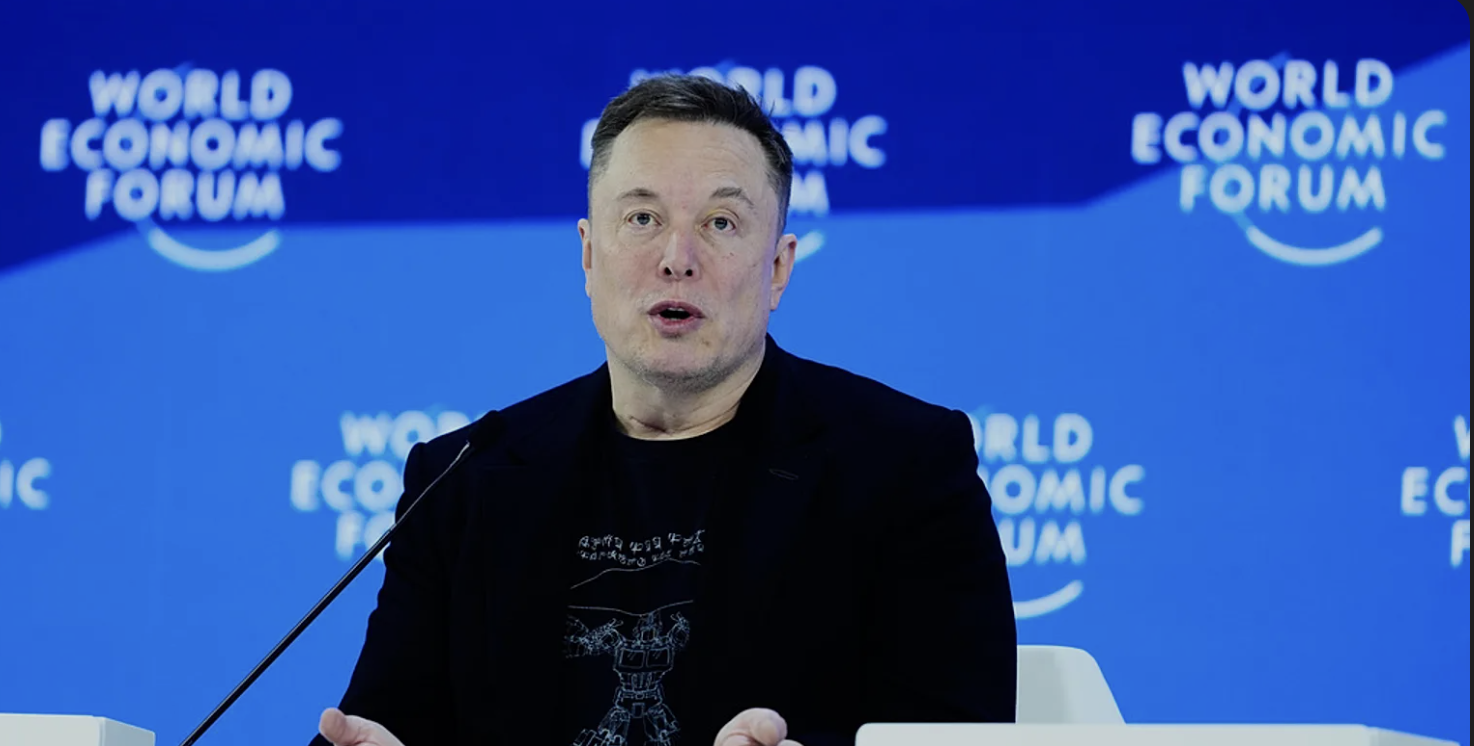
以下文章来源于科创板日报 ,作者赵昊 科创板日报 . 专注科创板和科技创新,上海报业集团主管主办,界面财联社出品。 当地时间周四(1月22日),世界首富、特斯拉CEO埃隆·马斯克现身瑞士达沃斯世界经济论坛, 批评了美国对太阳能征收的关税。 他还公布了特斯拉的一系列激进目标,包括明年开始销售人形机器人,同时还表示欧洲可能在数周内批准自动驾驶技术。 多年来,马斯克一直将达沃斯论坛年会形容为精英化、缺乏问责、与普通民众脱节的活动。因此,马斯克此次现身达沃斯颇为意外,他是在 最后时刻被确认加入周四议程的。 此前,这位世界首富曾多次批评该论坛,称这场全球精英的年度聚会"无聊",并抨击世界经济论坛正在"越来越像一个未经选举产生、人们既未要求 也不想要的世界政府机构"。 2022年,他还曾在社交媒体上发文称:"WEF / 达沃斯到底算什么?他们是想当地球的老大吗?" 马斯克周四接受了达沃斯论坛临时联席主席、贝莱德首席执行官拉里·芬克的采访,讨论话题涵盖了机器人和人工智能(AI)的未来,以及 特斯拉自动驾驶的进展等等。 特斯拉有望明年开始销售人型机器人 马斯克在瑞士达沃斯举行的世界经济论坛年会上发表演讲时表示,特斯拉已经在工 ...