开立医疗

Search documents
国泰海通:25年设备更新政策如期落地 医疗设备全年招采规模同比快速增长 维持“增持”评级
智通财经网· 2026-01-13 13:29
Core Viewpoint - The medical equipment procurement scale is expected to grow rapidly year-on-year due to the implementation of the 2025 equipment renewal policy, with a significant increase in demand for high-end medical devices [1][2][3] Group 1: Equipment Procurement Trends - In December 2025, the procurement scale for new medical devices showed a decline in MR by 11.8%, CT by 7.3%, DR by 3.9%, and ultrasound by 1.3%, while endoscopes increased by 1.4% and surgical robots decreased by 23.9% [1][2] - Cumulatively for the year 2025, the procurement scale for MR increased by 31.4%, CT by 53.2%, DR by 53.2%, ultrasound by 42.3%, endoscopes by 16.3%, and surgical robots by 21.9% [2] Group 2: Company Performance - In December 2025, the performance of specific companies showed that Union Medical's MR declined by 17.4%, while its CT increased by 17.4%. Mindray's ultrasound grew by 13.8%, and KAILI's ultrasound decreased by 13.5%. KAILI's endoscope increased by 61.1%, and Aohua's endoscope grew by 9.4% [2] - For the entire year of 2025, Union Medical's MR grew by 15.6%, CT by 47.7%, Mindray's ultrasound by 56.3%, KAILI's ultrasound by 69.7%, KAILI's endoscope by 85.0%, and Aohua's endoscope by 24.4% [2] Group 3: Policy Impact - The 2024 policy aims to increase medical equipment investment by over 25% compared to 2023 by 2027, enhancing the configuration of high-end equipment to levels seen in middle-income countries [3] - The implementation of the equipment renewal policy is expected to significantly boost procurement levels across various medical institutions, leading to a recovery in the domestic market and a turning point for equipment companies [3]




国泰海通|医药:25年设备更新政策如期落地,医疗设备全年招采规模同比快速增长
国泰海通证券研究· 2026-01-13 13:20
Core Viewpoint - The medical equipment bidding scale continues to show good growth, driven by the implementation of equipment renewal policies, which is expected to stimulate long-term procurement levels in the medical equipment sector [1][4]. Group 1: Equipment Renewal Policy Impact - The equipment renewal policy is set to be implemented as planned in 2025, with a rapid year-on-year growth in the annual bidding scale for medical equipment. For instance, in December 2025, the bidding scale for MR decreased by 11.8%, while CT and DR saw declines of 7.3% and 3.9%, respectively. However, the overall annual cumulative growth for 2025 shows significant increases: MR grew by 31.4%, CT by 53.2%, DR by 53.2%, ultrasound by 42.3%, endoscopes by 16.3%, and surgical robots by 21.9% [3][4]. - The four ministries jointly issued a notice in 2024, aiming for a more than 25% increase in medical equipment investment by 2027 compared to 2023, enhancing high-end equipment configurations to levels seen in middle-income countries [4]. Group 2: Market Recovery and Company Performance - The domestic market is showing signs of effective recovery due to policy implementation, with medical equipment companies expected to experience a performance turnaround. For example, in the first three quarters of 2025, United Imaging's domestic revenue reached 6.866 billion yuan, reflecting a year-on-year growth of 23.7%, indicating a recovery and structural upgrade trend in the medical equipment industry [4]. - The demand for innovative diagnostic and treatment equipment, particularly in imaging and radiotherapy, is rapidly increasing as a result of the ongoing equipment renewal policies [4].


股票行情快报:开立医疗(300633)1月13日主力资金净买入19.59万元
Sou Hu Cai Jing· 2026-01-13 13:20
Group 1 - The core viewpoint of the article highlights the recent performance and financial metrics of Kaili Medical (300633), indicating a decline in stock price and mixed financial results [1][2] - As of January 13, 2026, Kaili Medical's stock closed at 29.3 yuan, down 0.51%, with a turnover rate of 1.34% and a trading volume of 58,200 hands, amounting to a transaction value of 172 million yuan [1] - In terms of capital flow on January 13, 2026, the net inflow of main funds was 195,900 yuan, accounting for 0.11% of the total transaction value, while retail investors experienced a net outflow of 221,960 yuan, representing 1.29% of the total transaction value [1] Group 2 - For the first three quarters of 2025, Kaili Medical reported a main revenue of 1.459 billion yuan, an increase of 4.37% year-on-year, but the net profit attributable to shareholders decreased by 69.25% to 33.51 million yuan [2] - The third quarter of 2025 saw a single-quarter main revenue of 495 million yuan, up 28.42% year-on-year, but a net loss attributable to shareholders of 13.52 million yuan, which is an increase of 78.05% compared to the previous year [2] - The company has a debt ratio of 24.22%, with an investment income of 2.08 million yuan and financial expenses of -38.30 million yuan, while maintaining a gross profit margin of 60.36% [2] Group 3 - Over the past 90 days, 10 institutions have provided ratings for Kaili Medical, with 8 buy ratings and 2 hold ratings, and the average target price set by institutions is 39.71 yuan [2]

开立医疗:公司2025年的营收呈现逐季好转趋势
Zheng Quan Ri Bao Wang· 2026-01-13 12:41
证券日报网讯1月13日,开立医疗(300633)在互动平台回答投资者提问时表示,随着国内终端招标的 持续恢复,公司2025年的营收呈现逐季好转趋势。 ...
股票行情快报:开立医疗(300633)1月12日主力资金净卖出1509.90万元
Sou Hu Cai Jing· 2026-01-12 12:51
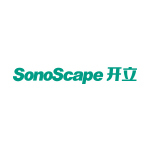
证券之星消息,截至2026年1月12日收盘,开立医疗(300633)报收于29.45元,上涨1.66%,换手率 1.25%,成交量5.4万手,成交额1.58亿元。 | | | | | 日期 收盘价 涨跌幅 主力净流入 主力净占比 游资净点比 游资净占比 散户净占比 | | | | | | --- | --- | --- | --- | --- | --- | --- | --- | --- | | 2026-01-12 | 29.45 | 1.66% | -1509.90万 | -9.54% | -161.49万 | -1.02% | 1671.39万 | - 10.56% | | 2026-01-09 | 28.97 | 0.42% | -549.55万 | -3.89% | 53.42万 | 0.38% | 496.13万 | 3.52% | | 2026-01-08 | 28.85 | 0.59% | -1523.37万 | -8.59% | 2890.71万 | 16.29% | -1367.34万 | -7.71% | | 2026-01-07 | 28.68 | 3.91% | -1635.01万 ...
浙商证券:AI应用多点开花 看好AI+生物医药投资机会
智通财经网· 2026-01-12 08:02
智通财经APP获悉,浙商证券发布研报称,AI医疗应用在国家战略与市场需求的共振下已迈入商业化落 地的快速阶段。该行认为AI制药核心价值在于大幅提升药物早研效率,看好国内多家AI制药平台服务 能力全球领先。AI制药的高需求将带来较大的落地验证实验及合作需求,建议关注已与AI制药平台有 战略合作的传统CRO公司。此外,早研效率大幅提升将快速传导至临床前、安评以及临床CRO需求。 浙商证券主要观点如下: 该行认为AI制药核心价值在于大幅提升药物早研效率,以英矽智能Pharma.AI为例,其能够使候选药物 从靶点发现到临床前候选药物确认时间从4.5年大幅缩短到12至18个月,早研阶段的投入产出比大幅提 升。该行看好:1)国内多家AI制药平台服务能力全球领先,海外业务拓展持续高速已验证,关注英矽智 能、晶泰科技、泓博医药、维亚生物、成都先导等;2)AI制药的高需求将带来较大的落地验证实验及合 作需求,建议关注已与AI制药平台有战略合作的传统CRO公司,关注皓元医药、美迪西、百诚医药、 阳光诺和、药石科技、药明康德等;3)早研效率大幅提升将快速传导至临床前、安评以及临床CRO需 求,建议关注昭衍新药、美迪西、益诺思、泰格 ...

持续布局AI医疗应用和创新药械相关资产
Xinda Securities· 2026-01-12 06:54
Investment Rating - The investment rating for the pharmaceutical and biotechnology industry is "Positive" [2] Core Insights - The pharmaceutical sector experienced a weekly return of 7.81%, outperforming the CSI 300 index by 5.03%, ranking 6th among 31 primary sub-industry indices. The medical services sub-sector had the highest weekly increase of 12.34% [3][15] - The report highlights the impact of recent events such as Elon Musk's announcement regarding Neuralink's product mass production in 2026, Arrowhead Pharmaceuticals' promising clinical data for its siRNA therapy ARO-INHBE, and OpenAI's launch of "ChatGPT health," which have driven the sector's performance. The report suggests that while the brain-computer interface theme may be at a short-term emotional peak, AI medical applications still have room for growth [3][14] - Continuous investment in innovative drugs and related assets in the CXO and upstream life sciences sectors is recommended [3][14] Summary by Sections 1. Market Performance - The pharmaceutical sector's monthly return was 4.87%, outperforming the CSI 300 index by 1.37%, ranking 18th among 31 primary sub-industry indices. The medical services sub-sector had the highest monthly increase of 12.19% [15][20] 2. AI Medical Applications - AI applications in healthcare include AI+medical testing, AI+medical large models, AI+imaging, AI+e-commerce/precision marketing, and AI+gene sequencing, with notable companies such as KingMed Diagnostics, Dian Diagnostics, and BGI Genomics leading in these areas [4][16] 3. CXO and Upstream Life Sciences - Key global CXO leaders to watch include WuXi AppTec, WuXi Biologics, and Kelun Pharmaceutical. Domestic clinical CRO leaders include Tigermed and PPD. The report also highlights resource-based CXOs and upstream life sciences companies [5][16] 4. High-end Medical Devices - The report suggests focusing on companies involved in robotic applications, pharmaceutical equipment, and consumer medical devices, as demand is gradually recovering [5][16] 5. Innovative Drugs - Investment opportunities are identified in small nucleic acids, ADCs, and IO dual/multi-antibodies, with specific companies recommended for each category [6][16]
最新!2026年首款创新医疗器械获批!
思宇MedTech· 2026-01-09 07:39
Core Viewpoint - Shanghai Weimi Medical Technology Co., Ltd. has received approval from the National Medical Products Administration (NMPA) for its self-expanding aneurysm embolization device, MeshCoil®, marking it as the first domestically approved device for treating wide-neck bifurcation intracranial aneurysms in China [2][3]. Clinical Pain Points - Bifurcation wide-neck aneurysms are considered a challenging subtype in intracranial aneurysm intervention due to their complex anatomical structures and the need for effective treatment strategies that minimize long-term intervention on normal vascular structures while ensuring adequate neck coverage [5]. Product Introduction - MeshCoil® utilizes an "intra-aneurysmal turbulence" technology, positioned within the aneurysm cavity to alter hemodynamic conditions and promote thrombosis, thereby occluding the aneurysm. This device aims to provide a supplementary solution for specific complex aneurysm morphologies, bridging the gap between stent-assisted coiling and flow diversion devices [6][7]. Design and Materials - The device is made from nickel-titanium alloy and composite wire, featuring self-expanding properties. Its design focuses on achieving neck coverage and device stability while minimizing long-term effects on normal vascular segments [7][10]. Clinical Validation - A multi-center clinical trial led by Xuanwu Hospital of Capital Medical University included 139 participants, demonstrating that MeshCoil® exhibits good safety and efficacy in treating bifurcation wide-neck aneurysms. The results indicated a 12-month complete occlusion rate of 88.5% and a bleeding rate of 0.7% [11][13]. Company Overview - Shanghai Weimi Medical Technology Co., Ltd. is based in the Zhangjiang International Medical Park in Shanghai, focusing on innovative technology development and promotion in the field of minimally invasive and precision medicine, particularly for intracranial aneurysms [12].
脑机接口的“身份证”来了?新晋顶流,最强马斯克概念!
Jin Rong Jie· 2026-01-09 06:34
Core Insights - The announcement of the first non-invasive brain-computer interface (BCI) medical device registration in China marks a significant shift from laboratory research to clinical and market applications, indicating a new growth trajectory for the industry [1][2] - The medical device sector is experiencing a surge, with companies like Dean Diagnostics and Kingmed Diagnostics hitting their upper trading limits, reflecting strong market interest in BCI technologies [1][3] - The BCI sector is seen as a promising investment opportunity, with a clean chip structure and lower entry points compared to other tech sectors like satellites and chips [1] Industry Developments - The Chinese government has included BCI in its new five-year plan as a key future industry, signaling ongoing support for research and approval processes [2][3] - Major players in the industry are accelerating their efforts, with Neuralink announcing plans for large-scale production by 2026 and significant investments being made domestically [2][3] - Technological advancements in China, such as the ability for paralyzed patients to drink water using their thoughts, demonstrate the country's leadership in BCI technology [2] Market Dynamics - The BCI technology is categorized under medical devices, which are essential for addressing real and painful issues faced by patients, such as stroke recovery and spinal cord injuries [3][4] - The medical device index ETF (159898) includes approximately 24% of companies with substantial BCI business operations, providing an efficient investment vehicle for this emerging sector [3][4] - The medical device sector, which has faced declines over the past four years, is expected to see a turnaround driven by advancements in BCI technology [4]
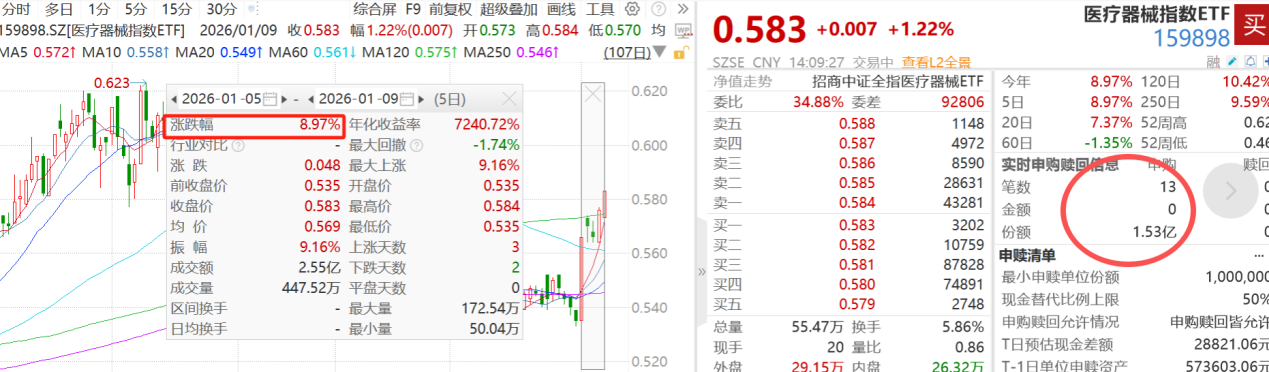
国内首张非侵入式脑机接口证出炉!医疗器械指数ETF(159898)午后拉升、标的指数“含脑量”约24%
Sou Hu Cai Jing· 2026-01-09 06:21
Group 1 - The medical device sector is experiencing a significant rally, with the Medical Device Index ETF (159898) seeing a net inflow of over 88 million yuan during intraday trading on January 8, following a previous inflow of over 116 million yuan [1] - Key stocks such as Di'an Diagnostics and Kingmed Diagnostics reached their daily limit, while others like Anbiping and Xiangsheng Medical saw gains exceeding 10% and 9% respectively [1] - The Medical Device Index ETF (159898) has a current scale of 659 million yuan, with approximately 24% of its holdings related to the brain-computer interface (BCI) concept [2][3] Group 2 - The brain-computer interface industry is highlighted as a key development area in the new five-year plan, with supportive policies for clinical trials, registration, and pricing [1] - Strong Brain Technology, a leading BCI company, recently completed a financing round of about 2 billion yuan, marking it as the second-largest financing in the BCI field globally, after Neuralink [2] - The Medical Device Index ETF (159898) includes several companies with substantial involvement in the BCI sector, making it a convenient and efficient tool for investment in this emerging field [3]