
神农集团

Search documents
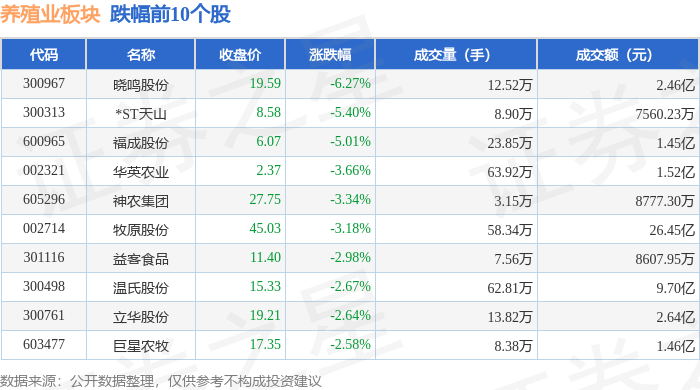
养殖业板块1月27日跌2.68%,晓鸣股份领跌,主力资金净流出4.56亿元
Zheng Xing Xing Ye Ri Bao· 2026-01-27 08:49
Core Viewpoint - The aquaculture sector experienced a decline of 2.68% on January 27, with Xiaoming Co. leading the drop [1] Group 1: Market Performance - The Shanghai Composite Index closed at 4139.9, up 0.18%, while the Shenzhen Component Index closed at 14329.91, up 0.09% [1] - Key stocks in the aquaculture sector showed significant declines, with Xiaoming Co. down 6.27% to a closing price of 19.59 [1] - Other notable declines included ST Tianshan down 5.40%, Fucheng Co. down 5.01%, and Huaying Agriculture down 3.66% [1] Group 2: Trading Volume and Capital Flow - The aquaculture sector saw a net outflow of 456 million yuan from main funds, while retail investors contributed a net inflow of 232 million yuan [1] - The trading volume for Xiaoming Co. was 125,200 shares, with a transaction value of 246 million yuan [1] - Lihua Co. had a net inflow of 14.20 million yuan from main funds, while retail investors had a net outflow of 30.52 million yuan [2]



神农集团跌3.34% 2021上市即巅峰募22亿中泰证券保荐
Zhong Guo Jing Ji Wang· 2026-01-27 08:43
中国经济网北京1月27日讯神农集团(605296)(605296.SH)今日股价下跌,截至收盘,该股报27.75元, 跌幅3.34%。该股目前处于破发状态。 神农集团于2021年5月28日在上交所主板上市,公开发行股票4,003.00万股,发行价格为56.08元/股,保 荐机构(主承销商)为中泰证券(600918)股份有限公司,保荐代表人为卢戈、仓勇。 神农集团首次公开发行股票募集资金总额为224,488.24万元,募集资金净额为209,143.44万元。神农集团 于2021年4月27日披露的招股书显示,该公司拟募集资金209,143.44万元,分别用于云南神农陆良年产50 万吨饲料及生物安全中心项目、优质仔猪扩繁基地建设项目、优质生猪育肥基地建设项目、云南神农曲 靖食品有限公司年50万头生猪屠宰新建项目、补充流动资金。 神农集团首次公开发行股票发行费用为15,344.80万元,其中,保荐及承销费用13,469.29万元。 2022年5月26日,神农集团以每10股转增3股并税前派息2.5元,除权除息日2022年6月1日,股权登记日 2022年5月31日。 上市首日,神农集团盘中创下上市以来最高价74.90元, ...

神农集团:2025年净利同比预降44.09%至54.43% 生猪销售价格下降
Zheng Quan Shi Bao Wang· 2026-01-27 08:10
人民财讯1月27日电,神农集团(605296)1月27日公告,预计2025年实现归属于母公司所有者的净利润 为3.13亿元至3.84亿元,同比减少44.09%到54.43%。报告期内,全年商品猪销售均价约13.39元/公斤, 较上年同期下降约17.70%,由于生猪销售价格同比出现较大幅度下降,导致生猪养殖业务利润同比减 少。 ...
神农集团(605296.SH)发预减,预计2025年归母净利润3.13亿元至3.84亿元,同比减少44.09%到54.43%
智通财经网· 2026-01-27 07:51
智通财经APP讯,神农集团(605296.SH)发布公告,公司预计2025年年度实现归属于母公司所有者的净 利润为3.13亿元至3.84亿元,同比减少44.09%到54.43%。 ...
神农集团(605296) - 2025 Q4 - 年度业绩预告
2026-01-27 07:45
证券代码:605296 证券简称:神农集团 公告编号:2026-003 云南神农农业产业集团股份有限公司 2025 年年度业绩预告 本公司董事会及全体董事保证本公告内容不存在任何虚假记载、误导性陈述 或者重大遗漏,并对其内容的真实性、准确性和完整性承担法律责任。 重要内容提示: 一、本期业绩预告情况 (一)业绩预告期间 2025 年 1 月 1 日至 2025 年 12 月 31 日。 1.经公司财务部门初步测算,预计 2025 年年度实现归属于母公司所有者的 净利润为 31,300.00 万元至 38,400.00 万元,与上年同期(法定披露数据)相比, 将减少 30,281.53 万元到 37,381.53 万元,同比减少 44.09%到 54.43%。 2.预计 2025 年年度实现归属于母公司所有者的扣除非经常性损益后的净利 润为 27,800.00 万元至 34,900.00 万元,与上年同期(法定披露数据)相比,将 减少 34,793.08 万元到 41,893.08 万元,同比减少 49.92%到 60.11%。 (三)本次业绩预告未经注册会计师审计。 -1- 本期业绩预告适用于:实现盈利,且净 ...
神农集团(605296.SH):预计2025年净利润同比减少44.09%到54.43%
Ge Long Hui A P P· 2026-01-27 07:44
报告期内,公司销售生猪307.42万头(包含对外销售和对内部屠宰企业销售),较上年同期增长 35.34%,公司持续做好生猪健康管理及提升产能利用率、生产管理效率,养殖成本较上年同期下降。 全年商品猪销售均价约13.39元/公斤,较上年同期下降约17.70%,由于生猪销售价格同比出现较大幅度 下降,导致生猪养殖业务利润同比减少。 格隆汇1月27日丨神农集团(605296.SH)公布,经公司财务部门初步测算,预计2025年年度实现归属于母 公司所有者的净利润为31,300.00万元至38,400.00万元,同比减少44.09%到54.43%。预计2025年年度实 现归属于母公司所有者的扣除非经常性损益后的净利润为27,800.00万元至34,900.00万元,同比减少 49.92%到60.11%。 ...
神农集团:预计2025年净利润同比减少44.09%-54.43%
Xin Lang Cai Jing· 2026-01-27 07:44
神农集团公告,预计2025年年度实现归属于母公司所有者的净利润为3.13亿元至3.84亿元,与上年同期 相比,将减少3.03亿元到3.74亿元,同比减少44.09%到54.43%。预计2025年年度实现归属于母公司所有 者的扣除非经常性损益后的净利润为2.78亿元至3.49亿元,与上年同期相比,将减少3.48亿元到4.19亿 元,同比减少49.92%到60.11%。 ...
未知机构:天润乳业天风农业牛市抱牛重视超级牛周期1牛板块肉牛超-20260127
未知机构· 2026-01-27 03:00
(天润乳业) 【天风农业】"牛市抱牛",重视超级牛周期!1、牛板块:肉牛超级周期趋势明确,奶牛去化接近尾声,重视超级 牛周期!1)本周价格:犊牛&淘牛价格持续上涨,育肥牛价格稳定。 截至1月23日,育肥公牛出栏价格25.66元/kg,环比持平,同比+9.47%;犊牛价格33.09元/kg,环比+0.19%,同比 +37.08%;淘牛价格19.93元/kg,环比+0.26%,同比+22.80%(数据来源:钢联)。 (天润乳业) 【天风农业】"牛市抱牛",重视超级牛周期!1、牛板块:肉牛超级周期趋势明确,奶牛去化接近尾声,重视超级 牛周期!1)本周价格:犊牛&淘牛价格持续上涨,育肥牛价格稳定。 截至1月23日,育肥公牛出栏价格25.66元/kg,环比持平,同比+9.47%;犊牛价格33.09元/kg,环比+0.19%,同比 +37.08%;淘牛价格19.93元/kg,环比+0.26%,同比+22.80%(数据来源:钢联)。 奶价仍处低位调整阶段,截至1月15日,生鲜乳价格3.03元/kg,环比+0.33%、同比-2.57%(数据来源:wind)。 2)肉牛方面,国内长亏损周期叠加深度亏损,驱动能繁母牛深度去化。 ...


2025年白羽祖代更新量157万套,我国牛存栏已累计下降8.6%
Huaan Securities· 2026-01-25 07:45
Investment Rating - The report maintains a positive investment rating for the pig farming sector, recommending continued investment in this area due to low valuations and expected profitability [4]. Core Insights - The report highlights a rebound in pig prices to 13 CNY/kg, with self-breeding and self-raising operations achieving profitability for two consecutive weeks [4]. - The white feather breeding stock update for 2025 is projected at 1.5742 million sets, with a year-on-year increase of 4.9% [5]. - The pet food market in urban China is expected to reach 312.6 billion CNY in 2025, growing by 4.1% year-on-year [6]. Summary by Sections Pig Farming - Pig prices have rebounded to 13 CNY/kg, with a week-on-week increase of 0.7%. The average weight of pigs at slaughter has risen to 128.89 kg, with a decrease in the proportion of heavier pigs [4]. - The profitability of self-breeding and self-raising operations has reached 43.35 CNY per head, marking a significant recovery since December 2025 [4]. - The report forecasts a new wave of price declines post-Spring Festival, indicating potential capacity reduction in the pig farming industry [4]. Poultry Farming - The white feather breeding stock update for 2025 is 1.5742 million sets, with 55% from self-breeding and 45% from imports. The price of yellow feather chicken has increased by 2.6% week-on-week [5]. - The average price of chicken products is reported at 9,250 CNY/ton, with a slight year-on-year decrease of 0.5% [5]. Pet Industry - The urban pet market is projected to grow to 312.6 billion CNY in 2025, with dog and cat markets at 160.6 billion CNY and 152.0 billion CNY, respectively [6]. - The number of pet dogs and cats in urban areas is expected to reach 126.32 million, with a year-on-year growth of 1.8% [8]. - Pet food remains the primary consumption category, accounting for 53.7% of the market share, with a projected market size of approximately 167.9 billion CNY in 2025 [8].


当前时点如何看待生猪养殖板块
2026-01-23 15:35
Summary of the Conference Call on the Swine Breeding Sector Industry Overview - The swine breeding sector is undergoing significant structural changes, with small farms being eliminated and large breeding groups expanding. This cycle is expected to see a more pronounced capacity reduction than previous cycles, with cost control and cash flow management becoming critical [1][2]. Key Insights and Arguments - Historical data indicates that when the cumulative reduction of breeding sows reaches approximately 3%, stock prices begin to rise. The industry has experienced deep losses for three consecutive months, and a faster capacity reduction is anticipated, benefiting companies with cost advantages and strong cash flow [1][2]. - As the New Year approaches, frozen meat inventories at slaughterhouses are increasing, and consumer demand remains strong. Some large groups are taking advantage of this to raise pork prices, although the reluctance of small farmers to sell may exert downward pressure on prices [1][4]. - From 2021 to 2023, the market saw a significant exit of small breeding entities, while large-scale groups expanded. The reduction in breeding sows during this period was 8.3% and 9.1% respectively, with listed companies increasing their sow inventory by 3.5% [5]. Market Dynamics - The public fund holding ratio in the sector has increased significantly, driven by the cumulative capacity reduction rather than merely the duration of the cycle. For instance, when the cumulative reduction reached 5.2% in Q3 to Q4 of 2021, the public fund holding ratio rose from 0.96% to 1.16% [6]. - The industry is expected to face challenges in the first half of 2026, with some companies predicting pork prices could drop below 10 yuan/kg. The large-scale capacity reduction has not yet formally begun, and cash flow consumption is severe [3][7]. Price Trends and Future Outlook - Currently, pork prices in northern regions have risen from 11.5 yuan/kg to around 12 yuan/kg, but the reluctance of small farmers to sell may lead to future price pressures [4]. - The overall health of pig herds has improved, leading to a significant reduction in the demand for vaccines and veterinary drugs, which has decreased from 120-180 yuan to around 50 yuan [9]. - The efficiency of breeding has improved, with the number of piglets weaned per sow per year (PSY) increasing from approximately 17-18 to over 28 in many large groups, contributing to lower overall breeding costs [8]. Additional Important Points - The current low pork prices, if sustained for over three months, could lead to the exit of some large breeding farms from the market, highlighting the importance of monitoring capacity reduction in the industry [12]. - In regions like Hunan and Jiangxi, the market dynamics are influenced by local demand and cash flow pressures faced by small farms, with some potentially being taken over by larger groups [10][11]. This comprehensive analysis highlights the critical factors affecting the swine breeding sector, including market dynamics, price trends, and the implications of capacity reductions on investment opportunities.