Tencent

Search documents
China Market Risk
HumbleDollar· 2026-01-17 06:00
Core Viewpoint - The relationship between the U.S. and China has deteriorated, creating significant concerns for investors due to rising tensions and domestic policies in China that negatively impact investment markets [1][2][5]. Group 1: U.S.-China Relations - Trade between the U.S. and China has increased significantly over the past 25 years, but tensions have also escalated, particularly regarding intellectual property theft, costing the U.S. economy at least $200 billion annually [2]. - Tariffs and restrictions have been imposed by both the Trump and Biden administrations, leading to retaliatory actions from China, including restrictions on rare earth exports critical for technology manufacturing [3]. Group 2: Domestic Policies in China - President Xi Jinping's policies have adversely affected major publicly-traded companies, exemplified by the punishment of Ant Group and Alibaba, resulting in significant fines and loss of control for their founders [6][7][8]. - The Chinese government has targeted other technology companies, leading to a loss of approximately $1 trillion in wealth from the stock market due to arbitrary fines and sanctions [8]. Group 3: Economic Challenges - China's economic model, heavily reliant on government direction, has led to an oversupply of housing, with estimates of up to 90 million vacant homes, contributing to bankruptcies among property developers [12]. - The autocratic approach of the Communist Party is seen as detrimental to innovation and economic growth, as highlighted by economist James Robinson's predictions [11]. Group 4: Investment Recommendations - Given the risks associated with investing in China, alternatives such as the Freedom 100 Emerging Markets ETF (FRDM) are recommended, which has outperformed traditional emerging markets indexes by delivering over 15% annual returns since its inception in 2019 [13]. - A new emerging markets ETF from Vanguard, VEXC, specifically excludes China and is considered a promising investment option [14].



投资者演示:开门红能否延续?-Investor Presentation-Can the Strong Opening Be Sustained
2026-01-15 02:51
Summary of Key Points from the Investor Presentation Industry Overview - **Focus**: The presentation centers on the **Tech and Supply Chain Competitiveness** in the Asia Pacific region, particularly highlighting China's role in various sectors including AI, robotics, and biotechnology [2][5][8]. Economic Development and Growth Targets - **Five-Year Plans**: The evolution of China's Five-Year Plans indicates a shift from quantity to quality in growth targets, with a focus on innovation as a core driver [3][4]. - **GDP Growth**: The projected GDP growth rates are expected to be above 7% for the 2021-2025 period, with a notable increase in the services share in GDP and urbanization rates [3][4]. AI and Technology Investment - **AI Capex Growth**: The top six companies in China are forecasted to increase their AI capital expenditures by **11% YoY**, reaching **Rmb 445 billion** in 2026 [17]. - **GPU Self-Sufficiency**: China's GPU self-sufficiency ratio is expected to reach **50% by 2027**, indicating a significant advancement in domestic technology capabilities [20]. Robotics and Automation - **Global Robotics Market**: China is projected to account for approximately **40% of the global robotics market by 2024**, with growth in drones, service robots, and collaborative robots [30]. - **Humanoid Adoption**: The cumulative adoption of humanoid robots is expected to reach **1 billion globally by 2050**, with around **30%** of these adoptions occurring in China [35]. Biotechnology and Innovation - **FDA Approvals**: By 2040, assets originating from China are expected to constitute **35% of US FDA approvals**, driven by the lifecycle of existing drugs [39]. - **R&D Spending**: There is a significant increase in R&D spending, with a focus on high-value invention patents and core industries of the digital economy [3]. Supply Chain Competitiveness - **Complexity in Exports**: China maintains a unique position with lower complexity in imports but higher complexity in exports, making its supply chain difficult to replicate [46]. - **Lithium Battery Production**: China holds a strong position in lithium battery production, benefiting from a complete value chain and rapid technological advancements [46]. Economic Challenges and Policy Recommendations - **Labor Market Impact**: The introduction of generative AI is expected to create substantial labor-equivalent value, but there may be significant displacement effects in the transition period [55][56]. - **Social Safety Nets**: Recommendations include strengthening social safety nets and providing support for AI-oriented education and career training to mitigate labor market disruptions [57]. Fiscal and Monetary Policy Outlook - **Fiscal Balance**: A gradual rebalancing of fiscal policy is anticipated, with a focus on consumption in 2027 after a supply-centric approach in 2026 [106]. - **Real GDP Growth**: Real GDP growth is expected to ease to **4.8% in 2026** and **4.6% in 2027**, indicating a shift from deflation to low inflation [81]. Consumer Behavior and Housing Market - **Deposit Migration**: There is a notable migration of deposits towards equities, with **Rmb 6-7 trillion** in excess time deposits being targeted for investment [77]. - **Housing Market**: The housing market remains under pressure, with significant inventory levels and a need for social spending rather than bailouts to address the situation [99][100]. Conclusion - The presentation outlines a comprehensive view of China's economic landscape, emphasizing the importance of innovation, technology, and strategic policy adjustments to sustain growth and competitiveness in the global market [1][2][5].
Alibaba upgrades Qwen app to order food, book travel
Reuters· 2026-01-15 02:09
Core Insights - Alibaba has launched significant upgrades to its Qwen AI app, enabling users to order food and book travel within the app, marking a strategic shift towards consumer-facing AI [1][2] Group 1: Upgrade Features - The new features allow users to complete tasks entirely within the AI chat interface, eliminating the need to switch between applications [1] - The upgrade integrates core Alibaba services such as Taobao, Alipay, Fliggy, and Amap into a unified AI interface, facilitating seamless transactions [4] - A new "Task Assistant" feature in beta can make real phone calls, process up to 100 documents simultaneously, and plan multi-stop travel itineraries [5] Group 2: Market Position and Strategy - This upgrade follows a previous major enhancement to the Qwen app, indicating Alibaba's strategic pivot into consumer-facing AI, an area where it has previously lagged behind competitors like ByteDance and Tencent [2] - The Qwen app has surpassed 100 million monthly active users within two months of its public beta launch, reflecting strong consumer interest [5] - The expansion of the Qwen app is part of a broader competition in China's AI sector, where companies are striving to translate advanced language models into practical applications [6]

WeRide Makes Robotaxi Booking Effortless via Tencent's Super-app WeChat in China
Globenewswire· 2026-01-14 09:00
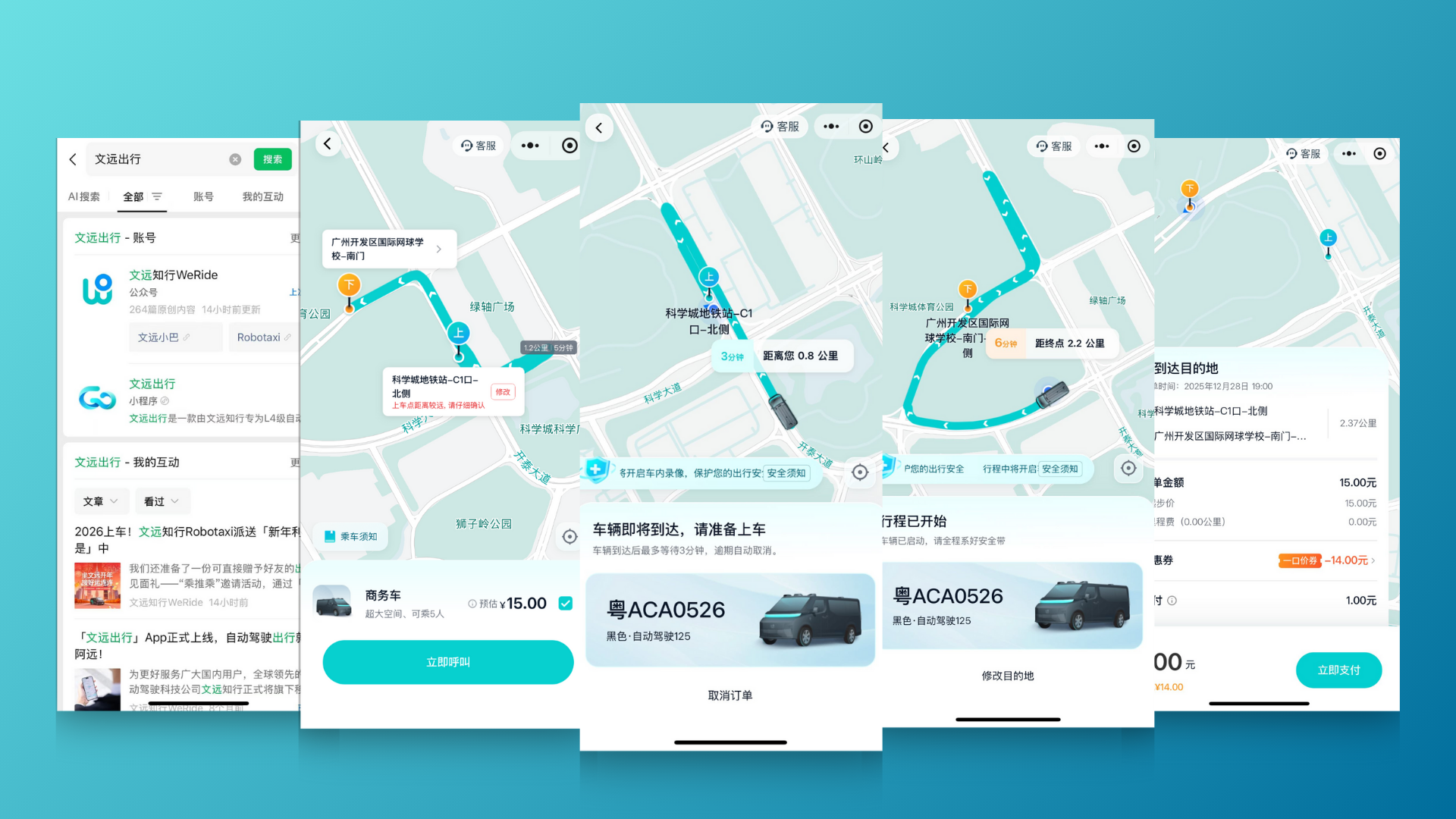
Core Insights - WeRide has launched its Robotaxi service Mini Program "WeRide Go" on WeChat, enhancing accessibility for users in China [1][3] - The integration with WeChat allows users to book Robotaxi rides without needing a separate app, streamlining the user experience [2][3] - WeRide aims to expand its Robotaxi fleet to tens of thousands by 2030, leveraging WeChat's extensive user base to boost ride volume and user retention [4] Company Overview - WeRide is a leader in the autonomous driving sector, operating over 1,000 Robotaxis globally, with fully driverless operations in major cities like Guangzhou and Beijing [4][5] - The company has received autonomous driving permits in eight markets, including China, the UAE, and the US, showcasing its regulatory compliance and market reach [5] - WeRide's technology platform, WeRide One, supports a range of autonomous driving products and services, addressing various transportation needs [5]

WeRide Makes Robotaxi Booking Effortless via Tencent's Super-app WeChat in China
Globenewswire· 2026-01-14 09:00
Core Insights - WeRide has launched its Robotaxi service Mini Program "WeRide Go" on WeChat, enhancing accessibility for users in China [1][3] - The integration with WeChat allows users to book Robotaxi rides without needing a separate app, streamlining the user experience [2][3] - WeRide aims to expand its Robotaxi fleet to tens of thousands by 2030, leveraging WeChat's extensive user base to boost ride volume and user retention [4] Company Overview - WeRide is a leader in the autonomous driving sector, operating over 1,000 Robotaxis globally, with fully driverless operations in major cities like Guangzhou and Beijing [4][5] - The company has received autonomous driving permits in eight markets, including China, the UAE, and the US, showcasing its regulatory compliance and market reach [5] - WeRide's technology platform, WeRide One, supports a range of autonomous driving products and services, addressing various transportation needs [5]


泛亚互联网 2026 展望 -AI 应用加速对变现与利润率的影响-Pan-Asia Internet 2026 Outlook Accelerating AI Adoptions Impact on Monetization Margins
2026-01-06 02:23
Summary of Pan-Asia Internet Research Conference Call Industry Overview - **Pan-Asia Internet Sector**: The conference call focused on the outlook for the Pan-Asia internet sector, highlighting the impact of AI adoption on monetization and margins for 2026 [1][4]. Key Insights by Region China Internet - **Performance**: China's internet sector led in 2025 with a +31% return, outperforming the US (+20%), Korea (+14%), SEA (+11%), Japan (+10%), and India (+9%) [5]. - **AI Focus**: Key themes for 2026 include: - Growth in recurring revenues from cloud infrastructure and AI model usage. - Competition among AI chatbots for user traffic. - Companies deploying proprietary AI agents for user engagement and monetization [8]. - **Top Picks**: Tencent and Alibaba as core AI plays, along with Trip.com and NetEase for stable earnings growth [8]. India Internet - **Operating Margins**: Expected improvement in operating margins driven by operating leverage and better unit economics, particularly for companies like Swiggy and Paytm [7]. - **Key Themes**: - Intense competition in quick commerce. - Regulatory easing for fintech, particularly for Paytm. - Rebound in online travel agencies (OTAs) due to sustained demand [7]. - **Top Picks**: Eternal and MakeMyTrip [7]. Korea Internet - **Market Dynamics**: - Coupang expected to gain market share in e-commerce and food delivery. - Integration of AI in KakaoTalk to enhance search capabilities [9]. - Selective approach to gaming due to competition and delays in major game releases [9]. - **Top Picks**: Coupang for e-commerce, Krafton for gaming, and HYBE for K-pop entertainment [9]. Japan Internet - **Growth Drivers**: - Solid online ads market driven by video and staffing ads, while search ads stagnate. - Mid-single-digit growth expected in e-commerce, supported by AI recommendations [10]. - **Top Picks**: Recruit and Nintendo [10]. ASEAN Internet - **Growth Potential**: - SEA positioned as an AI data center hub, supporting digital economy growth. - Intensifying competition between Shopee and TikTok in e-commerce [11]. - **Top Picks**: Grab and GoTo for operational efficiencies and potential synergies from consolidation [11]. Financial Metrics and Valuations - **China Internet Valuations**: - Alibaba Group: Target price of $225, representing a 54.9% upside [13]. - JD.com: Target price of $44, with a 57.8% upside [13]. - **Korea Internet Valuations**: - Coupang: Target price of $28, with an 18.7% upside [12]. - Krafton: Target price of $440, with a 78.9% upside [12]. - **India Internet Valuations**: - Eternal: Target price of $440, with a 58.3% upside [12]. Additional Insights - **Regulatory Developments**: Anticipated changes in India's laws regarding multi-brand retail FDI and fintech regulations [7]. - **Consumer Behavior**: Increased productivity from AI tools may lead to more leisure time, benefiting sectors like travel and online gaming [8]. This summary encapsulates the key points discussed during the conference call, providing insights into the performance and outlook of the Pan-Asia internet sector across various regions.



港股跨年行情延续!恒生科技指数一度涨超2%,年内涨幅超6%
Mei Ri Jing Ji Xin Wen· 2026-01-06 02:22
Core Viewpoint - The Hang Seng Tech Index has shown a strong performance, with a year-to-date increase exceeding 6%, driven primarily by advancements in AI technology [1] Group 1: Market Performance - On January 6, the Hang Seng Tech Index surged over 2% during early trading, with leading stocks such as SenseTime and JD Health contributing to the gains [1] - The overall sentiment in the Hong Kong tech market is being significantly influenced by AI developments, as evidenced by the recent IPO of Biren Technology, known as the "first domestic GPU stock," which has reignited investor interest in the tech sector [1] Group 2: Market Dynamics - The debate surrounding the "AI bubble" has persisted through Q4 2025, with the Hang Seng Tech Index experiencing a prolonged period of volatility and adjustment, leading to a return of index valuations to historical lows [1] - However, with the iterative optimization of AI models and products by major internet companies, market confidence has begun to recover [1] Group 3: Investment Opportunities - The Hang Seng Tech Index ETF (513180) focuses on core Chinese AI assets, combining both hardware and software technologies, and includes major holdings such as Alibaba, Tencent, Xiaomi, Meituan, SMIC, and BYD [1] - This ETF ranks first in terms of scale among those tracking the Hang Seng Tech Index, indicating strong liquidity and investor interest [1]
欧洲互联网_2026 年泛欧展望演示文稿-European Internet_ Pan-European Road Ahead 2026
2026-01-04 11:35
Summary of Key Points from the Conference Call Companies and Industries Involved - **Prosus**: Focus on AI exposure and share buyback program - **Entain**: Discussion on M&A potential and performance in the US market - **Hacksaw**: Emphasis on revenue growth and operational performance - **Delivery Hero**: Competitive landscape in food delivery - **Meituan**: Expansion into MENA and Brazil - **Flutter Entertainment**: Entry into prediction markets Core Insights and Arguments Prosus - **Target Price**: €74 with an expected total return (ETR) of 40% [3] - **AI Exposure**: Prosus's investments in AI through Tencent and its Ventures arm are expected to drive performance in 2026 [3] - **Share Buyback Program**: Increased buyback pace to approximately $655 million per month from $329 million in November 2025, with funding options expanding [3] Entain - **Target Price**: £11.5 with an ETR of ~50% [7] - **M&A Discussions**: Strong performance of BetMGM in the US is reigniting talks about potential offers from MGM Resorts for Entain or its stake in BetMGM [7] - **Tax Impacts**: Anticipated increases in UK iGaming and Online Sports Betting taxes in April 2026 and April 2027, respectively, but strong top-line performance is expected to continue [7] Hacksaw - **Target Price**: SEK108 with an ETR of ~75% [15] - **Revenue Growth**: Expected to maintain over 30% growth per annum, with EBIT margins above 80% [15] - **Capital Allocation**: Plans to return at least 75% of net profit to shareholders through dividends and/or buybacks [15] Delivery Hero - **Competitive Landscape**: The food delivery segment is experiencing changes due to consolidation and market expansion, particularly with Meituan's rapid international expansion [31] - **Growth Projections**: Expected year-over-year GMV growth of 12% in the MENA segment, down from 22% in 2025, with EBITDA growth projected at -1% [31] Meituan - **Market Expansion**: Rapid expansion into MENA and Brazil is impacting competitors like Delivery Hero and iFood [31] Flutter Entertainment - **Prediction Markets**: Flutter plans to enter the prediction markets with its FanDuel predict app, targeting states not currently regulated for online sports betting, potentially contributing positively to Adj. EBITDA by FY28e [22] Other Important Insights - **Market Trends**: The emergence of sports event contracts in the US is expected to remain a key topic in 2026, with varying strategies among competitors [22] - **Competitive Intensity**: Increased competition in the food delivery market is anticipated to affect growth rates and profitability for existing players [31] - **Investment Ratings**: Citi Research's ratings distribution shows a significant percentage of "Buy" recommendations, indicating a generally positive outlook across covered companies [55] This summary encapsulates the critical insights and projections discussed in the conference call, highlighting the strategic directions and financial expectations for the involved companies and industries.
AI 创新周期- 从页岩油创新周期中汲取的投资经验_ The AI Innovation Cycle_ Investment lessons from the Shale Innovation Cycle
2026-01-04 11:34
Summary of Key Points from the Conference Call Industry Overview - The discussion centers around the **AI Innovation Cycle** and its investment implications, drawing parallels with the **US Shale Innovation Cycle** from 2003-2020. The focus is on how the current phase of AI development compares to previous innovation cycles and what catalysts may drive future investment opportunities [1][5][21]. Core Insights and Arguments - **Current Phase**: The AI Innovation Cycle is currently in the **Appraisal phase**, which is favorable for infrastructure investment and equity multiples. This phase is characterized by optimism about future growth without immediate concerns about execution [5][6]. - **Catalysts for Transition**: Three key catalysts that transitioned the shale cycle from the Appraisal phase to the Execution phase are: 1. Eroding corporate returns 2. Limited financial flexibility 3. Oversupply conditions These factors are not yet present in the AI sector, indicating that a transition to the Execution phase may not be imminent [5][6][37]. - **Financial Flexibility**: While hyperscalers (large tech companies) currently maintain strong financial flexibility, concerns exist regarding the financial health of pure-play AI companies. Hyperscalers are projected to reinvest 76%-79% of their operating cash flow into capital expenditures (capex) from 2025-2027, leaving over 20% for shareholder returns or debt repayment [38][39]. - **Corporate Returns**: Current cash returns on cash invested for hyperscalers are projected to remain stable around 30% in the coming years, which is significantly higher than the sector average. This stability is driven by their legacy non-AI businesses [38][43]. Important but Overlooked Content - **Investment Themes**: The need for reliability in power, water, supply chains, labor, and networks is driving increased investment amid aging infrastructure and geopolitical shifts. This trend is expected to continue, creating favorable conditions for stocks in the AI/data center power supply chain [7][15]. - **Data Center Power Demand**: After being flat from 2015-2019, data center power demand has accelerated significantly, with expectations of a **175% increase** through the end of the decade. This growth is critical for infrastructure investment [13][16]. - **Investor Sentiment**: There is a prevailing sentiment among investors that the answers to key questions regarding infrastructure redundancy and the definition of AI's impact will likely favor a negative outlook, which could drive further investment opportunities in the reliability theme [15][37]. Conclusion - The AI Innovation Cycle is still in its early stages, with significant investment opportunities anticipated as the sector matures. The lessons learned from the shale cycle provide a framework for understanding potential future developments in AI, particularly regarding corporate returns, financial flexibility, and the overall investment landscape [21][37].
Emerging markets outpace the U.S. as China rebounds, Ben Harburg, CoreValues
Youtube· 2025-12-30 12:17
Group 1: China’s Economic Landscape - China is positioned as a leader in the next economy, particularly in sectors like robotics, shipbuilding, and AI, competing closely with the US [1][10] - The Chinese tech sector has rebounded after being oversold, with exports projected to grow by 5-6% over the next couple of years, contrary to previous negative expectations [5][6] - China has a trade surplus of approximately one trillion dollars, with a significant diversification of exports to other regions, including Asia and Europe [6][8] Group 2: Investment Opportunities - Investors can gain broad exposure to the Chinese market through ETFs, such as the Greater China Growth ETF, which includes a mix of tech giants and advanced manufacturing companies [2][3] - The ETF has shown a 20% increase this year and a 45% increase since its launch two years ago, indicating strong performance [3] - There is a growing trend of Chinese companies, like Xiaomi and Hikvision, expanding into emerging markets in South Asia, Southeast Asia, Africa, and the Middle East, providing investment opportunities [8][9] Group 3: Emerging Companies in AI and Technology - A new generation of Chinese companies in chip manufacturing and robotics is emerging, with some companies experiencing significant stock price increases since going public [12][13] - Companies like Black Sesame and Brennen are highlighted as promising investments in the tech sector, particularly in the context of the AI race between the US and China [12][13] - These underexposed Chinese tech firms are expected to perform well and can be accessed through ETFs, allowing investors to mitigate political and economic risks [13]