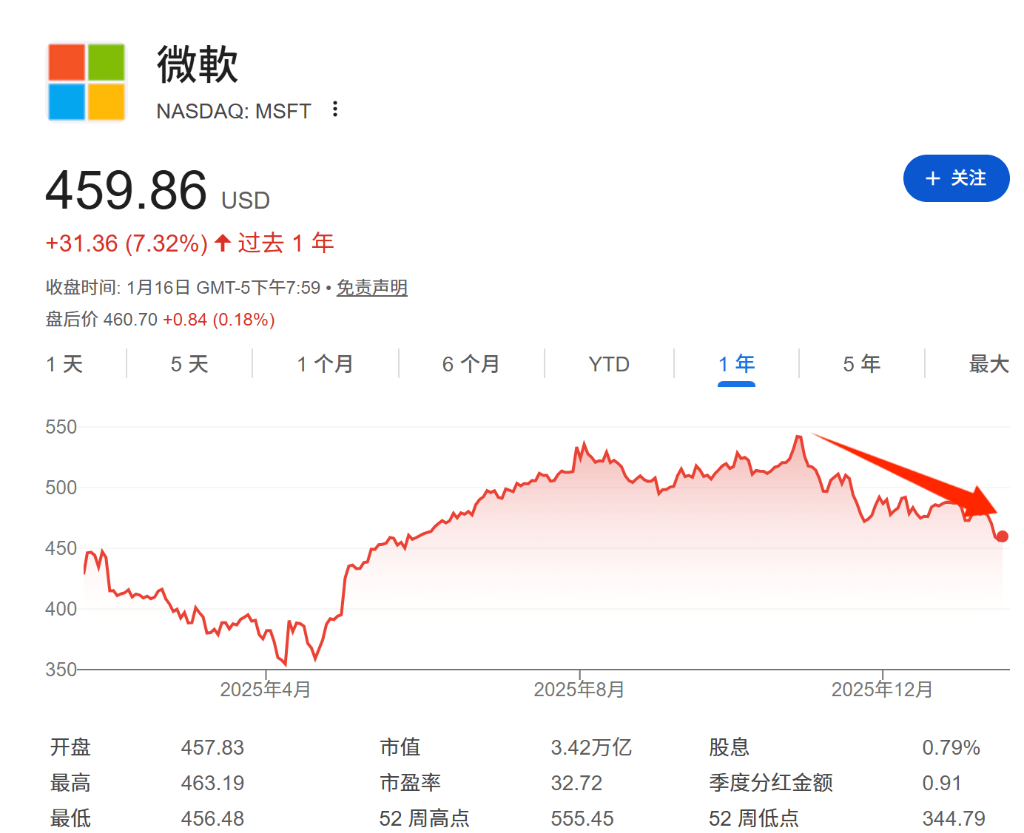
微软

Search documents
微软:评估电力成本上升的潜在影响
2026-01-20 03:19
19 January 2026 | 8:21PM EST Equity Research Microsoft Corp. (MSFT) Assessing the impact of potentially higher power costs MSFT 12m Price Target: $655.00 Price: $459.86 Upside: 42.4% There were two separate news reports tied to Microsoft's power costs last week: On 1/13, Microsoft announced its Community-First AI Infrastructure Plan, including its plans to pay higher utility rates to ensure that the electricity costs of serving data centers are not passed through to local residents. On 1/16, Bloomberg repor ...

马斯克向OpenAI和微软索赔 至多1345亿美元
Huan Qiu Wang Zi Xun· 2026-01-19 15:49
Core Viewpoint - Elon Musk has filed a lawsuit against OpenAI and Microsoft, claiming that OpenAI has abandoned its non-profit mission and engaged in fraudulent behavior, seeking damages between $78.8 billion and $134.5 billion [3]. Group 1 - Musk's compensation request could amount to as much as $134.5 billion, equivalent to approximately 9.373 trillion RMB [3]. - The lawsuit also indicates that Musk plans to seek punitive damages in addition to the compensation [3]. - The court hearing for this case is expected to commence in April of this year [3].
为何微软是当下“抄底”AI的最佳标的?高盛:AI利润率将重演云时代扩张奇迹
Hua Er Jie Jian Wen· 2026-01-19 13:51
Core Viewpoint - The recent market pullback may present an excellent "buying opportunity," with Goldman Sachs analysts asserting that Microsoft is the best investment choice to leverage the AI product cycle for compounded growth [2] Group 1: Financial Projections - Goldman Sachs predicts Microsoft's earnings per share (EPS) will steadily reach $35 by fiscal year 2030, indicating a compound annual growth rate (CAGR) of over 20% [2] - The current market panic may serve as an entry point for investors, as Microsoft is establishing its dominance in the AI era through flexible infrastructure and unique profit margin advantages [2] Group 2: AI Cycle and Profitability - Microsoft’s management highlighted that the current AI cycle mirrors the early cloud cycle, where high initial costs were followed by significant profit margin expansion due to scale effects and efficiency improvements [3] - The company believes its leadership in the AI cycle is even stronger than during the cloud cycle, driven by operational discipline and rapid efficiency gains [3] Group 3: Competitive Advantages - Microsoft's partnership with OpenAI provides a unique gross margin advantage, as it does not incur additional API costs for using OpenAI models, creating a significant competitive edge over other software providers [4] - Microsoft is redefining the role of large language models (LLMs) as the next generation of abstraction layers, which will shift applications from hard-coded rules to intent-driven execution [4] Group 4: Infrastructure Strategy - Microsoft has demonstrated strong strategic resolve by rejecting the "bring your own chip" (BYOC) model, which could isolate infrastructure stacks and undermine core profit drivers [6] - The company’s profit advantage stems from optimizing the entire stack of data centers, power, cooling, networking, and silicon, rather than focusing on individual components [6] Group 5: Market Demand Trends - There is a noticeable shift in enterprise customer discussions regarding AI adoption, moving from "whether to adopt" to "when and to what extent to expand" [7] - Microsoft has observed widespread adoption of enterprise AI, with customers typically starting with pilot programs and rapidly scaling up as familiarity increases [7] - The company has adjusted its sales incentives to focus on accelerating customer value realization rather than merely pricing, indicating a shift towards deeper ecosystem engagement [7]

估值达22750亿元,红杉、英伟达、微软、黑石、GIC争投的Anthropic有何来头?
Xin Lang Cai Jing· 2026-01-19 13:16
Core Insights - Anthropic, founded by former OpenAI team members, has raised $25 billion in funding, achieving a post-money valuation of $350 billion, nearing OpenAI's $500 billion valuation [1][9] - This funding round marks a strategic shift in the global AI competition from technological breakthroughs to enterprise-level value creation [1][9] Group 1: Founding Team - The founding team of Anthropic consists of notable figures from OpenAI, including Dario Amodei and Daniela Amodei, who were key contributors to the development of GPT-2 and GPT-3 [2][10] - Dario Amodei's departure from OpenAI was driven by differences in commercialization strategies, leading to the establishment of Anthropic's "Constitutional AI" principles aimed at ensuring ethical model outputs [2][10] Group 2: Capital Dynamics - The funding round was led by Singapore's GIC and the U.S. hedge fund Coatue, each contributing $1.5 billion, reflecting a strategy of heavy investment in leading AI firms [5][13] - Microsoft and NVIDIA's combined commitment of $15 billion indicates a deep binding strategy, as Anthropic has procured $30 billion in Azure cloud computing resources [5][13] - Sequoia Capital's participation signifies a shift in investment strategy, as they previously avoided competing firms, now recognizing the complementary strengths of Anthropic and OpenAI [5][13] Group 3: Technological Breakthroughs - Anthropic's flagship Claude series focuses on reliability, interpretability, and controllability, achieving a compliance rate of 98.7% in high-risk areas like medical diagnostics [6][14] - The Claude Opus 4.5 model has improved code generation accuracy to 92%, becoming a core engine for Amazon Alexa and other smart devices [6][14] - Anthropic's product matrix includes various models tailored for different market needs, emphasizing enterprise-level applications [6][14] Group 4: Industry Landscape - Despite its $350 billion valuation, Anthropic's financial data shows a projected revenue increase from $1 billion in 2024 to $10 billion in 2025, with a customer base exceeding 5,000 [7][15] - The company has a customer renewal rate of 91%, significantly higher than the industry average of 68%, indicating strong demand for its services [7][15] - Challenges include being placed on the U.S. Commerce Department's "entity list," which restricts access to certain GPUs, and potential complications with a $4 billion investment agreement with Amazon due to antitrust reviews [7][15] Group 5: Future Aspirations - Anthropic is developing an "Agent Skills" open standard to create an AI agent economy, allowing developers to package skills for cross-application use [8][16] - The company plans to invest $5 billion over the next three years to build a global computing network and initiate an "AI Safety Research Fund" in collaboration with leading universities [8][16] - This capital-driven technological revolution is set to redefine competition in the AI industry, with Anthropic and OpenAI's rivalry likely shaping the global tech landscape for the next decade [8][16]

三星请来微软前高管 应对欧盟数字监管挑战
Sou Hu Cai Jing· 2026-01-19 10:24
欧盟是三星的核心市场,其营收约占三星全球年营收的 17%,即约 50.1 万亿韩元(IT之家注:现汇率 约合 2375.74 亿元人民币)。然而,随着欧盟不断出台更严苛的监管法规与贸易保护措施,三星的担忧 正持续加剧。 其中,影响最为深远的法规当属《欧盟数字市场法案》。该法案将特定大型企业列为"守门人",并通过 施加特殊义务来遏制其滥用市场支配地位的行为。2023 年,三星勉强未被划入"守门人"名单。 目前,共有七家企业被该法案列为"守门人",分别是苹果、Alphabet、亚马逊、Meta、微软,以及的字 节跳动和总部位于荷兰的缤客(Booking.com)。 【来源:IT之家】 46 岁的罗利森已入职三星驻欧盟政策核心枢纽布鲁塞尔的欧洲对外关系团队。他曾在微软供职十余 年,长期负责欧盟政府关系与政策事务。 随着欧盟监管环境日趋复杂,三星有望借助罗利森在人工智能、云服务政策及网络安全领域的专业经 验,以及他在布鲁塞尔的人脉网络,更好地应对相关挑战。 罗利森毕业于美国弗吉尼亚州里士满大学,后于法国巴黎政治学院取得欧洲研究硕士学位。他的职业生 涯始于诺基亚,2014 年加入微软,负责欧盟对外关系事务,离职前担任微 ...

马斯克索赔1340亿美元!剑指OpenAI与微软
Sou Hu Cai Jing· 2026-01-19 09:21
全球首富马斯克突然掀桌!近日,他正式向人工智能巨头OpenAI及其最大金主微软发起天价诉讼,索赔金额高达 1340亿美元,震惊全球科技界。理由直指 OpenAI背弃创立初心——从"为人类福祉开发通用人工智能"的非营利组织,沦为微软的"闭源子公司",涉嫌对其构成欺诈。 此案不仅关乎千亿赔偿,更是一场关于AI未来走向的路线之争:是开放共享,还是巨头垄断?是公益驱动,还是资本主导?马斯克以一己之力挑战两大科 技帝国,无论胜负,都将重塑全球AI治理格局。 马斯克在诉状中痛陈:自己作为OpenAI早期关键创始人与最大捐赠者(累计捐资超4400万美元),曾坚信其将坚守开源、非营利、造福全人类的使命。然 而,自2019年OpenAI转向营利模式,并与微软达成百亿美元级合作后,一切彻底变质。GPT-4等关键技术被深度集成进微软产品,却拒绝公开模型细节,完 全违背"开放"之名。马斯克怒斥:"它现在是'封闭人工智能',只为微软利润服务!" 对此,OpenAI断然否认,称公司始终独立运作,使命未改;微软则强调自身不控制OpenAI,合作仅为技术授权。但马斯克不买账,要求法院强制OpenAI恢 复开源,并禁止其与微软从所谓"通用人工 ...
微软、英伟达、红杉重金押注!Anthropic估值瞄准3500亿美元
Ge Long Hui A P P· 2026-01-19 07:39
Core Insights - The article discusses the significant financing round for AI startup Anthropic, targeting $25 billion, which could double its valuation to $350 billion from $170 billion in just four months [1] - The financing involves major investors like Sequoia Capital, GIC, and Coatue, with a unique strategy of investing in multiple AI competitors [1][2] - Anthropic's revenue has been growing exponentially, with a projected increase from $100 million in 2023 to $8-10 billion by 2025 [2] Group 1: Financing and Valuation - Anthropic is seeking $25 billion in its latest funding round, which would elevate its valuation to $350 billion if successful [1] - Sequoia Capital, GIC, and Coatue are leading the investment, with Microsoft and Nvidia committing a total of $15 billion [1] - The funding strategy breaks traditional venture capital norms by investing in competing AI firms [1][2] Group 2: Revenue Growth and Market Position - Anthropic has achieved a tenfold revenue growth annually for three consecutive years, with a significant market share in the enterprise sector [2] - The company's core product, Claude, has seen a doubling in total web traffic and a 12% increase in daily active users this year [2] - Anthropic is focusing on the enterprise market, differentiating itself from competitors like Google and OpenAI [8] Group 3: IPO Preparation and Future Outlook - Anthropic is preparing for an IPO, with legal preparations underway, potentially launching in the near future [4] - The company has committed to approximately $100 billion in computing power, emphasizing a different approach compared to competitors [5] - Anthropic's leadership believes in sustainable growth rather than chasing exponential increases, indicating a cautious outlook on the AI market [6][8]
美国大型科技股在法兰克福交易所下跌,英伟达跌2%,微软与谷歌跌2.3%
Mei Ri Jing Ji Xin Wen· 2026-01-19 07:24
Group 1 - Major U.S. tech stocks experienced a decline on the Frankfurt Stock Exchange, with Nvidia dropping by 2% [1] - Microsoft and Google both saw a decrease of 2.3% [1]


大模型听懂语音却变笨?港中深与微软联合解决语音大模型降智问题
Xin Lang Cai Jing· 2026-01-19 05:48
Core Insights - The article discusses the challenges faced by Speech LLMs, particularly the "Modality Reasoning Gap," where the reasoning ability of models declines when switching from text to speech input [3][8]. - TARS (Trajectory Alignment for Reasoning in Speech) is introduced as a new framework that utilizes reinforcement learning to align reasoning processes dynamically, overcoming the limitations of traditional methods [7][9]. Group 1: Challenges in Speech LLMs - Speech LLMs experience a significant drop in logical reasoning capabilities when processing audio inputs compared to text inputs [3][8]. - Previous attempts to bridge the reasoning gap have been inadequate, focusing either on input alignment or output memorization, which do not address the deeper representation drift [8][9]. Group 2: TARS Framework Innovations - TARS employs on-policy reinforcement learning to dynamically align the reasoning trajectories of speech and text, rather than forcing a static alignment [9][17]. - Key innovations of TARS include: - Representation Alignment, which directly addresses the internal representation drift [11]. - Behavior Alignment, introducing flexible alignment standards at the output stage [12]. - Asymmetric rewards and modality-specific normalization to optimize the training process for speech models [13][14]. Group 3: Experimental Results - TARS demonstrated a 100% restoration of reasoning capabilities in speech models, achieving significant performance improvements on high-difficulty benchmarks [15][16]. - The model's performance metrics showed that TARS not only improved speech reasoning but also enhanced text reasoning accuracy, indicating a holistic improvement in model intelligence [16][17]. Group 4: Future Implications - The introduction of TARS marks a paradigm shift in speech model research, proving that on-policy reinforcement learning is superior to traditional off-policy methods for addressing modality alignment issues [17]. - TARS provides a viable pathway for researchers aiming to develop high-intelligence omni models capable of effective speech interaction [17].

昨夜今晨:马斯克起诉微软和OpenAI索赔千亿美元 央视春晚完成首次彩排
Sou Hu Cai Jing· 2026-01-19 04:18
Group 1 - The 2026 Spring Festival Gala has successfully completed its first rehearsal, integrating various program content with cutting-edge technologies such as AI, AR, and XR in stage design [3] - The gala continues the creative concept of "thought + art + technology," emphasizing the incorporation of "intelligent manufacturing" into content production and visual presentation [3] - A team of intelligent robots, which gained attention during the 2025 Spring Festival Gala, plans to reappear in a new format to showcase advancements in artificial intelligence and automation through human-machine collaboration [3] Group 2 - Elon Musk has filed a lawsuit against OpenAI and its partner Microsoft, seeking damages between $79 billion and $134 billion, based on his initial $38 million seed funding and claims of fraud due to a breach of the nonprofit mission [4] - Musk argues that based on OpenAI's current valuation of approximately $500 billion, he is entitled to a proportional equity return [4] - OpenAI has responded by calling the lawsuit "baseless" and characterized it as harassment, while Microsoft stated there is no evidence of wrongdoing [4] Group 3 - Avita Technology has issued a statement regarding a multi-vehicle accident in Nanning, Guangxi, confirming that the accident was caused by the driver's speeding [5] - The company analyzed vehicle data with user authorization, revealing that the Avita 07 model was in "NCA_STANDBY" mode, meaning the advanced driver assistance system was not activated at the time of the accident [5] - The vehicle's airbag system deployed normally after the collision, meeting safety standards [5] Group 4 - The China Railway 12306 platform has launched a "limited-time free refund for mistakenly purchased tickets" service, effective January 19, 2026 [6] - Passengers who purchase tickets for journeys on or after February 2, 2026, can self-process a full refund within 30 minutes of payment if they discover a mistake and if the train departs more than 4 hours later [6] - This initiative aims to optimize the ticket purchasing process and reduce economic losses due to operational errors, enhancing the convenience and user-friendliness of railway passenger services [6] Group 5 - The CEO of TracMii Technology, Yu Hao, clarified the company's vision of becoming the first trillion-dollar company in history, emphasizing that this goal requires sustained efforts over the next twenty years [7] - The company has maintained a cumulative profit status since its inception without relying on external capital for aggressive expansion, even while exploring multiple emerging business areas [7] - This statement aims to highlight the sustainability of the company's development strategy and its financial discipline [7]