赛诺菲

Search documents
全球与中国胰岛素笔针头市场现状及未来发展趋势(2025版)
QYResearch· 2025-10-15 02:20
Core Viewpoint - The insulin pen needle industry is experiencing rapid growth driven by the increasing prevalence of diabetes and the demand for convenient self-injection methods. Innovations in needle design and safety features are enhancing user comfort and safety, while market dynamics are shifting towards smart and sustainable solutions [5][6][11]. Industry Current Status - The insulin pen needle industry has evolved since the 1980s, transitioning from traditional syringes to more user-friendly pen-style injectors. The design of needles has improved significantly, focusing on comfort and safety, with shorter and thinner needles becoming the norm [5][6]. - The market is currently dominated by standard needles, but safety needles are gaining traction due to their protective features, reducing the risk of needlestick injuries and cross-contamination [6][11]. Development Trends - Key trends include the miniaturization and pain reduction of needles, with 4mm needles becoming mainstream. Future designs may incorporate advanced cutting techniques and lubricants to further enhance comfort [8][17]. - The rise of safety needles is a significant trend, driven by stricter regulations and the need for occupational safety in healthcare settings. These needles are expected to see increased adoption in home care scenarios as well [8][10]. - The industry is moving towards smart and digital integration, with potential for insulin pen needles to connect with smart devices for better medication management [8][17]. Market Size and Forecast - The global insulin pen needle market is projected to grow from $1.178 billion in 2024 to $1.799 billion by 2031, with a CAGR of 6.58% from 2025 to 2031. The Chinese market is expected to grow from $194 million in 2024 to $315 million by 2031 [14][15]. - The demand for insulin pen needles is primarily driven by the rising number of diabetes patients, which exceeds 500 million globally, and the increasing preference for home self-injection [14][15]. Challenges and Opportunities - The market faces challenges such as intense price competition, particularly from local manufacturers in countries like China and India, which may compress profit margins [15][16]. - Patient education and adherence to proper needle usage are critical for market growth, as some patients may not understand the importance of using new needles for each injection [16]. - The push for environmentally friendly materials and cost control is becoming increasingly important, with manufacturers exploring biodegradable and recyclable options [10][17]. Policy Analysis - Insulin pen needles are classified as Class II medical devices, requiring strict regulatory compliance in most regions, including certifications like ISO 13485 and local health authority approvals [18]. - Insurance coverage for insulin pen needles varies by region, with some countries providing reimbursement, which can significantly influence market demand [18].

钱塘企业天境生物加速创新药研发
Mei Ri Shang Bao· 2025-10-14 22:39
Core Insights - Tianjing Biotech successfully completed nearly 600 million RMB in C+ round financing, aimed at advancing phase III clinical trials and market applications for first-tier products, while accelerating the development of second-tier global innovative drug candidates [1] - The financing reflects recognition of Tianjing Biotech's innovative capabilities and growth potential, as well as the strong appeal of the biomedical industry in Hangzhou Qiantang [1] Company Overview - Tianjing Biotech focuses on autoimmune diseases, tumors, and metabolic diseases, and has shown rapid growth since its strategic restructuring in early 2024 [1] - The company has established a diversified revenue model combining commercialization of near-market products, external licensing of innovative products, and CDMO services, effectively balancing high investment and risk in innovation [1] - Key milestones achieved include a strategic cooperation with Sanofi valued at approximately 1.7 billion RMB for the rights of Ureliximab in Greater China, and the breakthrough therapy designation for Punalizumab by the National Medical Products Administration [1] Product Pipeline - The innovative drug pipeline is entering a "harvest period" with a clear "dual-tier" layout, where the first tier includes six major products in late clinical stages, with new drug applications nearing completion [2] - The second tier consists of globally innovative projects and next-generation drugs expected to enter clinical trials between 2025 and 2026 [2] - The production base in Hangzhou plays a crucial role in supporting the entire industry chain, having fully operated its first phase and complied with GMP standards [2] Industry Context - The financing news for Tianjing Biotech is part of a broader trend, as multiple biopharmaceutical companies in Qiantang have also secured funding in the third quarter, indicating a vibrant development ecosystem in the region [3] - Companies like Zhejiang Ganaiwei Medical Technology and Hangzhou Derui Zhiyao Technology have also completed significant financing rounds, showcasing the robust vitality of the Qiantang biomedical industry [3]

Hedge Fund Shah Capital Urges Novavax To Consider Sale Amid Vaccine Rollout Struggles, Sees $5 Billion Potential
Benzinga· 2025-10-14 17:08
Core Viewpoint - Shah Capital is urging Novavax Inc. to consider a sale due to ongoing challenges in the rollout of its COVID-19 vaccine, suggesting that its assets could be more valuable in the hands of a larger pharmaceutical company [1][2]. Company Performance - Novavax's stock is showing strong performance, with a current price of $8.89, reflecting a 3.07% increase [7]. - The company has a market capitalization of approximately $1.4 billion, while Shah Capital estimates its value could be "at least $5 billion" based on the potential of its vaccines [3]. Market Position - Novavax's COVID-19 vaccine, Nuvaxovid, has only captured 2% of the market, significantly underperforming compared to competitors like Pfizer and Moderna, which distributed nearly six million doses each [5][6]. - In the second quarter of 2025, Novavax reported sales of $239.24 million, a decrease from $415 million a year ago, but exceeding the consensus estimate of $156.29 million [6]. Strategic Insights - Shah Capital holds a 7.2% stake in Novavax, making it the second-largest shareholder, and has identified potential buyers among major pharmaceutical companies such as Sanofi, Merck, GSK, and AstraZeneca [2]. - The hedge fund noted that favorable political conditions and scientific data could benefit Novavax moving forward [4].

Sanofi: Information concerning the total number of voting rights and shares - September 2025
Globenewswire· 2025-10-14 16:30
Core Points - The document provides information regarding the total number of voting rights and shares for Sanofi as of September 30, 2025 [1] - Sanofi has a registered share capital of €2,454,937,946 and is registered at the Paris Commercial and Companies Registry [1] Summary by Category - **Total Number of Shares**: As of September 30, 2025, Sanofi has issued a total of 1,227,469,992 shares [1] - **Voting Rights**: The theoretical number of voting rights, including treasury shares, is reported as 1,361,772,559 [1] - **Excluding Treasury Shares**: The number of real voting rights, excluding treasury shares, stands at 1,352,290,790 [1]


呼吸道合胞病毒进入流行期,国内多家企业布局相关药物研发
Xin Jing Bao· 2025-10-14 10:13
Core Insights - The respiratory syncytial virus (RSV) is currently in an epidemic phase in China, with a significant number of children being hospitalized, including cases in the ICU [1] - There is no specific treatment for RSV in infants, making prevention crucial, and several companies are developing RSV-related drugs [1][2] - The global market for passive immunization agents for RSV prevention in infants is projected to grow at a compound annual growth rate (CAGR) of 78.4% from 2024 to 2028, reaching 2.99 billion yuan [2] Drug Development Landscape - Three monoclonal antibodies (mAbs) for RSV have been approved globally: Palivizumab, Nirsevimab, and Clonabivimab, with Nirsevimab being the first long-acting mAb approved in China [3] - Six additional mAbs are in clinical trials, with TNM-001 from Zhuhai Tenomab Pharmaceutical progressing to Phase III trials [3] Vaccine Development - There are 188 RSV vaccines in development globally, with three approved: GSK's Arexvy, Pfizer's Abrysvo, and Moderna's mRESVIA, none of which are available in China yet [4] - Several Chinese companies, including Chengdu Huarenkang and Beijing Kexing Zhongwei, are actively developing RSV vaccines, with some in Phase III clinical trials [4] Innovative Drug Research - Currently, there are no approved specific treatments for RSV, but notable progress is being made in small molecule drug development [6] - Aikobaf's Qiruisuo is the first targeted RSV fusion protein inhibitor to complete Phase III trials and is recognized as a breakthrough therapy in China [6] - Shionogi's oral antiviral S-337395 is in Phase II trials and has shown promising results in reducing viral load [6] Future Outlook - The ongoing development of vaccines, monoclonal antibodies, and therapeutic drugs is expected to lead to more effective prevention and treatment options for RSV [7]

国内外药企竞相布局合胞病毒疫苗
Bei Jing Shang Bao· 2025-10-13 15:39
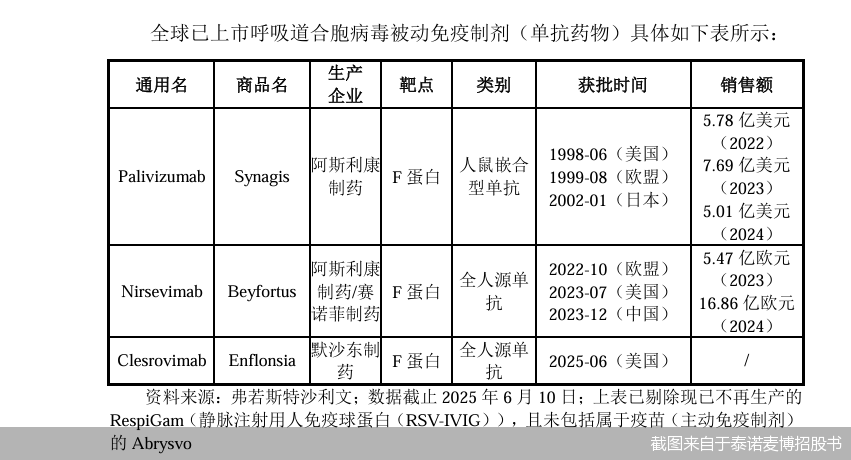
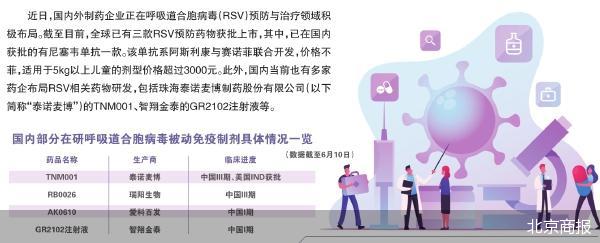
Core Insights - The pharmaceutical industry is actively developing and launching products for the prevention and treatment of Respiratory Syncytial Virus (RSV), with three RSV prevention drugs already approved globally, including the monoclonal antibody Nirsevimab, developed by AstraZeneca and Sanofi [1][3][4] Group 1: Market Overview - The World Health Organization (WHO) has prioritized RSV prevention products for global development [3] - The market for passive immunization agents against RSV for infants aged 0-1 in China is projected to grow at a compound annual growth rate (CAGR) of 78.4%, reaching 2.99 billion yuan by 2028, and further growing at a CAGR of 23.68% to 6.99 billion yuan by 2032 [3] Group 2: Approved Products - Three RSV prevention drugs have been approved globally: Palivizumab by MedImmune, Clonrava by Merck, and Nirsevimab by AstraZeneca and Sanofi [3][4] - Nirsevimab is the first long-acting monoclonal antibody approved for RSV prevention, with approvals from the European Medicines Agency (EMA) in 2022 and the U.S. Food and Drug Administration (FDA) in 2023, and is set to be available in China in December 2023 [4] Group 3: Pricing and Administration - Nirsevimab is priced at 2,369 yuan for infants under 5 kg and 3,677 yuan for those over 5 kg [4] - Palivizumab requires monthly injections during the RSV season, making it less suitable for widespread use due to its high cost and limited target population [4] Group 4: Ongoing Research and Development - Domestic companies are actively developing RSV-related products, with Tanomab's TNM001 injection showing significant progress in clinical trials [5][6] - TNM001 is a recombinant human monoclonal antibody targeting the RSV F protein, designed to neutralize the virus and prevent cell fusion [5] - Other companies, including RuYang Biotech and Aikobaf, are also in the clinical stages of developing RSV treatments [6]
TEVA Gets FDA Nod for Uzedy Label Expansion in Bipolar I Disorder
ZACKS· 2025-10-13 15:16
Core Insights - Teva Pharmaceutical Industries Limited (TEVA) has received FDA approval for the expanded use of its product Uzedy (risperidone) for the treatment of bipolar I disorder (BD-I) [1][8] - Uzedy is now approved as a once-monthly extended-release injectable suspension for adults with BD-I, either as monotherapy or in conjunction with lithium or valproate [1][8] - The approval is expected to significantly boost Uzedy's sales, which have already seen a 134% year-over-year increase in the first half of 2025 [6][8] Sales Performance - Uzedy's sales reached $93 million in the first half of 2025, with full-year sales projected to be between $190 million and $200 million [6][8] - The approval for BD-I is anticipated to further enhance Uzedy's sales trajectory in 2025 and beyond [6][8] Market Position and Growth - Teva has experienced market share growth for its newer branded drugs, including Uzedy, Austedo, and Ajovy [9] - Austedo's sales increased by 29% year-over-year in the first half of 2025, totaling $891 million, with expectations of exceeding $2.5 billion in annual revenues by 2027 [9][11] - Ajovy's sales rose by 34% year-over-year in the same period, reaching $117 million [9] Pipeline Developments - Teva is advancing its branded pipeline, which includes olanzapine for schizophrenia and duvakitug for inflammatory bowel diseases [10][11] - Teva has partnered with Sanofi for the development of duvakitug, with plans to enter phase III studies for ulcerative colitis and Crohn's disease in late 2025 [11] - A new drug application for olanzapine is expected to be filed in the fourth quarter of 2025 [11] Revenue Projections - Teva anticipates generating over $5 billion in revenues from its branded products by 2030 [11]

REGN Reports Encouraging Data on Gene Therapy for Genetic Hearing Loss
ZACKS· 2025-10-13 15:06
Core Insights - Regeneron Pharmaceuticals, Inc. (REGN) announced updated data on its investigational gene therapy DB-OTO from the CHORD study, which targets profound genetic hearing loss due to variants of the otoferlin (OTOF) gene [1][9] Group 1: DB-OTO Gene Therapy - DB-OTO is a cell-selective, dual adeno-associated virus (AAV) vector gene therapy designed to provide durable hearing to individuals with profound, congenital hearing loss caused by OTOF gene variants [2] - The CHORD study is a registrational phase I/II multicenter, open-label study evaluating the safety, tolerability, and efficacy of DB-OTO in infants, children, and adolescents with OTOF-related hearing loss, currently enrolling participants under 18 years across the U.S., U.K., Spain, and Germany [3] - The study consists of two parts: Part A involves a single intracochlear infusion of DB-OTO in one ear, while Part B involves administering DB-OTO in both ears at the selected dose from Part A [4] Group 2: Study Results - Out of 12 participants aged 10 months to 16 years, 11 experienced clinically meaningful hearing improvements, with three achieving normal hearing levels; eight participants with longer follow-up showed stability or continued improvement in hearing [5][7] - Among three participants who completed speech assessments, all showed substantial improvement, with one able to identify one- and two-syllable words without visual cues [6] - The trial met its primary endpoint, with nine participants showing hearing improvements at a threshold of ≤70 decibel hearing level (dBHL) at week 24 [6] Group 3: Regulatory and Market Context - DB-OTO has received Orphan Drug, Rare Pediatric Disease, Fast Track, and Regenerative Medicine Advanced Therapy designations from the FDA, with the European Medicines Agency also granting Orphan Drug Designation [7] - REGN plans to submit regulatory filings for DB-OTO in the U.S. later this year, pending discussions with the FDA [8] Group 4: Portfolio Diversification - REGN is diversifying its portfolio as its lead drug Eylea faces competition from Roche's Vabysmo, which has seen significant uptake [10] - Eylea HD sales surged 29% in the second quarter due to increased demand, helping to counter the decline in Eylea sales [13] - The company's oncology franchise has been bolstered by recent FDA approvals for Libtayo and linvoseltamab-gcpt, as well as Ordspono for treating certain types of lymphoma [15][16][17]


从强生爽身粉到“减肥神药”,盘点潜藏致癌风险的健康产品
Jing Ji Guan Cha Wang· 2025-10-13 13:52
Group 1 - Johnson & Johnson was ordered to pay $966 million (approximately 6.88 billion RMB) in a lawsuit related to its talc-based baby powder, marking the highest compensation awarded to a single plaintiff in 15 years of litigation [1] - The lawsuit was initiated by the family of May Moore, who died from mesothelioma, alleging that the baby powder contained asbestos fibers, which are linked to the rare cancer [1] - Johnson & Johnson has acknowledged that it was aware of the potential presence of asbestos in its talc products since the 1970s but did not disclose this risk to the public [1] Group 2 - Merck's Rofecoxib (Vioxx) was withdrawn from the market in 2004 due to increased cardiovascular risks, leading to a settlement of $48.5 billion for thousands of lawsuits related to heart disease and other conditions [2] - The FDA had approved Rofecoxib in 1999, but long-term studies indicated potential links to colorectal cancer, prompting Merck to take action [2] Group 3 - Sanofi's Zantac (Ranitidine) faced lawsuits after a laboratory found potential carcinogen NDMA in the drug, leading to a significant drop in stock value and potential losses of $45 billion for the companies involved [3] - By 2024, Sanofi agreed to settle approximately 4,000 personal injury claims related to Zantac, while over 75,000 cases remained pending in Delaware [3] Group 4 - Eisai's Belviq was withdrawn from the market in 2020 after studies indicated a slightly higher cancer occurrence rate among users, affecting around 8 million patients [5] - The FDA issued a safety warning advising patients to discontinue use and consult their doctors following the withdrawal of Belviq [5]


进口单抗最高超3000一针!呼吸道合胞病毒进入高发期,国内外药企竞相布局
Bei Jing Shang Bao· 2025-10-13 12:13
Core Insights - The Respiratory Syncytial Virus (RSV) is experiencing a surge in infections, particularly among infants and the elderly, leading to increased public health concerns and discussions on social media [1][3] - Currently, there are limited treatment options for RSV, with only one monoclonal antibody, Nirsevimab, approved for use in China, while several other pharmaceutical companies are actively developing RSV-related therapies [1][5] Industry Overview - RSV is a leading cause of respiratory infections in children under five globally, with no specific antiviral treatments available, primarily relying on symptomatic care [1][4] - The global market for passive immunization against RSV in infants is projected to grow significantly, with an estimated compound annual growth rate (CAGR) of 78.4% from 2024 to 2028, reaching approximately 2.99 billion yuan [5] Drug Development - Three RSV preventive drugs have been approved globally: Palivizumab, Nirsevimab, and Clesrovimab, with Nirsevimab being the only one currently available in China [5][6] - Nirsevimab is priced at over 3,000 yuan for children weighing over 5 kg, with two formulations available based on weight [6] - Domestic companies like TaenoMabo are developing their own RSV treatments, such as TNM001, which is currently in clinical trials [7][8] Market Demand - The demand for effective RSV prevention and treatment is expected to rise due to the increasing population of infants and the aging population in China, highlighting a significant market opportunity [8] - Companies are encouraged to focus on innovation and differentiation in drug development to meet diverse patient needs and improve drug accessibility [8]