
平安银行

Search documents
平安银行聘任首席合规官 今年近50家机构已配齐
2 1 Shi Ji Jing Ji Bao Dao· 2025-12-18 09:56
Core Viewpoint - Financial institutions are accelerating the appointment of Chief Compliance Officers (CCOs) in response to regulatory requirements and to enhance compliance management [1][5]. Group 1: Appointment of Chief Compliance Officers - Ping An Bank has appointed Wu Leiming as Chief Compliance Officer, pending approval from the financial regulatory authority [1]. - Nearly 50 financial institutions have had their CCO appointments approved this year, covering various sectors including banks, insurance, and consumer finance [1][6]. - The regulatory framework established in December 2022 mandates that financial institutions must establish a CCO at their headquarters and, ideally, at provincial or primary branch levels [1]. Group 2: Responsibilities and Structure of CCOs - The CCO is responsible for overseeing compliance management, ensuring the implementation of compliance norms, and reporting to regulatory bodies [1]. - CCOs can be appointed as either dedicated positions or as roles held by existing senior executives, with the latter often seen as a cost-saving measure [4][6]. Group 3: Trends in CCO Appointments - The trend of senior executives, such as Chief Risk Officers, also serving as CCOs is becoming common, with several examples noted in the industry [4]. - The appointment process for CCOs typically favors internal promotions, although external candidates are also considered [6][7]. - The demand for compliance talent is increasing, prompting smaller banks to actively recruit CCOs from the market [7]. Group 4: Recruitment Criteria for CCOs - Recruitment criteria for CCOs are stringent, often requiring extensive experience in finance and compliance, as well as specific educational qualifications [7].

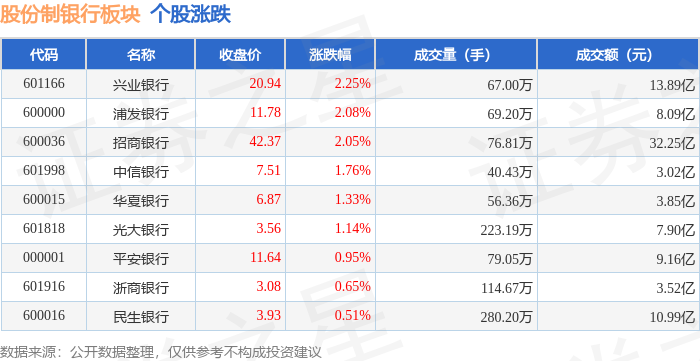
股份制银行板块12月18日涨1.76%,兴业银行领涨,主力资金净流入3.09亿元
Zheng Xing Xing Ye Ri Bao· 2025-12-18 09:09
Core Insights - The banking sector saw a rise of 1.76% on December 18, with Industrial Bank leading the gains [1] - The Shanghai Composite Index closed at 3876.37, up 0.16%, while the Shenzhen Component Index closed at 13053.98, down 1.29% [1] Stock Performance - Industrial Bank (601166) closed at 20.94, up 2.25% with a trading volume of 670,000 shares and a transaction value of 1.389 billion [1] - Other notable performers include: - Shanghai Pudong Development Bank (600000) at 11.78, up 2.08% [1] - China Merchants Bank (600036) at 42.37, up 2.05% [1] - CITIC Bank (601998) at 7.51, up 1.76% [1] - The overall trading volume and transaction values for various banks indicate active market participation [1] Fund Flow Analysis - The banking sector experienced a net inflow of 309 million from institutional investors, while retail investors saw a net outflow of 118 million [1] - Detailed fund flow for key banks includes: - Industrial Bank had a net inflow of 101 million from institutional investors [2] - China Everbright Bank (601818) saw a net inflow of 63 million from institutional investors [2] - Shanghai Pudong Development Bank had a net inflow of 46 million from institutional investors [2] - Retail investors showed significant outflows across most banks, indicating a cautious sentiment among smaller investors [2]







海南自贸港建设,有哪些银行在支持?
Jin Rong Shi Bao· 2025-12-18 08:52
自2020年《海南自由贸易港建设总体方案》发布以来,中国人民银行持续完善与海南自贸港相适应的金 融政策和制度体系,扎实做好金融改革发展稳定各项工作,有力支持海南自贸港建设成型起势。 在央行指导下,银行业金融机构也加紧布局。包括国家开发银行、中国进出口银行、中国农业发展银行 等3家政策性银行,工商银行、农业银行、中国银行、建设银行、交通银行、邮储银行(601658)等6家 国有大行,招商银行、浦发银行、中信银行、光大银行、民生银行等股份制银行和汇丰银行(中国)等 外资银行在内的众多银行业金融机构 聚力 于此,支持海南全面深化改革开放和自由贸易港建设,在助 力谱写中国式现代化海南篇章中展现新担当、新作为。 全岛封关运作是海南自贸港建设的标志性和基础性工程。在金融支持全岛封关运作方面: 国家开发银行海南省分行紧密对接海南省封关运作项目清单,聚焦基础设施互联互通、口岸物流等关键 领域,通过深化银政企合作,高效保障洋浦小铲滩、海口美兰机场、三亚凤凰机场等口岸升级改造,以 及洋浦国际集装箱枢纽港、新海陆岛物流园等重大基础设施项目融资需求。 紧邻海口美兰国际机场空港枢纽的海南国际智慧物贸 云 港是提升海南应急保障能力,促进 ...
银行行业资金流入榜:兴业银行、农业银行等净流入资金居前
Zheng Quan Shi Bao Wang· 2025-12-18 08:51
Market Overview - The Shanghai Composite Index rose by 0.16% on December 18, with 12 out of 28 sectors experiencing gains, led by the banking and coal industries, which increased by 1.97% and 1.89% respectively [1] - The power equipment and communication sectors saw the largest declines, with decreases of 2.22% and 1.58% respectively [1] Capital Flow Analysis - The main capital flow showed a net outflow of 32.578 billion yuan across the two markets, with 8 sectors experiencing net inflows [1] - The defense and military industry had the highest net inflow, totaling 2.29 billion yuan and a daily increase of 0.90%, followed by the banking sector with a net inflow of 927 million yuan and a daily increase of 1.97% [1] Banking Sector Performance - The banking sector increased by 1.97% with a total net inflow of 927 million yuan, comprising 42 listed companies, all of which saw gains [2] - Among the banking stocks, 27 experienced net inflows, with 9 stocks receiving over 50 million yuan; the highest inflow was for Industrial Bank at 157 million yuan, followed by Agricultural Bank and Bank of Communications with inflows of 137 million yuan and 116 million yuan respectively [2] - The stocks with the largest net outflows included Postal Savings Bank, Suzhou Bank, and Qingdao Bank, with outflows of 53.26 million yuan, 39.29 million yuan, and 15.34 million yuan respectively [2] Individual Banking Stocks Performance - Notable banking stocks and their performance include: - Industrial Bank: +2.25%, 157.19 million yuan inflow [2] - Agricultural Bank: +2.01%, 136.65 million yuan inflow [2] - Bank of Communications: +2.05%, 116.49 million yuan inflow [2] - China Construction Bank: +2.58%, 71.12 million yuan inflow [2] - Postal Savings Bank: +1.12%, 53.26 million yuan outflow [3]



平安银行成功发行首单科技创新债券,助力科技金融高质量发展
Jin Rong Jie Zi Xun· 2025-12-18 08:50
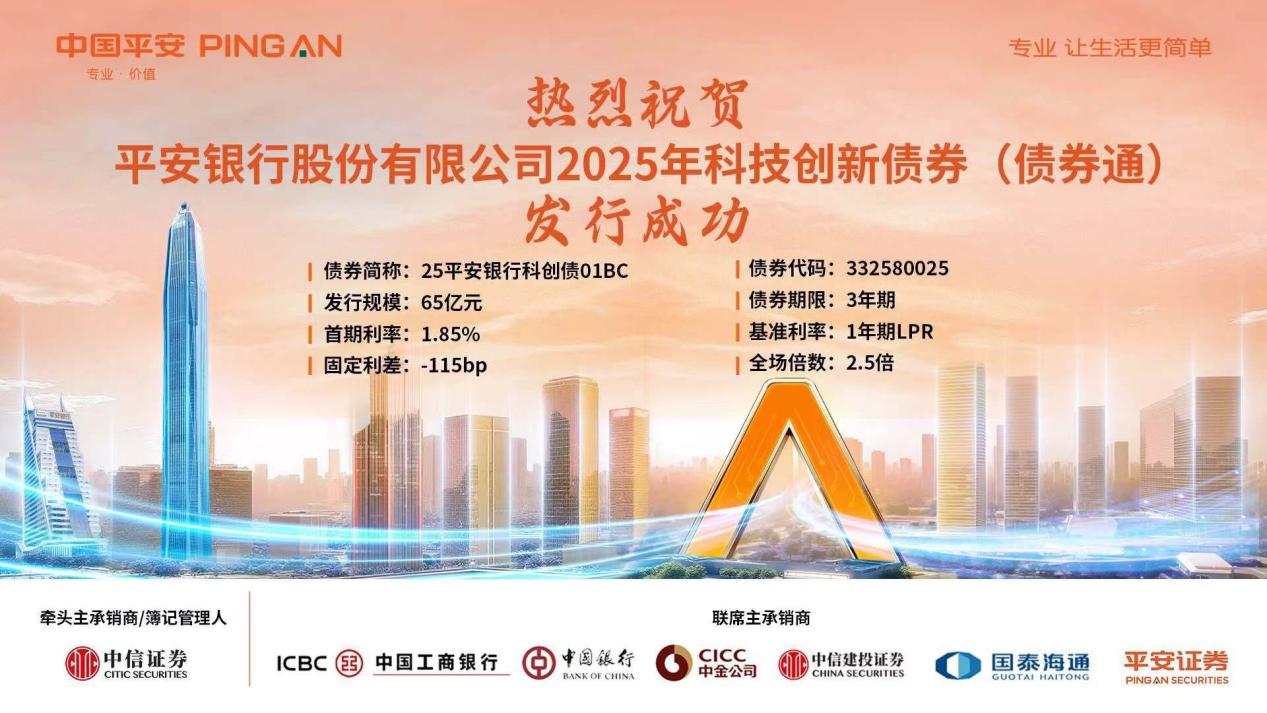
Core Viewpoint - Ping An Bank successfully issued the first market-based floating-rate technology innovation bond linked to LPR, with a scale of 6.5 billion and a term of 3 years at an interest rate of 1.85%, aimed at directing funds towards technology loans [1] Group 1: Bond Issuance - The bond issuance is a response to the central government's economic and financial work meetings, aligning with the national "technology power" strategy [1] - The funds raised will be specifically used for technology loan investments [1] Group 2: Strategic Focus on Technology Finance - Ping An Bank has elevated technology finance to a strategic level, incorporating it into one of the five key directions for corporate business [3] - The bank is establishing a "customer + policy + product + channel + organization + resources" operational system to support technology enterprises [3] - A total branch organization system "1+12+N" has been created, with a central technology finance center at the headquarters and branches in 12 key regions [3] Group 3: Financial Products and Services - The bank has introduced specialized financial products such as "Science and Technology Loan," "Venture Capital Loan," and "Listing Loan" to provide diversified financial services to technology enterprises [3] - As of September 2025, the number of technology enterprise clients reached 28,859, a year-on-year increase of 9.5%, with a technology loan balance of 297.53 billion, up 6.6% year-on-year [3] Group 4: Future Plans - Ping An Bank plans to continue optimizing financial supply and increasing support for technology enterprises and key national strategies [5] - The bank aims to contribute to the new chapter of technological innovation and high-quality economic development [5]
上市银行中期分红进入高峰期,银行ETF指数(512730)中长期配置价值凸显
Xin Lang Cai Jing· 2025-12-18 02:41
Group 1 - The China Banking Index (399986) increased by 0.73% as of December 18, 2025, with notable gains from major banks such as China Construction Bank (up 2.24%) and Suzhou Bank (up 1.73%) [1] - The Bank ETF Index (512730) rose by 0.60%, reaching a latest price of 1.67 yuan, and has accumulated a 14.05% increase over the past year as of December 17, 2025 [1] - Six state-owned banks are expected to distribute over 200 billion yuan in cash dividends, indicating stable profitability and capital resilience among listed banks [1] Group 2 - The Bank ETF Index closely tracks the China Banking Index and serves as an analytical tool for investors, categorizing the sample into various industry levels [2] - As of November 28, 2025, the top ten weighted stocks in the China Banking Index accounted for 65.3% of the index, including major banks like China Merchants Bank and Industrial and Commercial Bank of China [2]

封关运作启幕,金融活水涌向海南自贸港
Zhong Guo Zheng Quan Bao· 2025-12-18 01:00
Core Viewpoint - The banking and insurance sectors are actively positioning themselves in Hainan Free Trade Port, focusing on enhancing financial services to support the development of a modern industrial system characterized by "4+5+3+2" [1][5] Group 1: Financial Institutions' Initiatives - Several financial institutions have established a presence in Hainan, including the opening of the first domestic management-type financial leasing company, ICBC Leasing (Hainan) Co., Ltd. [2] - Major banks such as Guangfa Bank and HSBC have opened branches in Hainan, while strategic cooperation agreements have been signed between Hainan Development Holdings and multiple banks to enhance collaboration in credit, transaction settlement, and industrial synergy [3] Group 2: Asset Growth and Financial Support - As of October 2025, the total assets of Hainan's banking sector are projected to reach 1.96 trillion yuan, a 39.68% increase from the end of 2020, while the insurance sector's total assets are expected to reach 70.48 billion yuan, a 47.99% increase from the same period [3] - Financial institutions are innovating products and services to meet the needs of Hainan's key industries, including tourism, modern services, high-tech industries, and tropical agriculture [4] Group 3: Policy Support and Innovation - Recent policies have been introduced to support the banking and insurance sectors in Hainan, including guidelines for financial support and the establishment of a multi-functional free trade account [4] - Customized financial products have been developed to cater to the specific needs of enterprises in Hainan, alongside unique insurance products addressing special risk protection requirements [4] Group 4: Future Development Plans - Hainan's "14th Five-Year Plan" outlines a vision for the next five years, emphasizing the construction of a modern industrial system and the strategic positioning of financial resources to support key sectors [5] - Industry experts suggest that banks should enhance cross-border financial services and that insurance companies should adapt to changing risk profiles post-closure, offering comprehensive risk solutions [6]
封关运作启幕 金融活水涌向海南自贸港
Zhong Guo Zheng Quan Bao· 2025-12-17 22:27
Group 1 - Hainan Free Trade Port officially launched its full island closure operation on December 18, with financial institutions actively supporting its development through innovative products and services [1] - Several financial institutions have established a presence in Hainan, including the opening of management-type leasing companies and banks, indicating a strong commitment to the region [2] - By the end of October 2025, Hainan's banking sector is projected to have total assets of 1.96 trillion yuan, a 39.68% increase from the end of 2020, while the insurance sector's total assets are expected to reach 70.48 billion yuan, a 47.99% increase [2] Group 2 - Policies such as the "Guiding Opinions on Supporting Hainan's Banking and Insurance Industries" have been introduced to facilitate financial innovation and support the Free Trade Port's operations [3] - The People's Bank of China has developed an electronic fence construction plan for Hainan's Free Trade Port funds, with multifunctional free trade accounts set to launch in May 2024 [3] - Financial institutions are creating customized financial products tailored to Hainan's key industries, including tourism and high-tech sectors, while insurance companies are launching unique risk protection products [3] Group 3 - Hainan's "14th Five-Year Plan" outlines a vision for the next five years, focusing on building a modern industrial system characterized by "4+5+3+2" [4] - Financial resources are being directed towards key areas to support the development of Hainan's unique modern industrial system, with an emphasis on cross-border financial services and customized financial products [4] - The insurance sector is expected to adapt to changing risk characteristics post-closure, expanding its offerings to provide comprehensive risk solutions [4] Group 4 - Financial leasing companies are encouraged to focus on sectors such as aviation and marine engineering, aligning with Hainan's industrial positioning [5] - There is a call for deeper integration of financial technology to enhance service efficiency and explore applications of digital currency in cross-border trade [5]
关于发布2023—2024年度四川银行业履行社会责任工作示范单位名单的公告
Si Chuan Ri Bao· 2025-12-17 22:17
Core Viewpoint - The Sichuan banking industry is committed to implementing the spirit of the 20th National Congress of the Communist Party, focusing on five key areas: technology finance, green finance, inclusive finance, pension finance, and digital finance, to support high-quality economic development in Sichuan [1] Group 1: Industry Initiatives - Sichuan banking institutions are actively integrating into the new development pattern and enhancing their role in modern industrial construction, regional coordination, and safeguarding consumer rights [1] - The Sichuan Banking Association has initiated a social responsibility evaluation for the 2023-2024 period, recognizing 34 institutions for their exemplary social responsibility practices [1] Group 2: Recognized Institutions - Notable institutions recognized for their social responsibility include the China Development Bank Sichuan Branch and the Industrial and Commercial Bank of China Sichuan Branch, among others [1][2] - Categories of recognition include best inclusive finance institutions, best rural revitalization finance institutions, and best technology finance institutions, highlighting the diverse contributions of various banks [2]
封关运作启幕金融活水涌向海南自贸港
Zhong Guo Zheng Quan Bao· 2025-12-17 20:17
Core Viewpoint - The Hainan Free Trade Port has officially commenced its full island closure operations, with financial institutions actively investing and innovating to support its development [1][2]. Financial Institutions' Engagement - Multiple financial institutions, including ICBC Leasing and other banks, have established operations in Hainan, indicating a strong interest in the region [1]. - Strategic cooperation agreements have been signed between Hainan Development Holdings and several major banks to enhance collaboration in credit, transaction settlement, and industrial synergy [1]. Insurance Sector Development - Insurance companies have accelerated the establishment of branches in Hainan, with several new companies opening in recent years, including the first mutual insurance organization in Hainan [2]. - By the end of October 2025, the total assets of Hainan's banking sector are projected to reach 1.96 trillion yuan, a 39.68% increase from the end of 2020, while the insurance sector's total assets are expected to reach 70.48 billion yuan, a 47.99% increase [2]. Innovation in Products and Services - Financial institutions are launching customized financial products tailored to Hainan's key industries, including tourism and high-tech sectors, and are establishing green financing channels [3]. - Insurance companies are introducing unique insurance products to address specific risks associated with the Hainan Free Trade Port, including compensation insurance for shared scientific instruments and comprehensive insurance for innovative talents [3]. Support for Modern Industrial System - Hainan's "14th Five-Year Plan" outlines a vision for developing a modern industrial system characterized by "4+5+3+2" frameworks, with financial resources directed towards key sectors [3][4]. - Financial institutions are encouraged to enhance cross-border financial services and develop customized products that align with Hainan's industrial characteristics [4]. Future Directions - Analysts suggest that financial leasing companies should focus on sectors like aviation and marine engineering, while also exploring opportunities in renewable energy and commercial aerospace [4]. - There is a call for deeper integration of financial technology to improve service efficiency and explore applications of digital currency in cross-border trade [4].