中国人民银行

Search documents
央行开展1000亿元14天期逆回购操作
Ren Min Wang· 2025-12-19 05:34
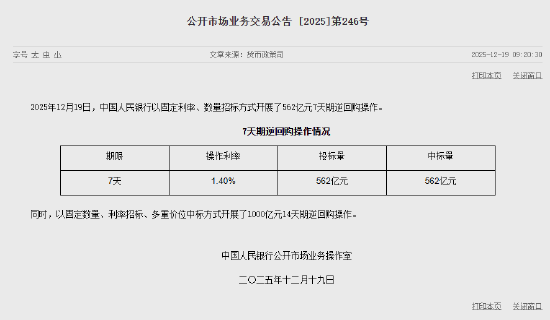
人民网北京12月19日电据中国人民银行网站消息,中国人民银行今日以固定利率、数量招标方式开展了 562亿元7天期逆回购操作。同时,以固定数量、利率招标、多重价位中标方式开展了1000亿元14天期逆 回购操作。 (文章来源:人民网) ...
央行今日开展562亿元7天期逆回购操作和1000亿元14天期逆回购操作
Xin Lang Cai Jing· 2025-12-19 01:28
Core Viewpoint - The People's Bank of China conducted a total of 1,562 billion yuan in reverse repurchase operations on December 19, 2025, indicating a strategy to manage liquidity in the financial system [1]. Group 1: Reverse Repo Operations - The central bank executed a 562 billion yuan reverse repurchase operation with a 7-day maturity using a fixed rate and quantity tender method [1]. - Additionally, a 1,000 billion yuan reverse repurchase operation with a 14-day maturity was conducted using a fixed quantity, interest rate tender, and multiple price bidding method [1].

中国人民银行将于12月22日招标发行400亿元中央银行票据
Jin Rong Shi Bao· 2025-12-19 01:27
Core Viewpoint - The People's Bank of China (PBOC) is enhancing the availability of high-credit-rated RMB financial products in Hong Kong by issuing central bank bills through the Central Moneymarkets Unit (CMU) [1] Group 1: Issuance Details - On December 22, the PBOC will issue the 10th batch of central bank bills with a total issuance amount of RMB 40 billion [1] - The bills will have a maturity of 6 months (182 days), with an interest payment structure and a face value of RMB 100 [1] - The issuance will utilize a Dutch auction method, with the interest rate as the bidding subject [1] Group 2: Timeline and Terms - The effective date for the bills is December 24, 2025, and they will mature on June 24, 2026, with the maturity date adjusted for public holidays [1] - This initiative aims to improve the RMB yield curve in Hong Kong [1]
数字人民币应用提速 这些诈骗陷阱需警惕
Ke Ji Ri Bao· 2025-12-19 00:32
Core Viewpoint - The digital RMB is facing increasing risks of fraud as its pilot program expands, prompting the People's Bank of China to issue warnings about scams related to this new digital currency [1][4]. Group 1: Current Application Status - The digital RMB has transitioned from a pilot phase to a comprehensive promotion phase, achieving significant breakthroughs in retail payments, wholesale finance, green finance, and inclusive finance [2]. - As of September 2025, the digital RMB pilot has expanded to 26 regions across 17 provinces, with a cumulative transaction amount of 14.2 trillion yuan and over 3.32 billion transactions [2]. - The digital RMB app has opened 225 million personal wallets, covering various sectors such as wholesale retail, public services, social governance, and rural revitalization, creating replicable application models [2]. - Innovative application scenarios include features like prepaid smart contracts to lock deposits, preventing losses from institutional defaults, and supporting dual offline payments for reliable transactions without internet or power [2]. Group 2: Risks in Promotion and Application - While the promotion of digital RMB is generally safe, there is a rising concern about fraud, with criminals exploiting the concept for scams [4]. - Public confusion between digital RMB and virtual currencies can lead to misleading information about high returns from "coin trading" [4]. - Scammers use communication tools to lure victims with promises of high returns, spreading false information about purchasing digital RMB wallets, leading to telecom fraud and money laundering [4]. - Fraudulent activities include fake promotional events and recruitment schemes that aim to extract personal information and funds from users [4]. Group 3: How to Avoid Related Fraud - To effectively avoid scams involving digital RMB, it is crucial to recognize its nature as a legal currency and understand the common fraud tactics [5]. - Key characteristics of digital RMB include: 1. No investment or speculative value, as it is equivalent to cash with no appreciation or trading potential [5]. 2. No official promotional rebate mechanisms, with no established grassroots promotional organizations or rebate activities [5]. - Public recommendations to prevent fraud include downloading apps through official channels, protecting personal information, and being wary of any promises of high returns or investment groups related to digital RMB [6].

央行时隔近三月重启14天期逆回购操作
Zhong Guo Zheng Quan Bao· 2025-12-18 20:23
Core Viewpoint - The People's Bank of China (PBOC) has resumed 14-day reverse repos, signaling a flexible and efficient monetary policy aimed at maintaining liquidity stability as the year-end approaches [1][2]. Group 1: Monetary Policy Actions - On December 18, the PBOC conducted a 7-day reverse repo operation of 883 billion yuan and a 14-day reverse repo operation of 1 trillion yuan [1]. - The resumption of the 14-day reverse repo operation after nearly three months indicates the PBOC's intention to inject liquidity to balance supply and demand while stabilizing market expectations [1]. Group 2: Liquidity Management - The PBOC has injected a total of 200 billion yuan in medium-term liquidity through reverse repos in December, with expectations of increasing the scale of medium-term lending facilities (MLF) [2]. - The central bank plans to maintain ample liquidity through a combination of various liquidity tools, enhancing the scientific and precise management of short, medium, and long-term liquidity [2]. Group 3: Economic Support - The focus of monetary policy remains on ensuring sufficient liquidity while facilitating the effective transmission of monetary policy to support high-quality economic development [2].
央行重启14天期逆回购操作维护年末资金面平稳
Zheng Quan Shi Bao· 2025-12-18 18:14
Group 1 - The People's Bank of China (PBOC) conducted a 7-day reverse repurchase operation of 88.3 billion yuan and a 14-day reverse repurchase operation of 100 billion yuan on December 18, aiming to meet year-end funding needs and maintain a stable liquidity environment [1] - The PBOC's decision to resume the 14-day reverse repurchase operation after nearly three months is seen as a measure to directly cover the funding demand during the New Year holiday and to smooth out potential short-term interest rate fluctuations [1] - The adjustment in the reverse repurchase operation structure, moving from a single-price bidding to a multiple-price bidding, reflects a focus on short-term liquidity tools rather than a significant overall easing of monetary policy [1] Group 2 - The PBOC plans to flexibly and efficiently utilize various monetary policy tools, including reserve requirement ratio (RRR) cuts and interest rate reductions, to ensure ample liquidity in the market next year [2] - The combination of various liquidity tools is expected to enhance the scientific and precise management of short, medium, and long-term liquidity, supporting increased credit supply from financial institutions [2] - The ongoing supportive stance of monetary policy is indicated by the continuous reinforcement of quantity-based policy tools [2]
央行重启14天期逆回购操作 维护年末资金面平稳
Zheng Quan Shi Bao· 2025-12-18 18:08
中国人民银行12月18日发布公告称,当天以固定利率、数量招标方式开展了883亿元7天期逆回购操作。 同时,以固定数量、利率招标、多重价位中标方式开展了1000亿元14天期逆回购操作。对于央行此次时 隔近3个月重启14天期逆回购操作,市场机构认为主要目的是满足跨年资金需求,维护年末资金面平稳 有序。 临近年末,银行体系短期流动性常遭到多方因素扰动,包括财政集中支出、企业结算需求增大以及居民 提现等。国家金融与发展实验室特聘高级研究员庞溟对证券时报记者表示,开展14天期逆回购操作旨在 直接覆盖元旦假期的资金需求,提前熨平可能出现的短期利率波动。面对年末复杂的流动性环境,央行 选择以期限结构调整为抓手而非在总量上大幅宽松,既满足了银行体系的临时性缺口,也避免了"大水 漫灌"可能引发的资金空转和杠杆攀升。 根据央行党委会议要求,明年将灵活高效运用降准降息等多种货币政策工具,把握好政策实施的力度、 节奏和时机,保持流动性充裕。东方金诚首席宏观分析师王青向记者指出,央行将通过各类流动性工具 搭配组合,提升短、中、长期流动性管理的科学性和精准性。这不仅有助于保持市场流动性充裕,引导 金融机构加大货币信贷投放力度,也将释放数 ...
中国人民银行重启14天期逆回购 护航资金面平稳跨年
Zheng Quan Ri Bao· 2025-12-18 15:41
Core Viewpoint - The People's Bank of China (PBOC) is actively managing liquidity in the banking system through reverse repurchase agreements, with a focus on maintaining stability amid year-end financial pressures [1][2]. Group 1: Reverse Repo Operations - On December 18, the PBOC conducted a 7-day reverse repo operation of 883 billion yuan at a fixed rate of 1.4%, while also initiating a 14-day reverse repo operation of 1,000 billion yuan [1]. - The net liquidity injection from these operations amounted to 697 billion yuan, considering the maturity of 1,186 billion yuan in 7-day reverse repos on the same day [1]. - The PBOC's adjustment of the 14-day reverse repo operation to a fixed quantity and multi-price bidding method aims to better meet the differentiated funding needs of various institutions [1]. Group 2: Market Stability and Expectations - The PBOC's actions are seen as a response to increased liquidity disturbances due to year-end bank assessments, fiscal expenditures, and cash withdrawals by residents [1][2]. - The maintenance of the 7-day reverse repo rate at 1.4% signals a commitment to stable policy rates, which is beneficial for market expectations [2]. - The simultaneous execution of both 7-day and 14-day reverse repos is intended to satisfy year-end funding demands while preventing excessive liquidity accumulation, reflecting the forward-looking and scientific nature of monetary policy [2]. Group 3: Future Liquidity Management - From December 19 to December 25, a total of 5,218 billion yuan in reverse repos will mature, along with 3,000 billion yuan in Medium-term Lending Facility (MLF) maturing on December 25 [2]. - The PBOC is expected to continue utilizing 7-day and 14-day reverse repos to effectively control short-term liquidity fluctuations [2]. - There are expectations for the PBOC to conduct additional long-term liquidity injections through government bond transactions, potentially increasing the net injection scale beyond the 50 billion yuan seen in November [2].
央行要给非银机构“兜底”?三个问题说清楚
经济观察报· 2025-12-18 13:44
Core Viewpoint - The article discusses the new proposal of providing liquidity to non-bank financial institutions under specific scenarios, raising questions about the rationale behind targeting non-banks, the meaning of "specific scenarios," and what risks this mechanism aims to mitigate [1][3][4]. Group 1: Context and Rationale - The focus on non-bank financial institutions (NBFIs) arises from the changing financial landscape where risks and leverage have increasingly concentrated in market-based finance and NBFIs, which are significant players in stock and bond markets [5][6]. - NBFIs manage trillions of yuan in assets and are crucial in trading across various markets, making them susceptible to liquidity risks due to their reliance on short-term financing [6][7]. Group 2: Mechanism and Implementation - The mechanism aims to address liquidity issues for NBFIs, ensuring that financing chains remain intact and market functions continue during stress scenarios, rather than directly influencing asset prices [8][12]. - The proposal reflects a shift towards a "last liquidity support framework," similar to international practices where central banks provide liquidity to key market participants during extreme conditions to prevent market dysfunction [12][13]. Group 3: Specific Scenarios and Risks - "Specific scenarios" refer to market conditions characterized by price jumps, sudden financing contractions, and dominant passive selling, which can lead to a breakdown in market liquidity [10][11]. - The primary goal of this mechanism is to prevent liquidity issues from escalating into systemic failures, while also managing moral hazard concerns [15][16][17]. Group 4: Broader Implications - The arrangement is linked to broader economic goals, such as stabilizing internal demand and maintaining financial system stability, which are essential for economic recovery and growth [18][19]. - The value of the mechanism lies in instilling confidence that there are tools and frameworks in place to manage extreme scenarios, thereby enhancing the resilience of the financial system [18][19].
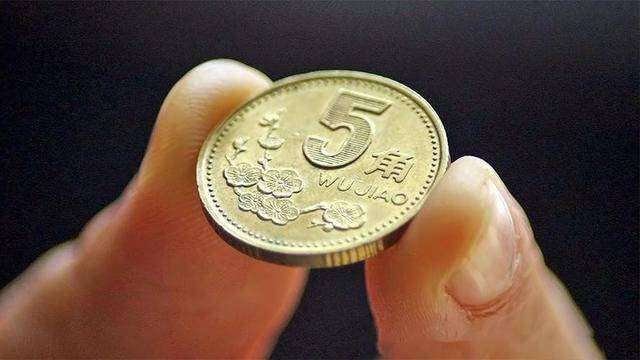
5角硬币里含黄金?是真还是假?多亏银行朋友提醒,看完涨见识
Sou Hu Cai Jing· 2025-12-18 11:45
Core Viewpoint - The rumors regarding the presence of gold in China's 5-dime coins are unfounded and have been debunked through various scientific analyses and official statements [1][5][9]. Group 1: Coin Material Evolution - The 5-dime coins in China have evolved from a copper-zinc alloy in the third series (1991-2001) to a nickel-plated steel core in the fourth series (2002-present), significantly reducing their metal value [3][5]. - The early 5-dime coins (1991-1994) used imported copper, resulting in a brighter color, while later versions switched to domestic copper to control costs [3]. - The current 5-dime coins (since 2019) are made of nickel-coated steel, containing no precious metals [3]. Group 2: Scientific Verification - Multiple professional institutions have conducted tests confirming that the 5-dime coins contain no gold, with analyses showing only copper, zinc, and trace impurities [5]. - A notable experiment by the Guangzhou Geological Testing Center demonstrated the chemical differences between the 5-dime coin and pure gold, further disproving the gold content claims [5]. Group 3: Rumor Trajectory - The initial spread of the "gold content" rumor began around 2005, fueled by online forums and later intensified by market speculation in 2016 and misleading content on social media in 2022 [7]. - The rumors exploit psychological factors such as curiosity about hidden wealth and misconceptions about the historical value of currency [7]. Group 4: Common Misconceptions - Public misconceptions include associating the gold color with gold content, assuming weight indicates precious metal, and believing certain years of coins are more valuable due to supposed gold content [9]. - The People's Bank of China has issued warnings against the destruction of currency, emphasizing that melting coins is illegal and economically unviable [9]. Group 5: Rational Collecting - The true value of coin collecting lies in historical significance rather than material composition, with certain years having lower mintages contributing to their collectible value [11]. - Current market prices for common 5-dime coins range from 1 to 5 yuan, while uncirculated rolls can fetch between 300 to 800 yuan, driven by supply and demand rather than material costs [11]. Group 6: Recommendations for Collectors - The China Numismatic Association advises against hoarding 5-dime coins and warns of high-price buyback scams, encouraging collectors to seek knowledge through official channels [13]. - Maintaining coins in their original condition is recommended for preserving value, as the worth of modern fiat currency is backed by state credit rather than the material itself [14].