
中航产融

Search documents
四只*ST股面临退市 今年A股告别23家公司
Shen Zhen Shang Bao· 2025-08-10 22:38
Group 1 - The A-share market is facing increased scrutiny as multiple listed companies are at risk of delisting due to suspected financial fraud or information disclosure violations, with *ST Zitian, *ST Suwu, *ST Tianmao, and *ST Gaohong being the focal points for investors [1] - On August 8, *ST Gaohong was subjected to mandatory delisting procedures by the Shenzhen Stock Exchange due to serious financial fraud and was fined 160 million yuan, while *ST Tianmao announced its intention to voluntarily withdraw its A-share listing [1] - *ST Zitian's stock price has plummeted by 87.01% this year, and it received a notice from the Shenzhen Stock Exchange regarding the potential termination of its stock listing [1] Group 2 - A total of 23 companies have been delisted from the A-share market this year, primarily due to financial-related delistings, trading-related delistings, and major illegal activities leading to mandatory or voluntary delistings [2] - Companies such as *ST Furun, *ST Dongfang, *ST Xulan, *ST Jiayu, and *ST Jiyuan have been delisted for having stock prices below par value, while others like *ST Boxin and *ST Dayao were delisted for having market capitalizations below 500 million yuan [2]




主动退市也是一种“战略调整”
Zheng Quan Ri Bao Zhi Sheng· 2025-08-10 16:39
Group 1 - *ST Tianmao announced its decision to voluntarily delist, marking the third case of voluntary delisting this year [1] - The crisis for *ST Tianmao became apparent four months prior when it failed to disclose its 2024 annual report and 2025 Q1 report on time, leading to regulatory scrutiny [1] - The company was placed under delisting risk warning on July 8, and if it could not disclose its annual report by September 6, it would face mandatory delisting [1] Group 2 - Voluntary delisting is seen as a strategic choice for controlling shareholders, allowing them to avoid greater risks and seek future development [2] - The process of voluntary delisting offers high controllability, enabling companies to manage timelines and handle shareholder communications effectively [2] - It significantly reduces ongoing costs associated with maintaining a listing, alleviating compliance burdens and public scrutiny [2] Group 3 - The capital market's essence is to serve as a platform for resource allocation, necessitating an effective mechanism for "survival of the fittest" to guide value investment [3] - As capital market reforms deepen, the number of delisting cases is expected to increase, promoting a healthier market ecosystem [3] - Market participants must collaborate, with companies focusing on core competencies, intermediaries ensuring financial information accuracy, and investors enhancing risk recognition [3]
年内第三家!*ST天茂拟主动退市,公司8月11日起复牌
Bei Jing Shang Bao· 2025-08-10 02:24
值得一提的是,*ST天茂目前尚未披露2024年年报和2025年一季报。此前,因*ST天茂无法在法定期限 内披露2024年年报和2025年一季报,公司股票已自5月6日开市起停牌,公司在股票停牌的两个月内仍未 能披露2024年年报和2025年一季报,公司股票于7月8日复牌并被实施退市风险警示。根据规定,若公司 在股票交易被实施退市风险警示之日起的两个月内仍未披露过半数董事保证真实、准确、完整的2024年 年报,深交所将决定终止公司股票上市交易。 *ST天茂表示,本次以股东会决议方式主动终止公司股票上市事项的议案尚需经出席天茂集团股东会的 全体股东所持有效表决权的三分之二以上通过,且经出席天茂集团股东会的除单独或者合计持有上市公 司5%以上股份的股东和上市公司董事、监事、高级管理人员以外的其他股东所持表决权的三分之二以 上通过。上述事项能否最终实施完成及实施结果尚存在不确定性。 北京商报讯(记者 马换换 王蔓蕾)继玉龙股份(601028)、中航产融(600705)后,A股市场出现年 内第三家拟主动退市公司。8月9日,*ST天茂(000627)披露公告称,公司拟以股东会决议方式主动撤 回A股股票在深交所的上市交易,并 ...
一夜之间,两家公司将告别A股,证监会释放重要信号
2 1 Shi Ji Jing Ji Bao Dao· 2025-08-09 12:23
Core Viewpoint - The recent announcements of delisting by *ST Gao Hong and *ST Tian Mao highlight the increasing trend of delistings in China's stock market, driven by stricter regulations and a focus on major violations [1][4][11]. Delisting Trends - As of August 8, 2023, 23 companies have been delisted since the beginning of 2025, with 10 of these due to major violations [1][11]. - The variety of delisting types is increasing, with five companies choosing voluntary delisting this year, including *ST Tian Mao and China Heavy Industry [1][14]. Regulatory Changes - The latest round of delisting reforms began in 2020, leading to a significant increase in the number of delistings and a shift in the structure of delistings [2][8]. - The new "National Nine Articles" and accompanying measures introduced in 2024 further refined the delisting system, focusing on serious financial fraud and supporting companies facing significant uncertainties to voluntarily delist [2][8]. Company-Specific Details - *ST Tian Mao opted for voluntary delisting due to business restructuring and uncertainties, offering shareholders a buyback price of 1.60 yuan per share, which is higher than its last trading price [4][16]. - *ST Gao Hong is facing forced delisting due to severe financial fraud, incurring a fine of 1.6 billion yuan, with its chairman receiving the heaviest penalty [4][5][12]. Delisting Characteristics - The characteristics of delistings in 2025 show a clear trend towards diversification, with 10 companies delisted for major violations, 9 for trading issues, and 9 for financial reasons [9][11]. - The regulatory focus on eliminating problematic companies is evident, with a significant increase in the number of companies facing forced delisting due to major violations [11][12].

一夜之间,两家公司将告别A股,证监会释放重要信号
21世纪经济报道· 2025-08-09 12:14
Core Viewpoint - The recent announcements of delisting by *ST Gao Hong and *ST Tian Mao highlight the increasing trend of delisting in China's stock market, driven by stricter regulations and a focus on major violations [1][2][10]. Group 1: Delisting Trends - As of August 8, 2025, 23 companies have been delisted, with 10 of them due to major violations, indicating a significant increase in delisting numbers this year [1][11]. - The types of delisting are diversifying, with five companies choosing voluntary delisting this year, including *ST Tian Mao, which cited business restructuring and uncertainty as reasons [1][12]. Group 2: Regulatory Changes - The latest round of delisting reforms began in 2020, leading to a notable increase in delisting numbers and a shift in the structure of delisting types [2][8]. - The 2024 "National Nine Articles" and accompanying measures further refined the delisting system, emphasizing the need to address serious financial fraud and support companies facing significant operational uncertainties to voluntarily delist [2][9]. Group 3: Specific Company Cases - *ST Tian Mao opted for voluntary delisting, offering shareholders a buyback price of 1.60 yuan per share, which is higher than its last trading price [4][14]. - *ST Gao Hong faced forced delisting due to severe financial fraud, resulting in a fine of 1.6 billion yuan and the initiation of delisting procedures by the Shenzhen Stock Exchange [5][10]. Group 4: Investor Protection - Companies that voluntarily delist are required to provide cash compensation to shareholders, which is seen as a more favorable outcome for investors compared to forced delisting [12][14]. - The increase in voluntary delistings reflects a regulatory support for companies to exit the market in a manner that protects investor interests [12][14].

退市新局:一夜两家!违法必退
2 1 Shi Ji Jing Ji Bao Dao· 2025-08-09 11:25
Group 1 - The core viewpoint of the articles highlights the increasing trend of companies facing delisting in the A-share market due to major violations, particularly financial fraud, with a significant rise in the number of companies entering delisting procedures in 2025 compared to previous years [2][4] - *ST Gao Hong has been forced to delist due to financial fraud, facing a hefty penalty of 160 million yuan, while *ST Tian Mao has opted for voluntary delisting, offering shareholders a cash option at 1.6 yuan per share [2] - In 2025, 10 companies have entered delisting procedures due to major violations, which is significantly higher than the 3 companies that faced delisting in the first five years following the 2014 regulations [2][4] Group 2 - Since the beginning of 2025, five companies have voluntarily delisted, including *ST Tian Mao, with others like Yulong Co. and AVIC Industry facing operational deterioration, while China Shipbuilding Industry and Haitong Securities delisted due to mergers [3] - The voluntary delisting process has included cash options for shareholders, such as 3.54 yuan per share for AVIC Industry and 13.2 yuan per share for Yulong Co., providing an exit strategy for small investors [3] - The structure of delisting is undergoing a significant transformation, shifting from being primarily finance-driven to a more diversified approach, with various categories of delisting including major violations, trading issues, financial problems, regulatory issues, and voluntary delisting [4]
*ST高鸿、*ST天茂,传出两大退市信号
2 1 Shi Ji Jing Ji Bao Dao· 2025-08-09 08:36
Core Viewpoint - The recent announcements of delisting by *ST Gaohong and *ST Tianmao highlight the increasing trend of delistings in the Chinese stock market, driven by stricter regulations and a focus on eliminating companies involved in significant violations [2][12]. Group 1: Delisting Trends - As of August 8, 2025, 23 companies have been delisted since the beginning of the year, with 10 of these being forced delistings due to significant violations [2][12]. - The types of delistings are diversifying, with an increase in companies choosing to delist voluntarily, including *ST Tianmao, Yulong Co., Zhonghang Chanyin, China Shipbuilding Industry, and Haitong Securities [2][15]. - The latest round of reforms to the delisting system began in 2020, leading to a significant increase in the number of delistings and a shift in the structure of delistings [2][9]. Group 2: Regulatory Environment - The regulatory focus has intensified on serious financial fraud and significant violations, with *ST Gaohong being the tenth company to enter forced delisting procedures due to such violations in 2025 [12][13]. - The new regulations aim to protect investors by supporting companies facing significant uncertainties to voluntarily delist, thereby enhancing the overall market ecosystem [3][11]. Group 3: Company-Specific Details - *ST Tianmao has opted for voluntary delisting, citing business restructuring and significant uncertainties, offering shareholders a buyback price of 1.60 yuan per share, which is higher than its last trading price [5][16]. - *ST Gaohong is facing forced delisting due to severe financial fraud, resulting in a fine of 1.6 billion yuan, with the chairman receiving the heaviest penalty of 750,000 yuan and a ten-year market ban [5][6]. - The delisting of *ST Gaohong is indicative of the severe consequences of financial misconduct, as it has been penalized for fraudulent activities and lack of commercial substance in its operations [5][6].
年内第三例!*ST天茂拟申请主动退市 财联社曾独家报道
Xin Lang Cai Jing· 2025-08-09 07:29
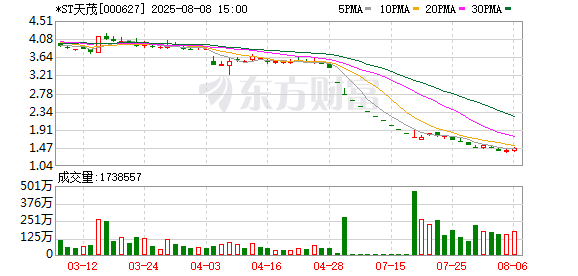
Core Viewpoint - *ST Tianmao (000627.SZ) announced its intention to voluntarily delist from the Shenzhen Stock Exchange, marking the third company to apply for voluntary delisting in A-shares this year [1][2]. Group 1: Delisting Announcement - The company plans to withdraw its A-share listing through a shareholder resolution and subsequently apply for management in the delisting section of the National Equities Exchange and Quotations [1]. - The decision to delist is attributed to significant uncertainties arising from the restructuring of Tianmao Group, which may have a substantial impact on the company [1][2]. Group 2: Shareholder Protection Mechanism - To protect investors, the company will implement a mechanism for dissenting shareholders and other shareholder protection measures [2]. - A cash option will be provided to all A-share shareholders, excluding certain major shareholders, at a price of 1.60 CNY per share, representing a premium of approximately 10% over the last trading price of 1.45 CNY per share [2]. Group 3: Comparison with Other Companies - In comparison, Yulong Co. (601028.SH) offered a cash option at 13.2 CNY per share, a premium of about 1.23% over its last trading price, while AVIC Capital (600705.SH) offered 3.54 CNY per share, a premium of approximately 2.91% [2]. Group 4: Company Profile - *ST Tianmao operates primarily as an investment holding company, with 99.99% of its main business revenue derived from insurance operations through its subsidiaries, Guohua Life and Huarui Insurance [2].
2024年年报迟迟未发,这家公司拟主动退市
Zheng Quan Ri Bao Wang· 2025-08-09 04:23
Core Viewpoint - Tianmao Industrial Group Co., Ltd. has announced its decision to voluntarily delist from the Shenzhen Stock Exchange to protect shareholder interests amid ongoing financial difficulties and regulatory scrutiny [1][2][4]. Group 1: Delisting Announcement - The company plans to withdraw its A-share listing and will apply to transfer to the National Small and Medium Enterprises Share Transfer System after delisting [1]. - A cash option will be provided to dissenting shareholders, with an exercise price of 1.60 CNY per share, representing a 10.34% premium over the last closing price of 1.45 CNY [1][5]. - The company will hold a temporary shareholders' meeting on August 25, 2025, to review the delisting proposal [1][5]. Group 2: Financial Struggles - The company has faced continuous declines in performance, with net profits dropping by 67.32%, 18.88%, 41.78%, and 337.82% from 2020 to 2023, culminating in a net loss of 6.52 billion CNY in 2023 [3]. - For the first three quarters of 2024, the company reported a net loss of 3.33 billion CNY, with forecasts indicating a potential loss of 5 to 7.5 billion CNY for the full year [3]. Group 3: Regulatory Issues - The company is on the verge of forced delisting due to failure to disclose its 2024 annual report, which was originally due on April 29, 2024 [2]. - The China Securities Regulatory Commission (CSRC) has initiated an investigation into the company for failing to timely disclose regular reports, leading to a suspension of trading since May 6, 2024 [2]. Group 4: Market Context - The number of companies voluntarily delisting has increased, with Tianmao being the third company to do so in 2023, reflecting stricter delisting regulations and increased operational pressures [7]. - The new regulations aim to reduce "shell" companies and enhance investor protection through mechanisms like cash options for shareholders [7].
节奏加快!年内23家公司退市
Jing Ji Wang· 2025-08-08 03:33
Group 1 - The core viewpoint of the articles highlights the increasing frequency of delisting risk warnings in the A-share market, with *ST Tianmao being a notable example due to its inability to disclose financial reports on time [1] - As of August 7, 2023, a total of 23 A-share companies have been delisted this year, with 8 due to trading-type delisting, 7 due to regulatory-type, and 3 due to voluntary delisting [1] - The A-share market is gradually establishing a stable and predictable delisting system, with a focus on strict enforcement, investor protection, and eliminating "shell value" expectations [1] Group 2 - Since 1999, a total of 312 companies have been delisted from the A-share market, with 212 of those delisted from 2019 onwards, which is more than double the number from the previous 20 years [2] - The proportion of trading-type delistings has increased significantly since 2019, with 40% of delisted companies in recent years falling into this category [2] - In 2023, 20 out of 45 delisted companies were due to trading-type reasons, primarily related to stock prices falling below par value [2] Group 3 - The number of companies delisted due to major violations has also increased, following the implementation of the "New National Nine Articles" which emphasizes strict delisting standards [3] - Three companies have been forcibly delisted this year due to major violations, indicating a trend towards stricter enforcement of delisting criteria [4] Group 4 - The new stock listing rules introduced by the exchanges have tightened delisting standards, raising the revenue threshold for financial delisting from 1 billion to 3 billion [5] - As of now, 107 companies are under delisting risk warnings due to financial issues, while 118 face regulatory delisting risks [5] - The "New National Nine Articles" also restricts major shareholders from reducing their holdings in companies that have not paid dividends or have low dividend ratios, further tightening market access for unprofitable companies [6]