Lyft

Search documents
美股三大指数收盘集体上涨,纳指收涨0.9%
Ge Long Hui A P P· 2026-01-22 22:21
格隆汇1月23日|美股三大指数收盘集体上涨,道指涨0.63%,纳指涨0.91%,标普500指数涨0.55%。科 技股普涨,Meta收涨5.7%,创7月31日以来最大单日涨幅;甲骨文涨超2%,AMD、微软、亚马逊涨超 1%。马斯克称在美国得州的无人驾驶出租车RoboTaxi取消安全监督员,特斯拉涨超4%,Lyft跌1.5%, Uber跌2%。 ...
Lyft Unusual Options Activity For January 21 - Lyft (NASDAQ:LYFT)
Benzinga· 2026-01-21 19:01
Core Insights - Investors with significant capital have adopted a bearish stance on Lyft, indicating potential insider knowledge of upcoming events [1] - The overall sentiment among large investors is 31% bullish and 62% bearish, with a notable amount of put options traded [2] Trading Activity - A total of 16 uncommon options trades for Lyft were identified, with 7 puts amounting to $823,268 and 9 calls totaling $778,073 [2] - The predicted price range for Lyft over the last three months is between $10.0 and $35.0 [3] Options Volume and Open Interest - Analyzing the volume and open interest of Lyft's options can provide insights into liquidity and investor interest within the price range of $10.0 to $35.0 over the past 30 days [4] Noteworthy Options Activity - Specific trades include a bearish put option with a total trade value of $521.3K at a strike price of $18.00, and a bullish call option with a total trade value of $128.5K at the same strike price [7] Company Overview - Lyft is the second-largest ride-sharing service provider in the US and Canada, offering various ride options and expanding into bike- and scooter-share markets [8] Market Standing - The consensus target price for Lyft is $21.0, with a Neutral rating maintained by analysts [9] - Lyft's current trading volume is 5,168,180, with a price increase of 1.48% to $18.45, indicating a neutral RSI status [10]



曹操出行20260118
2026-01-19 02:29
Summary of the Conference Call for Cao Cao Mobility Company Overview - **Company**: Cao Cao Mobility - **Current Valuation**: Approximately HKD 20 billion - **Projected Revenue for the Year**: CNY 26 billion - **Comparison**: Positioned against Didi, Uber, and Lyft in the ride-hailing sector [2][3][12] Industry Insights - **Evolution of Ride-Hailing**: Transition from traditional taxis to ride-hailing and now to autonomous vehicles, with algorithms replacing drivers and vehicle management handled by rental companies or platforms [2][4] - **Cost Advantage**: Shared mobility prices per kilometer are nearly half that of private cars, indicating potential to replace some private car demand. The private car market in China is approximately CNY 11 trillion [2][4] - **Market Size**: - China’s ride-hailing vehicle count is around 5 million, with expectations of a single operating entity exceeding 10,000 vehicles by 2028 and a 50% penetration rate for autonomous vehicles by 2030 [5] - Global Robotaxi count is projected to exceed 1.5 million by 2030, with North America leading in development, followed by China and the Middle East [5][8] Competitive Positioning - **Strategic Partnerships**: Backed by Geely, enhancing operational capabilities and technology through partnerships with Qianli Technology [2][6][7] - **Market Role**: Positioned as a third-party traffic platform in the autonomous vehicle era, similar to Didi in the ride-hailing era, with diversified supply sources [3][9] Financial Projections - **2026 Goals**: Aim to operate 500 Robotaxis, with expectations of reducing losses in traditional ride-hailing operations and achieving a projected revenue of CNY 26 billion, with a slight net loss of CNY 270 million [3][10] - **Long-term Vision**: Plans to operate around 100,000 Robotaxis by 2030, anticipating a market turning point by 2028 that will drive company valuation growth [3][11] Investment Opportunities - **Undervalued Status**: Current valuation is considered low compared to peers; if Didi lists successfully, its valuation should exceed that of Lyft or Uber. A price-to-sales ratio of at least 1x is suggested based on projected revenues [2][12] - **Catalysts for Growth**: Key developments such as Tesla's Subcab production in 2026, the launch of XPeng's second-generation VRA model, and the introduction of L3/L4 national standards are expected to accelerate market growth [3][13] Conclusion Cao Cao Mobility is positioned as a significant player in the evolving ride-hailing and autonomous vehicle market, with strong backing, strategic partnerships, and a clear growth trajectory. The company is currently undervalued, presenting potential investment opportunities as the market transitions towards autonomous mobility.
Is Lyft a Buy Going Into 2026?
The Motley Fool· 2026-01-18 13:30
Core Viewpoint - Lyft has stabilized its business, showing improved profitability and positive free cash flow, leading to questions about the stock's attractiveness heading into 2026 [1][2] Group 1: Business Performance - Lyft has transitioned to a self-funded business model, with multiple quarters of positive free cash flow and steady adjusted EBITDA margins, indicating potential for profitability [3] - The company's narrow focus on mobility allows for better capital allocation towards improving marketplace health, resulting in steadier ride growth and improved engagement metrics [4] Group 2: Strategic Moves - Lyft's acquisition of Freenow enhances its exposure to European markets, while partnerships in autonomous vehicles and AI provide long-term growth potential without heavy R&D costs [5] - Despite trading at a discount compared to larger competitors like Uber, continued profitability and execution could lead to multiple expansion and solid returns [6] Group 3: Challenges and Risks - Lyft's smaller scale compared to larger competitors limits its pricing flexibility and resilience during downturns, necessitating sharp execution [8] - Regulatory risks, particularly in North America, could significantly impact costs, with the Freenow acquisition introducing operational complexities and integration challenges [9][10] - Long-term opportunities in autonomous vehicles and AI may not yield near-term benefits, posing risks if adoption timelines slip [11] Group 4: Future Outlook - For Lyft to justify a "buy" rating in 2026, it must maintain profitability, ensure smooth integration of Freenow, and defend market share without reverting to subsidy-heavy tactics [12][13] - The company is now viewed as a more disciplined, cash-generating business, making it investable for long-term investors [14] - However, Lyft's smaller scale and regulatory exposure mean it is not a low-risk investment, suitable for those who believe in management's ability to sustain profitability [15]
‘I'm considering driving Lyft part time': I'm 58 with a $1 million home. Do I finally give up work and enjoy life?
MarketWatch· 2026-01-14 10:15
Core Viewpoint - The article discusses a retirement plan where one individual considers stopping work at age 60 while their spouse continues working for an additional two years in a teaching position [1] Group 1 - The individual is contemplating retirement at age 60 [1] - The spouse plans to work for two more years beyond the individual's retirement [1]

The Tesla Bear Case That Few Are Talking About
The Motley Fool· 2026-01-08 19:03
Core Viewpoint - Tesla's vehicle business is facing significant challenges, with a notable decline in deliveries and production, raising concerns about the sustainability of its growth and the potential impact of its Robotaxi service on overall profitability [1][2][3]. Group 1: Vehicle Deliveries and Production - Tesla's fourth-quarter deliveries fell nearly 16% year-over-year to approximately 418,000 vehicles, leading to a full-year 2025 delivery estimate of 1.64 million, which is an 8.6% decline year-over-year [1]. - The company's vehicle production also decreased sequentially in Q4, with about 434,000 cars produced, down from approximately 447,000 in Q3 [1]. Group 2: Robotaxi Service and Financial Implications - Investor enthusiasm for Tesla's Robotaxi service is driving its high price-to-earnings ratio, which is nearly 300, despite disappointing delivery figures [3]. - There are concerns that the capital expenditures required for the Robotaxi service may exceed expectations, similar to the situation faced by Meta Platforms, which saw a significant increase in capital expenditures due to AI investments [5][6][9]. - Tesla's CFO projected capital expenditures to rise substantially in 2026, indicating a shift towards more capital-intensive operations [9][10]. Group 3: Competitive Landscape - The autonomous ride-sharing market is becoming increasingly competitive, with major players like Alphabet and Amazon already in the space, alongside electric vehicle companies such as Rivian, Lucid, and BYD [11]. - Price sensitivity is expected to dominate the taxi service market, making it challenging for companies to differentiate themselves beyond pricing [12]. Group 4: Potential Outcomes - The combination of high capital intensity and the potential commoditization of ride-sharing services could lead to a scenario where the costs associated with the Robotaxi service exceed its revenue [13]. - Conversely, if Tesla can leverage its existing vehicle hardware for rapid deployment of the Robotaxi service, it may achieve a first-mover advantage and potentially license its technology to other manufacturers, creating a lucrative revenue stream [14][15].


Uber Technologies (NYSE:UBER) Faces Challenges and Opportunities in the Autonomous Vehicle Sector
Financial Modeling Prep· 2026-01-07 21:02
Core Viewpoint - Uber Technologies is a dominant player in the ridesharing industry, holding approximately 75% of the U.S. market, but faces challenges in the autonomous vehicle sector [1][2][6] Market Position - Uber controls about 75% of the U.S. ridesharing market and competes closely with Lyft [1] - The company's stock has been under pressure due to competition in the self-driving vehicle sector [2][6] Stock Performance - Uber's stock has lagged behind the S&P 500 index since its IPO in mid-2019, with a current price of approximately $86.26, reflecting a 0.84% increase [3] - The stock has traded between $85.90 and $87.73 today, with a market cap of approximately $179.23 billion [3] Revenue and Growth Potential - Despite challenges, Uber remains a strong cash generator with impressive revenue growth, indicating potential for future stock improvement [2][6] - The potential success of Uber's autonomous vehicle business is not fully reflected in the current stock price, suggesting room for significant growth in the coming years [5] Legislative Developments - A legislative push led by Republican Representative Brett Guthrie aims to facilitate the deployment of autonomous vehicles in the U.S., which could benefit companies like Uber [4] - The proposed Motor Vehicle Modernization Act seeks to increase the number of AVs exempt from certain safety standards, impacting Uber's AV business [4]


Uber Technologies (UBER) Targeting Parking Spots With Eyes on SpotHero
Yahoo Finance· 2026-01-07 11:50
Group 1 - Uber Technologies Inc. is considered one of the 8 best American stocks to buy and hold in 2026, with ongoing talks to acquire SpotHero, a parking app that complements Uber's ride-hailing services [1][2] - SpotHero's latest funding round valued the company at $290 million, although the potential deal with Uber has no guaranteed outcome as negotiations are still in progress [2] - SpotHero previously partnered with Lyft in 2022 and 2023, but the partnership was terminated as Lyft shifted its focus back to its core ride-hailing business, not due to any issues with SpotHero [3] Group 2 - Uber Technologies is a multinational transportation company primarily known for its ride-hailing services, and it also provides food delivery, courier services, and freight transport, headquartered in San Francisco, California [4]
Where Will Uber Technologies Stock Be in 3 Years?
The Motley Fool· 2026-01-07 09:25
Core Viewpoint - Uber has underperformed the stock market since its 2019 IPO, but there are indications that this trend may change as the company continues to grow and innovate in a rapidly expanding market [2][8]. Group 1: Market Position and Growth - Uber dominates approximately 75% of the ridesharing market in the United States and operates in around 15,000 cities across more than 70 countries [3][4]. - The global ridesharing market is projected to grow at a compound annual growth rate (CAGR) of over 18%, reaching $788 billion by 2035, providing a significant tailwind for Uber [4]. - Uber's revenue is growing at a rate of 20% year over year, with nearly $50 billion in annual revenue, and it has converted 17.4% of its revenue into free cash flow over the past four quarters [6]. Group 2: Financial Metrics and Valuation - Uber's stock has increased by 25% over the past year, but it currently trades at a price-to-earnings (P/E) ratio of just over 19 times 2026 earnings estimates, indicating a low valuation for a company with strong growth [8]. - The company is expected to have earnings of $4.25 per share in 2026, with a conservative assumption of a 20% CAGR for earnings growth [15]. Group 3: Competitive Landscape and Future Plans - Concerns exist regarding the rise of self-driving vehicles and autonomous ridesharing services, which could impact Uber's business model, as compensating human drivers is a significant expense [9][10]. - Uber is actively pursuing partnerships, such as with Nvidia, to develop self-driving technology and plans to build an autonomous fleet of 100,000 vehicles starting in 2027 [11]. - If Uber successfully implements its autonomous plans, the stock could potentially trade at a price as high as $294, representing over a 250% gain over three years [16].

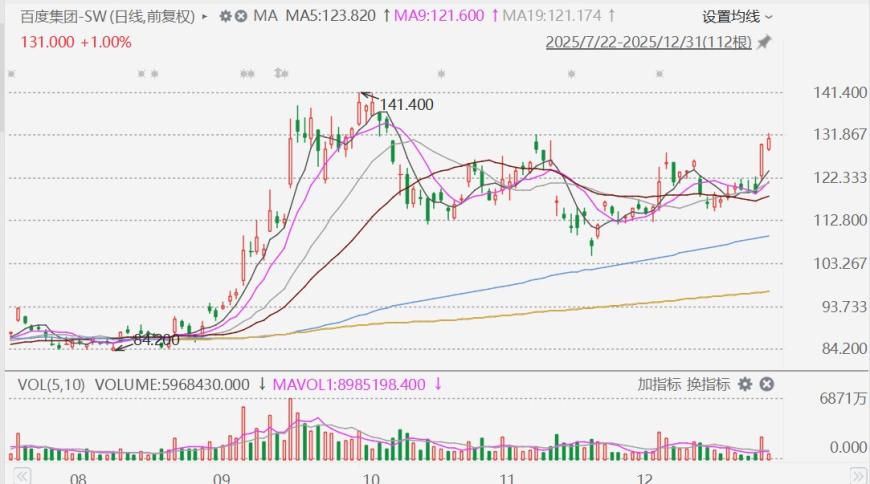
百度再涨2%,与Uber、Lyft达成合作,明年英国推Robotaxi试点
Ge Long Hui· 2025-12-31 03:45
Group 1 - The core viewpoint of the article highlights that Baidu's stock has continued to rise, reaching a new high since October 9, with a peak increase of 2% to 132.3 HKD on December 31 [1] - Baidu has entered into a partnership with American ride-hailing platforms Uber and Lyft to launch a pilot program for autonomous taxis (Robotaxi) in the UK next year [1]