MediaTek

Search documents
印度智能手机 Q3 出货量同比增长 5%,Apple 跻身前五
Counterpoint Research· 2025-11-06 07:03
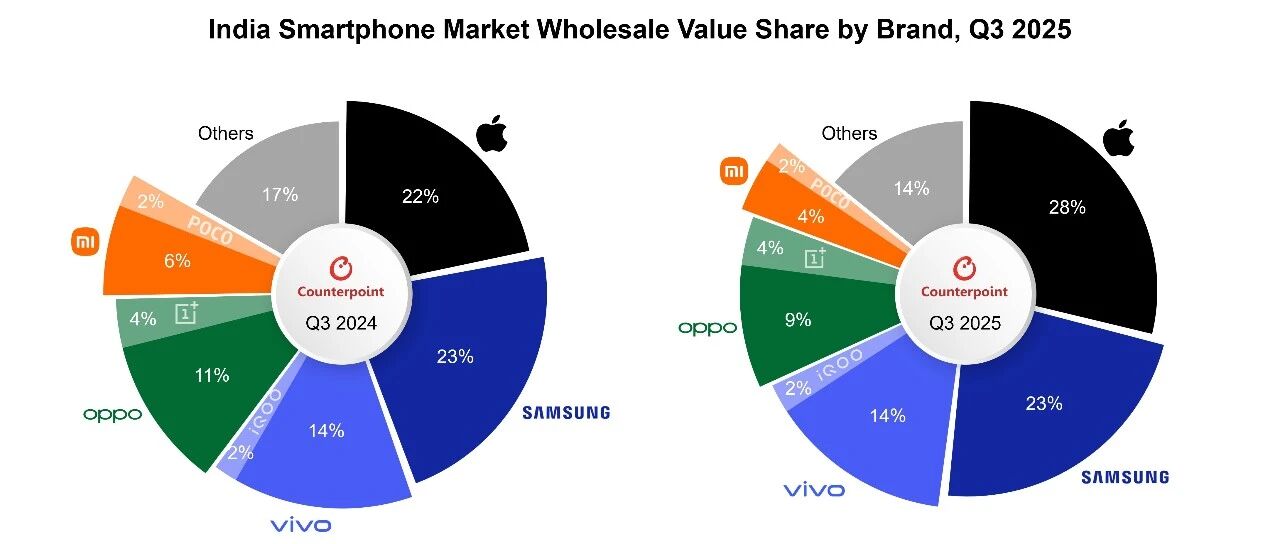
Core Insights - The Indian smartphone market experienced a 5% year-on-year increase in shipment volume and an 18% increase in shipment value in Q3 2025, reaching a historical quarterly high, driven by pre-festival stockpiling and sustained demand for high-end models [4][5][6]. Market Dynamics - The market is transitioning towards a stable growth phase focused on value, supported by festive season stockpiling and promotional activities across online and offline channels. Key drivers include convenient installment payment plans, trade-in policies, and significant discounts [5][6]. - Retail inflation has slowed, and fiscal support has improved household liquidity, leading to a notable recovery in consumer confidence during the festive season [6]. High-End Market Performance - The high-end segment (priced above 30,000 INR, approximately 339 USD) saw a 29% year-on-year increase in shipment volume, making it the fastest-growing segment. The overall market value increased by 18%, with the average selling price (ASP) rising by 13% [9]. - Apple led the market with a 28% share of sales value, driven by strong demand for the iPhone 16 and 15 series, while the newly launched iPhone 17 series outperformed its predecessor [6][9]. Brand Performance - Vivo (excluding iQOO) captured the top market position with a 20% share, benefiting from a robust offline network and the popularity of its mid-range T series [7][9]. - Samsung followed with a 13% market share, supported by its S series and A series, along with successful promotions for its high-end Galaxy Z Fold series [6][7]. - OPPO achieved accelerated growth through a diverse product portfolio and enhanced retailer collaboration [7]. - Apple entered the top five in shipment volume for the first time in Q3 2025, making India the third-largest iPhone market globally [9]. Additional Trends - The online channel accounted for 45% of shipments during the festive season, while offline channels maintained a dominant 55% share [14]. - iQOO emerged as the fastest-growing brand with a 54% year-on-year increase in shipments, driven by a strong gaming-focused product line and community marketing efforts [14]. - Motorola's shipments grew by 53%, fueled by demand for its G series and Edge series [14].


Keysight and MediaTek Collaborate to Advance Pre-6G Integrated Sensing and Communication Technology
Businesswire· 2025-11-04 16:00
Core Insights - Keysight and MediaTek are collaborating to enhance pre-6G integrated sensing and communication technology, which aims to improve 6G network performance [1] Company Collaboration - The partnership between Keysight and MediaTek focuses on advancing the capabilities of 6G networks through integrated sensing and communication technology [1]


Taiwan's MediaTek targets billions in AI accelerator chip revenue by 2027
Yahoo Finance· 2025-10-31 10:21
Core Insights - MediaTek anticipates generating billions in revenue from AI accelerator ASIC chips by 2027, with a target of $1 billion from cloud AI chips in 2026 [1][2] - The total addressable market for data center ASIC chips is estimated at $50 billion, with MediaTek aiming for a market share of 10 to 15 percent within the next two years [2] - MediaTek has partnered with Nvidia to co-design the GB10 Grace Blackwell Superchip for Nvidia's DGX Spark AI supercomputer [3] Financial Performance - MediaTek reported third-quarter revenue of T$142.1 billion ($4.64 billion), a 7.8% increase year-over-year, while net income decreased by 0.5% to T$25.5 billion [4] - MediaTek's shares have declined by 7.4% this year, contrasting with a 22.6% rise in the benchmark index [4] Competitive Landscape - Competitor Qualcomm has introduced two AI chips for data centers, set to be available in 2026 and 2027, indicating increasing competition in the AI chip market [2] - TSMC, the world's largest contract chipmaker, has raised its full-year revenue forecast due to a positive outlook on AI spending [5]
Why Midrange Phones Are Beating Flagships in 2025
Medium· 2025-10-30 05:30
Core Insights - Midrange smartphones are increasingly outperforming flagship models, with consumers favoring $400 devices over $1,200 ones due to comparable performance and value [2][8]. Performance Comparison - The performance gap between midrange and flagship phones has diminished significantly, with processors like Snapdragon 7 Gen 3 and Dimensity 8300 providing flagship-level power [2][3]. - For most everyday tasks, users cannot distinguish between midrange and flagship devices, as the extra performance of flagships is often unnecessary [3][4]. Camera Quality - The advancements in camera technology have plateaued, with midrange phones now capable of producing high-quality images for the majority of use cases, thanks to AI image processing [5]. - While flagships still excel in extreme conditions, midrange devices deliver similar results for common photography needs [5]. Value Proposition - Economic factors such as inflation and subscription fatigue have shifted consumer focus towards practicality and value, making midrange phones the preferred choice for many [6]. - Consumers are increasingly questioning the necessity of spending on flagships when midrange options provide 80% of the experience at a fraction of the cost [6]. Software Support - Software support for midrange phones has improved, with companies like Google and Samsung extending update policies to 3-5 years, a feature previously exclusive to flagships [4][7]. - The gap in software longevity between budget and flagship devices is closing rapidly [7]. Market Trends - Flagships have lost their innovative edge, often offering only incremental improvements, leading to consumer skepticism and a shift in purchasing behavior [8]. - The prevailing question among consumers has shifted from "Why buy a midrange phone?" to "Why pay more when you don't have to?" [8].


大中华半导体行业 - 后端观察:台湾封测厂 2026 年将提价-Greater China Semiconductors-Backend Observations Taiwan OSAT to Hike Price in 2026
2025-10-29 02:52
Summary of Conference Call on Greater China Semiconductors Industry Overview - The semiconductor industry in Greater China is experiencing a price hike due to strong demand for AI semiconductors and some recovery in general servers and niche memory [2][12] - The overall industry view has been upgraded to "attractive" due to robust AI demand [2][12] Key Companies Discussed - **ASE Technology Holding Co. Ltd. (ASE)**: Price target raised to NT$228, reflecting strong demand for CoWoS (Chip on Wafer on Substrate) and better pricing power [4][34] - **King Yuan Electronics Co. Ltd. (KYEC)**: Price target raised to NT$218, benefiting from AI GPU demand and share gains in chip probing and ASIC testing [4][22] - **MediaTek**: Mentioned as a potential victim of the price hikes in the semiconductor supply chain [1] Core Insights - **Price Increases**: - Advanced packaging prices are expected to rise by 5-10% in 2026, marking the first price upcycle since the COVID-19 chip shortage [3][12] - TSMC has finalized a wafer price hike of 3-5% for 2026, indicating improved pricing power among leading-edge foundry and memory vendors [2][12] - **Capacity Constraints**: - ASE and KYEC are facing tight capacity, leading to a shift from lower-margin products to AI-related products [3][15] - ASE's CoWoS capacity is nearly fully utilized, with expectations to double by 2026 due to overflow demand from TSMC [20][34] - **Material Cost Inflation**: Rising costs for materials such as gold, copper, and BT substrate are contributing to the price hikes [3] Financial Performance and Projections - **ASE's 3Q25 Results**: Preliminary revenue is expected to be up 12% Q/Q, driven by better FX and higher utilization rates [34] - **KYEC's Revenue Expectations**: Anticipated revenue growth in low-teens Q/Q for 4Q25, supported by strong AI demand [27][35] - **Earnings Estimates**: - EPS estimates for ASE have been raised to NT$2.46 for 3Q25, higher than consensus estimates [34] - EPS for KYEC is expected to maintain flattish capex for 2026, reflecting strong demand [27] Market Dynamics - **Competitive Landscape**: - JCET is underperforming due to lower fab utilization and intense competition in the China market [5][22] - ASE and KYEC are recommended for investment ahead of earnings due to their strong market positions and upcoming price hikes [4][16] Additional Insights - **Capex Trends**: KYEC's capex for 2026 has been raised from NT$15 billion to NT$37 billion to reflect strong demand [26] - **Testing Revenue**: KYEC is rejecting some lower-margin memory testing orders due to supply tightness, focusing instead on higher-margin AI-related testing [27][31] This summary encapsulates the key points from the conference call regarding the Greater China semiconductor industry, highlighting the significant trends, company performances, and market dynamics.
OPPO Find X9 Series Launches Globally, Redefining Flagship Experience with 200MP Hasselblad Telephoto, 7000+mAh Battery, Top-Tier Performance, and ColorOS 16
The Manila Times· 2025-10-28 16:16
Core Insights - OPPO has launched its latest flagship smartphones, Find X9 and Find X9 Pro, which are now available globally, showcasing significant advancements in mobile imaging, battery life, and performance [1][22]. Camera Innovations - The Find X9 Series features a new-generation Hasselblad Master Camera System, enhancing image quality through advanced computational photography [4]. - Find X9 includes a pro-level 50MP main camera, a 50MP ultra-wide camera, and a 50MP periscope telephoto camera, while Find X9 Pro introduces a 200MP Hasselblad Telephoto camera [5][6]. - The LUMO Image Engine enhances photo clarity and reduces CPU and memory usage by up to 50% and 60% respectively, while also improving power consumption by 50% [7]. Video Capabilities - The series supports 4K Motion Photos and 4K 120fps Dolby Vision HDR video recording, with Find X9 Pro extending capabilities to its telephoto camera [8][10]. - OPPO's Super Zoom algorithm allows for enhanced clarity in zoomed photos and videos, with Find X9 Pro capable of lossless zoom up to 13.2x [9]. Battery Technology - Find X9 is equipped with a 7025mAh battery, while Find X9 Pro features a 7500mAh battery, the largest in any OPPO flagship [13]. - Both models support 80W wired flash charging and 50W wireless charging, utilizing OPPO's third-generation Silicon-Carbon Battery technology [14]. Design and Durability - The Find X9 Series boasts a modern design with ultra-thin bezels and a durable build, featuring IP66, IP68, and IP69 ratings for water and dust resistance [15][17]. Performance Enhancements - Powered by the MediaTek Dimensity 9500 chipset, the series achieves up to 32% higher performance and 55% less peak power consumption compared to previous models [18]. - The All-New Trinity Engine optimizes chip-level resource management for sustained high performance and superior power efficiency [18]. Software Features - ColorOS 16 introduces AI-powered features for enhanced productivity and creativity, including AI Mind Space and AI Recorder [19][20]. - The O+ Connect feature expands cross-device capabilities, allowing users to manage phone files from their computers [21].

Peraso (NasdaqCM:PRSO) 2025 Conference Transcript
2025-10-22 14:32
Summary of Peraso's Conference Call Company Overview - **Company Name**: Peraso - **Incorporation**: 2008, went public in December 2021 through a merger - **Business Focus**: Semiconductor company specializing in high-speed wireless technology, particularly mmWave technology, similar to Nvidia's business model [1][2] Industry Insights - **Market Growth**: The millimeter wave market is projected to grow from $5 billion this year to approximately $30 billion by 2023, representing an annual growth rate of about 25% [5] - **Military Segment Growth**: The military segment for millimeter wave technology is expected to grow at a rate of 42% due to its stealth capabilities [5] Core Business Areas 1. **Fixed Wireless Access**: - Focus on providing high-speed internet, particularly in rural areas where large telcos do not operate [6] - Lead customer: Ubiquiti, a $40 billion company with eight products based on Peraso's chips [6] 2. **Military Communications**: - Emphasis on stealthy communication capabilities that are undetectable in military environments [4] - Ongoing trials and demos with the U.S. government and other international military entities [10][11] 3. **Edge AI Applications**: - High bandwidth video processing for applications like self-driving cars and factory automation [12][13] 4. **Transportation**: - Trials in Asia to provide internet access on moving trains [14][15] Technological Advantages - **Beamforming Technology**: - Allows for long-distance signal transmission (over 25 kilometers) with low interference, making it suitable for dense urban environments and military applications [4][7] - **Patent Portfolio**: - Strong patent portfolio with 60 issued and pending patents, including nine essential claim patents in IEEE 802.11ay [2] Financial Performance - **Revenue**: - Fiscal 2024 revenue was $14.5 million, with 90% from legacy memory products [20] - mmWave revenue was $1.5 million in 2024, with a trajectory to reach approximately $10 million in 2025 [21][22] - **Gross Margin**: - Targeting a gross margin of 50% for mmWave products, with a current margin of about 48% [22] - **Cash Position**: - Reported $1.8 million in cash as of June 30, with plans to extend runway into mid-2026 [22] Market Position - **Competitive Landscape**: - Peraso is a sole supplier in the unlicensed mmWave market, while Qualcomm and MediaTek dominate the licensed segment [24] - **Total Addressable Market (TAM)**: - Estimated at about half a billion dollars for unlicensed mmWave technology [24] Challenges and Opportunities - **Adoption Barriers**: - The transition to mmWave technology is slow as customers adapt to the new high-frequency technology [24] - **Potential Acquisition**: - Mobix Labs has expressed interest in acquiring Peraso, with ongoing discussions about a potential hostile takeover [27][28] Conclusion - Peraso is positioned as a leader in the mmWave semiconductor market with significant growth opportunities in various sectors, particularly military and urban communications. The company is navigating challenges related to technology adoption and market competition while maintaining a focus on expanding its customer base and product offerings [18][19]

NVIDIA, MediaTek Co-Design GB10 Superchip for New DGX Spark Personal AI Supercomputer
Yahoo Finance· 2025-10-21 09:37
Core Insights - NVIDIA Corporation is highlighted as a top investment opportunity in the tech sector, particularly due to its collaboration with MediaTek on the GB10 Grace Blackwell Superchip, which powers the new DGX Spark personal AI supercomputer [1][3] Company Overview - NVIDIA Corporation operates as a computing infrastructure company, providing graphics, compute, and networking solutions across various regions including the US, Singapore, Taiwan, China, and Hong Kong [4] Product Details - The GB10 Grace Blackwell Superchip integrates the latest Blackwell GPU and a 20-core Grace Arm CPU, leveraging MediaTek's expertise in power-efficient and high-performance designs [2] - The superchip configuration includes 128GB of unified memory and can deliver up to 1 PFLOP of AI performance, enhancing model tuning and real-time inferencing capabilities [2] - The DGX Spark allows developers to work with large AI models of up to 200 billion parameters locally, and can connect two systems for inference on models up to 405 billion parameters [3] - The system is designed to be power-efficient, operable from a standard electrical outlet, and features a compact design suitable for desktop use [3]

人工智能供应链:台积电展望、ASIC 最新动态、OCP 对 AI 半导体的影响- Technology-AI Supply Chain TSMC outlook, ASIC updates, OCP implication for AI Semis
2025-10-21 01:52
Summary of Key Points from the Conference Call Industry Overview - The conference call primarily discusses the **AI semiconductor industry**, with a focus on **TSMC** (Taiwan Semiconductor Manufacturing Company) and its outlook for 2026, as well as implications for AI supply chains and related technologies [1][2][58]. Core Insights and Arguments - **Strong AI Demand**: TSMC reported that AI demand is stronger than previously anticipated, with expectations of a **mid-40% CAGR** over the next five years, even with potential restrictions on foreign AI GPUs in China [2][58]. - **Capacity Management**: TSMC is actively working to close the gap between demand and supply for both CoWoS (Chip on Wafer on Substrate) and wafer front-end capacity. The company maintains that its capacity for CoWoS can be expanded within **six months** if needed [2][58]. - **Prioritization of AI Semiconductors**: TSMC's wafer front-end capacity is tight, but AI semiconductors will be prioritized over other applications like crypto mining and Android smartphone SoCs [2][58]. - **Bottlenecks in Supply Chain**: Potential bottlenecks in the AI semiconductor supply chain may arise from niche memory and server racks rather than TSMC's production capacity [1][58]. Key Developments in AI Infrastructure - **OCP Initiatives**: The Open Compute Project (OCP) introduced standards for AI infrastructure, including **Open Datacenter for AI** and **Open Cluster Design for AI**, which aim to streamline procurement and deployment processes [3][10][58]. - **AI Clusters**: The industry is moving towards clusters with **100k GPUs or more**, which necessitates ethernet-first designs and liquid cooling solutions as standard for new AI racks [8][10][58]. Market Dynamics and Customer Insights - **Customer Demand**: Major customers like NVIDIA, Broadcom, and AMD are expected to see significant growth in CoWoS capacity demand, with NVIDIA's demand projected to increase from **53k wafers in 2023** to **685k wafers in 2026** [36][39][58]. - **AI Capex Growth**: The AI server capital expenditure (capex) is expected to grow by approximately **70% year-over-year in 2026**, driven by strong demand for AI infrastructure [57][58]. Additional Insights - **Data Center Constraints**: While semiconductor capacity is no longer the primary constraint, challenges now lie in data center space, power availability, and supporting infrastructure, which require longer planning cycles [26][58]. - **Growing AI Inference Demand**: There is a notable increase in AI inference demand, with significant growth in token processing by major cloud service providers (CSPs) [60][58]. - **Investment Recommendations**: The report maintains an **overweight (OW)** rating on several companies in the AI semiconductor space, including TSMC, Samsung, Alchip, and MediaTek, indicating a positive outlook for these stocks [58][72]. Conclusion - The AI semiconductor industry is poised for robust growth, driven by strong demand and strategic capacity management by key players like TSMC. However, potential supply chain bottlenecks and infrastructure constraints may pose challenges moving forward.

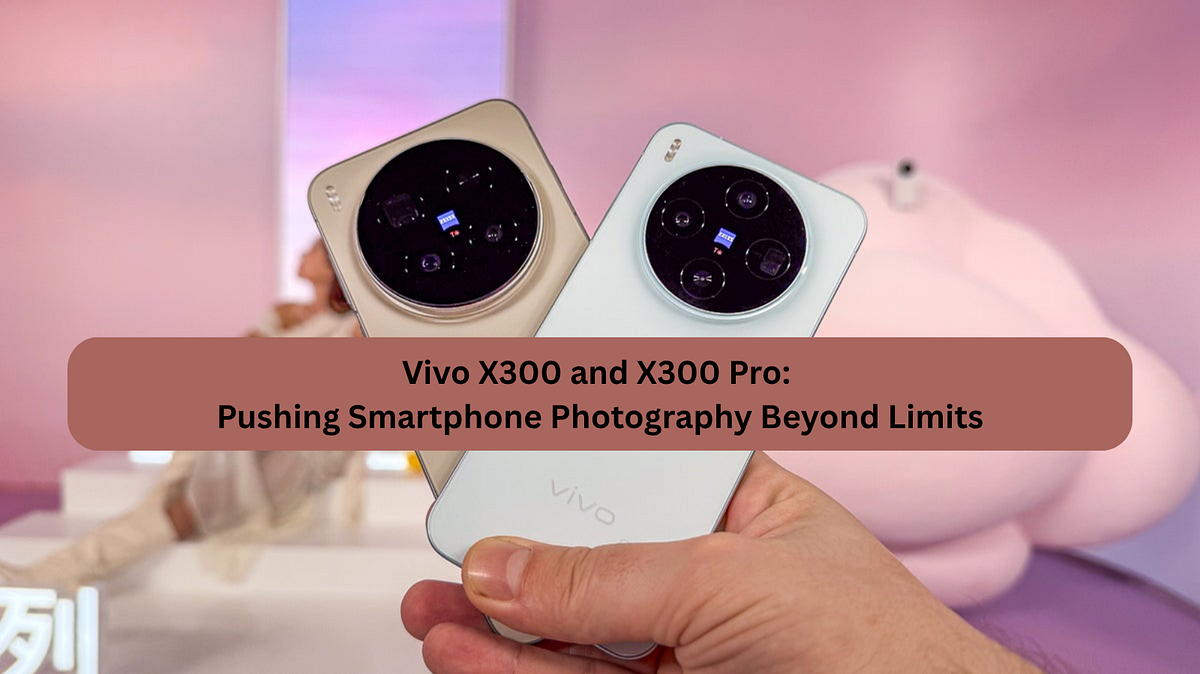
Vivo X300 and X300 Pro: Pushing Smartphone Photography Beyond Limits
Medium· 2025-10-14 06:00
Core Insights - Vivo is launching its X300 and X300 Pro flagship smartphones, enhancing its reputation in smartphone innovation and photography [1][2] Camera Innovation - Both models feature a 200-megapixel HPB imaging sensor co-engineered with Samsung, with the X300 Pro utilizing it for a telephoto lens [3] - The main camera on the X300 Pro incorporates the Sony LYT-828 sensor for improved light capture and detail rendering [5] - Both devices support 4K, 120fps, and 10-bit Log video recording, positioning them as elite options for mobile photography [5] Telephoto Extender - The telephoto extender, a 2.35x optical add-on lens, is available for both models, enhancing long-distance photography capabilities [6][7] Design and Durability - Both models are slim (under 8mm thick) and have IP68 and IP69 ratings for durability [9] - The X300 Pro has a 6,510mAh battery, while the standard model has a 6,040mAh battery, showcasing Vivo's optimization in battery technology [9] Performance - The X300 series is powered by the MediaTek Dimensity 9500 chipset, competing with Qualcomm's Snapdragon 8 Elite Gen 5 [10] - Both models support 90W wired and 40W wireless charging for quick power replenishment [10] Data Transfer - Smart Transfer app facilitates seamless data transfer between devices, enhancing user experience [11][12][13] Pricing and Availability - The X300 is priced at approximately $620, while the X300 Pro is around $745, with the telephoto extender priced separately at $180 [14] Future Developments - An X300 Ultra is anticipated in early 2026, promising advanced features [15] Overall Experience - The X300 series exemplifies Vivo's commitment to combining design, engineering, and camera technology, creating a unique user experience [18]