SpaceX

Search documents
SpaceX Now Has 10,000 Starlink Satellites In Space — And Polymarket Is Betting The IPO Is Coming Soon
Yahoo Finance· 2026-03-20 18:31
Core Insights - SpaceX has successfully launched over 10,000 active Starlink satellites, marking a significant milestone for the company as it prepares for a potential IPO, which could be the largest in history [1] - Prediction markets indicate a high likelihood of SpaceX achieving a market cap of over $1 trillion on its first trading day, with a 45% chance of exceeding $2 trillion [3] - The company is targeting a valuation of approximately $1.75 trillion and plans to raise around $50 billion, with last year's profits estimated at $8 billion on revenues between $15 billion to $16 billion, primarily from Starlink [4] Market Predictions - Polymarket gives SpaceX an 87% chance of being the largest IPO by market cap in 2026, with a total volume of $1.2 million [1] - A separate timing contract suggests a 60% probability of a summer debut for SpaceX [2] - Goldman Sachs is currently leading the underwriting process with a 57% chance, reversing the earlier position of Morgan Stanley [2] Financial Metrics - Analysts project that SpaceX's revenue could reach $24 billion by 2026, which would result in a forward multiple exceeding 70x, compared to Tesla's 16x and Saudi Aramco's 6x at its IPO [5] - The S&P 500 Index is considering a rule change that would allow SpaceX to join immediately, potentially leading to significant forced buying from index-tracking funds [5] Company Developments - The recent merger with xAI valued SpaceX at $1 trillion, while xAI was valued at $250 billion, although xAI is reportedly facing financial challenges [6] - Musk has acknowledged issues with xAI's initial setup and is in the process of rebuilding it, asserting that SpaceX will outperform competitors in the AI sector [6]
SpaceX Knocks Boeing From Dominant Role in NASA Moon Mission
Bloomberg Technology· 2026-03-20 17:57
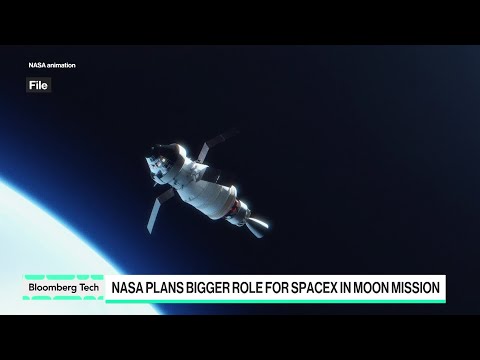
Tell us, Lauren, about what this implication really means for how you actual astronauts, human beings get to the moon. Right. So under the original plan, Boeing's built s rocket, which Nassar owns, would have played a substantial role in propelling astronauts to the moon. So astronauts flying inside the Orion crew capsule would have launched on top of the SLAC, which would have sent them to the vicinity of the moon.From there, the capsule would have gone into the moon's orbit and it would have met up with S ...

SpaceX Knocks Boeing From Dominant Role in NASA Moon Mission
Youtube· 2026-03-20 17:57
Core Insights - NASA's original plan for lunar missions involved Boeing's SLS rocket, but the new strategy shifts the heavy lifting to SpaceX's Starship, which will now launch the Orion crew capsule to Earth orbit before propelling it to the moon [1][2][3] - NASA has greenlit two proposals for lunar landers, one from SpaceX and another from Blue Origin, with the urgency for both companies to accelerate their designs to meet NASA's timeline [4][5] - The success of SpaceX's Starship is contingent on untested cryogenic refueling technology, which poses significant challenges for its mission to the moon [6][11] Company and Industry Analysis - The changes in the Artemis program, including more frequent launches, are beneficial for Boeing and SpaceX, indicating a competitive landscape where speed and efficiency are critical [9][10] - NASA's commitment to the Artemis program remains strong, with a focus on establishing a human presence in deep space, emphasizing the importance of getting astronauts beyond low-Earth orbit [17] - Blue Origin is also actively working on its own plans, which may influence the timeline for human landings on the moon, highlighting the competitive dynamics in the space industry [15][16]

SpaceX knocks Boeing from dominant role in NASA moon mission #shorts #nasa #spacex #boeing
Bloomberg Television· 2026-03-20 17:38
NASA's rewriting its moon mission and SpaceX is potentially getting a much bigger role. Here's what's new. Instead of Boeing's space launch system rocket doing the heavy lifting to the moon, SpaceX's Starship would take over a key part of that job.Under the revised plan, Orion launches on SLS to low Earth orbit, then docks with Starship in orbit. Then Starship pushes Orion, carrying the crew, to lunar orbit. Once there, astronauts transfer into Starship, which takes them down to the surface.That's a major s ...
X @Bloomberg
Bloomberg· 2026-03-20 17:36
NASA is revising its moon-landing plans, reducing Boeing’s role while elevating SpaceX’s Starship rocket to do the job of propelling astronauts to lunar orbit, people familiar with the matter said.@EdLudlow reports on the new proposal https://t.co/2CytXdG4wa https://t.co/o2wYWfLBIN ...
Nvidia Wants to Help Bring Data Centers to Space. Should You Bet on NVDA Stock Now for Out-of-This-World AI?
Yahoo Finance· 2026-03-20 17:18
Core Insights - Nvidia has invested $58.2 billion in research and development, with a significant portion of its workforce dedicated to R&D, indicating a strong commitment to innovation and competitive advantage [1] Company Overview - Nvidia is headquartered in Santa Clara, California, and is recognized as a pioneer in accelerated computing, positioning itself as a full-stack computing infrastructure company [4] - The company operates through two primary segments: Compute & Networking and Graphics, with key growth markets including data centers, gaming, professional visualization, and automotive [5] Recent Developments - At GTC 2026, Nvidia announced the Vera Rubin Space-1 chip system, which could be utilized for orbital AI data centers, addressing the challenges of energy consumption associated with AI infrastructure [2] - The Vera CPU, designed for agentic AI, is set to launch in the second half of 2026, promising twice the efficiency and 50% faster performance compared to traditional CPUs, contributing to future growth [9] Financial Performance - For fiscal 2026, Nvidia reported a revenue growth of 65% year-over-year to $215.9 million, with an operating cash flow of $102.7 billion [6] - The company anticipates continued strong growth, guiding for Q1 revenue of $78 billion and a gross margin of 75% for fiscal 2027 [6] Stock Performance - Nvidia's stock has increased by 49% over the past 52 weeks, although it has seen a slight decline of less than 1% over the past six months and a 5% decrease year-to-date, suggesting a potential accumulation opportunity during this consolidation phase [7]

太空光伏异动!特斯拉,计划采购较大规模的中国光伏设备
DT新材料· 2026-03-20 16:05
Core Viewpoint - The article discusses the recent developments in the photovoltaic sector, particularly focusing on the potential procurement of large-scale solar equipment by Tesla's team from Chinese companies, indicating a growing interest in space photovoltaic applications [1]. Group 1: Market Developments - On March 20, solar companies related to the space photovoltaic concept experienced a surge, driven by rumors of Tesla's team planning to purchase significant amounts of solar equipment from China, involving several listed companies [1]. - A specific solar company revealed that the contract size is at the gigawatt level, highlighting the scale of potential orders [1]. Group 2: Company Interactions - In February, both SpaceX and Tesla teams conducted preliminary assessments of Chinese photovoltaic companies, with Tesla visiting multiple industry chain enterprises and SpaceX focusing on photovoltaic equipment manufacturers [1]. - A notable order from SpaceX is expected to be delivered in the first week of May, although details remain confidential due to commercial secrecy [1]. Group 3: Technical Exploration - The photovoltaic orders from Elon Musk's teams are categorized into SpaceX (S-chain) and Tesla (T-chain), with applications planned for space and ground respectively [1]. - Currently, the T-chain collaboration orders are still under negotiation, involving several TOPCon equipment manufacturers [1]. Group 4: Company Responses - Multiple listed companies responded to the procurement rumors, with JinkoSolar confirming recent contact with Musk's team, who inquired about the company's technology and production capabilities [1]. - JinkoSolar clarified that, as of February 4, it has not entered into any formal agreements or secured any orders related to the discussions with Musk's team, emphasizing that the "space photovoltaic" concept is still in the early stages of technical exploration [1].



Tech talent tops the 2026 Forbes billionaires list — what everyday investors can learn from the superrich like Elon Musk
Yahoo Finance· 2026-03-20 14:00
Group 1 - The Forbes 2026 billionaire list reveals a record 3,428 billionaires with a combined fortune of $20.1 trillion, marking an increase of 400 new billionaires and an additional $4 trillion in total wealth [1] - Elon Musk tops the list with a net worth of $839 billion, followed by Google founders Larry Page and Sergey Brin, and Amazon's Jeff Bezos [2] - The majority of the wealth among the richest billionaires is derived from ownership of technology companies, with seven of the top ten billionaires linked to the tech sector [3][4] Group 2 - Jeff Bezos's wealth primarily comes from Amazon, while he has diversified investments in various sectors, including space exploration through Blue Origin [5] - Elon Musk has expanded his ventures beyond Tesla and SpaceX into artificial intelligence and other emerging technologies [6] - Amancio Ortega, founder of Inditex, has built a significant real estate portfolio and earns over $400 million annually in dividends, which he reinvests [7]


【Tesla每日快訊】 FSD歐洲大突破!RDW審批倒數,160萬公里測試數據全曝光🔥Terafab晶片廠/SpaceX(2026/3/20-2)
大鱼聊电动· 2026-03-20 11:52
大家好我是大鱼 欧洲FSD车主 等了快两年 原本以为 3/20荷兰就过关 结果Tesla Europe 突然公告 要延到4/10 但这不是挫败 而是Tesla交出的 最硬成绩单 160万公里实测 13000+次同乘 4500+次赛道验证 数千页文件 全数通过联合国 与欧盟 Article 39审核 RDW正在 最后把关 这18个月血汗 证明Tesla在 欧洲最严监管下 用真实数据 硬闯出一条路 一旦荷兰点头 其他国家 将直接跟进 夏天很可能 将全欧开跑 大家不要错过 今天的精彩内容 OK let's go 第一部分 FSD欧洲 重大突破! 明明马斯克 之前放话3/20 荷兰就要批准 FSD Supervised 大家都在焦急等待 结果今天 Tesla Europe 官方直接丢出 一则公告 要延到4/10? 那些在欧洲 耐心等了 快两年的车主 岂不是又要 多熬半个月? 不过这不是坏消息 这其实是Tesla 交出的一份 狠到爆的成绩单! 因为公告说 Tesla跟荷兰 RDW合作 已经正式完成 Full Self-Driving (Supervised)的 最终车辆测试阶段 而且把所有 联合国欧洲 经济委员会 UN ...

“薛定谔的订单”:马斯克到底买没买中国的光伏设备?
经济观察报· 2026-03-20 10:56
Core Viewpoint - The space photovoltaic sector has seen significant market speculation and stock price increases, yet no A-share listed company has confirmed receiving orders from SpaceX or Tesla for space photovoltaic projects [1][5]. Market Activity - On March 20, A-share space photovoltaic stocks surged, with notable increases in companies such as Sunpower Electric (20% increase), Jiejia Weichuang (9.41% increase), and Maiwei Co. (9.19% increase) [2]. - Market rumors suggested that SpaceX had ordered equipment from a domestic heterojunction equipment company, and Tesla was negotiating a $2.9 billion procurement of photovoltaic manufacturing equipment from Chinese firms [2]. - Despite the stock price increases, companies contacted did not confirm these rumors, stating they would disclose information as required by regulations [2][3]. Historical Context - The space photovoltaic concept has previously led to stock surges due to market rumors, notably in early 2026 when reports of SpaceX and Tesla's interest in Chinese photovoltaic companies caused significant price increases [4][10]. - Over 20 listed companies issued risk warnings or clarifications following the previous surge, indicating the speculative nature of the market [4][10]. Technological Developments - The space photovoltaic field is evolving, with three main technological routes being explored: Gallium Arsenide, P-type Heterojunction, and Perovskite tandem cells [14][16]. - Gallium Arsenide is currently used in satellites but is costly, limiting its scalability [15]. - P-type Heterojunction is seen as the most viable for commercial satellites, with companies like Jiejia Weichuang developing advanced manufacturing processes [17]. - Perovskite cells are considered a long-term option but face challenges related to stability and radiation resistance [18]. Market Challenges - The cost of space photovoltaic energy remains significantly higher than terrestrial solar energy, with estimates suggesting it could be two to three dollars per kilowatt-hour, compared to mere cents for ground-based solar [19][20]. - The global market for space photovoltaic is projected to be around 4.5 billion RMB from 2026 to 2030, contingent on the number of satellites launched [21]. - Criticism from industry experts highlights the impracticality of moving data centers to space due to high launch costs and maintenance challenges [22].