太空光伏设备

Search documents
“薛定谔的订单”:马斯克到底买没买中国的光伏设备?
经济观察报· 2026-03-20 10:56
Core Viewpoint - The space photovoltaic sector has seen significant market speculation and stock price increases, yet no A-share listed company has confirmed receiving orders from SpaceX or Tesla for space photovoltaic projects [1][5]. Market Activity - On March 20, A-share space photovoltaic stocks surged, with notable increases in companies such as Sunpower Electric (20% increase), Jiejia Weichuang (9.41% increase), and Maiwei Co. (9.19% increase) [2]. - Market rumors suggested that SpaceX had ordered equipment from a domestic heterojunction equipment company, and Tesla was negotiating a $2.9 billion procurement of photovoltaic manufacturing equipment from Chinese firms [2]. - Despite the stock price increases, companies contacted did not confirm these rumors, stating they would disclose information as required by regulations [2][3]. Historical Context - The space photovoltaic concept has previously led to stock surges due to market rumors, notably in early 2026 when reports of SpaceX and Tesla's interest in Chinese photovoltaic companies caused significant price increases [4][10]. - Over 20 listed companies issued risk warnings or clarifications following the previous surge, indicating the speculative nature of the market [4][10]. Technological Developments - The space photovoltaic field is evolving, with three main technological routes being explored: Gallium Arsenide, P-type Heterojunction, and Perovskite tandem cells [14][16]. - Gallium Arsenide is currently used in satellites but is costly, limiting its scalability [15]. - P-type Heterojunction is seen as the most viable for commercial satellites, with companies like Jiejia Weichuang developing advanced manufacturing processes [17]. - Perovskite cells are considered a long-term option but face challenges related to stability and radiation resistance [18]. Market Challenges - The cost of space photovoltaic energy remains significantly higher than terrestrial solar energy, with estimates suggesting it could be two to three dollars per kilowatt-hour, compared to mere cents for ground-based solar [19][20]. - The global market for space photovoltaic is projected to be around 4.5 billion RMB from 2026 to 2030, contingent on the number of satellites launched [21]. - Criticism from industry experts highlights the impracticality of moving data centers to space due to high launch costs and maintenance challenges [22].




影响市场重大事件:马斯克携SpaceX剑指“外星造城”:月球10年内完工!“木头姐”旗下太空ETF首度买入特斯拉,或押注特斯拉与SpaceX合并
Mei Ri Jing Ji Xin Wen· 2026-02-09 23:46
Group 1: Space Exploration and Technology - Elon Musk announced that SpaceX is shifting its focus to building a self-expanding city on the Moon, with a completion timeline of less than 10 years, while still pursuing the Mars vision which is projected to take over 20 years [1] - Cathie Wood's Ark Invest has made a notable investment by purchasing Tesla stock for the first time in its space ETF, potentially betting on a merger between Tesla and SpaceX, as Tesla advances its humanoid robot project for extraterrestrial construction [2] - CITIC Securities predicts that the demand for space photovoltaic equipment will experience exponential growth, with Chinese photovoltaic manufacturers expected to enter the supply chains of Tesla and SpaceX, leading to significant new growth opportunities [3] Group 2: Semiconductor and Memory Market - Counterpoint's report indicates that memory prices are expected to surge by 80%-90% in the first quarter of 2026 compared to the fourth quarter of 2025, marking an unprecedented increase in the market [4] - TrendForce reports that the value of the memory industry, driven by AI, is projected to reach $551.6 billion, significantly surpassing the $218.7 billion expected for the foundry sector, indicating a major shift in market dynamics [5] Group 3: Innovation in Brain-Computer Interfaces - A research team from Northwestern Polytechnical University has achieved a milestone by successfully verifying a wireless implanted brain-computer interface in space, marking the first international achievement in this field [6] Group 4: Private Equity Growth - The number of private equity firms managing over 10 billion yuan has reached a historic high of 122, surpassing the previous record of 116 set in March 2022, with an increase of 10 firms in the current year [10]

光伏产业链再度走强,科创新能源ETF易方达(589960)、光伏ETF易方达(562970)标的指数涨超2%
Mei Ri Jing Ji Xin Wen· 2026-02-09 06:44
Core Viewpoint - The demand for space photovoltaic technology is expected to experience exponential growth, driven by investments from major players like Elon Musk, which could open new growth opportunities for leading Chinese photovoltaic equipment manufacturers [1] Group 1: Market Performance - The Shanghai Stock Exchange Sci-Tech Innovation Board New Energy Index rose by 2.3%, with stocks like Juhe Materials hitting a 20% limit up and Mingguan New Materials increasing by over 9% [1] - The CSI Photovoltaic Industry Index increased by 3.5%, featuring stocks such as GCL-Poly Energy and TCL Zhonghuan reaching the limit up, while Aiko Solar and Robotech rose by over 9% [1] Group 2: Industry Insights - CITIC Securities reports that leading Chinese photovoltaic equipment manufacturers possess strong capabilities for efficient iteration and rapid response, positioning them to enter the supply chains of companies like Tesla and SpaceX, potentially securing high-value orders [1] - Space photovoltaic equipment is anticipated to have significant inflationary effects, with its value expected to experience a leap in enhancement [1] - The Shanghai Stock Exchange Sci-Tech Innovation Board New Energy Index focuses on advantageous new energy enterprises, with nearly 50% weight on space photovoltaic and about 40% on solid-state battery themes, indicating strong elasticity [1] - The CSI Photovoltaic Industry Index emphasizes the photovoltaic industry chain, covering key players in silicon materials, silicon wafers, battery cells, modules, inverters, and power station operations, suggesting high industry purity and potential benefits from space photovoltaic development and global energy storage construction [1]
直线拉升,集体涨停!马斯克,彻底引爆!还有重大利好袭来
券商中国· 2026-02-09 05:47
Core Viewpoint - The photovoltaic concept stocks in A-shares experienced a significant surge, driven by two main positive factors: Tesla's increased investment in photovoltaic manufacturing and positive signals in the industry fundamentals, leading to improved market confidence in supply-demand dynamics [1][3][6]. Group 1: Market Performance - A-shares photovoltaic concept stocks collectively surged, with nearly 30 stocks hitting the daily limit or rising over 10% by midday [1]. - The Space Photovoltaic Index rose over 6%, while other indices such as the BC Battery Index and Photovoltaic Glass Index increased by more than 5% [3]. Group 2: Positive Drivers - Tesla is reportedly evaluating multiple sites in the U.S. to expand its solar cell manufacturing capacity, aiming for an annual production capacity of 100 GW over the next three years [3][5]. - The Chinese photovoltaic equipment leaders are expected to meet Tesla and SpaceX's high standards, potentially capturing significant shares of their supply chains [5][8]. Group 3: Industry Fundamentals - Since 2026, leading manufacturers have repeatedly raised component prices, indicating a recovery in the photovoltaic industry after a prolonged downturn [6]. - The "anti-involution" policy and expectations of capacity clearance have enhanced market confidence regarding supply-demand improvements [6]. Group 4: Future Market Potential - The global demand for space photovoltaics is projected to reach 1 GW and a market space of over 80 billion yuan by 2030 under conservative scenarios, with optimistic scenarios suggesting demand could reach 70 GW and nearly 3 trillion yuan [8][9]. - The domestic photovoltaic industry is well-positioned to benefit from increased orders and profit growth as global demand for satellite launches and space photovoltaic technology expands [9].



中信证券:太空光伏需求有望迎来指数级增长
Ge Long Hui· 2026-02-09 04:11
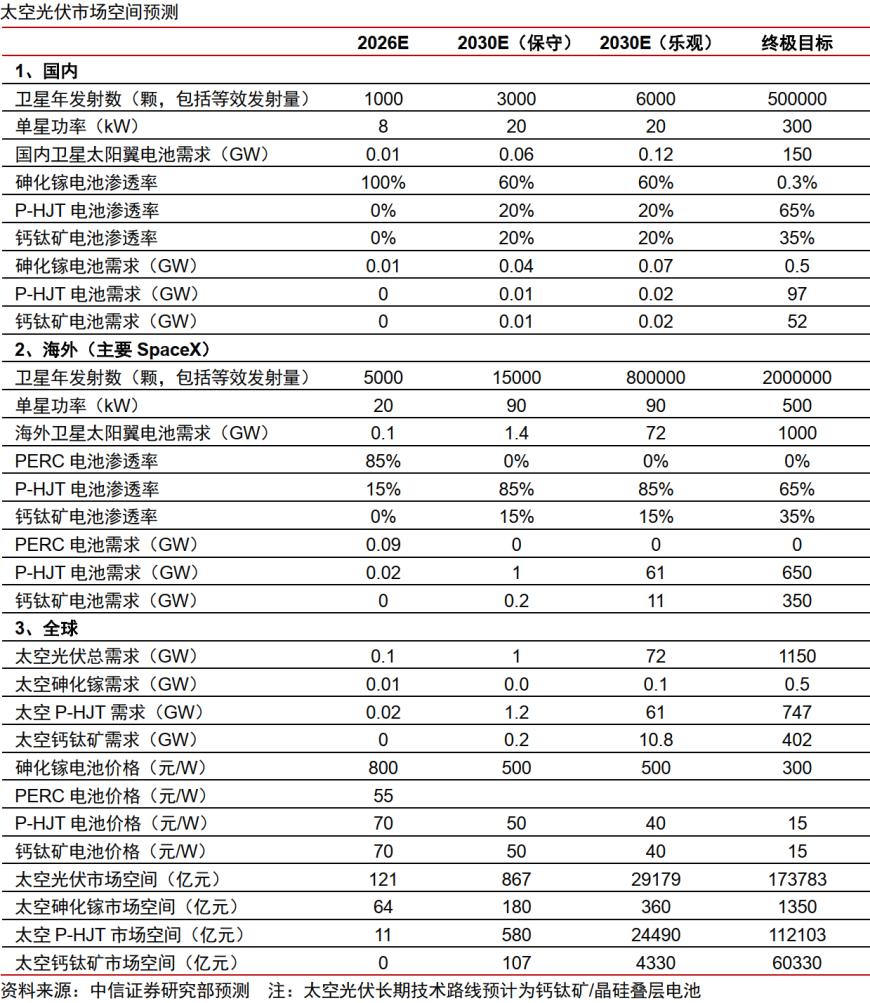
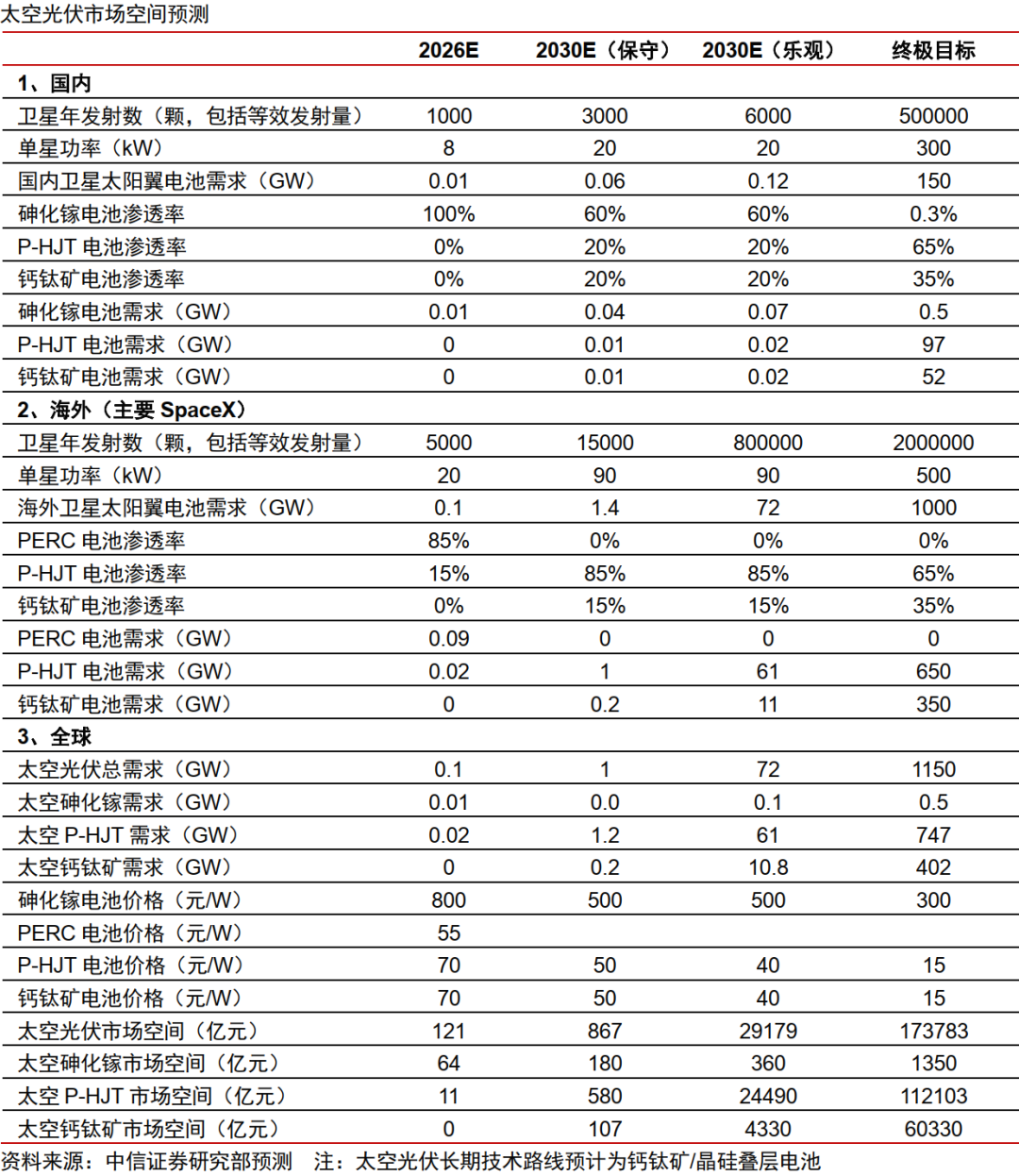
Core Insights - The demand for space photovoltaics is expected to experience exponential growth, driven by investments from companies like Tesla and SpaceX in photovoltaic manufacturing to support orbital computing and AI [1] - Leading Chinese photovoltaic equipment manufacturers are well-positioned to enter the supply chains of major players like Tesla and SpaceX, potentially securing substantial orders and opening new growth opportunities [1] - Space photovoltaic equipment may exhibit significant inflationary effects, leading to a substantial increase in value [1] Domestic Market Projections - By 2026, the annual satellite launch count in China is projected to reach 1,000, increasing to 3,000 by 2030 under conservative estimates and potentially 6,000 under optimistic scenarios, with a long-term goal of 500,000 [2] - The demand for satellite solar wing batteries in China is expected to grow from 0.01 GW in 2026 to 0.12 GW by 2030 under optimistic conditions, with a long-term target of 150 GW [2] - The penetration rates for P-HJT and perovskite batteries are anticipated to reach 20% by 2030, with long-term goals of 65% and 35% respectively [2] Overseas Market Projections - The annual satellite launch count overseas, primarily driven by SpaceX, is expected to rise from 5,000 in 2026 to 15,000 by 2030, with an ultimate target of 20 million [2] - The demand for overseas satellite solar wing batteries is projected to increase from 0.1 GW in 2026 to 72 GW by 2030 under optimistic estimates, with a long-term goal of 1,000 GW [2] - The penetration rate for P-HJT batteries is expected to reach 85% by 2030, with a long-term target of 65% [2] Global Market Projections - The total demand for space photovoltaics globally is projected to grow from 0.1 GW in 2026 to 72 GW by 2030 under optimistic conditions, with a long-term target of 1,150 GW [2] - The market space for space photovoltaics is expected to expand significantly, from 121 billion yuan in 2026 to 29,179 billion yuan by 2030 under optimistic estimates, with a long-term goal of 173,783 billion yuan [2] - The price of P-HJT batteries is expected to decrease from 70 yuan/W in 2026 to 15 yuan/W in the long term, indicating a trend towards cost reduction in the industry [2]

中信证券:太空光伏设备价值量或将实现跃迁式提升 重点推荐龙头公司
智通财经网· 2026-02-09 00:58
Core Viewpoint - The report from CITIC Securities highlights Elon Musk's investment in photovoltaic manufacturing as a pathway to power orbital computing and AI, indicating strong growth potential for leading Chinese photovoltaic equipment manufacturers in the supply chains of Tesla and SpaceX, which could lead to substantial orders and new growth opportunities [1] Group 1: SpaceX and Photovoltaic Demand - SpaceX is targeting orbital computing, with the demand for space photovoltaics expected to grow exponentially, driven by the rapid development of the Starlink satellite network and plans to deploy millions of satellites [2] - In a conservative scenario, global space photovoltaic demand is projected to reach 1GW and a market size of over 80 billion yuan by 2030; in an optimistic scenario, these figures could rise to 70GW and nearly 3 trillion yuan [2] Group 2: Market Projections and Technology - The report outlines significant growth in satellite launches and power requirements, with domestic satellite launches expected to increase from 1,000 in 2026 to 3,000 by 2030, and eventually to 500,000 [3] - The demand for space photovoltaic batteries, particularly P-HJT and perovskite technologies, is anticipated to grow dramatically, with projections indicating a market expansion of up to 100 times or more in the next five years [2][3] Group 3: Manufacturing Capacity and Equipment Value - Musk revealed plans for Tesla and SpaceX to establish 100GW of photovoltaic manufacturing capacity each in the coming years, with Tesla likely to adopt TOPCon technology and SpaceX favoring P-HJT technology [4] - The leading Chinese photovoltaic equipment manufacturers are well-positioned to meet the high standards and demands of Tesla and SpaceX, potentially capturing significant market share and opening up extensive growth opportunities from ground to space [4][7] Group 4: Future Market Dynamics - The growth of space photovoltaic technology is expected to surpass traditional photovoltaic systems due to higher complexity, customization, and equipment standards, leading to a significant increase in equipment value [7] - The overall market for space photovoltaics is projected to exceed expectations, with a potential market size reaching 173.78 trillion yuan by the ultimate target [3][7]
中信证券:太空光伏卖铲人,有望迎价值跃迁
Xin Lang Cai Jing· 2026-02-09 00:55
Core Insights - The demand for space photovoltaic technology is expected to experience exponential growth, driven by SpaceX's initiatives and the need for energy in satellite and orbital computing [3][12] - Major Chinese photovoltaic equipment manufacturers are well-positioned to enter the supply chains of Tesla and SpaceX, potentially securing high-value orders and opening new growth opportunities [3][5][12] - The value of space photovoltaic equipment is anticipated to significantly increase due to its unique requirements and technological advancements [7][16] Group 1: Market Demand and Projections - SpaceX is accelerating the development of its Starlink project and plans to deploy millions of satellites, which will drive the demand for space photovoltaic systems [3][12] - In a conservative scenario, global demand for space photovoltaic systems is projected to reach 1GW and a market size of over 80 billion yuan by 2030; in an optimistic scenario, these figures could rise to 70GW and nearly 3 trillion yuan [3][12] - The market for space P-type HJT and perovskite batteries is expected to grow by 100 to 1000 times in the next five years [3][12] Group 2: Technological Developments and Manufacturing Capacity - Elon Musk announced plans for Tesla and SpaceX to establish 100GW of photovoltaic manufacturing capacity each, focusing on ground and space applications [5][14] - The technological focus for Tesla is likely to be on TOPCon technology, while SpaceX may adopt the P-type HJT technology route [5][14] - The increasing complexity and customization of space photovoltaic technology will likely enhance the value of related equipment, with expectations for a market size that exceeds current estimates [7][16] Group 3: Investment Opportunities - The strong iterative capabilities and rapid response of leading Chinese photovoltaic manufacturers position them favorably to meet the high standards set by Tesla and SpaceX [5][12][18] - The anticipated inflationary effects on space photovoltaic equipment value could lead to significant investment opportunities in this sector [7][18] - Recommendations are made to focus on leading photovoltaic equipment manufacturers that possess technological, product, and market share advantages [3][12][18]
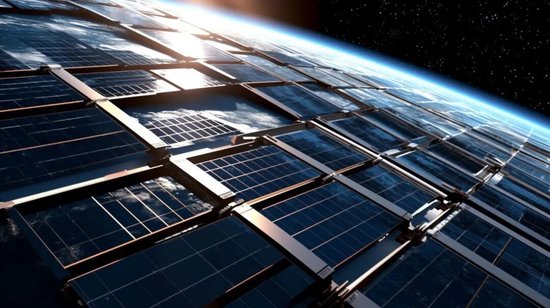
【研选行业】SpaceX百万颗算力卫星计划曝光,催生100GW太空光伏年需求,设备商迎订单拐点,机构建议关注三条主线
第一财经· 2026-02-04 10:41
Group 1: Space-Based Photovoltaics and AI Computing - SpaceX's plan to deploy one million computing satellites is expected to create an annual demand of 100GW for space-based photovoltaics, marking a turning point for equipment suppliers [2] - The demand for space photovoltaics is anticipated to grow significantly, with early orders for equipment likely to materialize on a large scale [2] - Key companies to watch include photovoltaic equipment suppliers Maiwei (300751.SZ), Jiejia Weichuang (300724.SZ), and others, as well as high-efficiency heat exchanger suppliers and photovoltaic battery manufacturers [2] Group 2: Copper Industry and Strategic Reserves - Copper concentrate may be included in the national strategic reserve, enhancing the security of the supply chain [5] - The global decline in copper ore grades is expected to continue, which may elevate the importance of copper as a key metal [5] - Companies to focus on include Zijin Mining (601899.SH) for copper mining and Tongling Nonferrous Metals (000630.SZ) for copper smelting, as they are positioned to benefit from profit recovery [5] Group 3: Hydrogen Energy Development - Hydrogen energy is set to be a key focus during the 14th Five-Year Plan, with significant investments expected to drive the industry forward [7] - By the end of 2025, China's renewable energy hydrogen production capacity is projected to exceed 250,000 tons per year, doubling from the previous year [7] - Companies involved in hydrogen energy, such as Kewell and Huadian Technology, are expected to benefit from the growing emphasis on hydrogen as a critical component of the national energy system [10] Group 4: Agricultural Drones and Technology - The Chinese government is promoting agricultural modernization, emphasizing the integration of technology in agriculture, including the use of drones [12] - The agricultural drone market is experiencing rapid growth, with over 300,000 drones in operation and an annual operational area exceeding 46 million acres [12] - Key players in the agricultural drone sector, such as Haowei Group and Zhaoyi Innovation, are positioned to capitalize on this trend [14]

太空算力定义光伏设备未来 - 推荐:迈为股份&晶盛机电
2026-02-04 02:27
Summary of Conference Call on Space Photovoltaics Industry Overview - The discussion centers around the **space photovoltaic** sector, highlighting the advancements and potential of space-based solar power systems, particularly in relation to companies like **SpaceX** and **Tesla** [1][2]. Key Points and Arguments 1. **SpaceX and Tesla's Ambitious Plans**: Elon Musk announced that both companies aim to establish **100 GW** of space and ground photovoltaic capacity within three years, indicating a significant push in the sector [1]. 2. **Technological Developments**: SpaceX's acquisition of **XAI**, an AI company, aims to integrate AI capabilities with space operations, enhancing the efficiency of space photovoltaic systems [1][2]. 3. **Demand for Space Computing Power**: The immediate demand for space computing centers is expected to come from the U.S., where there is a greater need for energy solutions compared to China, which currently has sufficient power supply [2]. 4. **Cost Efficiency of Space Data Centers**: Deploying computing modules in space can drastically reduce energy costs. For instance, a **40 MW** cluster on Earth incurs energy costs of **$140 million** over ten years, while a space-based solution requires a one-time investment of a few million dollars [3]. 5. **Cooling Cost Reduction**: Space computing centers can achieve cooling costs that are **one-tenth** of ground systems due to the extremely low temperatures in space, allowing for efficient heat dissipation [3]. 6. **Photovoltaic Technology Transition**: The current dominant technology, **triple-junction gallium arsenide**, has limitations in scalability and cost. Alternatives like silicon-based solutions are being explored as more viable options for large-scale applications [5][6]. 7. **Emerging Technologies**: The report discusses three potential solutions for space photovoltaics: - **Silicon-based** technology as a short-term alternative due to its lower cost and scalability. - **Thin-film technologies** which are less favorable due to poor efficiency. - **Perovskite solar cells**, which are still in development and expected to mature in **5-6 years** [6][7]. 8. **Weight Reduction in Solar Arrays**: Transitioning to **flexible solar arrays** can significantly reduce the weight of solar panels, which is crucial for lowering launch costs. The new designs can achieve over **100 W/kg**, compared to the **40 W/kg** of traditional designs [7][8]. 9. **Market Dynamics**: The report emphasizes the importance of **automated production** for ultra-thin silicon wafers to ensure high yield rates, which is critical for the success of space photovoltaic technologies [8][9]. 10. **Optimal Orbital Deployment**: The discussion includes the feasibility of deploying large numbers of satellites in optimal orbits, particularly in **sun-synchronous orbits**, which can support significant energy generation [11][12]. 11. **Capacity Constraints**: The current orbital space is limited, and deploying numerous satellites with substantial power generation capabilities poses challenges. Solutions from major players like **NVIDIA** and **Google** are being explored to address these constraints [13][14]. Recommended Companies and Investment Opportunities 1. **Jingsheng Mechanical & Electrical**: A leader in crystal pulling and slicing equipment, well-positioned to benefit from the space photovoltaic market due to its automation capabilities [14]. 2. **Maiwei**: Recognized as a leader in the production of high-efficiency solar cells, particularly in the context of the emerging space photovoltaic sector [14]. 3. **High Measurement Co.**: A key player in slicing equipment, recommended for investment due to its market position [15]. 4. **Laplacian and Jiejia Weichuang**: Both companies are noted for their leadership in TOPCon technology, which is expected to be a significant part of ground photovoltaic capacity expansion [15]. 5. **Aotwei**: A leading global player in construction equipment, also highlighted as a key investment opportunity [15]. Additional Insights - The report underscores the potential for significant advancements in space photovoltaic technology, driven by both market demand and technological innovation. The integration of AI and automation is seen as critical for enhancing efficiency and reducing costs in the sector [1][2][3].

国泰海通 · 晨报260203|策略、光伏设备、航空
国泰海通证券研究· 2026-02-02 14:19
Market Overview - The Chinese market has experienced significant volatility, with an average adjustment of 6% in all A-shares and the Shanghai Composite Index nearing 4000 points, leading to panic selling [2] - The market downturn is attributed to multiple factors, including concerns over the new Federal Reserve Chairman Kevin Walsh's policy stance of "rate cuts + balance sheet reduction," which has raised fears of tightening financial conditions [2][3] Investment Opportunities - Despite the recent downturn, the market is expected to stabilize and regain upward momentum before the Spring Festival, with a positive outlook for the Chinese stock market [2] - The focus of Chinese government policy is shifting towards domestic demand, which is anticipated to boost economic prospects and asset returns [4] - The China Securities Regulatory Commission has reiterated its commitment to maintaining a stable capital market and has introduced new policies to attract long-term capital [2] Sector Recommendations - Emerging technologies are highlighted as a key investment theme, with recommendations in sectors such as food and beverage, consumer services, aviation, chemicals, real estate, and construction materials [5] - The financial sector is seen as a stabilizing force, benefiting from the growth in wealth management demand, with recommendations for insurance, brokerage, and banking [5] - The rapid advancement of AI and related technologies is expected to create opportunities in the internet, media, computing, robotics, and electronics sectors [5] Spring Festival Travel Outlook - The Spring Festival travel volume is projected to reach historical highs, with an expected 95 billion cross-regional movements during the 2026 Spring Festival, marking a 5.3% increase year-on-year [15] - The extension of the Spring Festival holiday is anticipated to further boost travel demand, with significant increases in passenger volumes across various transportation modes [14][15] Aviation Industry Insights - The Chinese aviation industry is poised for a "super cycle," driven by market-driven pricing and a recovery in passenger demand, which is expected to enhance profitability and valuation [17] - The upcoming Spring Festival is expected to see a strong performance in air travel, with high load factors and ticket prices supporting airline revenue management [16]