爱协生

Search documents
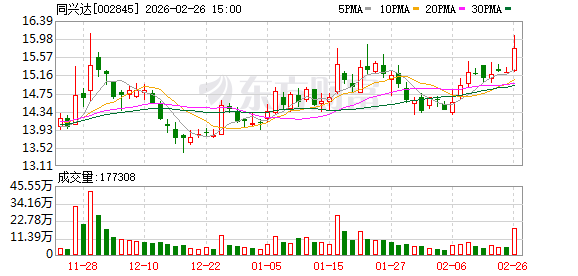
同兴达:公司封测业务主要客户有联咏科技、奕力科技、敦泰科技、瑞鼎、豪威科技、格科微等
Mei Ri Jing Ji Xin Wen· 2026-02-26 09:14
同兴达(002845.SZ)2月26日在投资者互动平台表示,我司封测业务主要客户有联咏科技、奕力科技、 敦泰科技、瑞鼎、豪威科技、格科微、集创北方、爱协生等;目前产能利用率高。 (文章来源:每日经济新闻) 每经AI快讯,有投资者在投资者互动平台提问:公司封测业务,有哪些客户或合作伙伴?封测产能利 用率如何? ...


新相微1亿增资关联方布局AI算力 业绩回暖发力创新研发费增30.36%
Chang Jiang Shang Bao· 2025-09-21 23:17
Core Viewpoint - The company, Xinxiangwei, is strategically investing in the AI industry chain to capitalize on the explosive growth opportunities presented by artificial intelligence, aiming to create a synergistic ecosystem for new technologies and business models [1][2]. Group 1: Investment and Strategic Moves - Xinxiangwei's wholly-owned subsidiary, Shanghai Xinxiang Technology Co., plans to invest 100 million yuan in Beijing Electronic Intelligence Technology Co., to seize growth opportunities in the AI sector [1]. - The investment aims to build a collaborative ecosystem and foster new technologies and products that align with market trends, ultimately creating more value for the company and its shareholders [2]. - Beijing Electronic Intelligence, established in July 2023, focuses on computing power and has a strong shareholder base, including major players like BOE Technology Group and government funds [2]. Group 2: Financial Performance - In the first half of 2025, Beijing Electronic Intelligence reported revenues of 158 million yuan, a significant increase year-on-year, but incurred a net loss of 101 million yuan [3]. - Xinxiangwei's revenue for the first half of 2025 reached 285 million yuan, reflecting a year-on-year growth of 23.5%, with a net profit of 5.45 million yuan, marking a turnaround from previous losses [4]. Group 3: Innovation and Market Position - Xinxiangwei has been focusing on display chip research and development, with a notable increase in R&D expenses by 30.36%, accounting for 12.85% of its revenue in the first half of 2025 [4]. - The company is actively responding to market demands by increasing production capacity for high-end display chips, which has contributed to revenue growth [4]. - Future plans include a deeper focus on high-end display technologies such as AMOLED and MicroLED, indicating a commitment to innovation in next-generation display solutions [6].

新相微布局AI算力 拟1亿元增资关联方北电数智
Zheng Quan Shi Bao· 2025-09-19 17:56
Group 1 - New Xiang Micro (688593) announced a capital increase of 100 million yuan to Beijing Electronic Digital Technology Co., Ltd. (North Electric Digital), which constitutes a related party transaction [1] - North Electric Digital, established in 2023 with a registered capital of 350 million yuan, focuses on AI technology innovation and has major products including intelligent computing power and AI cloud services [1] - North Electric Digital's significant project, the Beijing Digital Economy Computing Power Center, aims to provide 1000 PFLOPS of intelligent computing power upon completion [1] Group 2 - New Xiang Micro specializes in the research, design, and sales of display chip products, with major clients including BOE, Tianma, and Visionox [2] - The company's gross margin has declined from 67.71% in 2021 to 14.94% in 2024, with a reported revenue of 285 million yuan and a net profit of 5.45 million yuan for the first half of 2025 [2] - New Xiang Micro attempted to acquire Aisheng Technology, a company focused on human-computer interaction chips, but the acquisition was terminated in August due to disagreements among parties [2]
新相微2025年中报简析:营收净利润同比双双增长,存货明显上升
Zheng Quan Zhi Xing· 2025-08-23 23:25
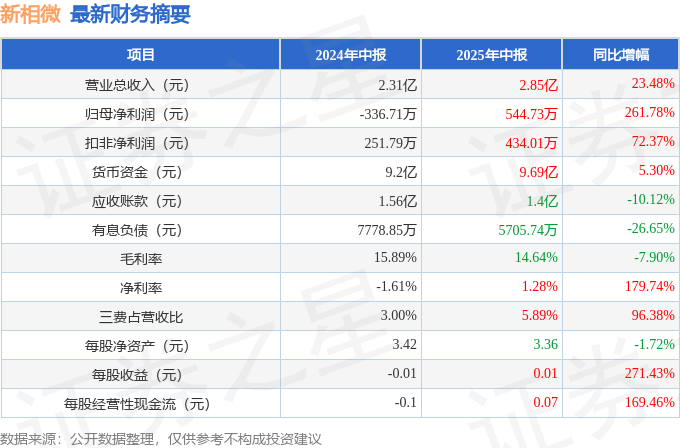
Core Viewpoint - The recent financial report of Xinxiangwei (688593) shows significant growth in revenue and net profit, but also highlights challenges such as increased inventory and rising expenses [1] Financial Performance - Total revenue for the first half of 2025 reached 285 million yuan, a year-on-year increase of 23.48% [1] - Net profit attributable to shareholders was 5.45 million yuan, up 261.78% year-on-year [1] - Gross margin decreased to 14.64%, down 7.9% year-on-year, while net margin improved to 1.28%, an increase of 179.74% [1] - Total expenses (selling, administrative, and financial) amounted to 16.81 million yuan, representing 5.89% of revenue, a 96.38% increase year-on-year [1] - Earnings per share rose to 0.01 yuan, a 271.43% increase year-on-year [1] Balance Sheet Changes - Inventory increased significantly by 88.68% year-on-year [1] - Accounts receivable decreased by 10.12% to 140 million yuan [1] - Interest-bearing debt decreased by 26.65% to 57.06 million yuan [1] - Cash and cash equivalents increased by 5.30% to 266.96 million yuan [1] Operational Insights - The company experienced a 25.32% increase in operating costs due to higher sales volume [11] - Research and development expenses rose by 30.36% as the company increased its investment in R&D [13] - The company reported a significant increase in cash flow from financing activities, up 2964.88% due to loans for share buybacks [13] Market Position and Strategy - The company aims to maintain its competitive edge in the semiconductor and chip industry by focusing on innovation and expanding its product lines [19] - The management emphasizes a combination of organic growth and strategic acquisitions to drive future development [18] - The company has established a comprehensive product matrix in the display chip sector, covering various applications [19] Future Outlook - Analysts project a net profit of 41.01 million yuan for 2025, with an average earnings per share of 0.09 yuan [17] - The company plans to continue exploring acquisition opportunities while being cautious about the valuation and strategic fit of potential targets [18]
CINNO Research周华:全球驱动芯片市场“洗牌”,技术迭代、地缘政治与存量竞争交织下的机遇重构
CINNO Research· 2025-03-17 03:08
Core Insights - The display driver chip market is undergoing significant transformation due to intense capital movements, with China holding 76% of global display panel capacity and a localization rate of 34% for driver chips [1][2] - The industry is facing pressures from technological iterations, geopolitical factors, and a capital downturn, making mergers and acquisitions a necessity rather than an option [1][3] - The market is experiencing a bifurcation between high-end competition and price wars, leading to a decline in overall market prices and profits [1][3] Market Dynamics - The global driver chip industry has seen a "boom and bust" cycle, with a peak in 2021 due to chip shortages, followed by a decline in 2022-2023 due to weak consumer demand [1][2] - The demand for AI chips is expected to boost wafer foundry utilization rates, but display driver chip prices remain under pressure as the market shifts towards inventory competition [1][2] Technological Trends - OLED driver chips are advancing towards 22nm processes to meet the demands for lower power consumption and smaller sizes in high-end smartphones [2][4] - The integration of TDDI chips is increasing in the automotive and tablet markets, with low power consumption and high integration becoming key R&D focuses [6][7] Competitive Landscape - The gross margin for leading global driver chip companies has decreased from 50% in 2021 to 40% in 2023, while the average gross margin for Chinese companies is below 20% [3][4] - Price wars have reached critical levels, threatening the survival of many companies in the industry [3][4] Mergers and Acquisitions - The sale of MagnaChip's OLED driver business exemplifies the trend of technology exchange, as companies focus on core competencies amid declining market shares [8][9] - Taiwanese company ILI Technology's acquisition of MediaTek's TCON assets highlights a strategy of enhancing competitiveness through integration [9] - The anxiety in the industry is reflected in the struggles of Chinese companies to secure funding and navigate technological barriers, leading to a wave of mergers and acquisitions [9][10] Industry Evolution - The reshaping of the driver chip industry signifies a shift from "scale expansion" to "value reconstruction," where technological depth and ecosystem integration are crucial for survival [10][11] - Companies must not only focus on domestic substitution but also on building an irreplaceable ecological position in the technology race [10][11]
CINNO Research周华 :全球驱动芯片市场“洗牌”,技术迭代与并购潮下的机遇重构
CINNO Research· 2025-03-12 11:40
Core Insights - The display driver chip market is undergoing significant transformation due to intense capital movements, technological iterations, and geopolitical pressures, leading to a shift from optional mergers and acquisitions to mandatory ones [1][3][4] Market Overview - China holds 76% of the global display panel production capacity, with the localization rate of driver chips increasing from less than 10% to 34% in three years [3] - The high-end OLED driver chip market, particularly below 28 nm, remains dominated by Taiwanese and Korean companies, with mainland Chinese firms holding less than 15% market share [3][5] - The industry is facing a "volume increase but price decline" dilemma, resulting in a market size shrinkage of nearly 40% from $12 billion in 2021 to $6.4 billion in 2023 [4] Profitability and Competition - The average gross margin for mainland companies is below 20%, while leading Taiwanese firms like Novatek have seen their gross margin drop from 50% in 2021 to 40% in 2023 [6] - Price wars have reached critical survival thresholds, with 28 nm process technology becoming a pivotal point for companies [6] Technological Developments - The industry is experiencing a dual revolution in technology and ecosystem, with innovations such as Samsung's 22 nm OLED driver chip and BOE's AI-integrated smart driver chip [8][11] - The automotive sector is emerging as a key battleground, with demand surging by 18% in 2023, but stringent certification processes filtering out 90% of players [9] Mergers and Acquisitions - The sale of MagnaChip's OLED driver business exemplifies the trend of technological asset exchange, while companies like Taiwan's Etron are integrating technologies to reduce development costs by 30% [12] - The ongoing merger wave reflects the industry's anxiety, with companies like Aisino and Yunyinggu facing challenges in brand and technology certification [12][13] Strategic Shifts - The display driver chip industry is transitioning from "scale expansion" to "value reconstruction," emphasizing the importance of technological depth and ecosystem integration for survival [13] - Companies must focus on building an irreplaceable ecological position rather than merely aiming for domestic substitution [13]
汇顶终止收购云英谷,英集芯收购辉芒微,新相微收购爱协生
半导体行业观察· 2025-03-04 00:53
Core Viewpoint - The article discusses the termination of the acquisition of Yunyinggu Technology by Huizhi Technology, highlighting the reasons behind the decision and the financial status of Yunyinggu Technology [2][3][5]. Group 1: Termination of Acquisition - Huizhi Technology announced the termination of the acquisition of 100% shares of Yunyinggu Technology due to failure to reach an agreement on the transaction price and commercial terms [2][3]. - The decision was made after thorough analysis and discussions with the transaction parties, aiming to protect the interests of the company and its shareholders [3]. Group 2: Yunyinggu Technology Overview - Yunyinggu Technology specializes in OLED display driver chips (DDIC) and is classified under the "new generation information technology industry" as a strategic emerging industry [3][4]. - The company operates a Fabless model, focusing on integrated circuit design, quality control, and sales, while outsourcing manufacturing and testing [4]. Group 3: Financial Performance - As of September 30, 2024, Yunyinggu Technology reported total assets of 1.27 billion, total liabilities of 170 million, and a revenue of 704 million with a loss of 162 million for the first three quarters of the year [5]. - The losses are attributed to high early-stage R&D investments, which exceed 100 million annually, but are expected to improve as commercial applications scale up [5][6]. Group 4: Competitive Landscape - Yunyinggu Technology's main competitors are South Korean and Taiwanese firms, and it is currently in a revenue growth phase with relatively high production costs [6]. - The company has established stable partnerships with leading Micro-OLED panel manufacturers, positioning itself as a key supplier in the market [5].