Airtel

Search documents
Etalon Group H1 Earnings Call Highlights
Yahoo Finance· 2026-02-13 10:12
Core Insights - The company reported a decline in video revenue by 12.3% to EUR 260 million, attributed to sanctions on Russia, with an expected impact of EUR 16 million for the full year 2025-2026 [1] - Total revenue for the first half was EUR 592 million, stable on a like-for-like basis but down 2.4% on a reported basis, with LEO revenues increasing nearly 60% [3][4] - The company has made significant progress in its OneWeb satellite procurement and refinancing efforts, which are crucial for its strategic continuity [5][16] Financial Performance - "Other revenues" amounted to EUR 18 million, including EUR 8 million from hedging operations related to the IRIS² project [2] - Adjusted EBITDA for the half year was EUR 308 million, down 6.1% like-for-like, with a margin of 52.1% [13] - The net loss narrowed to EUR 236 million from EUR 873 million a year earlier, with lower depreciation and amortization contributing to this improvement [6][14] Connectivity Revenue Breakdown - Total connectivity revenues reached EUR 307 million, up 11.8%, with LEO revenues rising to EUR 110.5 million, offsetting a decline in GEO revenues [7][8] - Fixed connectivity revenue was EUR 132 million, up 17.2%, driven by growth in connectivity solutions [9] - Government services revenues increased by 7.7% to EUR 99 million, reflecting growth in LEO-enabled solutions [10] Strategic Developments - The company procured an additional 341 OneWeb satellites, bringing the total to 440, and signed a multi-launch agreement with MaiaSpace [19] - Management is advancing the IRIS² consortium work and is in a key phase with the European Commission [20] - The halted ground-segment sale is expected to positively impact EBITDA margins by up to 5 points [18] Refinancing and Capital Expenditure - A EUR 1.5 billion capital raise was completed, followed by rating upgrades from Moody's and Fitch [16] - Full-year gross CapEx guidance was revised to around EUR 900 million, down from a previous range of EUR 1.0 billion to EUR 1.1 billion [15] - Net debt was reported at EUR 1.3 billion, with a net debt to adjusted EBITDA ratio of 2.0x [17]
Singtel’s Turnaround: Can the Stock Finally Break Out in 2026?
The Smart Investor· 2026-01-14 23:30
Core Insights - Singapore Telecommunications Limited (Singtel) is undergoing transformative initiatives that may positively impact its market perception and financial performance [1][2] Financial Performance - Headline turnover decreased by 1% YoY to S$6.91 billion, but revenue increased by 2% YoY on a constant currency basis [3] - Operating earnings before interest and taxes (EBIT) rose 13% YoY to S$0.83 billion, indicating effective cost management [3] - Underlying net profit increased by 14% YoY to S$1.35 billion, driven by strong contributions from regional associates [4] Growth Drivers - The non-telecom technology arm NCS generated revenue of S$1.5 billion, up 6% YoY, with EBIT rising 41% YoY to S$184 million [5] - Optus, Singtel's core telecom business, saw EBIT grow by 27% YoY to AUD$283 million, supported by mobile growth [7] Regional Associates - Contributions from regional associates, particularly Airtel, significantly boosted underlying net profit, with profit after tax rising to S$915 million, up 12% YoY [9][10] Dividend and Cash Flow - Singtel raised its interim dividend to S$0.082 per share, a 17% YoY increase, supported by an 11% rise in free cash flow to S$1.45 billion [11][12] Balance Sheet Strength - Net debt decreased from S$8.9 billion to S$8.0 billion, improving the net debt gearing ratio from 26.7% to 24.3% [13][14] Future Outlook - Sustained profit growth in NCS and Optus, along with contributions from regional associates, could lead to share price appreciation [15][16] - Management anticipates softer growth in operating profit for FY2026 due to operational disruptions at Optus Australia [17][18]


印度股票策略-2025 年回顾与 2026 年开年新投资者调研速览-India_Equity_Strategy_Quick_Look_Back_at_2025__New_Investor_Poll_to_Kick_Off_2026
2026-01-04 11:35
Vi e w p o i n t | 01 Jan 2026 18:32:56 ET │ 15 pages CITI'S TAKE Indian equities underperformed both EM and DM in 2025 (~27%/13%). In 2026, we think earnings growth trajectory is likely improving, aided by Financials (bottom-up estimates reflect recovery across Consumer & Industrials as well). Further, decent risk-reward should support NIFTY/MSCI India returns (relative valuations, potential US trade deal, global equity broadening beyond AI enablers etc). In 2025, FII outflows reached US$18bn; DII inflows ...
瓜分印度
首席商业评论· 2025-12-26 03:34
Core Insights - Major AI companies like OpenAI, Google, and Perplexity are aggressively competing in the Indian market by offering unprecedented free subscription plans to attract users [5][6] - The user engagement in India has surged, with ChatGPT's daily active users increasing by 607% year-on-year to 73 million, significantly surpassing the U.S. user base [5][6] Group 1: Digital Colonization - The historical context of digital colonization is drawn parallel to the 17th-century colonial exploitation of India, with AI companies now seeking to extract valuable data tokens [7] - India, with over 1.4 billion people and a significant gap in non-English data, presents a vast resource for AI training, making it a prime target for these companies [7][10] - The unique linguistic landscape of India, including the use of Hinglish, offers rich training material for AI models, enhancing their capabilities [10][14] Group 2: Competitive Strategies - OpenAI employs a strategy of integrating its services into daily life, such as UPI payments, to create a comprehensive data chain from user interactions [17] - Google collaborates with local telecom giant Reliance Jio to boost its user base, leveraging the extensive reach of Jio's infrastructure to gather passive data for model training [19] - Perplexity focuses on data accumulation by offering free access to its Pro version, significantly increasing its user engagement and data collection [21] Group 3: Economic Implications - The financial model for AI companies shifts from traditional profit-making to data acquisition, where operational costs are minimized by leveraging free user data [26] - The value generated from Indian users, despite being free, is substantial, with estimates suggesting that ChatGPT's 73 million daily active users could contribute $16.79 billion annually [29] - Users in India, while benefiting from free services, are effectively acting as unpaid data contributors, creating a cycle of exploitation reminiscent of historical colonial practices [30][31] Group 4: Future Outlook - Google's diverse data sources, including YouTube and Maps, position it favorably against OpenAI in the Indian market, especially in voice interaction capabilities [33] - The Indian government is becoming increasingly aware of data sovereignty issues, which could lead to tighter regulations on data export, impacting the operations of these tech giants [33]


Beyond the wallet: How payments banks have quietly re-invented themselves
MINT· 2025-12-24 04:32
Core Insights - Payments banks in India accept deposits but cannot lend, instead investing customer deposits in government securities to generate modest interest and occasional gains [1] - They earn fees and commissions from various activities including digital payments, remittances, and micro-ATM transactions, contributing to their revenue model [2] Industry Overview - There are six payments banks in India, collectively holding only 0.1% of total bank deposits, yet they have managed to survive and serve over 250 million customers, primarily in rural and semi-urban areas [3] - Payments banks were established to enhance financial inclusion, utilizing the Jan Dhan-Aadhar-Mobile (JAM) framework to create a "phygital" model that combines digital banking with physical customer touchpoints [6] Customer Engagement - Payments banks have successfully improved financial inclusion by leveraging trusted local brands and agents, particularly reaching women customers who prefer familiar local representatives [7][19] - They provide accessible financial services through neighborhood customer service points, making banking less intimidating for first-time users [8] Brand Trust and Recognition - High customer acceptance is attributed to the backing of well-known brands like Airtel and Jio, which are among India's top valuable brands [9] - Payments banks have seen rising transaction volumes, comparable to large traditional banks, despite their relatively short existence [10] Business Model and Growth - Payments banks face regulatory limitations, such as a cap on deposits and restrictions on offering fixed deposits, yet they have adapted by focusing on their strengths to acquire customers [13] - Airtel has dominated the National Common Mobility Card market, while Fino and NSDL excel in micro-ATM and AePS segments, crucial for remote areas [14] Financial Products and Innovations - New product offerings, such as Jio Payments Bank's 'Savings Pro' account, attract customers by providing liquidity and returns, integrating them into a larger financial ecosystem [15] - Payments banks outperform other bank categories in terms of deposit value owned by women, with initiatives to support female customers and agents [18][19] Risk Mitigation and User Trust - Payments banks serve as a gateway for users hesitant about digital banking, with campaigns like Airtel's 'safe second account' promoting safer transaction practices [22] - They resonate particularly with elderly and less tech-savvy users, offering a low-risk entry point into digital finance that emphasizes familiarity and trust [23]
X @BitMart
BitMart· 2025-12-23 16:07
🌟 Upcoming New Listing 🌟🤩 #BitMart will list Airtel coin (ATC) @Airtel__LTD soon!👀Keep an eye on our socials for further announcements.👇Share in the comments what you like about this project.🔥Register Now: https://t.co/XaX4MXKpyM#ATC #BitMartListing https://t.co/6RCh299UEx ...
瓜分印度
Ge Long Hui· 2025-12-19 13:35
Group 1 - Major AI companies like OpenAI, Google, and Perplexity are aggressively launching free subscription plans in India to attract users, resulting in significant increases in daily active users (DAU) [2][4] - ChatGPT's DAU in India has surged by 607% year-on-year, reaching 73 million, which is more than double the number of users in the US [2][4] - The Indian market is viewed as a vast resource for AI training data due to its large population and diverse languages, making it a critical area for AI development [5][10] Group 2 - OpenAI's strategy focuses on integrating its services into daily life, such as enabling UPI payments, which generates valuable interaction data [12][20] - Google collaborates with local telecom giant Reliance Jio to boost its Gemini user base, leveraging Jio's extensive reach and data collection capabilities [15][16] - Perplexity aims to gather data from Indian users by offering free access to its Pro version, significantly increasing its user engagement and data collection [17][19] Group 3 - The financial model for AI companies is shifting; instead of traditional profit models, they are focusing on data acquisition as a low-cost asset through free services [20][22] - Indian users, while benefiting from free AI services, are effectively acting as data contributors without compensation, creating a cycle of exploitation reminiscent of historical colonial practices [22][26] - The potential for AI development in India is immense, with Google positioned to leverage its diverse data sources, including video and voice data, to gain a competitive edge [28][31] Group 4 - The Indian government is becoming aware of the data sovereignty issues and is considering policies to retain data within the country, which could impact the operations of foreign tech giants [32][34] - The future of AI in India may hinge on the government's ability to regulate data outflow, potentially altering the landscape for companies operating in the region [33][34]

US tech majors Apple, Amazon, Cisco, Meta jointly oppose Reliance Jio and VI’s demand on 6 GHz band spectrum
BusinessLine· 2025-11-24 05:34
Core Viewpoint - US tech giants, including Apple, Amazon, Cisco, Meta, HP, and Intel, oppose the allocation of the 6 GHz band for mobile services, advocating instead for its use for Wi-Fi services [1][2]. Group 1: Spectrum Allocation and Auction - The US technology companies argue that the technical and commercial readiness for mobile services in the 6 GHz band is not established [2]. - The government has indicated that 400 MHz of frequencies in the 6 GHz band are available for auction, with 300 MHz expected to be available by 2030 and 500 MHz to be delicensed for low power applications, primarily Wi-Fi [5][6]. - Reliance Jio has requested that the entire 1200 MHz spectrum in the 6 GHz band be included in the upcoming auction, despite the government's decision to delicence 500 MHz for low power applications [5][6]. Group 2: Industry Responses and Concerns - Airtel has also requested a deferment of the 6 GHz band auction due to ecosystem readiness challenges, including device availability and network equipment [7]. - Qualcomm supports the deferment, emphasizing the importance of aligning with global standards and safeguarding India's 6G future [8]. - The Cellular Operators Association of India (COAI) opposes the delicensing of the 6 GHz band, arguing that it undermines quality of service and scalability for digital applications [9][10]. Group 3: Implications of Delicensing - COAI warns that delicensing any part of the 6 GHz band could permanently limit its use for licensed mobile broadband services, affecting India's long-term digital capacity [10]. - Concerns are raised that unlicensed Wi-Fi deployments by global OTT players could disadvantage local telecom operators and reduce government revenues [11].


US vendors Apple, Cisco, Broadcom, HPE jointly oppose Jio, Vodafone Idea on 6GHz band
ETTelecom.com· 2025-11-24 02:34
Core Viewpoint - US technology companies, including Amazon and Qualcomm, oppose the allocation of the upper 6GHz band for International Mobile Telecommunications (IMT) services, advocating instead for the entire 6GHz band to be designated for Wi-Fi services due to concerns over technical and commercial readiness [1][8][10] Group 1: Spectrum Allocation and Auction - The Indian government has stated that 400MHz of airwaves in the 6GHz band are available for auction, with an additional 300MHz expected by 2030, and 500MHz to be delicensed for low-power applications like Wi-Fi [2][10] - Reliance Jio is pushing for the entire 1200MHz spectrum in the 6GHz band to be included in the upcoming auction, despite the government's decision to delicence part of the band for low-power applications [2][10] - Airtel and Qualcomm have called for the deferment of the auction for the 6425-6725 MHz and 7025-7125 MHz bands, citing the need for ecosystem readiness and alignment with global standards [4][10] Group 2: Industry Associations' Stance - The Cellular Operators Association of India (COAI) opposes the delicensing of the 6GHz band, arguing that licensed IMT spectrum is essential for quality service and scalability for future applications like 6G [5][6][10] - COAI warns that delicensing any part of the 6GHz band could permanently limit India's digital capacity and affordable service provision [6][10] - The Manufacturers Association of Information Technology (MAIT) supports the idea of allowing unlicensed access in the lower 6GHz band and suggests extending this to parts of the upper 6GHz for future Wi-Fi generations [7][10]



新加坡在Counterpoint Research的《2025年全球AI城市指数》中获评全球顶级AI城市
Counterpoint Research· 2025-11-20 04:14
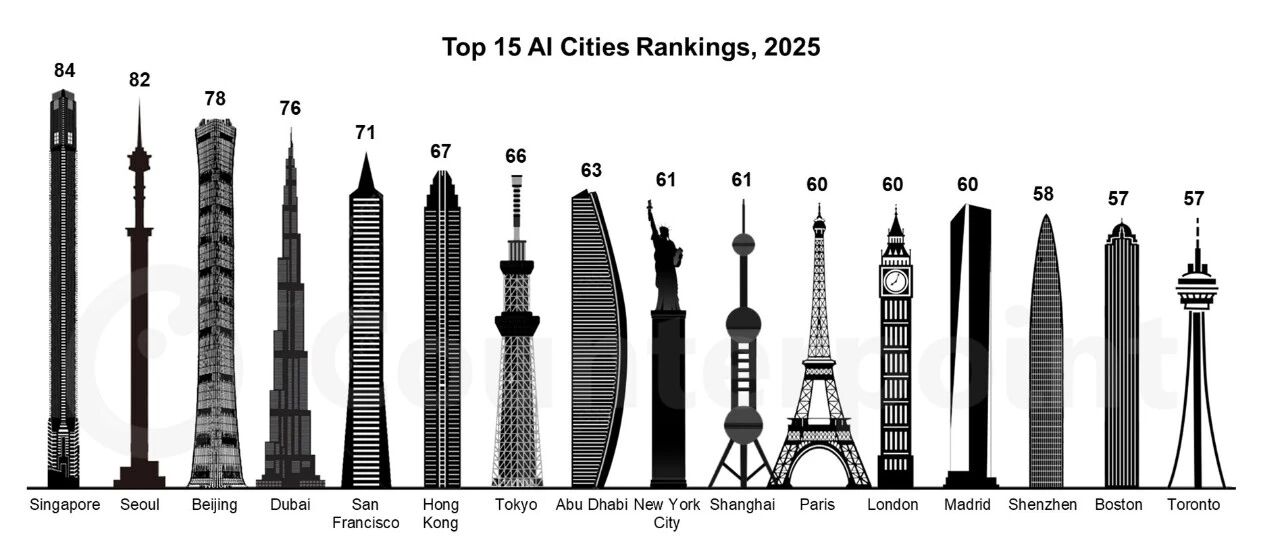
Core Insights - Counterpoint Research's report ranks Singapore as the top AI city globally, followed by Seoul, Beijing, Dubai, and San Francisco in the top five [4][8][9]. Ranking Summary - The report evaluates AI adoption in the world's 100 largest metropolitan areas, scoring each city on a scale of 0 to 100 [6][11]. Regional Highlights - Singapore's success is attributed to government-supported initiatives through organizations like the Singapore AI Association, fostering a vibrant startup ecosystem and strong public-private collaboration in sectors like healthcare and transportation [7][8]. - Seoul ranks second due to active government deployment of AI in healthcare and education, with companies like SK Telecom and Naver innovating in AI services [7]. - Beijing is third, with plans to provide formal AI education to all primary and secondary students starting in 2025 and collaborations with China Unicom and Huawei on "5G+AI" applications [7][8]. - North America leads in AI city development, but China is rapidly catching up, with cities like Wuhan, Chengdu, and Suzhou making significant investments in supercomputing [7][8]. Key Players in AI City Development - Microsoft and Google are identified as major players driving AI city initiatives, focusing on data center development and AI training programs [8][11]. - Huawei excels in promoting AI in telecommunications through its 5G-A technology [8]. - Nvidia's supercomputing facilities in Dallas position it as a leader in global computing power, surpassing Beijing [8][11]. Emerging Cities of Interest - Unexpectedly, Dubai surpassed San Francisco in overall scores due to substantial investments in AI across various economic sectors, including a plan to train 1 million AI engineers [9]. - Riyadh, Bangalore, and Hangzhou are highlighted as rapidly developing AI cities with significant potential [9][12]. Telecommunications Ecosystem - Telecommunications infrastructure is crucial for AI city development, with cities like Beijing deploying 10G fiber and Boston expanding to meet AI computing demands [12]. - Innovations such as GPU-as-a-Service by Singtel and AI-driven network management by STC in Riyadh are examples of how telecom companies are enhancing AI city capabilities [12].