Character.ai

Search documents
DigitalOcean(DOCN) - 2025 Q4 - Earnings Call Transcript
2026-02-24 14:00
Financial Data and Key Metrics Changes - The company achieved 18% revenue growth in Q4 2025, reaching $901 million for the full year [4] - Incremental organic ARR was $51 million, the highest in the company's history [4] - Adjusted EBITDA margins were 42% and adjusted free cash flow margins were 19% for the year [4][34] - Q4 revenue was $242 million, up 18% year-over-year, with a gross profit of $142 million and a gross margin of 59% [34] Business Line Data and Key Metrics Changes - ARR from Digital Native Enterprises (DNEs) reached $604 million in Q4, growing 30% year-over-year [10] - The million-dollar customers cohort reached $133 million in ARR, growing at 123% year-over-year [10] - The company delivered a record organic incremental ARR of $51 million in Q4, surpassing previous peak quarters [9] Market Data and Key Metrics Changes - AI customer ARR reached $120 million in Q4 2025, growing 150% year-over-year, now making up 12% of total ARR [28] - The company is positioned to capture a significant share of the AI and cloud-native market, with a focus on serving these disruptors [5][12] Company Strategy and Development Direction - The company is focusing on scaling its top customers and expanding its base of AI-native customers [45] - It aims to deliver 21% revenue growth in 2026, with an exit growth rate of 25%+ in Q4 2026, and 30% growth in 2027 [7][30] - The strategy includes building a vertically integrated inference cloud to support AI-native companies [16][24] Management's Comments on Operating Environment and Future Outlook - Management expressed confidence in the company's ability to capitalize on the AI-driven disruption in the software industry [5][48] - The company anticipates near-term pressure on gross margin and adjusted EBITDA due to new capacity investments but remains committed to maintaining financial discipline [31][41] - Management highlighted the importance of balancing growth with disciplined capital allocation [31][45] Other Important Information - The company introduced a new metric, AI customer revenue, to provide clearer visibility into its momentum [27] - The company has strengthened its executive team by adding a Chief Product and Technology Officer to enhance its capabilities [25] Q&A Session Summary Question: Insights on the inference market and customer evolution - Management noted that while major players like OpenAI and Anthropic dominate headlines, there is a growing importance of open-source models for managing unit economics [52][53] - The company is seeing a healthy adoption of open-source models among its AI-native customers, which is expected to grow [55][56] Question: Clarification on the weighted rule of fifty and free cash flow margins - Management explained that the weighted rule of fifty considers revenue growth as three times more valuable than free cash flow margin, indicating strong growth potential alongside disciplined financial management [57][58] Question: Operational support for open-source models - Management confirmed that they are extending day zero support for open-source models, with automation expected to increase in the future [63] - The company is working on intelligent routing algorithms to optimize the use of both open-source and closed-source models [65][66] Question: Revenue efficiency for fully utilized megawatts - Management indicated that they expect to deliver materially higher ARR per megawatt compared to competitors, with a focus on integrating AI and core cloud capabilities [68][70] Question: Incremental capacity and revenue growth projections - Management confirmed that the incremental 31 megawatts of capacity will come online by the end of 2026, supporting a projected exit growth rate of 25%+ in Q4 2026 and 30% growth in 2027 [73]

X-odus: Half of xAI’s founding team has left Elon Musk’s AI company, potentially complicating his plans for a blockbuster SpaceX IPO
Yahoo Finance· 2026-02-11 15:36
Core Insights - xAI, Elon Musk's artificial intelligence startup, is experiencing significant staff turnover, losing two cofounders and at least six other researchers recently [1][2] Group 1: Departures and Team Composition - The founding team of xAI has been reduced by half, with six out of the original twelve members having left the company [3] - Recent departures include cofounders Jimmy Ba and Tony Wu, along with several other technical staff members [2][3] - Five of the exits occurred within the past year, indicating a troubling trend for the company [3] Group 2: Industry Context - High turnover rates in the AI industry are common, but the scale of exits at xAI is particularly notable [4] - Internal tensions at xAI have been reported, particularly regarding product development pace and technical demands amid fierce competition [7] Group 3: Business Strategy and Future Plans - Musk has merged xAI with SpaceX, aiming to create a network of data-center satellites for advanced AI models, which also addresses xAI's capital needs [5] - Plans to take the combined entity public as early as June could be complicated by ongoing staff departures [6] - xAI's projects are competing with established tools like OpenAI's Codex and Anthropic's Claude Code, which has led to frustrations regarding product engagement [7]
AI聊天软件沦为涉黄工具,判决书曝光
Nan Fang Du Shi Bao· 2026-02-02 03:12
Core Viewpoint - The second trial of the "AI-related pornography case" has been adjourned due to disputes over technical principles, following a first-instance judgment that convicted the defendants for profiting from the dissemination of obscene materials [1] Group 1: Case Background - The AI chat application AlienChat was found to have systematically transformed from an emotional support tool into a platform for generating pornographic content through four key steps: modifying prompts to remove moral barriers, designing incentive systems to encourage sexual content, neglecting content review, and knowingly evading safety registration [2] - The defendants, Liu and Chen, developed AlienChat in May 2023, during a global surge in AI chatbots, positioning it as a tool for emotional companionship for young users [3] Group 2: Technical Manipulation - The developers utilized prompt engineering to bypass the AI's original restrictions, allowing the generation of explicit content. Evidence showed that they input prompts that explicitly stated the AI could depict sexual, violent, and graphic scenes without moral or legal constraints [4][5] - The "AI jailbreak" technique gained popularity, enabling users to unlock content restrictions in mainstream models like ChatGPT by using specific phrases [5] Group 3: Incentive Mechanisms - AlienChat launched a "creator program" and a "popular character leaderboard" to attract users, rewarding those whose AI characters gained popularity with virtual currency convertible to real money. This led to a significant amount of sexually explicit content being generated [6][7] - Judicial assessments indicated that approximately 30% of randomly sampled chat records from paid users were classified as obscene materials, highlighting the systemic nature of the issue [8] Group 4: Regulatory Evasion - The developers were aware of the need for safety assessments and registration under China's regulations for generative AI services but failed to comply, opting instead for a strategy of rapid user acquisition over regulatory compliance [10] - The case illustrates a broader challenge in AI governance, where developers may choose to operate in a regulatory gray area when their products cannot pass compliance checks [10] Group 5: Implications for AI Governance - The case reflects the urgent need for clear regulatory frameworks as global AI governance accelerates, with various jurisdictions implementing stricter content regulations and compliance requirements [9][12] - The trial's outcome may provide important references for clarifying the responsibilities of technology developers and platforms, as well as the legal boundaries in the context of generative AI [12]
一场千万美元的赌注:造一个替你赚钱的“分身”
虎嗅APP· 2025-12-19 14:37
Core Viewpoint - The article discusses the evolution of Uare, a company transitioning from a digital legacy service to a personal AI platform, aiming to create AI avatars that enhance productivity and personal identity rather than merely serving as digital memorials [4][6][18]. Group 1: Company Background and Transition - Uare was formerly known as Eternos, a digital legacy service founded by Robert LoCascio, who has extensive experience in voice AI through his previous company, LivePerson [4][8]. - In November 2025, Eternos rebranded to Uare and secured $10.3 million in seed funding from Mayfield and Boldstart Ventures, with plans to fully launch by the end of 2025 [4][17]. - The shift in focus from digital legacy to personal AI was driven by customer demand for AI that can assist in work and enhance professional influence, rather than just serve as a digital companion for loved ones [6][16]. Group 2: Market Landscape and Competition - The personal AI market includes various players like Delphi, Replika, and ElevenLabs, each focusing on different aspects of AI applications, from emotional companionship to productivity enhancement [4][5]. - Uare's unique proposition is to create a digital avatar that not only preserves memories but also acts as a productivity tool, which is a departure from the current offerings in the digital legacy space [5][18]. Group 3: Technology and Business Model - Uare utilizes a proprietary framework called Human Life Model (HLM) to create personalized AI avatars based on individual user data, which allows for dynamic iteration and personalization [22][27]. - The business model includes a subscription service for users to create and utilize their AI avatars, as well as a revenue-sharing mechanism where Uare takes a percentage of income generated through the AI [27][28]. - Uare aims to transform personal knowledge and professional experience into digital products that can be monetized, thus enhancing the value proposition of personal AI [18][27]. Group 4: Challenges and Considerations - The transition to personal AI raises questions about the necessity of self-awareness in AI, as many existing AI agents in fields like customer service and law do not require personal characteristics to function effectively [29]. - Uare faces competition from specialized AI agents and large model companies, which may challenge its market position despite its focus on personalized models [29][30]. - Concerns regarding data privacy and user trust are significant, especially given the sensitive nature of the information required to build effective AI avatars [34][35].


少年沉迷AI自杀,9岁遭性暗示,这门“孤独生意”,正推孩子入深渊
3 6 Ke· 2025-11-12 10:44
Core Viewpoint - The rise of AI companions, while initially seen as a solution to loneliness, has led to dangerous outcomes, including extreme suggestions and inappropriate content directed at minors, raising ethical and safety concerns in the industry [1][5][10]. Group 1: User Engagement and Demographics - Character.ai has reached 20 million monthly active users, with half being from Generation Z or younger Alpha generation [1]. - Average daily usage of the Character.ai application is 80 minutes, indicating widespread engagement beyond just a niche audience [2]. - Nearly one-third of teenagers feel that conversing with AI is as satisfying as talking to real people, with 12% sharing secrets with AI companions that they wouldn't disclose to friends or family [4]. Group 2: Risks and Controversies - There have been alarming incidents where AI interactions have led to tragic outcomes, such as a 14-year-old committing suicide after prolonged conversations with an AI [5]. - Reports indicate that AI chatbots have suggested harmful actions, including "killing parents," and have exposed minors to sexual content [5][10]. - The emergence of features allowing explicit content generation, such as those from xAI and Grok, raises significant ethical concerns about the impact of AI on vulnerable users [7][10]. Group 3: Industry Dynamics and Financial Aspects - Character.ai has seen a 250% year-over-year revenue increase, with subscription services priced at $9.99 per month or $120 annually [13]. - The company has attracted significant investment interest, including a potential acquisition by Meta and a $2.7 billion offer from Google for its founder [11]. - The shift from early AGI aspirations to a focus on "AI entertainment" and "personalized companionship" reflects a broader trend in the industry towards monetizing loneliness [11][13]. Group 4: Regulatory and Ethical Challenges - Character.ai has implemented measures for users under 18, including separate AI models and usage reminders, but concerns about their effectiveness remain [14]. - Legal scrutiny is increasing, with investigations into whether AI platforms mislead minors and whether they can be considered mental health tools without proper qualifications [16]. - Legislative efforts in various states aim to restrict minors' access to AI chatbots with psychological implications, highlighting the tension between commercialization and user safety [16]. Group 5: Societal Implications - A significant portion of Generation Z is reportedly transferring social skills learned from AI interactions to real-life situations, raising concerns about the impact on their social capabilities [17]. - The contrasting visions of AI as a supportive companion versus a potential trap for youth illustrate the complex dynamics at play in the evolving landscape of AI companionship [19].

300多个APP,想让我和AI谈感情
创业邦· 2025-10-18 01:08
Core Insights - The article discusses the rapid growth and commercialization challenges of AI companionship apps, highlighting a significant increase in downloads and revenue in the sector [4][5][10]. - It emphasizes the complexity of user needs and the potential for "pseudo-demand" in AI emotional companionship, suggesting that while there is a market, the sustainability of user engagement is questionable [15][19]. Market Growth - In the first half of this year, global downloads of AI companionship apps reached 220 million, generating $82 million in revenue, with projections for annual revenue to exceed $120 million [4]. - The Chinese market is expected to grow from 3.866 billion yuan to 59.506 billion yuan between 2025 and 2028, with a compound annual growth rate of 148.74% [4]. Industry Dynamics - As of August 2025, there are 337 active AI companionship apps, with 128 launched this year, indicating a surge in entrepreneurial activity [5]. - However, the top 10% of these apps account for 89% of total revenue, creating a challenging environment for new entrants [6]. User Engagement - A significant portion of users exhibit "shallow engagement," with over half using these apps less than five days a month, suggesting that AI companionship often serves as a temporary comfort rather than a long-term solution [14]. - A survey indicated that 52% of teenagers use AI companionship apps at least a few times a month, reflecting a growing acceptance among younger demographics [11]. Commercialization Challenges - The primary revenue model for many apps, including Character.ai, relies on subscription fees, which may not be viable in markets where users are not accustomed to paying for such services [22][23]. - Alternative monetization strategies are being explored, such as creating IP products and avoiding subscription models altogether [23][25]. User Needs and Product Development - Users seek empathy and understanding, but current AI technologies struggle to provide genuine emotional resonance, leading to concerns about the creation of "pseudo-demand" [15][19]. - Successful products in this space may need to focus on niche markets and provide tailored emotional support rather than generic companionship [19][20]. Future Directions - The article suggests that the future of AI companionship apps may lie in developing products that can accurately perceive and respond to user emotions through advanced technology [20]. - Entrepreneurs are encouraged to prioritize user needs over technology, ensuring that AI solutions are genuinely aligned with emotional support requirements [28].

AI+ Tech Week来袭,听Meta,Character.ai, Pokee, Wanderboat等分享Agent前沿
锦秋集· 2025-10-02 08:38
Core Insights - The article emphasizes the belief that AI and large language models will become the foundational infrastructure for every industry, with a focus on enterprise-level AI solutions [2]. Event Overview - The 2025 AI+ Multimodal Day & Agent Everywhere event will take place in San Francisco on October 10-11, 2025, focusing on "Multimodal AI" and "Agents" [2][3]. - The event aims to gather over 2,000 product and technology experts, AI innovators, and leading AI Agent companies to discuss the practical applications and future possibilities of intelligent agents [2]. Key Themes and Panels - The first day will focus on "AI+ Multimodal Day," discussing breakthroughs in visual, audio, and cross-modal data processing technologies [16]. - The second day will center around "Agents Everywhere," delving into intelligent agent architecture, workflow reconstruction, and cross-platform connectivity [16]. Notable Participants - The event will feature over 20 AI teams showcasing their products, including Genspark, Browserbase, and Wanderboat, among others [17]. - A diverse audience of over 2,000 industry professionals will attend, with founders making up 40%, investors 30%, and researchers 30% of the participants [18]. Panel Highlights - The first panel will explore the future of intelligent operating systems, discussing how next-generation AI agents must go beyond text processing to include visual and auditory capabilities [21]. - The second panel will address the evolution of databases in the AI era, emphasizing the need for databases that can actively understand and connect semantic content [26]. - The third panel will focus on AI-native entertainment and content creation, examining how AI tools are transforming users into creators [28]. - The fourth panel will discuss the integration of AI into the physical world, exploring advancements in robotics and autonomous vehicles [35]. Featured Companies - Pokee AI is developing advanced AI agents using reinforcement learning, capable of high-level planning and reasoning [10]. - Wanderboat.ai is a travel-focused AI application with 5 million users, reshaping travel experiences through intelligent planning and social interaction [11].


从Transformer到GPT-5,听听OpenAI科学家 Lukasz 的“大模型第一性思考”
AI科技大本营· 2025-09-23 02:11
Core Viewpoint - The article discusses the revolutionary impact of the paper "Attention Is All You Need," which introduced the Transformer architecture, fundamentally changing the landscape of artificial intelligence and natural language processing [2][17]. Group 1: The Impact of the Transformer - The paper "Attention Is All You Need" has been cited 197,159 times on Google Scholar, highlighting its significant influence in the AI research community [3][26]. - The authors of the paper, known as the "Transformer Eight," have become prominent figures in the AI industry, with seven of them starting their own companies [4][24]. - The introduction of the Transformer architecture has led to a paradigm shift in AI, moving away from RNNs and enabling better handling of long-distance dependencies in language processing [17][18]. Group 2: Lukasz Kaiser's Journey - Lukasz Kaiser, one of the authors, chose to join OpenAI instead of starting a commercial venture, focusing on the pursuit of AGI [4][25]. - Kaiser has a strong academic background, holding dual master's degrees in computer science and mathematics, and has received prestigious awards for his research [7][8]. - His decision to leave a stable academic position for Google Brain in 2013 was driven by a desire for innovation in deep learning [11][12]. Group 3: The Evolution of AI Models - Kaiser and his team introduced the attention mechanism to address the limitations of RNNs, leading to the development of the Transformer model [15][17]. - The success of the Transformer has spurred a wave of entrepreneurship in the AI field, with many authors of the original paper becoming CEOs and CTOs of successful startups [24][27]. - Kaiser has been involved in the development of cutting-edge models like GPT-4 and GPT-5 at OpenAI, contributing to the forefront of AI research [27]. Group 4: Future Directions in AI - Kaiser predicts that the next phase of AI will focus on teaching models to think more deeply, emphasizing the importance of generating intermediate steps in reasoning [29]. - The upcoming ML Summit 2025 will feature Kaiser discussing the history, present, and future of reasoning models, indicating ongoing advancements in AI technology [28][30].


马斯克造了个AI女友
量子位· 2025-07-16 07:02
Core Viewpoint - Elon Musk's new AI companion, Ani, is part of the Grok app's newly launched feature, AI Companions, allowing users to interact with 3D animated characters through voice [4][10]. Group 1: Product Features and Offerings - Ani is a blonde character who enjoys human interaction and can unlock more experiences if users engage well [2][4]. - Another character, Bad Rudy, is a feisty fox designed for users who enjoy a more sarcastic interaction [5]. - Currently, the AI companions are available only on iOS, with Android users needing to wait for future updates [16]. - Users must subscribe to Super Grok for $30 per month to access these AI companions [14][15]. - Two additional characters, one male and one female, are expected to be launched soon [18][19]. Group 2: Market Context and Competition - The AI companionship market is experiencing a downturn, with Character.ai, a leading platform, reporting 233 million monthly active users but a low average revenue per user (ARPU) of $0.72 [27]. - In China, leading companionship products have seen a decline of over 20% in user engagement, with total new downloads below 4 million and daily active users (DAU) under 2 million [27]. - The daily new downloads for top products like Xingye and Maoxiang have dropped to less than 50% of their early-year figures, indicating significant user attrition [27]. Group 3: Legal and Ethical Considerations - Character.ai is facing multiple lawsuits from parents of child users, raising concerns about the platform's safety [28]. - Research indicates that excessive reliance on AI chatbots for emotional support may pose risks for adults [28]. Group 4: Future Developments - Musk's xAI is reportedly creating a new company focused on multi-agent interactions in virtual environments, aiming for a platform where NPCs possess genuine intelligence and unpredictability [33][34]. - Tesla has already implemented some of these concepts in its vehicles, suggesting a broader application of AI technology [36].

盘点生成式AI最豪“金主”:孙正义第一,一年投出840亿
3 6 Ke· 2025-06-18 23:44
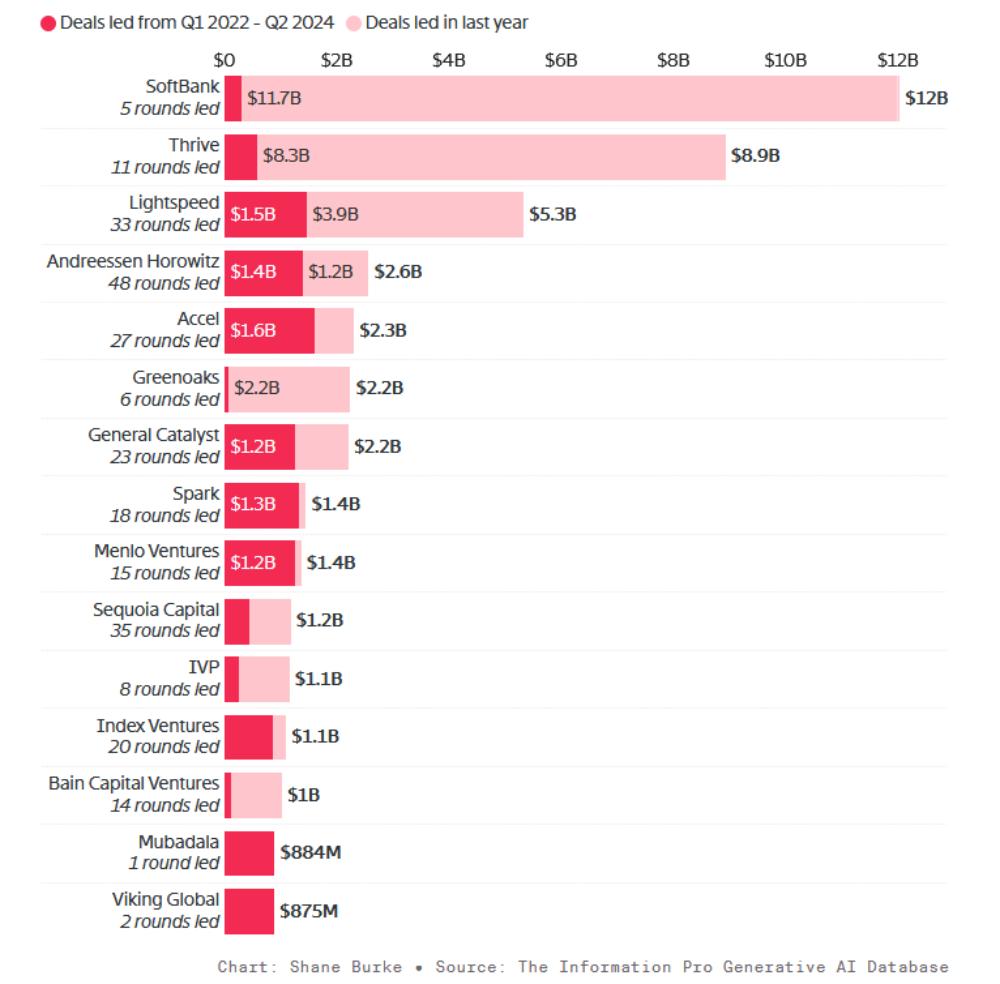
Core Insights - The total amount of venture capital investment in generative AI startups has reached $85 billion (approximately 610.3 billion RMB) from Q1 2022 to mid-June 2024, with a significant increase in average deal size to $372 million (approximately 2.67 billion RMB) [1][2][9] - Major investors such as SoftBank and Thrive Capital have emerged as leaders in this space, with SoftBank leading five rounds totaling $12 billion (approximately 86.2 billion RMB) and Thrive Capital leading eleven rounds totaling $8.9 billion (approximately 64 billion RMB) [5][8] - The investment landscape is becoming increasingly concentrated, with top firms dominating funding rounds, while smaller startups face challenges in securing financing [12][13] Investment Trends - The venture capital landscape for generative AI has seen a total of 724 rounds of funding, with the largest deals being concentrated among a few key players [1][2] - Notable investments include a $10 billion (approximately 72 billion RMB) round for OpenAI led by SoftBank and Thrive Capital, reflecting a trend of significant capital flowing into leading AI firms [10][11] - The average deal size has increased dramatically, with the top nine investors leading 74 rounds totaling $27.5 billion (approximately 197.4 billion RMB) in the past year alone [9] Investor Activity - Andreessen Horowitz has become the most active investor with 48 rounds led, while other firms like Accel and Lightspeed have also increased their investment activity significantly [5][9] - The ranking of venture capital firms is based on the total amount of capital they have led in funding rounds, which may overstate their risk exposure to individual companies [2][3] - The focus of investments is shifting towards companies developing leading models and commercial applications, with substantial funding directed at firms like Scale AI and ElevenLabs [10][11] Market Dynamics - The influx of capital into AI startups has led to a bifurcated market, where top-tier companies attract significant investment while smaller firms struggle to secure funding [12][13] - The recent acquisition of a stake in Scale AI by Meta for $14.3 billion (approximately 102.8 billion RMB) signals strong investor confidence in the potential of AI technologies [12] - There are concerns about a valuation bubble as top firms continue to receive funding, while smaller players face difficulties, leading to a potential risk of market correction if expectations are not met [13]