Microchip

Search documents
STMicroelectronics: Turning The Corner As Fundamentals Improve (Rating Upgrade)
Seeking Alpha· 2026-01-21 11:52
Core Viewpoint - The analysis of STMicroelectronics (STM) indicates a constructive setup despite its underperformance over the past 12 months, lagging behind peers like Microchip and Infineon, which saw increases of +30% and +28% respectively [1] Group 1 - STM's recent performance has been less favorable compared to competitors, highlighting a potential area for improvement [1] - The analysis suggests that recent preannouncements from Microchip are particularly relevant for understanding market dynamics [1]


The surprising stocks powering the chip sector toward its first new high in a month
MarketWatch· 2026-01-06 18:21
Core Viewpoint - Analog-semiconductor stocks have underperformed over several years, but recent comments from Microchip are raising expectations for a potential recovery in the sector [1] Company Summary - Microchip's latest commentary suggests optimism for a sustained recovery in the analog-semiconductor market, which has been lagging for an extended period [1]

Microchip Stock Surges. Why the Chip Maker Boosted Sales Guidance.
Barrons· 2026-01-06 12:43
Core Insights - The chip maker has increased its sales guidance for the second time for the quarter ending December 31 [1] Group 1 - The company is experiencing positive momentum in sales, prompting a revision of its sales forecast [1] - This adjustment indicates strong demand for the company's products in the current market [1] - The revised guidance reflects the company's confidence in its operational performance and market conditions [1]


中资半导体出海再遇“国家安全”壁垒:FTDI事件背后的全球产业博弈
Huan Qiu Wang· 2025-12-27 12:39
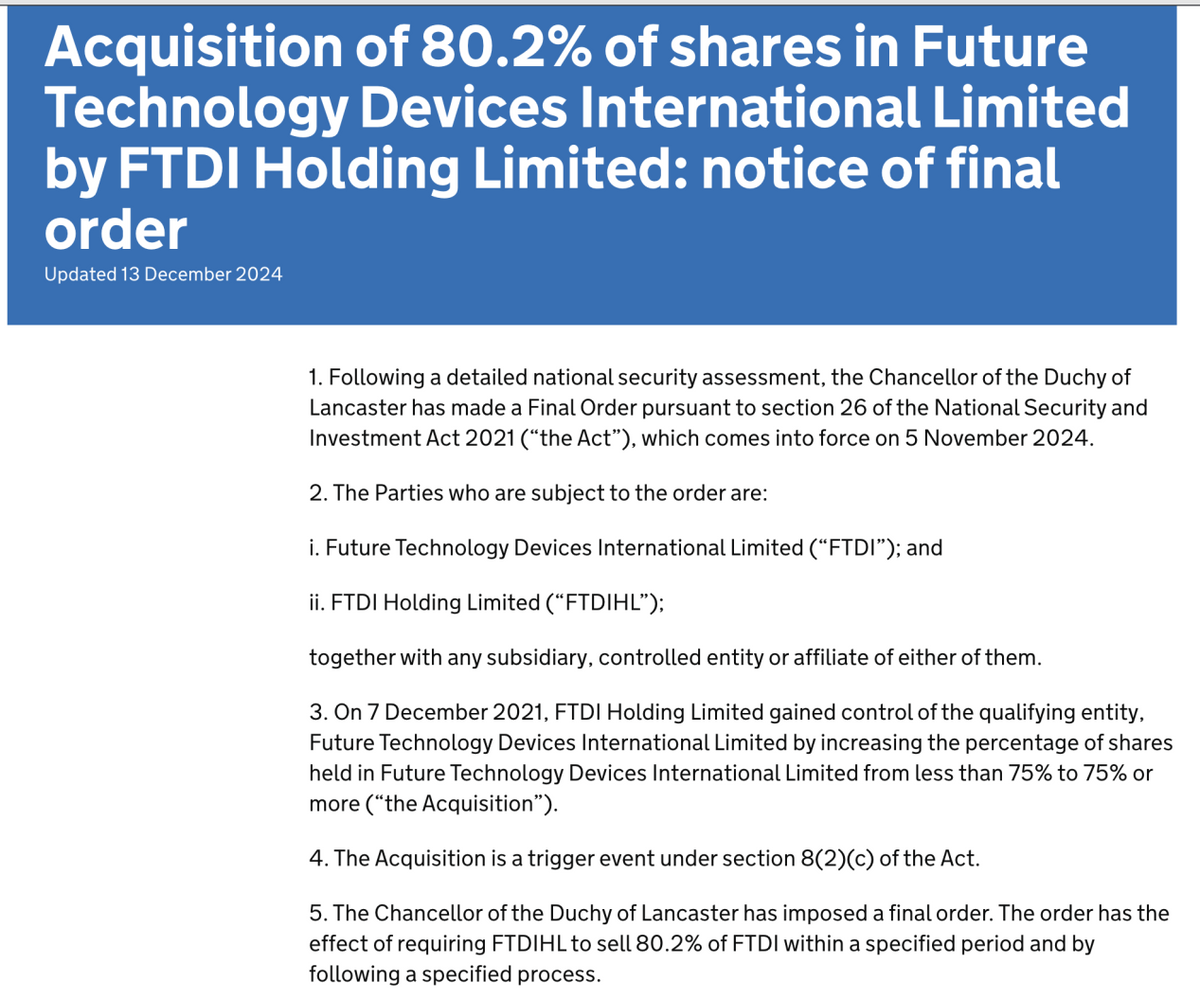
Core Viewpoint - The forced divestment of FTDI by the UK government highlights the increasing fragmentation and geopolitical tensions within the global semiconductor industry, particularly affecting Chinese investments in high-end technology sectors [1][5][7]. Group 1: Acquisition Details - In December 2021, Jian Guang Asset acquired 80.2% of FTDI for $414 million, marking a strategic move into the high-end analog chip sector by Chinese capital [1][3]. - FTDI, established in 1992, is a leading company in the USB bridge chip market with nearly 20% market share, crucial for various applications including automotive electronics and IoT [3][4]. - The acquisition was intended to integrate FTDI into the Chinese semiconductor ecosystem, addressing long-standing technological gaps [3][4]. Group 2: Regulatory Actions - The UK government initiated a security review under the National Security and Investment Act, classifying the acquisition as a "trigger event" [4][5]. - On November 5, 2024, the UK government mandated the sale of FTDI due to concerns over potential misuse of technology and threats to critical infrastructure, setting a deadline for divestment by December 2025 [1][4]. - Despite legal challenges from the Chinese entity, the UK High Court upheld the government's decision, removing legal obstacles to the forced sale [4][6]. Group 3: Implications for the Semiconductor Industry - The case reflects a broader trend of Western nations using "national security" as a rationale to restrict foreign investments, potentially leading to increased scrutiny of any Chinese semiconductor investments [5][6]. - The forced divestment of FTDI may undermine global supply chain stability and efficiency, as the semiconductor industry relies on international collaboration [7]. - The situation raises concerns about the potential for further fragmentation of the semiconductor market, which could exacerbate global chip shortages and price volatility [7]. Group 4: Future Considerations - The FTDI incident serves as a catalyst for reevaluating semiconductor governance rules, emphasizing the need for transparent and non-discriminatory international regulations [7]. - China advocates for open cooperation and fair competition in the semiconductor sector, contrasting with the political motivations observed in some Western countries [7].

Cadence's Free Cash Flow Continues to Power M&A, Buybacks
ZACKS· 2025-12-26 18:16
Core Insights - Cadence Design Systems Inc. (CDNS) is positioned to benefit from increasing demand for its AI-driven solutions amid strong design activity and customer spending on AI initiatives [1] Financial Performance - In Q3, CDNS reported revenues of $1.339 billion, reflecting a year-over-year increase of 10.2% [2][8] - The company generated operating cash flow of $311 million and free cash flow of $277 million [2] - As of September 30, 2025, CDNS had cash and cash equivalents of $2.753 billion and long-term debt of $2.479 billion [2] Growth Strategy - CDNS is pursuing a disciplined inorganic growth strategy, acquiring technologies that enhance organic growth [3] - Recent acquisitions include the Design & Engineering division of Hexagon AB, Artisan foundation IP from Arm Holdings, and Secure-IC [3] Shareholder Returns - CDNS repurchased shares worth $200 million in Q3 and plans to repurchase another $200 million in Q4 [4] - The company intends to use at least 50% of its free cash flow for share buybacks in 2025 [6][8] Future Outlook - The company expects revenues for 2025 to be between $5.262 billion and $5.292 billion, with operating cash flow projected between $1.65 billion and $1.75 billion [6][8] - Trends such as 5G, hyperscale computing, and autonomous driving are anticipated to drive design activity and sustain top-line growth [5]


11份料单更新!出售纳芯微、安世、TI等芯片
芯世相· 2025-12-15 05:38
Core Insights - The article discusses the challenges of managing excess inventory in the semiconductor industry, highlighting the financial burden of storage and capital costs associated with unsold materials [1] - It promotes a service called "Chip Superman," which has served 22,000 users and offers rapid inventory clearance, claiming transactions can be completed in as little as half a day [9] Group 1: Inventory Management - The company faces significant costs related to excess inventory, estimating a loss of at least 30,000 yuan after six months due to storage fees and capital costs [1] - There is a need for effective promotion strategies for unsold materials, as the company struggles to find buyers and achieve favorable prices [1] Group 2: Inventory Offerings - The article lists various semiconductor components available for sale, including brands like Nexperia, TI, and ON, with quantities ranging from 15 to 87,500 units [4][5] - The total inventory includes over 5 million chips across more than 1,000 models, with a total value exceeding 100 million yuan [8] Group 3: Service Features - "Chip Superman" provides a platform for users to buy and sell excess inventory, emphasizing quick transaction times and discounts to clear stock [9] - The company operates a 1,600 square meter smart storage facility in Shenzhen, equipped with a dedicated laboratory for quality control [8]


10份料单更新!出售安世、WINBOND、Diodes等芯片
芯世相· 2025-12-04 09:49
Core Viewpoint - The article discusses the challenges of managing excess inventory in the semiconductor industry, highlighting the financial burden of storage and capital costs associated with unsold materials, while promoting a platform for quick sales of surplus stock [1][8]. Group 1: Inventory Management - A significant amount of excess inventory, specifically 100,000 units, incurs monthly storage and capital costs of at least 5,000, leading to a potential loss of 30,000 if held for six months [1]. - The company offers a platform, "Chip Superman," which has served 21,000 users, to facilitate quick sales of surplus inventory, claiming transactions can be completed in as little as half a day [8]. Group 2: Inventory Listings - The article lists various electronic components available for sale, including: - NEXPERIA components such as BUK9K17-60EX (100K units) and BZT52H-C6V8 (240K units) [4]. - Gainsil components like GS8723-TR (3,000 units) and GS8552-SR (17,000 units) [4]. - Other brands and models with quantities ranging from thousands to hundreds of thousands [5]. Group 3: Purchase Requests - The company is actively seeking specific components, including: - GD32A503KCU3 (2,940 pcs) and ATMEGA2561-16AU (2,000 pcs) [6]. - TDK ICM-42688-P (60,000 pcs) and various components from 安世 and 博通 [6]. Group 4: Warehouse and Quality Control - The company operates a 1,600 square meter smart warehouse with over 1,000 models and 50 million chips in stock, valued at over 100 million [7]. - Each component undergoes quality control checks in an independent laboratory located in Shenzhen [7].

半导体存储控制的投资机遇:四大主线与估值锚点
2025-11-14 03:48
Summary of Semiconductor Storage Controller Conference Call Industry Overview - The semiconductor storage controller industry is experiencing significant innovation driven by AI applications, particularly in SSD controllers which may integrate compression, indexing, and simple inference functions to enhance SSD value [1][3] - CXL (Compute Express Link) technology is facilitating the pooling of storage and memory, leading to the development of new hybrid controller products as cloud service providers adopt CXL memory pooling [1][4] - There is an increasing demand for high-security and high-quality storage solutions in smart automotive and industrial systems, including SSDs, UFS, and eMMC, which require high durability and safety standards [1][7] Key Points and Arguments 1. **AI-Related Applications**: Future storage controllers will not only serve data storage but also perform computational tasks, addressing bottlenecks in memory bandwidth and latency during AI model training and inference. This technology is already being implemented in advanced SSDs by companies like Samsung and Marvell, but widespread commercial adoption is still pending [3][6] 2. **CXL Technology**: The advancement of CXL technology is expected to create a closer integration between storage and memory management, leading to new hybrid controller products once widely adopted by cloud service providers [4][5] 3. **Automotive and Industrial Applications**: The demand for long-lasting, high-margin products in automotive and industrial sectors is increasing, with a focus on meeting stringent safety and durability standards [7][8] 4. **Computational SSDs**: Future computational SSDs will integrate lightweight DPU/NPU to perform complex data processing tasks, positioning SSDs as micro-nodes in AI clusters and driving market demand [7][6] Company Insights - **US Companies**: Microchip and Marvell are highlighted as strong performers in the AI and automotive markets, with Marvell showing significant growth in AI revenue and a robust presence in data centers and automotive sectors [9] - **Taiwanese Companies**: Taiwanese firms like Phison Electronics and Silicon Motion are well-positioned in the high-end storage controller market, with Silicon Motion transitioning to PCIe 6.0 and collaborating with NVIDIA [10] - **Domestic Companies**: Chinese companies such as Jiangbo Technology and Lianyun are upgrading from low-end consumer controllers to mid-to-high-end data center and enterprise-level products, benefiting from the storage supercycle [11] Valuation Insights - Major storage manufacturers like Samsung, SK Hynix, Micron, Western Digital, and Seagate are currently valued within a normal range, with PE ratios around 10-16 times based on projected net profits for 2026 [12][14] - SK Hynix is particularly favored due to its expected net profit growth, while Micron is seen as lagging behind [12][15] - The valuation of HDD manufacturers tends to be higher than that of pure semiconductor manufacturers, reflecting historical trends [13] Market Demand and Trends - The current market shows strong demand for HBM (High Bandwidth Memory) and NAND, with prices rising due to increased demand from AI servers and the overall industry [16] - The storage controller industry is evolving with interface and firmware upgrades, making controllers increasingly complex, which may impact the growth potential of companies focused on consumer-grade products [17] Conclusion - The semiconductor storage controller industry is poised for growth driven by AI applications, CXL technology, and increasing demands in automotive and industrial sectors. Companies that can adapt to these trends and enhance their product offerings are likely to see significant investment interest and market opportunities [5][11][20]
CEVA(CEVA) - 2025 Q3 - Earnings Call Transcript
2025-11-10 14:30
Financial Data and Key Metrics Changes - Revenue for Q3 2025 was $28.4 million, up 4% year-over-year from $27.2 million and up 11% sequentially [12] - Non-GAAP EPS for the quarter was $0.11, exceeding expectations [4] - Gross margin improved to 88% on a GAAP basis and 89% on a non-GAAP basis, compared to 85% and 87% respectively a year ago [13] Business Line Data and Key Metrics Changes - Licensing and related revenue totaled $16 million, representing 56% of total revenue, reflecting a 3% year-over-year increase and a 7% sequential increase [12] - AI processor licensing contributed roughly one-third of licensing revenue in both Q2 and Q3 2025, marking a significant impact on the licensing mix [8][12] - Royalty revenue for Q3 was $12.4 million, reflecting 44% of total revenue, a 16% sequential increase, and a 6% year-over-year increase [13] Market Data and Key Metrics Changes - Consumer IoT posted 9% year-over-year growth, supported by record shipments in cellular IoT and Wi-Fi [13] - 5G WAN infrastructure revenues increased by 91% compared to last year [10] - Mobile royalties grew 4% year-over-year and 7% sequentially, driven by recovering low-end smartphone segments [10] Company Strategy and Development Direction - The company is focused on expanding its market-leading position in wireless connectivity and accelerating growth in AI [4] - CEVA aims to lead the transition to NPUs as a foundational technology for AI inference, similar to the licensing model of CPUs and GPUs [5][6] - The strategy includes leveraging a unified software framework and tools to enhance customer differentiation and experience [6] Management's Comments on Operating Environment and Future Outlook - Management expressed optimism about continued growth in AI-led licensing momentum and wireless connectivity, highlighting a robust pipeline and deal flow [18] - The company expects seasonal momentum in Q4, driven by share gains at a US OEM smartphone customer and strong ramps in Wi-Fi and cellular IoT [18] - The guidance for Q4 total revenue is expected to be in the range of $29-$33 million [19] Other Important Information - CEVA's cash and cash equivalents were approximately $152 million as of September 30, 2025 [17] - The company repurchased approximately 340,000 shares for about $7.2 million in 2025 [17] - Shipped units by CEVA's licensees during Q3 2025 were 559 million units, up 19% sequentially and 11% year-over-year [15] Q&A Session Summary Question: Can you describe the performance of other segments besides smartphones? - Management noted growth momentum in mobile, Wi-Fi shipments, cellular IoT, and automotive ADAS solutions, all contributing to royalty growth [22][24] Question: What is the timeline for Microchip NPU shipments to impact CEVA's royalty revenue? - Typical licensing agreements last a few years, with royalties expected to materialize within two to three years after productization [31] Question: What does the competitive landscape look like for the Microchip deal? - The competitive landscape includes other potential IP vendors, but CEVA's comprehensive NPU portfolio and advanced software stack provided a competitive advantage [44][45]

这一芯片赛道,天塌了!
半导体芯闻· 2025-09-26 10:43
Core Viewpoint - The strategic alliance between NVIDIA and Intel aims to integrate AI-accelerated computing with the x86 ecosystem, significantly enhancing the influence of NVIDIA's NVLink technology over the traditional PCIe standard [3][15][21] Group 1: NVLink vs PCIe - NVLink technology offers several times the bandwidth and lower latency compared to PCIe, posing a significant challenge to the long-standing PCIe standard [3][15] - Intel's embrace of NVLink is a symbolic shift, indicating a potential restructuring of CPU and GPU interconnect paradigms, which may impact the demand for PCIe Retimer chips [3][15][21] Group 2: PCIe Retimer Chips - PCIe Retimer chips emerged as a necessary solution to address signal integrity issues as data transfer rates increased from PCIe 3.0 to PCIe 6.0, with insertion loss rising from 22dB to 36dB [6][7] - Retimer chips are crucial for extending transmission distances and improving signal quality in high-speed data center environments, especially as AI demands grow [10][11] Group 3: Market Dynamics - The PCIe Retimer chip market is characterized by a "duopoly" led by AsteraLabs and Lanqi Technology, with other players like Pericom and TI competing in various segments [12][13][14] - The global PCIe Retimer chip market is projected to reach $1.8 billion by 2025, driven by the increasing demand for high-speed interconnects in AI and server applications [14] Group 4: Impact of NVIDIA and Intel Alliance - The partnership between NVIDIA and Intel may disrupt the PCIe Retimer market, as NVLink's superior bandwidth and lower latency could reduce the need for Retimer chips in AI server configurations [15][16][21] - Intel's integration of NVLink into its x86 CPUs could lead to a shift in the server ecosystem, potentially establishing NVLink as the new industry standard [17][18] Group 5: Future Outlook - Despite the potential challenges posed by NVLink, PCIe Retimer chips may still hold value in scenarios where long-distance transmission and complex topologies are required, ensuring their relevance in the AI era [21]