
Murata

Search documents
Should You Buy QuantumScape Stock When its Trading at Around $7?
ZACKS· 2026-02-27 17:00
Key Takeaways QS trades near $7 as investors await measurable progress on its Eagle Line ramp.QuantumScape targets capital-light licensing, backed by Volkswagen and milestone payments.QS expects $250-$275M EBITDA loss in 2026 as capex rises before royalties materialize.QuantumScape Corp. (QS) remains one of the most closely followed names in the solid-state battery space. As a development-stage company, it offers significant long-term potential — but also meaningful uncertainty. With the stock trading aroun ...



Auto Sector Q4 Earnings: 4 Stocks With Surprise Potential
ZACKS· 2026-01-30 13:16
Core Insights - The fourth-quarter earnings season for the Auto-Tires-Trucks sector is underway, with Tesla and General Motors beating earnings expectations, while PACCAR matched expectations [1] - The auto sector's earnings for fourth-quarter 2025 are projected to decline by 12.9% year-over-year, with revenues expected to contract by 5.7% [1] Industry Performance - The U.S. auto industry experienced a slowdown in the fourth quarter, with vehicle sales dropping to an annualized pace of 15.6 million units from 16.4 million in the third quarter, marking the weakest period of the year [3] - Tariffs on imported vehicles and components, along with inflation, have pressured automakers, leading to increased costs and reduced profitability [4] - The average transaction price for new vehicles reached a record $50,326 in December, contributing to affordability issues for buyers [4] - The electric vehicle (EV) market saw a significant decline, with EV sales falling to 234,000 units in the fourth quarter, down 46% sequentially and 36% year-over-year [5] Company Highlights - **Ford**: Sales rose 2.7% to over 545,200 vehicles in the fourth quarter, with a market share increase of 0.9%. The company expects around $19.5 billion in special charges related to restructuring its U.S. EV strategy [8][9] - **QuantumScape**: Focused on solid-state battery technology, the company has an Earnings ESP of +17.02% and is set to release results on Feb. 11, with a consensus loss estimate of 16 cents per share [11][12] - **Lear Corp.**: The company is enhancing its position through strategic acquisitions and automation, with an Earnings ESP of +1.75% and a scheduled release on Feb. 4 [13][14] - **BorgWarner**: A leader in clean technology solutions, BorgWarner has an Earnings ESP of +2.61% and is expected to release results on Feb. 11, with a consensus estimate of $1.16 per share [15][16]




行业聚焦:全球植入式设备用电池行业头部生产商市场份额及排名调查(附核心企业名单)
QYResearch· 2026-01-29 03:47
Core Insights - The report focuses on batteries used in implantable medical devices, highlighting lithium-ion batteries as a crucial type for devices like pacemakers and neurostimulators [2] - The global sales volume of these batteries is projected to reach approximately 108.04 MWh by 2025, with a unit price of about $3.26 per Wh [2] - The industry average gross margin is around 41%, benefiting from high certification barriers and long supply cycles [2] Market Overview - The global market for implantable device batteries is expected to reach $590 million by 2031 [3] - In 2025, the top ten manufacturers are estimated to hold about 71.4% of the market share [6] - The primary product type, Vanadium Oxide (Li/CFₓ–SVO), accounts for approximately 53.8% of the market share [8] - Minimally invasive/subcutaneous devices represent the largest application segment, capturing about 33.6% of the market [10] Industry Drivers and Challenges - Key drivers include the growing demand for chronic disease management and precision medicine, expanding applications in cardiac management and neurostimulation [14] - Challenges include high regulatory barriers, long clinical validation cycles, and the need for long-term biocompatibility and low failure rates [14] Development Opportunities - Opportunities exist in the parallel evolution of high energy density primary and rechargeable battery systems, as well as advancements in wireless charging and energy harvesting technologies [15] - The aging population and increased penetration of home healthcare are expected to create a broader development space for battery companies with material innovation capabilities [15] Leading Companies - Major manufacturers in the global implantable device battery market include EnerSys, Abbott Labs, Boston Scientific, Medtronic, Panasonic, and others [5] - EnerSys has a long history and has evolved into a global industrial technology company, providing energy storage solutions across various sectors [16]

行业报告 | 全球与中国LCP-FCCL市场现状及未来发展趋势
QYResearch· 2026-01-26 05:59
Core Viewpoint - The LCP-FCCL industry is transitioning from "usable" to "stable mass production," with a focus on addressing production pain points such as film thickness consistency, dielectric stability, and moisture absorption control [2][4]. Industry Development Status - The core of LCP-FCCL lies in the matching of LCP film, adhesive systems, and copper foil processes, with current challenges in achieving consistent production quality and performance [2]. - The demand for LCP-FCCL is driven by high-frequency, low-loss, and moisture-resistant characteristics, particularly in applications like 5G antennas and RF modules [3]. - Key bottlenecks include lamination, drilling, and reliability validation, with the industry facing challenges in achieving stable and cost-effective production [4]. Market Dynamics - The high-end market is primarily driven by leading companies, with domestic alternatives accelerating but showing clear segmentation [5]. - The industry is shifting from a "performance-first" approach to a "comprehensive cost-first" strategy, as LCP-FCCL prices remain higher than mainstream PI systems [6]. Development Trends - The demand for high-frequency applications continues to grow, with LCP-FCCL expected to penetrate more into high-frequency interconnects and antenna arrays due to its advantageous properties [7]. - The trend towards ultra-thin and lightweight designs is evolving, with a focus on reducing copper and film thickness while maintaining signal integrity [8]. - Material system iterations are underway to enhance low-loss bonding and surface treatment, improving thermal reliability and chemical resistance [10]. Domestic Market Insights - The domestic market for LCP-FCCL is rapidly evolving, with significant growth expected in China, which is projected to account for 54.03% of the global market by 2031 [14]. - The electronic communication sector is the largest consumer of LCP-FCCL, with a market share of approximately 69.06% in 2024 [15]. Competitive Landscape - Major global players in the LCP-FCCL market include Kurary, Panasonic, and Murata, with the first tier holding about 49% of the market share [17]. - The industry is witnessing increased competition as more companies enter the field, driven by the growing demand for high-frequency communication materials [17]. Industry Opportunities - The upgrade in high-frequency communication technologies such as 5G and satellite communication is creating a strong demand for LCP-FCCL materials [18]. - The automotive sector is also experiencing rapid growth in LCP-FCCL applications due to the increasing need for high-speed data links and radar systems [18]. - The trend towards terminal miniaturization and high integration is pushing the adoption of LCP-FCCL in various devices [19]. Supply Chain and Cost Considerations - The maturation of the supply chain and expected cost reductions are anticipated to enhance market stability and expand opportunities for LCP-FCCL [21].

行业洞察:全球电池电芯温度传感器市场生产商排名及市场占有率
QYResearch· 2026-01-07 08:58
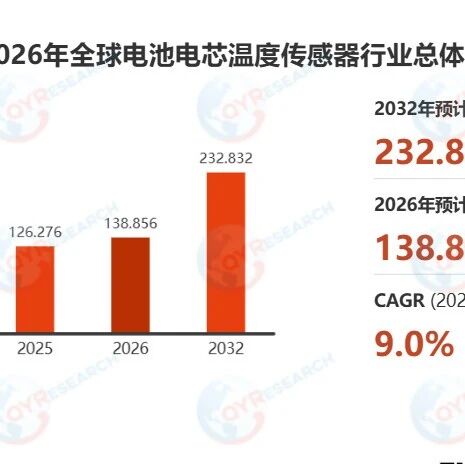
Core Viewpoint - The battery cell temperature sensor market is projected to reach $3.424 billion by 2032, with a compound annual growth rate (CAGR) of 8.99% in the coming years [1][5]. Industry Overview - Battery cell temperature sensors are critical components in battery management systems, used for real-time monitoring of individual cell temperatures to prevent thermal runaway, optimize charge and discharge efficiency, and extend battery lifespan [1]. - The supply chain includes upstream components like semiconductor materials and packaging materials, midstream manufacturing and calibration, and downstream applications in electric vehicles, consumer electronics, and energy storage systems [1]. Market Dynamics Key Drivers - Stricter safety regulations for power batteries are driving the need for real-time, high-precision monitoring of cell temperatures, as mandated by various international standards [5]. - The proliferation of high-energy-density batteries, such as nickel-rich and silicon-carbon anodes, increases the demand for high-end sensors due to their heightened thermal sensitivity [6]. - The evolution of battery management systems towards a "cloud + edge" architecture necessitates advanced temperature data inputs for AI thermal runaway warning models, pushing sensors from single-point to multi-point distributed monitoring [6]. Major Obstacles - Cost pressures and intense price competition are compressing the unit price of temperature sensors, making it difficult for small and medium enterprises to invest in high-precision technology development [7]. - Long-term reliability testing requirements, such as AEC-Q200 certification, pose challenges for domestic manufacturers in terms of material stability and packaging processes [7]. - Low standardization across different battery structures and installation methods complicates the design and integration of temperature sensors [7]. Industry Opportunities - The emergence of solid-state batteries, which operate over a wider temperature range, is creating demand for new temperature sensing technologies, such as film-type and wireless sensors [8]. - The trend towards domestic supply chain localization by leading battery manufacturers is opening opportunities for local sensor companies with automotive-grade certification [8]. - The integration of multiple sensing parameters (temperature, voltage, pressure) into single sensors is becoming a trend, enhancing space utilization and system efficiency [8].
SMD热敏电阻市场细分研究报告(总体规模、主要厂商、产品&应用)
QYResearch· 2026-01-07 08:58
Core Viewpoint - The SMD thermistor market is projected to grow significantly, with a global revenue forecast of approximately $270.61 million in 2024, reaching $430.18 million by 2031, representing a compound annual growth rate (CAGR) of 6.95% from 2024 to 2031 [3]. Market Overview - SMD thermistors are electronic components that change resistance with temperature, widely used in temperature sensing, overheat protection, and temperature compensation [2]. - The global market for SMD thermistors is dominated by NTC type thermistors, which are expected to reach a market size of $181.43 million in 2024 and $265.05 million by 2031, with a CAGR of 5.67% from 2025 to 2031 [5]. Regional Analysis - In 2024, the Chinese market for SMD thermistors is estimated to be around $117.11 million, accounting for approximately 43.28% of the global market. North America and Europe are expected to hold market shares of 16.98% and 15.41%, respectively [5]. - The CAGR for the Chinese market is projected at 8.1%, while the U.S. and European markets are expected to grow at CAGRs of 4.10% and 5.28%, respectively [5]. Application Segments - The consumer electronics sector is the largest downstream application for SMD thermistors, with a market size of $95.69 million in 2024, anticipated to grow to $144.07 million by 2031, reflecting a CAGR of 6.08% from 2025 to 2031 [8]. Competitive Landscape - Major global players in the SMD thermistor market include Thinking Electronic, TDK Corporation, Murata, Shiheng Electronic, TE Connectivity, and Panasonic, with the top five companies expected to hold over 27.73% of the market share in 2024 [11]. Market Drivers - The growth in market demand is driven by the rapid development of smart appliances, automotive electronics, renewable energy, and environmental protection, which require high precision in temperature control [12]. - The expansion of application fields for SMD thermistors includes smart homes, medical devices, industrial automation, and aerospace, with increasing precision requirements [13]. - Government policies supporting environmental protection and sectors like new energy vehicles and smart homes are providing significant growth opportunities for the market [14]. Market Restraints - Intense price competition among numerous market players makes it challenging to increase product prices and profit margins [15]. - The demand for smaller and more compact electronic devices may impose higher requirements on the size and performance of SMD thermistors [16]. - Changes in market demand, such as reduced consumer spending on electronic devices, could impact the demand for SMD thermistors [18]. Development Trends - The application fields for SMD thermistors are continuously expanding, with significant growth expected in consumer electronics, automotive, home appliances, and industrial equipment [19]. - Technological advancements are enhancing the performance of SMD thermistors, enabling them to meet higher precision and wider temperature range requirements [19]. - Policy support and supply chain optimization are crucial for market development, particularly in the environmental sector [20].

QuantumScape vs. SES AI: Which Battery Stock Looks Better Now?
ZACKS· 2025-12-30 13:35
Core Insights - QuantumScape Corp. (QS) and SES AI Corp. (SES) are competing in the lithium-based battery market with differing strategies [1] - QuantumScape focuses on fully solid-state batteries for electric vehicles (EVs), while SES AI combines lithium-metal batteries with artificial intelligence [2] QuantumScape Overview - QuantumScape aims to deliver lighter, faster-charging, and safer solid-state batteries compared to lithium-ion technology, representing a significant breakthrough for EVs [5] - The company launched its Cobra manufacturing process in June 2025, which is 25 times faster than the previous Raptor system, facilitating large-scale production [6] - QuantumScape's shares have increased by approximately 104% year-to-date, indicating strong investor interest [3][7] - The company has begun delivering B1 samples produced with the Cobra process to automakers, with several major manufacturers evaluating these new cells [6] - Partnerships are crucial for QuantumScape, including a $131 million agreement with Volkswagen's PowerCo to support the QSE-5 pilot line [9] - QuantumScape recorded $12.8 million in customer billings for the first time in Q3, marking progress toward commercialization [10] SES AI Overview - SES AI is integrating AI with lithium-metal batteries, targeting higher energy density for various applications, including EVs and energy storage [12] - The company is in the early stages of commercialization and faces challenges in scaling production of lithium-metal batteries [12] - SES AI's Molecular Universe platform uses AI to optimize battery materials, with plans to monetize through software subscriptions and battery products [13] - The acquisition of UZ Energy allows SES to enter the energy storage systems market, targeting a $300 billion opportunity [14] - SES AI's revenues reached $16.4 million in the first nine months of 2025, with a full-year target of $20–$25 million [17] Comparative Analysis - QuantumScape's focused strategy on solid-state batteries provides clearer execution visibility compared to SES AI's broader approach, which includes multiple technologies and markets [18][19] - SES AI's diverse strategy increases execution risk, especially with limited revenues at this stage [18] - QuantumScape's recent manufacturing advancements and OEM support suggest a more straightforward path to market [19] - QuantumScape is currently rated as a better investment option compared to SES AI, which has a lower ranking [20]


中国加速度传感器行业 营销渠道与占有率调查报告2026年版
Sou Hu Cai Jing· 2025-12-26 11:33
中国加速度传感器行业 营销渠道与占有率调查报告2026年版 【全新修订】:2025年12月 【出版机构】:鸿晟信合研究院 【内容部分有删减·详细可参鸿晟信合研究院出版完整信息!】 【免费售后 服务一年,具体内容及订购流程欢迎咨询客服人员 】 报告目录 1 加速度传感器市场概述 1 1.1 产品定义及统计范围 1 1.2 按照不同产品类型,加速度传感器主要可以分为如下几个类别 1 1.2.1 全球不同产品类型加速度传感器销售额增长趋势2020 VS 2024 VS 2031 1 1.2.2 电容式 3 1.2.3 压电式 3 1.2.4 压阻式 4 1.2.5 其他 4 1.3 从不同应用,加速度传感器主要包括如下几个方面 4 1.3.1 全球不同应用加速度传感器销售额增长趋势2020 VS 2024 VS 2031 4 1.3.2 汽车 6 1.3.3 消费电子 6 1.3.4 航空航天和国防 7 1.3.5 其他 7 1.4 加速度传感器行业背景、发展历史、现状及趋势 8 1.4.1 加速度传感器行业目前现状分析 8 5.7.3 TDK加速度传感器销量、销售额、价格及毛利率(2020-2025) 52 5. ...

数字经济双周报(2025年第23期):美国启动“科技力量”计划,展开举国AI动员-20251224
Yin He Zheng Quan· 2025-12-24 07:00
Group 1: U.S. AI Initiatives - The U.S. government has launched the "U.S. Tech Force" program to mobilize national AI capabilities, involving agencies like OPM, OMB, GSA, and OSTP[7] - The program includes 28 initial private sector partners such as Adobe, Amazon Web Services, and AMD, with plans for further expansion[7] - This initiative reflects a broader trend of nations reorganizing resources as AI evolves from an industrial tool to a foundational national capability[10] Group 2: Global AI Developments - China is focusing on AI, computing power, and data as key components of its "14th Five-Year Plan," indicating a consensus on digital economic development[3] - The EU is advancing its AI governance framework, with a focus on enforceable regulations and expanding computational power[20] - Other countries, including South Korea and Japan, are enhancing their AI and semiconductor competitiveness through national capital and institutional tools[22][23] Group 3: AI Governance and Infrastructure - The U.S. is moving towards a unified AI governance framework, with federal oversight of AI regulation marking a new phase in governance[17] - The expansion of AI infrastructure in Europe is characterized by a dual approach of sovereign power and commercial capital[21] - AI safety and data governance are transitioning from principles to actionable tools, indicating a systematic approach to regulation[15]
Q425 智能手机调研:内存短缺会影响需求吗-UBS Evidence Lab inside 4Q25 Smartphone Survey_ Will memory shortages impact demand_
UBS· 2025-12-15 01:55
Investment Rating - The report maintains a cautious outlook on the smartphone industry, with a preference for component suppliers over OEMs due to rising memory prices and supply challenges [5][8]. Core Insights - The smartphone industry is expected to face challenges in 2026, with limited unit growth forecasted at +1.0% YoY in 2026 and +2.0% YoY in 2027, following a +3.5% YoY growth in 2025 [2][8]. - The UBS Evidence Lab 4Q25 Smartphone Survey indicates a moderate increase in purchase intent, with 40% of respondents planning to buy a smartphone in the next 12 months, up from 36% in 2Q25 [3][19]. - Rising memory prices are projected to significantly impact Bill of Material (BOM) costs, potentially accounting for approximately 14% of flagship smartphone BOM costs and 34% of mid-range/lower-end smartphone BOM costs by 4Q26 [4][101]. Summary by Sections Industry Outlook - The smartphone market is anticipated to grow moderately, with unit sell-in forecasts slightly raised to 1.27 billion units in 2025 and 1.28 billion units in 2026, reflecting a +3.5% and +1.0% YoY growth respectively [50][55]. - The average age of the smartphone installed base has decreased to 22.0 months, indicating a normalization in the replacement cycle [30][44]. Purchase Intent Trends - Purchase intent for the iPhone 17 series is strong, with 66% of respondents interested in this model, up from 61% for the iPhone 16 series [3][89]. - Retention rates for Apple and Samsung remain stable at 87% and 75% respectively, while Chinese OEMs have seen declines in retention rates [59][61]. Component Supplier Preference - The report favors component suppliers such as ASE, SK Hynix, and TSMC, while maintaining neutral ratings on major OEMs like Apple, Lenovo, and Xiaomi, and a buy rating on Samsung Electronics [5][8]. - The memory supply shortage is expected to create significant challenges for OEMs, particularly smaller ones, as they may struggle to secure adequate memory supply [4][110].
