
Rigetti Computing Inc.

Search documents
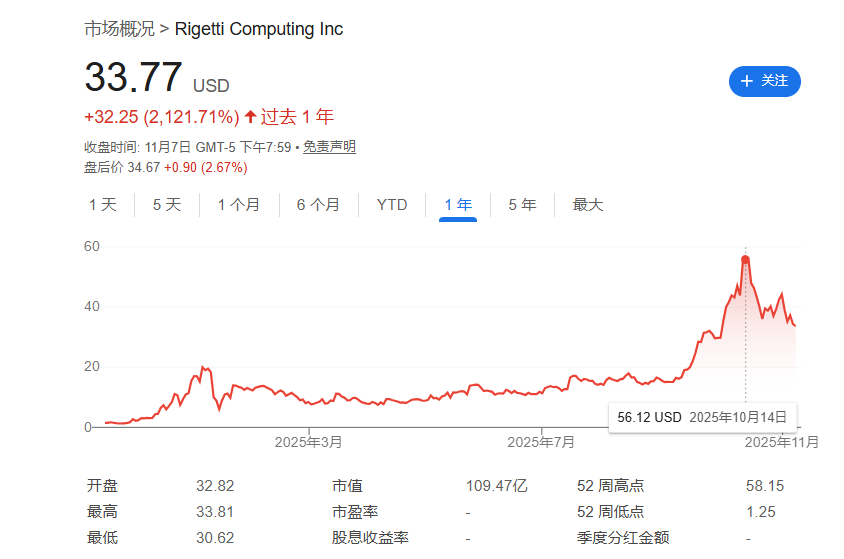
12个月涨超1900%,“量子妖股”远超“AI妖股”
美股IPO· 2025-11-10 07:05
量子计算概念股的市场狂热正在上演。以Rigetti和D-Wave为首的公司,在几乎没有收入和实际应用的情况下,股价于12个月内一度暴涨1900%,市值 突破百亿美元。这一现象引发了市场关于"下一个颠覆性技术"与"投机泡沫"的激烈辩论。 以Rigetti Computing Inc.和D-Wave Quantum Inc.为代表的量子计算公司,在过去12个月里股价一度飙升超过1900%,表现远超许多热门人工智能股 票,成为市场中最具争议的投机热点。 这一惊人涨幅使两家公司的市值双双突破100亿美元,甚至远超AI明星公司Palantir,也超过了金宝汤公司(Campbell's Co.)等老牌企业。然而,它们目 前几乎没有实际应用,且预计未来数年都无法产生可观收入,现金消耗巨大。 市场对此看法两极分化。多头认为,量子计算有望解决从疾病治疗到气候变化等重大问题,是不容错过的下一个颠覆性技术。而空头则警告称,这只是 一个由投机情绪驱动、缺乏基本面支撑的泡沫,注定将会破灭。 在人工智能热潮之后,资本市场正将目光投向量子计算这一更具想象空间的领域。 泡沫担忧并非空穴来风。据彭博汇编数据,Rigetti的估值超过其远期销售 ...


12个月涨超1900%,“量子妖股”远超“AI妖股”
Hua Er Jie Jian Wen· 2025-11-10 02:02
Core Insights - The capital market is shifting its focus from artificial intelligence to quantum computing, which is seen as a field with greater potential for innovation [1] - Quantum computing companies like Rigetti Computing Inc. and D-Wave Quantum Inc. have experienced stock price surges exceeding 1900% over the past year, outperforming many popular AI stocks [1] - Despite their impressive stock performance, these companies currently lack practical applications and are not expected to generate significant revenue in the coming years, leading to high cash burn rates [1] Market Sentiment - There is a polarized view in the market regarding quantum computing; bulls believe it can address major issues like disease treatment and climate change, while bears warn of a speculative bubble lacking fundamental support [1] - Concerns about high valuations are substantiated, with Rigetti's valuation exceeding 500 times its forward sales, compared to 72 times for AI company Palantir and less than 6 times for the Nasdaq 100 index [4] - Despite high valuations, Wall Street analysts remain optimistic, with all ten analysts covering D-Wave recommending a buy, although some analysts face backlash for their bullish outlook on Rigetti [4] Stock Performance - Rigetti's stock has seen a decline of approximately 28% over the past month, while D-Wave's stock has dropped around 16% in the same period [4] - As of November 7, Rigetti's market capitalization stands at $10.947 billion, with a closing price of $33.77, down 28.32% over the past month [5] - D-Wave's market capitalization is approximately $10.09 billion, with a closing price of $29.50, reflecting a decrease of 15.88% over the past month [7]
美股繁荣只是假象?“泰坦尼克”凶兆浮现,小心冰山!
Jin Shi Shu Ju· 2025-11-06 03:22
Group 1 - The U.S. major stock indices are close to historical highs despite recent mild weakness, indicating potential underlying issues in the market [1] - SentimenTrader's report highlights concerning signals related to the number of stocks participating in the recent rally, suggesting a possible period of sustained weakness ahead [1][2] - The "Titanic Syndrome" has flashed four times in the past five trading days, while the "Hindenburg Omen" has triggered twice, both indicating potential market trouble when they cluster [1][2] Group 2 - The "Titanic Syndrome" and "Hindenburg Omen" indicators are triggered during market breadth deterioration, where a few stocks drive index gains while most are declining [2] - Weak market breadth suggests that indices are more vulnerable to sell-offs, especially when the Nasdaq is near historical highs and the number of stocks hitting 52-week lows exceeds those hitting new highs [2] - Analysts emphasize that while these signals may not be alarming individually, their occurrence in clusters significantly increases their warning power [2] Group 3 - Extreme bullish indicators, significant breadth divergence, and complacent market sentiment are seen as a dangerous combination by analysts [3] - Speculative stocks, including popular quantum computing names, have faced pressure recently, with momentum trading experiencing sell-offs [3] - The S&P 500 index recently rebounded after its worst day in nearly a month, indicating some resilience in the market despite broader concerns [3]
量子计算怎么一下子成了“国家安全”下一个战场?
硬AI· 2025-10-27 09:29
Core Viewpoint - Quantum computing is rapidly transitioning from a laboratory concept to a central focus in geopolitical competition, with significant implications for national security and technological advancement [3][4]. Group 1: Technological Breakthroughs - Major U.S. quantum computing companies, including IonQ, have achieved significant technological milestones, with IonQ announcing a 99.99% gate fidelity breakthrough, indicating that "quantum advantage" could be reached within three to five years [3][6]. - Quantum advantage is defined by four criteria: at least 1,000 qubits, at least 99.9% fidelity for two-qubit gates, a maximum gate speed of 15 nanoseconds, and some form of error correction [6]. - The potential for quantum computing to solve large-scale optimization problems far exceeds that of traditional computers, which operate on binary systems [6]. Group 2: National Security Implications - Quantum computing poses a significant threat to existing encryption systems, with the ability to potentially crack sensitive communications in government, banking, and healthcare sectors [4][8]. - Governments are accelerating investments in post-quantum cryptography to safeguard against potential quantum attacks [4]. - The geopolitical landscape is intensifying, with China committing over $15.3 billion to quantum technology, significantly outpacing the U.S. government's $3.2 billion investment [4][10]. Group 3: Market Dynamics and Investment - The optimism surrounding quantum technology stocks has been reignited, despite many companies in the sector not yet achieving profitability [3][6]. - Financial institutions, including JPMorgan Chase, are actively investing in quantum computing as part of broader strategies to enhance national economic security [9][10]. - The integration of artificial intelligence with quantum computing is expected to unlock new levels of technological advancement, with AI accelerating quantum development and vice versa [10].

华尔街日报:量子计算怎么一下子成了“国家安全”下一个战场?
美股IPO· 2025-10-27 03:58
Core Insights - Major US quantum computing companies like IonQ are achieving technological breakthroughs, with predictions of reaching "quantum advantage" within 3-5 years, which could disrupt existing encryption systems and pose security threats to critical sectors like government and finance [1][3][4] Group 1: Technological Advancements - IonQ has announced a breakthrough with 99.99% gate fidelity, leading to optimism about achieving "quantum advantage" within a critical timeframe of 3-5 years [3][6] - Quantum advantage is defined by four criteria: at least 1000 qubits, at least 99.9% fidelity for two-qubit gates, gate speed of no more than 15 nanoseconds, and some form of error correction [6] - The transition from academic interest to a national security imperative is driven by the potential of quantum computing to solve complex problems traditional computers cannot handle [6][10] Group 2: Geopolitical Context - The competition between the US and China in quantum technology is intensifying, with China investing over $15.3 billion compared to the US's $3.2 billion [4][10] - Quantum technology is now viewed as a critical infrastructure, with significant government funding and strategic investments from major tech companies [9][10] Group 3: Investment Trends - The market is experiencing a surge in investment interest, with companies like Rigetti Computing seeing stock price increases of up to 3100% despite not yet achieving profitability [6][9] - Financial institutions are also ramping up their investments in quantum computing, with JPMorgan Chase announcing a $1.5 trillion plan that includes quantum technology as a key focus area [9] Group 4: Security Implications - The ability of quantum computers to break existing encryption methods poses a dual threat and opportunity, leading to increased government focus on post-quantum cryptography [8][9] - The Biden administration has enacted legislation to prepare federal systems for quantum threats, emphasizing the urgency of transitioning to quantum-resistant encryption [8][9]

Hot-Money Retail Traders Turn Momentum Chasers Into Bagholders
Yahoo Finance· 2025-10-22 20:49
Market Dynamics - A significant rally in shares of Beyond Meat Inc. saw an increase of over 1,000%, followed by a rapid decline in gains [1] - Retail traders are becoming a dominant force in the market, often driving prices up by buying dips but also causing volatility when chasing trends [2] Retail Trading Trends - The average daily trading volume of US-listed stocks has reached nearly 12 billion shares since the introduction of free trading in 2019, which is about 75% higher than the previous six-year average [5] - In the past year, the daily trading volume has averaged approximately 16.7 billion shares, indicating increased engagement among amateur traders [5] Retail Participation Metrics - Trades executed by off-exchange venues, such as those operated by equity wholesalers like Robinhood, are expected to account for 50% of total trades this year, marking a significant milestone [6] - Retail traders have consistently favored buying call options over puts, with demand for calls exceeding puts for 24 consecutive weeks, the longest streak since tracking began in 2020 [7] Sector-Specific Observations - Quantum computing stocks have experienced extreme volatility, with some stocks rising over 1,000% in the past year but facing significant declines recently, with drops of 6% or more in a single day [3]