
SES

Search documents
Kratos Defense & Security Solutions(KTOS) - 2025 Q4 - Earnings Call Transcript
2026-02-23 23:02
Kratos Defense & Security Solutions (NasdaqGS:KTOS) Q4 2025 Earnings call February 23, 2026 05:00 PM ET Company ParticipantsAnthony Valentini - VPAustin Moeller - Director of Equity ResearchBrock Cannon - Equity Research AssociateColin Canfield - DirectorDeanna Lund - EVP and CFOEric DeMarco - President and CEOGavin Parsons - Director of Aerospace and Defense Equity ResearchJosh Sullivan - Managing Director of Equity ResearchKen Herbert - Managing DirectorMarie Mendoza - Senior VP and General CounselMichael ...

Kratos Defense & Security Solutions(KTOS) - 2025 Q4 - Earnings Call Transcript
2026-02-23 23:00
Kratos Defense & Security Solutions (NasdaqGS:KTOS) Q4 2025 Earnings call February 23, 2026 05:00 PM ET Speaker15Good day, everyone, and welcome to Kratos Defense & Security Solutions' fourth quarter and fiscal year 2025 earnings conference call. At this time, all participants are in a listen-only mode. After the speaker's presentation, there will be a question-and-answer session. To participate, you will need to press star 11 on your telephone. You will then hear a message advising your hand is raised. To ...
金融时报:马斯克的太空数据中心,梦想还是现实?
Feng Huang Wang· 2026-02-10 09:11
Core Viewpoint - Elon Musk is betting on the future of AI in space by merging SpaceX with the struggling xAI, aiming to create a $1.25 trillion giant and potentially launch an IPO, with a focus on building data centers in space powered by solar energy and cooled by the vacuum of space [1] Group 1: Feasibility and Industry Perspectives - Industry executives and researchers believe that Musk's timeline for launching data centers in space is ambitious but increasingly feasible due to declining launch costs and rising AI computing demands [2] - Will Marshall, CEO of Planet, states that the project is timely and not just a publicity stunt for Musk's IPO, as they are already collaborating with Google on a pilot project for orbital data centers [2] - The concept of generating computing power in space dates back to Isaac Asimov's 1941 short story, with modern innovations focusing on using solar energy to power AI chips and transmitting processed data back to Earth via satellite networks [3] Group 2: Competitive Landscape - Other tech leaders, including Jeff Bezos, are also pursuing similar concepts, with Bezos predicting the construction of "giant gigawatt data centers" in space [4] - Google plans to collaborate with Planet to launch prototype satellites equipped with AI chips by early 2027 as part of its "Project Sunroof" [4] - Startups like Starcloud and Aetherflux aim to launch GPU chips into space within the next 12 months, driven by the rising energy consumption associated with AI [4] Group 3: Cost and Technical Challenges - The former CEO of SES, Steve Collar, acknowledges that while Musk's ideas may be ahead of their time, they align with future trends, particularly the efficient use of solar energy in the cold environment of space [5] - Philip Johnston, co-founder of Starcloud, asserts that the technology will be validated within two to three years, predicting that all computing power will be built in space within the next decade [6] - However, the economic viability of this concept hinges on several unproven assumptions, including significant reductions in launch costs and the ability of current AI hardware to withstand space conditions [6][7] Group 4: Future Outlook - A report from Google suggests that if launch costs can drop from at least $1,000 per kilogram to below $200 per kilogram, the operational costs of space data centers could become comparable to those on Earth [6] - Some believe that advancements in reusable rockets, such as SpaceX's Starship and Blue Origin's New Glenn, could change the economic calculations for launching satellites [7] - Despite the optimism, many in the tech industry remain skeptical about overcoming the technical and economic hurdles, with concerns about the weight and complexity of server racks in space [8]
可持续领域的防御策略:2026 年六大趋势-Sustainability-Defence in Sustainability Six Trends into 2026
2026-01-21 02:58
Summary of the Conference Call on Defence in Sustainability Industry Overview - The report focuses on the **Defence in Sustainability** sector, particularly in Europe, highlighting trends and insights for 2026 [2][3]. Key Trends and Insights 1. **Easing of Exclusions**: - Exclusions related to conventional and nuclear weapons are easing, with positioning in Article 9 and Article 8 funds increasing by approximately **5 percentage points** and **10 percentage points**, respectively [2][21]. - Investors are adopting a more nuanced approach towards conventional weapons, allowing exposure to military software and surveillance while maintaining exclusions on combat equipment [15][21]. 2. **Security as a Prominent Theme**: - The **Security** theme generated the highest net inflows in 2025, surpassing even AI and Big Data, and is expected to remain significant in 2026, encompassing national security, energy security, and cybersecurity [10][29]. 3. **Dual-use Technologies**: - There is growing investor interest in dual-use technologies, with some focusing on technologies applicable to both civilian and defence sectors, while others are identifying companies pivoting towards defence markets [30][32]. 4. **Autonomous Weapons Development**: - The development of autonomous weapons is primarily driven by private companies, with public corporates focusing on "wingman" capabilities. Significant deployment is not expected until the mid-2030s [33][35]. 5. **Anti-defence Technologies**: - The focus on cost-effective counter-warfare technologies is increasing due to the declining costs of offensive capabilities, such as low-cost drones. This trend is accelerating demand for scalable defensive solutions [38][39]. 6. **Corporate Restructuring**: - Companies outside traditional aerospace and defence (A&D) sectors are pivoting towards defence, with firms like thyssenkrupp and Indra Sistemas deriving over **5%** of their revenues from defence-related activities. There is also a trend of corporate restructuring to unlock valuation upside [41][43]. Additional Insights - The European Commission's stance on defence investing within sustainability remains unchanged, clarifying that nuclear weapons are not classified as controversial weapons [5]. - The report indicates that European defence spending is projected to reach **3% of GDP by 2030**, implying a **7% CAGR** and total spending exceeding **$700 billion** [47]. - The report highlights the importance of upcoming country-level defence budgets in driving order momentum and earnings estimates for companies in the sector [48]. Conclusion - The Defence in Sustainability sector is evolving with significant trends in exclusions, security themes, dual-use technologies, and corporate restructuring. The insights provided in this report are crucial for understanding the investment landscape and potential opportunities in the defence sector moving into 2026 [2][3][10].
Gilat Satellite Networks (NasdaqGS:GILT) FY Conference Transcript
2026-01-13 16:17
Summary of Gilat Satellite Networks FY Conference Company Overview - **Company**: Gilat Satellite Networks (NasdaqGS: GILT) - **Industry**: Satellite communication services and solutions - **Established**: Nearly 40 years ago - **Employees**: Approximately 1,200 across 20 locations - **Core Markets**: Defense, In-Flight Connectivity (IFC), solar backhauling, land mobility, maritime, government and enterprise connectivity, digital inclusion [2][3] Key Segments 1. **Defense Segment**: Focused on U.S. Department of Defense (DOD) and international markets 2. **Commercial Segment**: Includes IFC, solar backhauling, and enterprise solutions 3. **Peru Segment**: Provides both terrestrial and satellite-based solutions, connecting large parts of the country to fast internet [3][4] Market Dynamics - **Total Addressable Market (TAM)**: Expected to grow from approximately $4 billion to $7 billion in the coming years [6] - **Megatrends**: - Increased satellite capacity due to advancements in technology (from single beams to hundreds of beams) - 90% reduction in satellite launch costs [7] - **Focus Areas**: Very High Throughput Satellites (VHTS), Non-Geostationary Orbits (NGSO), and IFC [8] Financial Performance - **2025 Revenue Guidance**: Expected between $445 million and $455 million, representing a 47% growth year-over-year [13] - **EBITDA Guidance**: Expected to grow from $42 million to a midpoint of $50 million to $52 million, representing a 23% growth [13] Customer Base - **Key Customers**: Satellite operators (e.g., SES, Intelsat), service providers (e.g., T-Mobile, Gogo), system integrators (e.g., Boeing, General Dynamics), and government agencies [4][5] Recent Developments - **Acquisitions**: - Acquired Stellar Blu, enhancing IFC capabilities and contributing significantly to revenue [10][15] - Acquired DataPath, focusing on portable and transportable solutions for the defense sector, increasing revenues from $30 million to $100 million [12][30] - **New Products**: Introduction of SkyEdge 4 platform, designed for multi-orbit and high throughput constellations [9] Growth Opportunities - **Defense Market**: Anticipated growth due to increased defense budgets and demand for satellite solutions [11][32] - **Peru Operations**: Expected to grow from $60 million to a run rate of $80 million in the next two to three years, driven by large orders and recurring revenue [36][37] - **Line Fit Opportunities**: Anticipated growth in more profitable line fit orders compared to retrofit installations [21] Competitive Landscape - **Emerging Competition**: Increased interest in sovereign satellite constellations due to geopolitical factors, with countries seeking independence from major players like Starlink [39][41] - **Market Position**: Gilat's technology is considered three to five years ahead of competitors, positioning the company well for future growth [40] Conclusion - **Outlook**: Gilat is poised for significant growth driven by advancements in satellite technology, strategic acquisitions, and expanding market opportunities in both defense and commercial sectors. The company aims to leverage its advanced technology and strong customer relationships to capitalize on the growing demand for satellite communication solutions [38][39]
AI4S电池创新价值兑现,三个痛点:真实、规律、效率
高工锂电· 2026-01-13 15:57
Core Viewpoint - The article emphasizes that while AI has made significant advancements, particularly in language models, it still lacks a true understanding of the physical world, which limits its potential applications in scientific fields [1][20]. Group 1: AI's Limitations and Future Directions - Current mainstream AI excels in language and statistical associations but struggles to grasp fundamental concepts like distance, scale, and causality [1]. - The concept of "AI for Science" (AI4S) is introduced as a critical pathway that aims to integrate AI into scientific research, focusing on understanding the physical world governed by chemistry and physics [2][20]. - AI4S is not merely an enhancement of computational power but a targeted approach to solving complex scientific problems [2]. Group 2: Industry Applications and Capital Market Interest - AI4S is transitioning from concept to practical applications, with SES AI's "Molecular Universe" platform demonstrating real economic value through the development of new electrolyte materials [3]. - The capital market is increasingly interested in AI4S, with several companies in this space achieving billion-dollar valuations, indicating a growing recognition of its commercial potential [3][4]. - SES AI has developed six breakthrough electrolyte materials, showcasing the practical applications of AI4S in industries like battery manufacturing [3][7]. Group 3: Case Studies and Success Stories - The success of companies like Jingtai Technology, which became the first "specialized technology stock" in Hong Kong, illustrates the potential of AI4S in the pharmaceutical sector [4]. - The growth of AI4S companies is often rooted in long-term, practical experience in specific scientific fields rather than merely competing in model capabilities [4][6]. Group 4: Technological Innovations and Breakthroughs - SES's MU platform has produced innovative solutions across various applications, including electric vehicles and drones, with significant performance improvements over industry benchmarks [7][8][10]. - The introduction of the "Flavor" system in MU-1.5 allows AI to leverage both known scientific knowledge and hidden data correlations, enhancing its predictive capabilities [14][15]. Group 5: Efficiency and Future Prospects - The MU platform aims to transform research efficiency by integrating a comprehensive workflow that reduces costs and accelerates development cycles [16][17]. - The "MU in a Box" initiative allows for localized deployment of the MU platform, enabling companies to utilize their proprietary data for tailored AI applications [17][18]. - The article concludes that the true value of AI4S lies in its ability to enhance scientific understanding and drive efficient research, positioning it as a critical component of future innovations in battery technology and beyond [20][22].

中国版“猎鹰”加速!蓝箭航天冲刺科创板,卫星产业仍将狂飙?
Jin Rong Jie· 2026-01-05 06:39
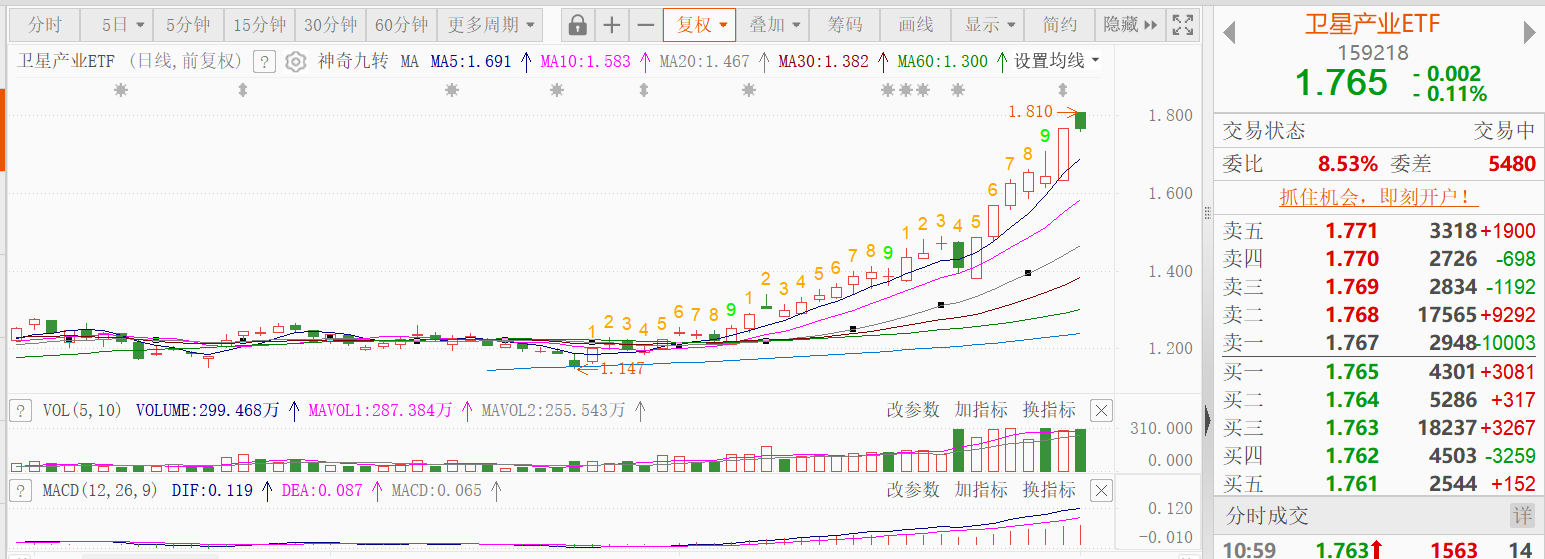
Group 1: Market Overview - On the first trading day of the year, global capital markets experienced a strong start, with the Shanghai Composite Index successfully breaking through 4000 points [1] - The satellite industry ETF showed strong performance but faced profit-taking sell-offs, leading to a decline near midday [1] - The daily trend indicates that the bullish arrangement of moving averages remains unchanged, and a pullback to the 5-day line can be seen as a good opportunity for positioning [1] Group 2: Industry Developments - Blue Arrow Aerospace, a leading player in China's commercial space sector, has had its IPO application accepted, aiming to raise 7.5 billion yuan for the production and R&D of reusable rockets, marking a key step towards commercialization [3] - The industry is driven by several factors, including policy support, with the "14th Five-Year Plan" outlining a clear roadmap for the launch of multiple new rocket types by 2026 [3] Group 3: Commercialization and Applications - Since 2025, China has completed 87 space launches, with private commercial rocket companies executing 23 of these, successfully placing 324 spacecraft into orbit [4] - The application scenarios are continuously expanding, with China Telecom reporting over 25 million units of mobile terminals supporting direct satellite connectivity sold by November 2025 [4] - The initiation of satellite IoT commercial trials and advancements in reusable rocket technology are accelerating the formation of integrated communication networks, injecting strong momentum into the digital economy [4] Group 4: Global Competition - The global competition in the commercial space sector is intensifying, with major players like SpaceX and Amazon leading low Earth orbit communication constellations, while traditional giants like Lockheed Martin and Boeing focus on high-value government markets [5] - In Europe, companies like Airbus and Thales are balancing government projects with commercial services, while OneWeb offers differentiated competitive advantages [6] - In China, major groups like Aerospace Science and Technology and Aerospace Science Industry lead significant projects, while commercial companies focus on small satellite manufacturing and launches [6] Group 5: Industry Outlook - Major countries worldwide are increasing their investments in the commercial space sector, which will enhance the overall industry climate and further promote technological development [7] Group 6: Investment Tools - The satellite industry ETF (159218) tracks the CSI Satellite Industry Index (931594.CSI), covering the entire industry chain from manufacturing and launching to operational services and terminal applications, providing investors with a streamlined way to invest in this high-growth sector [9] - The index's core advantage lies in its unique compilation rules, which adjust weights based on the proportion of revenue from satellite-related businesses, meaning companies with higher revenue contributions have greater weight in the index [9]
Electrovaya (NasdaqCM:ELVA) FY Conference Transcript
2025-11-19 22:22
Summary of Electrovaya Conference Call Company Overview - **Company**: Electrovaya - **Ticker**: ELVA - **Industry**: Lithium-ion battery technology - **CEO**: Rajdas Gupta - **VP of Investor Relations**: Jason Roy - **Client Status**: New client of Three Part Advisers since November [2][3] Core Technology and Product Offering - **Infinity Battery Technology**: Developed in 2018, enhances cycle life by a factor of four compared to traditional lithium-ion batteries [5] - **Cycle Life**: Electrovaya batteries can achieve 10,000 cycles at 100% depth of discharge and 15,000 cycles at normal utilization [6] - **Safety Features**: Utilizes a full ceramic separator technology, unique in the industry, to mitigate fire risks associated with lithium-ion batteries [8][31] - **Market Applications**: Focused on material handling, robotics, energy storage, and defense sectors, avoiding the highly competitive automotive battery market [10][21][23] Market Position and Financial Performance - **Client Base**: Powers operations for 16 Fortune 100 companies, particularly in retail, across over 300 warehouse sites globally [14] - **Financial Results**: Achieved 10 consecutive quarters of positive EBITDA and expects to be net profitable for the full year of 2025 [14][15] - **Manufacturing Expansion**: New manufacturing facility in Jamestown, New York, under construction, expected to start operations in fall 2024 [15][41] Competitive Advantages - **Domestic Production**: Provides a competitive edge, especially for defense applications [17] - **High Margins**: Battery systems sold at margins around 30%, with expectations for further improvement due to domestic manufacturing [46] - **Long-lasting Technology**: Demonstrated longevity with batteries still operational after years of use, providing significant savings to customers [29] Future Growth and Market Segments - **Targeted Markets**: Expanding into robotics, airport ground equipment, and energy storage, with expected multimillion revenue in robotics by 2026 [18][24] - **Partnerships**: Collaborations with major companies like Toyota Material Handling and Sumitomo Corporation to enhance market reach [26][27] - **Emerging Technologies**: Developing solid-state batteries and energy as a service models to diversify offerings [36][39] Financial Health and Investment - **Recent Funding**: Completed an equity round raising $28 million and secured a $25 million working capital facility from BMO [44] - **Revenue Growth**: Anticipated revenue of approximately $20 million for Q4, continuing a growth trajectory [43][44] Key Challenges and Considerations - **Cost Differential**: Higher initial costs for Electrovaya's batteries compared to conventional options, but justified by performance and safety benefits [49][50] - **Market Complexity**: Navigating a complex battery market with various emerging technologies and competitors [19][20] Conclusion Electrovaya is positioned as a leader in the lithium-ion battery market for mission-critical applications, leveraging its unique technology and strong financial performance to expand into new markets while maintaining a focus on safety and longevity. The company is well-prepared for future growth with ongoing investments in manufacturing and technology development.

X @Bloomberg
Bloomberg· 2025-11-19 09:18
Hedge fund manager Davide Leone boosted his stake in SES this year, wagering the satellite company’s strategic shift toward defense will unlock long-term value https://t.co/AmHh5JgvAw ...
宇宙人(1869期)嫦娥六号样品中找到月球赤铁矿;马斯克最新访谈:目标每年发射100吉瓦AI卫星;宇树科技完成 IPO 辅导
Sou Hu Cai Jing· 2025-11-17 13:53
Group 1 - China's Chang'e 6 mission has discovered micron-sized hematite (α-Fe2O3) and magnetite (γ-Fe2O3) crystals from lunar samples, marking a significant breakthrough in lunar science research [1][3] - The research indicates that large impact events can create a transient high oxygen fugacity environment, leading to the oxidation of iron sulfide (FeS) and the formation of hematite and magnetite, challenging the traditional view of the Moon's lack of oxidation [3] Group 2 - China Telecom has achieved a milestone by completing the world's first quantum-classical hollow-core fiber transmission experiment over a distance of 101.6 kilometers, showcasing advanced technology in quantum communication [4] - The experiment utilized innovative spectrum coordination and crosstalk suppression techniques, achieving a stable transmission capacity of 37.6 Tbps and a key rate of 5 kbps, positioning China Telecom as a leader in this field [4] Group 3 - Elon Musk aims to launch 100 gigawatts of solar-powered AI satellites annually, which he believes could be the most cost-effective way to power large-scale AI operations [5] - Musk emphasized the importance of collaboration with TSMC and Samsung for AI chip manufacturing, expressing concerns about the lengthy timeline for new wafer fabrication plants [5] Group 4 - Blue Origin successfully completed the second flight of its New Glenn rocket, achieving a vertical landing of the booster on a recovery ship, and is evaluating whether to reuse the booster for future flights [6][8] - The company plans to launch the "Blue Moon" MK1 lunar lander in its next mission, with a goal to produce 20 second stages annually by 2026 [8] Group 5 - SES has signed a contract with Infinite Orbits to become the first commercial customer for its "Endurance" satellite servicing vehicle, aimed at extending the lifespan of geostationary satellites [11] - SES is developing a comprehensive satellite servicing system that includes robotic docking and propulsion upgrades, setting a new standard for GEO fleet management [11] Group 6 - Sierra Space's "Dream Chaser" spaceplane has completed critical electromagnetic interference tests, confirming its systems will not interfere with its rocket or itself [12][14] - The company plans to focus on national security applications for the Dream Chaser, which was originally developed for cargo missions to the International Space Station [14] Group 7 - Virgin Galactic confirmed its new generation Delta suborbital spaceplane is on track for test flights in Q3 2026, with commercial flights expected to begin shortly thereafter [16] - The company plans to resume ticket sales in 2026, with prices expected to increase from the previous $600,000 [16] Group 8 - OHB expressed concerns over the necessity of a joint venture among competitors in the European aerospace sector, questioning its impact on market opportunities [19] - OHB anticipates significant growth in European government space spending, including a planned investment of €35 billion in military space systems over the next five years [19] Group 9 - Canadian company SBQuantum has secured an €800,000 contract from the European Space Agency to develop a quantum diamond magnetometer, enhancing Earth observation capabilities [20][22] - The instrument aims to provide superior sensitivity for monitoring ecological changes, leveraging advanced laser and microwave technology [20] Group 10 - A bipartisan group of Maryland Congress members has raised concerns about NASA's plans to close facilities at the Goddard Space Flight Center, fearing it may weaken research capabilities [23][25] - NASA has defended its consolidation plan, stating it will save operational costs while maintaining mission support [25] Group 11 - Yushu Technology has completed its IPO counseling and plans to apply for an initial public offering in China [27] - The company is backed by its controlling shareholder, Wang Xingxing, who holds a significant portion of its equity [27] Group 12 - Alibaba's AI application "Tongyi" has undergone a major rebranding, now named "Qianwen," and has launched with enhanced features aimed at competing with top AI applications globally [27][28] Group 13 - Google's new model for transcribing ancient texts has achieved a core error rate of only 0.56%, demonstrating high accuracy comparable to expert transcribers [29] - The model showcases strong adaptability and contextual reasoning capabilities, enhancing its performance in complex transcription tasks [29]
