
UBTECH

Search documents
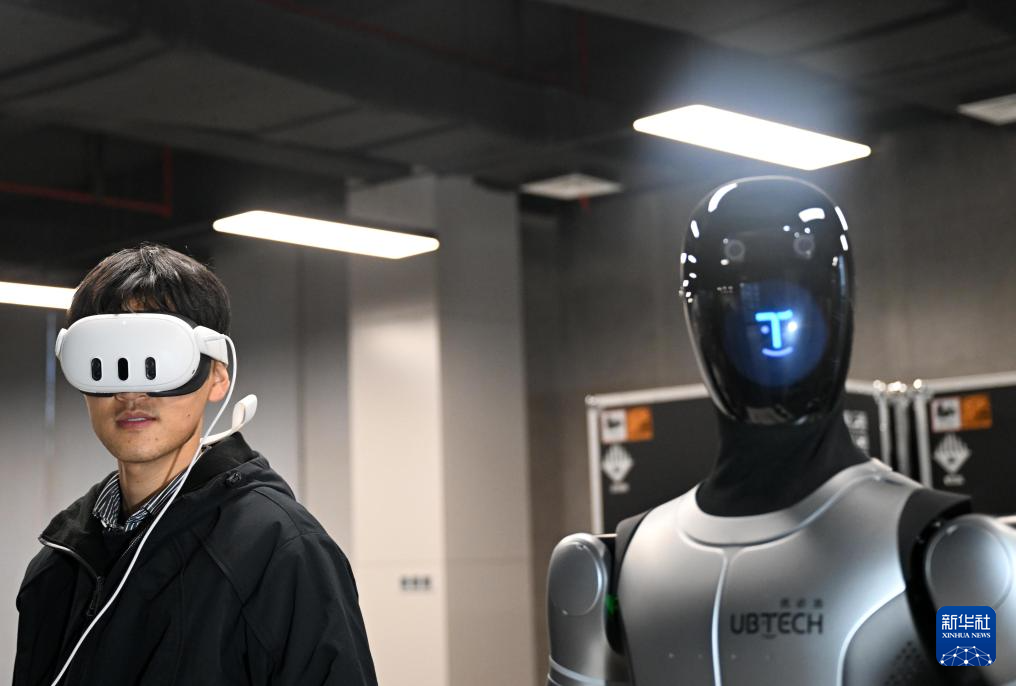
广西柳州:00后“奶爸”教机器人学“做人”
Xin Hua Wang· 2026-02-14 00:44
. UBTECH 4:30 NON I WALKER UBTECH I WALKER UBTECH I WALKER ■ 7 미국 8 IT -f 新华社 ASS 柳州具身智能 12 D UBTECH 新华社 AD 0 0 0 Edit UBTECH 新目前 香蕉 . 新目市 000 DICE: บBუ๕๕Å St WALKER P 新增加 参考 MHH 0 ( 新目前 香港 C . 8 o (80) s 新目前 . O ® 2017 部目 24- 214 UBTECH Ch 1 ■ and Search n e a 日本 e and 新华社 (11) AD - > 新目前 ...


物理人工智能
美国安全与新兴技术中心· 2026-02-06 02:00
Investment Rating - The report does not explicitly provide an investment rating for the Physical AI industry Core Insights - The convergence of AI and robotics, termed Physical AI, is seen as a potential breakthrough akin to previous technological revolutions, with significant market growth anticipated, particularly in humanoid robotics, projected to reach $5 trillion by 2050 [3][12][49] - The industry faces challenges including technology and economic barriers, with a lack of standardization in the robotics supply chain hindering scalability and innovation [4][14][21] - Policymaker interest in Physical AI is driven by economic, social, and national security factors, particularly in addressing labor shortages and enhancing operational efficiency in various sectors [12][14] Summary by Sections Introduction - Physical AI enables autonomous machines to learn and interact with their environment, with current focus on humanoid, industrial, and autonomous mobile robots [8][10] AI-Robotics Supply Chain - The report outlines the hardware and software supply chains essential for Physical AI, highlighting the need for breakthroughs in both areas to support the convergence of AI and robotics [5][16] Robotics Hardware Supply Chain - The hardware supply chain is characterized by a lack of standardization, which limits economies of scale and innovation among component suppliers [21][64] - Key components include structural systems, actuation systems, power systems, computing systems, and sensor systems, each with specific requirements and challenges [19][22] Robotics Software Supply Chain - Advances in AI, including large language models and reinforcement learning, are enhancing how robots are trained and how they learn from their environments [27][28] - The software ecosystem is critical for enabling robots to understand and interact with the physical world effectively [34][60] Competitiveness Assessment - The report assesses global competitiveness in AI-robotics convergence, noting that while China leads in research output, the U.S. excels in highly cited work and investment [37][42] - U.S. firms dominate in investment and patenting activities, particularly in specific sub-markets of robotics [44][43] Market Analysis - The global AI-robotics market is projected to grow significantly, with estimates suggesting it could exceed $100 billion in the next decade [49][50] - The market for humanoid robots is expected to grow from $6 billion today to $38 billion by 2035, with substantial investment directed towards warehouse robotics [48][49]
机器人行业周报:1XTechnologies发布世界模型,SkildAI获14亿美元融资
GUOTAI HAITONG SECURITIES· 2026-01-20 03:15
Investment Rating - The report assigns an "Overweight" rating to the robotics industry, indicating a projected performance that exceeds the Shanghai and Shenzhen 300 Index by more than 15% [5][26]. Core Insights - The robotics industry is experiencing significant advancements with the release of the "World Model" by 1X Technologies, which enables the NEO robot to achieve autonomous learning, marking a pivotal step towards embodied intelligence [5][7]. - There is a robust demand in the investment and financing market, with notable funding rounds such as Skild AI securing $1.4 billion to develop a general-purpose robot "brain" [5][13]. - The domestic market is witnessing a surge in new products and applications, with companies like Matrix Super Intelligence and Kepler Robotics making strides in humanoid robot capabilities [5][8][10]. Summary by Sections Industry News and Company Developments - 1X Technologies launched the "World Model" for its NEO humanoid robot, allowing it to autonomously learn and execute tasks based on real-world physics [7]. - Humanoid and Schaeffler announced a strategic partnership to integrate humanoid robots into manufacturing, enhancing industrial automation [7]. - The CES 2026 showcased significant participation from Chinese humanoid robot companies, highlighting advancements in technology and applications [12]. Investment and Financing Dynamics - Skild AI raised $1.4 billion from major investors including SoftBank and NVIDIA, emphasizing a shift in focus from hardware to the cognitive capabilities of robots [13]. - The domestic company Self-Variable Robotics completed a 1 billion yuan A++ financing round led by ByteDance, indicating strong investor interest in the sector [13]. - The first robot leasing platform, "Qingtian Rent," successfully completed seed financing, demonstrating a growing business model in the robotics market [13]. Investment Recommendations - The report recommends focusing on both complete robot manufacturers and core component suppliers, including actuators, motors, reducers, and sensors, with specific companies highlighted for investment [5][18]. - Key recommended companies include Zhaowei Electromechanical, Mingzhi Electric, and Jiechang Drive for actuators and motors, and others for reducers and precision components [18].


2025年卖出超5000台 智元登顶全球人形机器人出货量榜首
Zhong Guo Jing Ying Bao· 2026-01-09 04:41
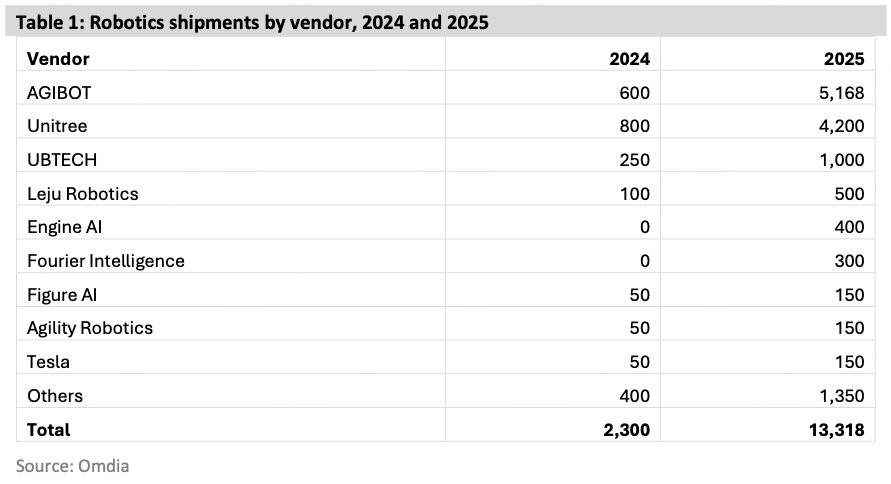
| Vendor | 2024 | 2025 | | --- | --- | --- | | AGIBOT | 600 | 5,168 | | Unitree | 800 | 4,200 | | UBTECH | 250 | 1,000 | | Leju Robotics | 100 | 500 | | Engine Al | 0 | 400 | | Fourier Intelligence | 0 | 300 | | Figure Al | 50 | 150 | | Agility Robotics | 50 | 150 | | Tesla | 50 | 150 | | Others | 400 | 1,350 | | Total | 2,300 | 13,318 | 2025年,智元(AGIBOT)机器人出货量超过5000台。Omdia/图 中经记者杨让晨张家振上海报道 2026年1月8日,全球权威市场研究机构Omdia正式发布《通用具身机器人市场雷达报告》(以下简称《报告》),系统分析了 2025年全球人形机器人的市场趋势、关键商用指标与综合技术实力。 《中国经营报》记者注意到,上述《报告》显示,202 ...
具身智能产业深度研究(七):新一代“蓝领”:人形机器人如何站上工厂流水线
Haitong Securities· 2025-12-17 06:28
Investment Rating - The report does not explicitly state an investment rating for the industry Core Insights - In industrial scenarios, humanoid robots are primarily suited for handling and quality inspection tasks, with a focus on ROI and the potential for expansion into more processes as their generalization capabilities improve [1][10][11] - The market demand for humanoid robots in China's industrial sectors, including automotive manufacturing, electronics manufacturing, and logistics warehousing, is projected to reach 484,000 units by 2035, with a market space exceeding 48 billion yuan [4][12] Summary by Sections 1. Core Insights - Humanoid robots are best suited for handling and quality inspection tasks, gradually expanding into basic assembly tasks as their capabilities develop [3][11] - The commercial viability hinges on achieving a return on investment (ROI) within two years, necessitating a reduction in robot prices to around 100,000 yuan and efficiency improvements to match human performance [3][11] 2. Industrial Manufacturing Flexibility - The demand for flexibility in manufacturing is increasing, with humanoid robots starting from short-chain tasks and gradually taking on more complex tasks [2][16] - Humanoid robots complement industrial robots, adapting to flexible production needs and enhancing operational efficiency [2][17] 3. Market Potential - The total demand for humanoid robots in the industrial sector is expected to reach 484,000 units by 2035, with a market potential of 48.36 billion yuan [4][12] - Collaboration between automotive companies and robotics firms is crucial for the deployment of humanoid robots in industrial settings, with companies like Tesla and XPeng leading the way [4][12]


中国人形机器人调研:高采用意愿遭遇产品尚不成熟-China Humanoids Survey High Willingness to Adopt Meets Premature Products
2025-12-03 02:16
December 2, 2025 09:00 PM GMT Humanoids | Asia Pacific China Humanoids Survey: High Willingness to Adopt Meets Premature Products M This is our first AlphaWise survey with C-suites across various industries in China. In this report, we share the key findings, which are interesting and in some cases surprising to us. Key Takeaways Data Analyst Mavis.Ng@morganstanley.com +852 2239-7840 Tim Hsiao Equity Analyst Tim.Hsiao@morganstanley.com +852 2848-1982 Carlos Chai Research Associate Carlos.Chai@morganstanley. ...
中国人形机器人周要点:对恒立液压与优必选的积极影响-China Humanoid Robots-Weekly Highlights; Positive Implications for Hengli Hydraulic and UBTECH
2025-12-01 03:18
Summary of Key Points from the Conference Call Industry Overview - The focus is on the humanoid robot industry in China, highlighting key developments and implications for specific companies, particularly Hengli Hydraulic and UBTECH. Company Highlights Hengli Hydraulic (601100.SS) - **Supply Chain Entry**: Hengli Hydraulic confirmed its entry into the leading US humanoid robot supply chain, becoming a component supplier for a major US humanoid robot manufacturer [1][2]. - **Competitive Advantages**: The company's strengths include a robust R&D team sourced from a leading European ball screw/bearing firm and a cost advantage achieved by replacing grinding machines with lathe machines [2]. - **Revenue Projections**: Estimated humanoid robot revenue for Hengli is projected to be between Rmb150 million and Rmb200 million in 2026, which would represent 1%-2% of total revenue [2]. - **Valuation**: The target price for Hengli is set at Rmb105.0, based on a P/E ratio of 43x for 2025E, reflecting its average P/E since 2021 [9]. UBTECH (9880.HK) - **Order Acquisition**: UBTECH secured an additional Rmb143 million order from the Jiangxi Jiujiang humanoid robot data collection and training center, bringing total orders to Rmb1.3 billion year-to-date [1][7]. - **Standardization Committee Membership**: Key personnel from UBTECH, including CTO Dr. Xiong Youjun, were appointed to the MIIT's Humanoid Robot Standardization Technical Committee, which is seen as a validation of UBTECH's R&D capabilities [1][2]. - **Manufacturing Capacity**: UBTECH's assembly line in Shenzhen has a daily capacity of 10-15 humanoid robots, with plans to reduce costs by making structural parts lighter [5]. - **Valuation**: The target price for UBTECH is set at HK$155.0, based on a P/S ratio of 23x for 2026E [13]. Regulatory Environment - The NDRC indicated plans to establish a mechanism in the 15th Five-Year Plan to limit the proliferation of homogeneous humanoid robot products, which could lead to a healthier supply-demand balance in the market [1][2]. Competitive Landscape - The report ranks the companies in the humanoid robot space as follows: Hengli > Leader Drive (LD; 688017.SS) > UBTECH, indicating a preference for Hengli due to its valuation and growth potential [1][2]. Risks - **Hengli**: Risks include weaker demand for excavator components, reduced profitability from production scale, and lower-than-expected gross profit margins [10]. - **Leader Drive**: Risks involve slower growth in the automation market, increased competition, higher raw material costs, and lower contributions from humanoid robots [12]. - **UBTECH**: Risks include weaker-than-expected revenue growth, slower humanoid robot development, and higher R&D costs impacting profitability [14]. Conclusion - The humanoid robot industry in China is experiencing significant developments, with positive implications for Hengli Hydraulic and UBTECH. The regulatory environment is evolving, which may impact market dynamics and competition.

中国人形机器人 - 花旗 2025 行业考察:2026 年或迎产能指数级增长-China Humanoid Robot-What’s New from Citi 2025 Industrial Tour Likely Exponential Production Growth in 2026
花旗· 2025-11-24 01:46
Investment Rating - The report maintains a positive sector view on humanoid robots, with a top pick being UBTECH and recommendations to accumulate stocks of Hengli Hydraulic, Leader Drive, and Shuanghuan Drive due to recent stock weakness [1]. Core Insights - Humanoid robot revenues are expected to grow exponentially in 2026, with all five companies visited during the Citi Industrial Tour anticipating at least a doubling of revenues compared to 2025 [1]. - The production ramp-up by Chinese and leading US humanoid robot makers is driving this growth, supported by accelerated supply chain build-up and increased capacity [1]. - Orbbec's humanoid robot revenue is projected to increase from Rmb10 million in 2025 to Rmb100-200 million in 2026, with key customers including UBTECH and AgiBot [2]. - UBTECH is enhancing its data collection capabilities through partnerships with training centers, which is expected to boost future shipments [3]. - Lingyi iTech anticipates humanoid robot orders to reach Rmb1 billion in 2025, with a target to grow revenue to Rmb10 billion by 2030 [4]. - Leader Drive expects its humanoid robot product shipments to at least double in 2026, driven by aggressive production guidance from key customers [5]. - Rongtai is expanding its micro ball screw capacity to support a leading US humanoid robot maker's production ramp-up to 3,000 units per week by Q1 2026 [5]. Summary by Company Orbbec - Revenue growth from Rmb1 million in 2024 to Rmb10 million in 2025, with a potential increase to Rmb100-200 million in 2026 [2]. UBTECH - Main products include Walker S1/S2 for industrial applications, with a forecast of humanoid robot shipments reaching at least 500 in 2025 and 2,000 in 2026 [9]. Lingyi iTech - Aims for humanoid robot revenue of Rmb10 billion by 2030, with significant orders expected in 2025 [4]. Leader Drive - Approximately 20% of revenue in 9M25 came from humanoid robot products, with expectations for significant growth in 2026 [5]. Rongtai - Preparing to support a production increase to 3,000 humanoid robots per week by Q1 2026, with plans to expand capacity to 5,000 per week by the end of 2026 [5].

中国考察要点:人形机器人聚焦应用场景验证-China Industrials-Trip Takeaways – Humanoids Eyes on Use Case Verification
2025-11-18 09:41
Summary of Conference Call on Humanoid Robotics Industry Industry Overview - The conference focused on the humanoid robotics sector within the China Industrials industry, highlighting the current state and future expectations for humanoid robots and related technologies [1][3][9]. Key Companies Discussed - **Fortior (1304.HK)** - **Paxini (Private)** - **Zhaowei (003021.SZ)** - **UBTECH (9880.HK)** - **TC Drive (Private)** - **Youibot (Private)** [3] Core Insights and Arguments Adoption and Market Growth - UBTECH has delivered approximately 200 humanoid robots year-to-date (YTD) and anticipates reaching around 500 units and approximately Rmb400 million in revenue for the full year 2025, with expectations of 2,000 to 3,000 units in 2026 [4][18]. - Paxini predicts the industry volume of humanoids with working capabilities will reach 10,000 units in 2026 [4]. - Zhaowei expects its revenue from humanoid-related products to quadruple to around Rmb100 million in 2026 from Rmb20-30 million in 2025 [14]. - TC Drive anticipates its humanoid-related revenue to double next year [27]. Importance of Use Case Verification - User feedback is deemed crucial for growth in 2026, with companies like TC Drive and Youibot emphasizing the need for real-world application testing to validate humanoid robots' effectiveness [5][30]. - Specialized robots are seen as more efficient and cost-effective for industrial applications, with humanoids serving as supplemental solutions [5][30]. Technological Developments - Fortior is developing a coreless motor joint venture and rotary transformer technology, indicating ongoing innovation in humanoid components [12]. - Zhaowei is exploring various dexterous hand technologies, noting that no single optimal solution exists yet [15]. - UBTECH is set to unveil a new humanoid model equipped with the Nvidia Thor chip in 1H26, aiming to enhance performance [18][20]. Challenges and Limitations - Despite improvements in humanoid robots' working capabilities, efficiency remains significantly lower than human labor, currently at about 30% of human efficiency, with a target to improve to 60% next year [19]. - The humanoid robotics industry is still in its early stages, with many technologies not yet fully developed or settled [12][9]. Additional Important Insights - The supply chain is experimenting with new technologies, such as rotary transformers and aluminum components, but practical applications remain uncertain [9]. - Real data collection is critical for training humanoid robots, with companies like Paxini investing in data collection facilities to gather high-quality data for machine learning [23][25]. - The market outlook for humanoid robotics remains optimistic, with various companies setting ambitious targets for 2026 despite the current limitations in humanoid capabilities [9]. Conclusion - The humanoid robotics industry is poised for growth, driven by technological advancements and increasing adoption in various sectors. However, challenges related to efficiency, technology development, and real-world application validation must be addressed to realize the full potential of humanoid robots in the market [1][9].
优必选-买入评级_人工智能融合类人形机器人先锋企业
2025-11-03 02:36
Summary of UBTECH Conference Call Company Overview - **Company**: UBTECH - **Industry**: Humanoid Robots and Smart Service Robotics - **Market Position**: Leading player in China's humanoid robot and smart service robot market, with a diverse product portfolio including industrial, logistics, commercial, and educational applications [11][57] Key Insights Market Potential - **Global Humanoid Robot Sales**: Expected to reach 1 million units by 2030, driven by advancements in AI, 3D perception, control technologies, and declining costs of components [1][14] - **CAGR Forecast**: Anticipated 57% total revenue CAGR from 2025 to 2028, with humanoid robots contributing 66% of total sales by 2028, up from 21% in 2025 [3][30] Financial Projections - **Revenue Estimates**: Projected sales of HK$1,958 million in 2025, increasing to HK$4,958 million by 2027 [9] - **Net Income**: Expected to improve from a loss of HK$1,234 million in 2023 to a loss of HK$156 million by 2027, with a break-even point anticipated by 2028 [4][31] - **Valuation**: Price Objective (PO) set at HK$187, indicating a 34% upside potential from the current price of HK$140 [1][32] Product Development and Partnerships - **Walker-Series Deployment**: As of 2025, Walker-series humanoid robots deployed in major auto factories including BYD and FAW-Volkswagen, with strategic partnerships formed with Foxconn and SF Express [2][29] - **AI Network Development**: Introduction of BrainNet, an industrial-use AI network enabling collaboration among multiple humanoid robots [2] Sales Growth and Market Dynamics - **Sales CAGR for Humanoid Robots**: Expected 131% CAGR for humanoid robot sales from 2025 to 2028, with significant order backlog of over RMB600 million [3][30] - **ASP Reduction**: Anticipated average annual ASP reduction of 25% for Walker-series and 13% for Tiangong-series humanoid robots, driving demand growth [30] Risks and Challenges - **Market Risks**: Potential slower development of humanoid robots, increased competition, and technological complexities [1][3] - **Production Constraints**: Near-term production capacity constraints for key components may impact growth [48] Additional Insights - **Long-term Demand Drivers**: Aging population, labor shortages, and technological improvements are expected to drive demand for humanoid robots [46][49] - **Global Market Leadership**: The US and China are leading in humanoid robot technology, with different focuses on software and hardware integration [55][56] Conclusion UBTECH is positioned for significant growth in the humanoid robot market, with strong revenue projections and a robust product pipeline. The company is leveraging strategic partnerships and technological advancements to enhance its market presence, while also navigating potential risks associated with competition and production challenges.