中资券商国际化

Search documents
中资券商深度参与港股市场股权融资活动
Zheng Quan Ri Bao Zhi Sheng· 2026-01-19 16:37
Core Insights - The Hong Kong stock market has seen active financing since the beginning of the year, with equity financing reaching HKD 39.09 billion, a year-on-year increase of 316.27% [1] - Chinese securities firms are increasingly taking a leading role in the Hong Kong market, with six out of the top ten equity underwriting positions held by Chinese institutions, accounting for a total market share of 56.15% [1][2] Group 1: Market Performance - The Hang Seng Index rose by 27.77% in 2025, and the primary market equity financing reached HKD 612.7 billion, a year-on-year increase of 248.8% [1] - The active investment and financing environment is attributed to the deep involvement of intermediary institutions, providing valuable development opportunities for investment banks [1] Group 2: Underwriting and Advisory Services - In IPO sponsorship, China International Capital Corporation (CICC) led with a sponsorship scale of HKD 51.65 billion, followed by CITIC Securities (Hong Kong) at HKD 46.03 billion [2] - CICC also demonstrated a strong advantage in refinancing underwriting, with a scale of HKD 24.97 billion and 13 transactions [2] Group 3: Strategic Developments - Chinese securities firms are enhancing their presence in Hong Kong to capture growth opportunities, with several firms increasing capital for their subsidiaries and providing guarantees for business development [4] - For instance, Guotai Junan Securities announced plans to secure a bank loan of up to HKD 35 million to support its Hong Kong subsidiary [4] Group 4: Future Outlook - The Hong Kong market is becoming a crucial platform for Chinese securities firms to expand internationally, with expectations of increased opportunities as international investors seek quality Chinese assets [3] - The core opportunity for Chinese securities firms lies in leveraging their client networks and understanding of Chinese enterprises to serve "A+H" listed companies and support the internationalization of domestic industry chains [5]
券商出海三大经验!中国银河证券王晟发声
券商中国· 2026-01-03 01:52
Core Viewpoint - The mission of the securities industry is to strengthen overseas layout, enhance competitiveness in global financial markets, and build a world-class investment bank, which has become an inevitable choice for Chinese securities firms due to fluctuations in domestic business income and the growing demand for cross-border investment and financing [1][3]. Group 1: Challenges in Overseas Expansion - Chinese securities firms have been expanding internationally for over 30 years, but they now face significant challenges due to stricter capital flow regulations and increased compliance risks amid global economic turmoil [2][3]. - The macroeconomic environment, characterized by frequent adjustments in U.S. trade and economic policies, has led to market volatility, posing challenges to the development of overseas businesses for Chinese securities firms [3]. - Structural challenges, including geopolitical conflicts and slowing global economic growth, are reshaping the competitive landscape of global financial markets, testing the internationalization strategies of Chinese securities firms [3]. Group 2: Opportunities for Growth - Despite challenges, there are opportunities for Chinese securities firms, particularly in Southeast Asia, where the firm aims to enhance its comprehensive financial service capabilities and international competitiveness [4][6]. - The firm emphasizes the importance of cooperation with ASEAN countries, highlighting the strong willingness of various partners to engage in bilateral investment and capital flow [5][6]. Group 3: Constraints on Overseas Subsidiaries - The operational capabilities of overseas subsidiaries of Chinese securities firms are constrained by factors such as capital, management, talent, and culture [2][7]. - Capital constraints are significant, as the capital scale of Chinese securities firms is considerably lower than that of international peers, affecting their ability to develop capital business and electronic trading platforms [7]. - Management challenges arise from differences in management philosophies and decision-making processes between headquarters and local teams, impacting operational efficiency [7][8]. Group 4: Strategic Recommendations - To navigate internationalization successfully, firms should leverage their strengths, focus on core regions and businesses, and enhance their service capabilities for Chinese enterprises going abroad [9]. - Maintaining strict compliance with risk management and understanding financial market risk hedging tools is crucial for managing market, credit, and liquidity risks [9]. - Strengthening cultural integration and business collaboration between domestic and overseas teams is essential for optimizing profit models and improving market adaptability [9].



中金2026年展望 | 证券:投资中国优质券商正当时
中金点睛· 2025-12-30 00:01
Core Viewpoint - The growth of the Chinese securities industry is benefiting from economic development and capital market reforms, with leading Chinese brokers expected to accelerate their progress towards becoming world-class investment banks during the "14th Five-Year Plan" period, enhancing their business scale, professional capabilities, and profitability [2][7]. Industry Future Trends - The industry is poised to leverage diverse and complex financial needs from enterprises, institutions, and residents, leading to opportunities and higher service demands. Key strategies include creating "industrial investment banks" and "asset investment banks" to support economic transformation, enhancing global sales and multi-asset trading capabilities, and addressing wealth management needs through a "wealth investment bank" model [6][14][15]. Investment Value Understanding - The securities sector has historically been underweighted by investors due to competition homogenization and earnings volatility. However, improvements in industry structure, stability, and profitability are expected to enhance long-term investment value. Factors include regulatory emphasis on supporting strong firms, balanced business structures among leading brokers, and a focus on high-quality development [3][39][42]. 2026 Investment Opportunities - The industry is expected to maintain a relatively high level of prosperity, with an overall profit growth forecast of 12%. Key investment lines include the performance of investment banks and private equity leaders, brokers with strong institutional sales and trading services, and firms with significant international business growth [4][58][59].

中信建投执委会委员蒋月勤:中资券商国际化破局之道
2 1 Shi Ji Jing Ji Bao Dao· 2025-12-16 23:57
Core Viewpoint - Internationalization is deemed a necessary path for Chinese securities firms to achieve the goal of becoming a first-class investment bank, as highlighted by the chairman of CITIC Securities International, Jiang Yueqin [1][3]. Group 1: Internationalization Goals - The China Securities Regulatory Commission has set a target to establish 2 to 3 investment banks with international competitiveness and market leadership by 2035 [3]. - Leading Chinese securities firms currently have over 20% of their revenue from international operations, while top global investment banks like Goldman Sachs and Morgan Stanley achieve 30% to 40% [3]. - By mid-2025, the total assets of overseas subsidiaries of leading securities firms are expected to exceed HKD 1.64 trillion, with Chinese investment banks dominating core businesses such as Hong Kong IPOs [3]. Group 2: Key Projects and Achievements - CITIC Securities International has completed several landmark projects, including acting as the sole sponsor for "Laopu Gold" to list in Hong Kong in 2024 and facilitating the largest technology sector IPO for "Dihorizon" [3]. - The firm also assisted CATL in listing on the Hong Kong Stock Exchange in just 98 days, setting a new record, and completed a RMB 3.584 billion zero-coupon convertible bond issuance for ZTE, marking the first RMB-denominated convertible bond in Hong Kong in four years [3]. Group 3: Strategic Development Directions - Jiang Yueqin emphasized the need for internationalization to align with trends of "value investment banks," "new quality investment banks," and "digital intelligence investment banks" [4]. - The development strategy includes focusing on core advantages, enhancing local connections, and strengthening compliance and risk management to navigate complex international environments [4]. - The "Belt and Road" initiative is seen as a crucial opportunity for Chinese securities firms to use Hong Kong as a strategic hub to connect with global capital and support national strategies [4].


引入国际资本!中信证券助力外资系统认知中国市场
券商中国· 2025-12-11 00:35
Core Viewpoint - The article emphasizes the accelerating internationalization of Chinese securities firms, particularly CITIC Securities, which is enhancing its global presence and connecting international capital with Chinese market opportunities [1][2]. Group 1: Internationalization Strategy - CITIC Securities has seen its international business revenue contribution rise to 17.2% in 2024, achieving record levels in both revenue and net profit [2]. - The firm leverages a unique domestic and international collaborative mechanism, enhancing its competitive edge through shared customer resources, coordinated product services, and integrated IT systems [2]. Group 2: Enhancing Global Understanding of China - CITIC Securities is aiding international capital in understanding investment opportunities in China by utilizing its global network and in-depth market research [4]. - The firm has established a "cognitive coordinate system" for international investors, supported by a research team of over 500 analysts and a network covering more than 95% of global stock market capitalization [4]. Group 3: Comprehensive International Services - The company connects international capital with high-quality Chinese enterprises through tailored cross-border roadshows and investment evaluations [5]. - CITIC Securities provides real-time policy analysis and compliance support to minimize cross-border investment friction, facilitating investments through mechanisms like QFLP [5]. Group 4: International Exchange Platforms - The CITIC Lyon Securities Investor Forum has become a premier platform for international investors, recognized for fostering face-to-face communication and collaboration [7]. - The forum has attracted over 3,000 representatives this year, covering various asset classes and industries, enhancing understanding and cooperation among global investors [8]. Group 5: Promoting Renminbi Asset Appeal - CITIC Securities has significantly increased its northbound swap business and has become a key issuer of RMB-denominated derivatives in Hong Kong [9][10]. - The firm aims to enhance the attractiveness of RMB bonds and derivatives to global investors, contributing to the internationalization of the Renminbi [10].


90亿港元!招商证券大手笔增资子公司,年内多家券商加码香港市场
Xin Lang Zheng Quan· 2025-12-10 02:25
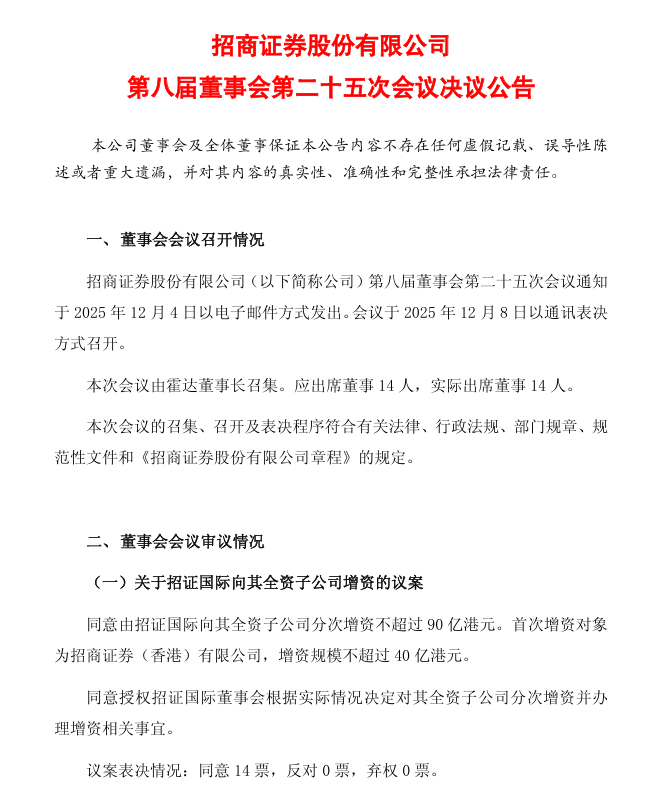
Group 1 - The core announcement from China Merchants Securities is the approval for its wholly-owned subsidiary, China Merchants Securities International, to increase capital by up to 9 billion HKD, with an initial injection of up to 4 billion HKD into its subsidiary, China Merchants Securities (Hong Kong) [1] - China Merchants Securities International reported a significant growth in performance for the first half of 2025, achieving a revenue of 477 million HKD and a net profit of 128 million HKD [4] - The asset management scale of China Merchants Securities International increased to 17.311 billion HKD, reflecting a substantial rise of 62.91% compared to the end of the previous year [6] Group 2 - Several brokerage firms have announced increased capital investments in their Hong Kong subsidiaries this year, with China Merchants Securities' 9 billion HKD capital increase being the largest in the industry [7] - The report indicates that leading firms like CICC, CITIC Securities, and Huatai Securities have established a competitive edge in international business, with their overseas business contributing significantly to overall profits [8] - The profitability of major brokerage firms' overseas subsidiaries has shown remarkable growth, with many firms experiencing net profit increases exceeding 160%, driven by an active Hong Kong stock market and rising cross-border financing demands [10]

中资券商“必答题”:中信建投证券蒋月勤详解国际化破局之道
2 1 Shi Ji Jing Ji Bao Dao· 2025-12-07 01:49
Core Viewpoint - Internationalization is a crucial strategy for Chinese securities firms to achieve the goal of becoming world-class investment banks, as emphasized by the chairman of CITIC Securities International, Jiang Yueqin [1][2]. Group 1: Internationalization Strategy - Jiang Yueqin highlighted that the internationalization process of Chinese securities firms is aligned with national strategies and industry development, marking it as a necessary path to achieve international competitiveness [1][2]. - The China Securities Regulatory Commission has set a goal to establish 2 to 3 investment banks with international competitiveness by 2035, indicating that internationalization is not optional but essential for achieving top-tier status [1][2]. - As of mid-2025, the total assets of leading securities firms' overseas subsidiaries have increased by over 20%, reaching HKD 1.64 trillion, with most firms experiencing year-on-year growth in international business revenue [3]. Group 2: Historical Context and Current Opportunities - The internationalization of American investment banks began in the 1960s and 1970s, driven by internal competition and external globalization opportunities, which created significant demand for cross-border financial services [2]. - Chinese securities firms are currently facing unprecedented strategic opportunities for internationalization, responding to high-level opening-up policies and serving national strategies, with Hong Kong as the starting point for their international expansion [2]. Group 3: Practical Implementation - CITIC Securities International has successfully executed several high-impact projects, showcasing its cross-border comprehensive service capabilities, including significant IPOs and bond issuances [3][4]. - The firm has played a leading role in the Hong Kong IPO market, with notable projects such as the listing of "Lao Pu Gold" and "Horizon Robotics," achieving record speeds and substantial oversubscriptions [3][4]. Group 4: Future Development Trends - The development of internationalization should focus on becoming a "value investment bank," integrating financial functionality with profitability while creating comprehensive value for stakeholders [5][6]. - The transition to a "new quality investment bank" is necessary, emphasizing a shift from traditional services to a partnership model that supports clients throughout their lifecycle [7][8]. - Embracing the "digital investment bank" concept is essential, where data becomes a core asset, and leveraging AI and adaptive algorithms enhances decision-making precision [9]. Group 5: Pathways for Internationalization - The first pathway involves focusing on core advantages and developing differentiated strategies based on unique market positioning and resource endowments [11]. - The second pathway emphasizes strengthening local connections, moving from mere physical presence to deep integration within local business ecosystems [12]. - The third pathway stresses the importance of establishing compliance and risk management frameworks to navigate complex international environments effectively [13].
券商频频“输血”海外子公司,释放什么信号?
证券时报· 2025-11-28 09:31
Core Viewpoint - Chinese securities firms are significantly increasing capital support for their overseas subsidiaries, driven by the demand for cross-border investment banking and wealth management expansion, particularly in high-margin OTC derivatives business [1][5][7]. Group 1: Capital Support Mechanisms - Huatai Securities announced the issuance of four medium-term notes totaling $230 million, backed by its wholly-owned subsidiary [1]. - Common methods for capital supplementation by Chinese securities firms include direct shareholder capital increases, issuance of perpetual bonds/subordinated debt, and capital loans with shareholder support [3][5]. - Notable firms such as Dongxing Securities, Shanxi Securities, and Bank of China Securities have announced capital increases for their Hong Kong subsidiaries, with amounts reaching up to 2.137 billion HKD [4]. Group 2: Business Expansion Drivers - The demand for capital supplementation is primarily driven by the expansion of cross-border business and the growth of high capital-consuming operations, particularly in OTC derivatives [7][8]. - The surge in cross-border client demand and the need for risk management and asset allocation services are pushing Chinese securities firms to enhance their capital base [7][8]. - The Hong Kong market is becoming a hub for cross-border wealth management, benefiting Chinese securities firms due to their inherent advantages [8]. Group 3: Challenges in Capital Supplementation - Despite the push for capital increases, challenges remain, including restrictions on cross-border capital injection, difficulties in overseas financing, and liquidity risks [11][12]. - Current foreign exchange management policies limit the ability of Chinese securities firms to conduct cross-border transactions effectively, creating obstacles in capital flow and business development [11][12]. - The need for regulatory policy optimization, group-level coordination, and transformation of subsidiaries into lighter capital businesses is emphasized to overcome these challenges [12].

券商频频“输血”海外子公司,释放什么信号?
券商中国· 2025-11-28 04:00
Core Viewpoint - Chinese securities firms are significantly increasing capital support for their overseas subsidiaries, driven by the demand for cross-border investment banking and wealth management expansion [2][6]. Group 1: Capital Support Initiatives - Huatai Securities announced the issuance of four medium-term notes totaling $230 million, guaranteed by its wholly-owned subsidiary [1]. - This year, several Chinese securities firms, including Dongxing Securities and Huatai Securities, have provided capital support to their Hong Kong subsidiaries, with the highest capital increase reaching HKD 21.37 billion [3][4]. - The common methods for capital supplementation include direct shareholder capital increases, issuance of perpetual bonds, and capital loans [3]. Group 2: Business Expansion Drivers - The demand for capital supplementation is primarily driven by the expansion of cross-border businesses and high capital-consuming operations, particularly in the OTC derivatives sector [6][7]. - The growth in cross-border client demand and the need for risk management and asset allocation services are pushing Chinese securities firms to enhance their capital strength [6][7]. Group 3: Challenges in Capital Supplementation - Despite the increasing capital support, challenges remain, including restrictions on cross-border capital flows and difficulties in overseas financing [8][9]. - The current foreign exchange management system poses obstacles for Chinese securities firms in conducting cross-border transactions, leading to liquidity risks [9]. - Recommendations for overcoming these challenges include optimizing regulatory policies, enhancing group coordination, and transforming subsidiaries towards lighter capital business models [10].

全链条发力,中资券商晋级国际“金融航海家”
券商中国· 2025-11-25 23:22
Core Viewpoint - The article emphasizes the transformation of Chinese securities firms into "financial navigators" as they expand internationally, contributing significantly to the global capital market and enhancing their competitiveness and market leadership by 2035 [1][2]. International Business Development - Chinese securities firms are entering a harvest phase in their international business, with significant profit contributions from their international subsidiaries, such as CICC (46%), Huatai Securities (43%), and CITIC Securities (18%) in 2024 [2]. - The revenue from international subsidiaries of Huatai Securities and CITIC Securities exceeded 15 billion yuan, while CICC approached 10 billion yuan [2]. - The internationalization of Chinese securities firms has evolved through four stages: initial exploration, differentiated competition, gradual business enrichment, and enhanced comprehensive financial service capabilities [2]. Growth Strategies - The international expansion strategies of large securities firms often involve external mergers and acquisitions to quickly gain market share, while smaller firms focus on deepening their presence in the Hong Kong market [3]. - The total asset scale of international subsidiaries of leading firms has shown consistent growth, with CITIC Securities International's total assets reaching 50.6 billion USD in 2024, a 46% increase from the beginning of the year [3]. Revenue Diversification - The article predicts that international business will be a key driver for revenue diversification among securities firms, particularly in comprehensive financial services related to investment and cross-border operations [4]. Market Opportunities - The demand for overseas investment and financing from Chinese enterprises is a significant driver for the development of international business among securities firms [5]. - In 2023, China's non-financial direct investment abroad reached approximately 917 billion yuan, a 16.7% increase year-on-year [5]. Globalization Trends - The internationalization of Chinese securities firms is characterized by a focus on developed markets and regions with strong economic ties to China, particularly in Europe and countries involved in the Belt and Road Initiative [6]. - Southeast Asia has become a key area for overseas expansion, with firms like Galaxy Securities targeting local acquisitions to establish their international business [7]. Risk Management and Adaptation - The article highlights the importance of balancing short-term gains with long-term risks in the internationalization process, particularly in managing credit risks associated with high-yield investments [9][10]. - A clear path for international business development is essential, with a focus on local adaptation and the establishment of a management system that balances local team flexibility with centralized control [8][9].