居民财富再配置

Search documents
2.11犀牛财经早报:10年期国债收益率下破1.8%
Xi Niu Cai Jing· 2026-02-11 01:53
Group 1: Banking and Wealth Management - The scale of bank wealth management products has decreased by approximately 815 billion yuan, with 14 major wealth management companies managing a total of 24.59 trillion yuan as of the end of January 2026, marking a decline for the second consecutive month since reaching a peak in November 2025 [1][2] - Despite the decline, there is optimism in the industry as low fixed deposit rates and a large amount of fixed deposits maturing in 2026 may lead to a reallocation of household wealth towards wealth management products [1] - Sales of bank wealth management products surged before the Spring Festival, with some products breaking sales records, indicating a potential recovery in the market [1] Group 2: Private Equity and Investment - The number of domestic private equity firms managing over 10 billion yuan has reached a record high of 122, increasing by 10 from the end of December 2025 [1] - Eight new private equity firms entered the 10 billion yuan club in January 2026, showcasing a growing trend in the private equity sector [1] Group 3: Energy Market - The EIA's short-term energy outlook report predicts that Brent crude oil prices will average $58 per barrel in 2026, up from a previous estimate of $56 per barrel, while WTI crude oil prices are expected to average $53.42 per barrel, an increase from $52.21 per barrel [2] Group 4: Silver Market - The World Silver Association forecasts that the silver market will experience a supply deficit for the sixth consecutive year in 2026, with a projected shortfall of 67 million ounces [3] - Global silver demand is expected to remain stable, driven by robust retail investment, which may offset declines in other key demand areas such as jewelry and industrial use [3] Group 5: IPO Market - The Hong Kong IPO market has been active in 2026, with fundraising exceeding 79 billion HKD, representing a year-on-year increase of over 1220% [3][4] - As of February 10, 2026, 422 companies are queued for IPOs in Hong Kong, with over 100 having submitted applications since the beginning of the year [3] Group 6: Credit Card Industry - In 2025, 65 credit card centers were closed, surpassing the total number of closures from 2020 to 2024, indicating a significant contraction in the credit card industry [4] - The trend of closing credit card centers is spreading from state-owned and joint-stock banks to city commercial banks, reflecting a shift from expansion to competition in the credit card sector [4] Group 7: Corporate Actions - Ningde Times issued its first green technology innovation bond for 2026, raising 5 billion yuan with a coupon rate of 1.70% [6] - Huazhang Technology plans to acquire 100% of Huayi Microelectronics for 29.96 billion yuan, aiming to enhance its packaging and testing business in the semiconductor sector [10]




独家|银行理财“开门红”未兑现!后续有望承接海量存款配置潮
券商中国· 2026-02-10 23:29
Core Viewpoint - The banking wealth management market experienced a decline in scale at the beginning of 2026, contrary to expectations for a strong start to the year, with a total scale of 24.59 trillion yuan at the end of January, down approximately 815 billion yuan from the previous month [2][3]. Group 1: Market Performance - The total scale of 14 major wealth management companies decreased by about 815 billion yuan compared to the end of 2025, marking a second consecutive month of decline since reaching a peak in November 2025 [2][3]. - The decline was primarily driven by the four major state-owned banks, which accounted for nearly 500 billion yuan of the total drop, with individual companies like Agricultural Bank of China Wealth Management, CCB Wealth Management, and ICBC Wealth Management each seeing declines exceeding 100 billion yuan [3]. - Despite the downturn, there is optimism in the industry, with expectations that the wealth management market will benefit from a reallocation of household wealth due to low fixed deposit rates and a large volume of deposits maturing in 2026 [2][3]. Group 2: Product Trends - The decline in scale was mainly observed in two product categories: fixed-income pure bond products and cash management products, with fixed-income non-cash pure bond products dropping by approximately 560 billion yuan and cash management products decreasing by about 500 billion yuan [4][5]. - Conversely, "equity-linked" wealth management products experienced growth, particularly in "fixed income plus" and mixed products, with the total balance of "fixed income plus" products increasing by about 190 billion yuan to 4.14 trillion yuan [5]. - The shift towards multi-asset and multi-strategy approaches is becoming a common choice in the wealth management industry, reflecting a gradual transition from pure fixed income to "fixed income plus" strategies [5]. Group 3: Future Expectations - Analysts predict a rebound in wealth management scale in February, estimating an increase of around 1 trillion yuan, driven by low deposit rates and year-end bonuses being distributed [4][6]. - Approximately 50 trillion yuan in deposits are set to mature this year, which is expected to lead to a significant reallocation of funds into wealth management, insurance, or asset management products [6][7]. - The focus on wealth management is increasing among banks, with strategies being implemented to enhance product offerings and meet customer needs, particularly for low-risk profiles [6][7].


短期耐心等待市场企稳信号
British Securities· 2026-01-21 04:38
Market Overview - The report indicates that the A-share market is likely to continue its oscillating adjustment in the short term, with major indices experiencing collective declines [2][3][11] - The overall market sentiment is cautious, with a significant drop in trading volume, as the total transaction amount in the two markets has shrunk to approximately 2.7 trillion [3][12] - The report highlights that the market is currently in a phase of performance expectations versus fundamental verification, particularly as the end of January approaches, which will see a peak in annual report forecasts [3][12] Sector Analysis Precious Metals - The precious metals sector has shown continued strength, driven by rising gold and silver futures, with five key factors contributing to this trend: the onset of a Fed rate cut cycle, increased geopolitical tensions, strong demand for gold from global central banks, a weakening dollar, and rising inflation concerns [9] - The report advises caution against chasing prices in the precious metals market after significant increases, suggesting short-term trading opportunities with stop-loss measures [9] Real Estate - The real estate sector has become active due to a series of supportive policies from central and local governments aimed at stabilizing the market, including relaxed lending and purchasing restrictions [10] - The report anticipates that ongoing policy support and improving supply-demand dynamics will boost the sector, with a focus on high-quality companies with land reserve advantages and those returning to stable growth [10] Future Market Outlook - The report maintains a positive medium-term outlook for the market, citing a global interest rate cut cycle entering its second half and a favorable macro liquidity environment [3][12] - It suggests that investors should remain cautious in the short term, waiting for signs of market stabilization before adjusting strategies, while also identifying long-term investment opportunities in sectors with strong policy support and performance certainty [3][12]
机构行为更新专题:识与变化:一季度居民财富再配置新变局
Guoxin Securities· 2026-01-10 15:01
Investment Rating - The report maintains an "Outperform" rating for the non-bank financial sector [4][5][47]. Core Insights - The report highlights a significant shift in resident wealth allocation due to a low interest rate environment, leading to a reallocation of funds from traditional savings to riskier assets [1][12][19]. - The phenomenon of "deposit migration" is characterized by a transition from slow outflows to a more concentrated release of funds, indicating a rapid increase in market risk appetite [2][29]. - The report anticipates that the pulse-like release of deposits will provide substantial incremental capital to the A-share and Hong Kong markets, potentially exceeding 500 billion yuan in the first quarter [3][12]. Summary by Sections Deposit Low-Interest Environment - Deposit rates have fallen below 2%, prompting residents to seek higher-yielding investments [1][17]. - The decline in deposit attractiveness is pushing savings towards wealth management products and other financial instruments [13][19]. Wealth Management Transformation - There is a notable shift in asset allocation from bank deposits to non-bank financial products, with household deposits decreasing while non-bank financial institution deposits are increasing [20][22]. - The capital market's performance since June 2025 has catalyzed this shift, with the A-share market experiencing significant gains, thereby attracting more funds [20][24]. Changes in Deposit Migration - The report notes that the upcoming maturity of a significant volume of deposits, particularly three-year fixed deposits, will lead to a concentrated outflow of funds, enhancing risk appetite [29][33]. - The breaking of the "rigid redemption" of wealth management products has led to a reassessment of risk among conservative investors, prompting a return to safer deposit options [29][39]. Investment Recommendations - The report recommends focusing on non-bank financial institutions that are likely to benefit from the ongoing deposit migration trend, particularly in the insurance and brokerage sectors [3][43]. - Specific companies highlighted for their strong potential include China Life, Ping An, and major brokerage firms like CITIC Securities and Huatai Securities [4][43].
证券2026年展望-投资中国优质券商正当时
2026-01-08 02:07
Summary of Key Points from the Conference Call Industry Overview - The conference call discusses the Chinese securities industry, highlighting the growth opportunities for domestic brokers due to deepening capital market reforms, increased foreign investment, and rising demand for prime brokerage services [1][2]. Core Insights and Arguments - **Growth Projections**: The profitability growth rate for Chinese brokers is expected to reach 12% in 2026, supported by policies such as the normalization of IPO issuances and the expansion of derivatives [1][5]. - **Regulatory Environment**: The regulatory focus on supporting strong firms while limiting weaker ones is leading to accelerated industry consolidation, improving the performance structure of leading brokers [1][4]. - **Investment Value Changes**: Historically low investment value in the securities sector is changing due to reduced competition, improved performance stability, and a shift towards risk-neutral strategies [4][10]. - **Market Dynamics**: The demand for direct financing is increasing due to economic transformation, with a notable rise in M&A and debt restructuring activities [2][19]. Investment Opportunities - **Short-term Opportunities**: Key investment lines for 2026 include: 1. Increased activity in the primary market driven by normalized A-share IPOs. 2. Brokers with strong sales and trading capabilities benefiting from stable returns generated by institutional investors. 3. Companies with strong international business growth, particularly those leading in cross-border operations [6][22]. - **Wealth Management Trends**: The shift in resident wealth towards financial assets presents opportunities for brokers to enhance their wealth management services, focusing on differentiated offerings for retail clients [8][9]. Important but Overlooked Content - **Long-term Investment Value**: The long-term investment value of the securities sector is expected to improve as the industry structure becomes more balanced and competitive pressures decrease [10][14]. - **Regulatory Changes**: The ongoing regulatory reforms are expected to enhance the growth potential and valuation framework for brokers, particularly in attracting long-term foreign capital [19][20]. - **Valuation Metrics**: Current valuations for the securities sector are low, providing a safety net for future growth, with A-share and Hong Kong brokers trading at 1.5x and 0.98x PB levels, respectively [20]. Conclusion - The Chinese securities industry is poised for significant growth driven by regulatory support, market demand, and evolving investment strategies. Key players are expected to capitalize on these trends, enhancing their market positions and profitability in the coming years [21][22].
中金2026年展望 | 证券:投资中国优质券商正当时
中金点睛· 2025-12-30 00:01
Core Viewpoint - The growth of the Chinese securities industry is benefiting from economic development and capital market reforms, with leading Chinese brokers expected to accelerate their progress towards becoming world-class investment banks during the "14th Five-Year Plan" period, enhancing their business scale, professional capabilities, and profitability [2][7]. Industry Future Trends - The industry is poised to leverage diverse and complex financial needs from enterprises, institutions, and residents, leading to opportunities and higher service demands. Key strategies include creating "industrial investment banks" and "asset investment banks" to support economic transformation, enhancing global sales and multi-asset trading capabilities, and addressing wealth management needs through a "wealth investment bank" model [6][14][15]. Investment Value Understanding - The securities sector has historically been underweighted by investors due to competition homogenization and earnings volatility. However, improvements in industry structure, stability, and profitability are expected to enhance long-term investment value. Factors include regulatory emphasis on supporting strong firms, balanced business structures among leading brokers, and a focus on high-quality development [3][39][42]. 2026 Investment Opportunities - The industry is expected to maintain a relatively high level of prosperity, with an overall profit growth forecast of 12%. Key investment lines include the performance of investment banks and private equity leaders, brokers with strong institutional sales and trading services, and firms with significant international business growth [4][58][59].

工银理财吴茜:银行理财9月末规模已超过32万亿元
Hua Xia Shi Bao· 2025-10-21 05:28
Core Insights - As of the end of September, the scale of the bank wealth management industry has exceeded 32 trillion yuan, reaching 32.1 trillion yuan [2] - The reallocation of resident wealth presents growth opportunities for various asset management sectors, although the growth rate of insurance and public funds is higher than that of wealth management this year [2] - The differentiation in risk preferences among clients during the wealth reallocation process indicates a clear positioning for various wealth management tools [2] - The bank wealth management sector needs to maintain its differentiated positioning in the asset management race, shifting from "asset-driven" to "strategy combination capability-driven" to enhance product performance stability and consistency [2]

工银理财吴茜:银行理财9月末规模已超过32万亿元|快讯
Hua Xia Shi Bao· 2025-10-21 04:53
Core Insights - As of the end of September, the scale of the bank wealth management industry has exceeded 32 trillion yuan, reaching 32.1 trillion yuan [2] - The reallocation of resident wealth presents growth opportunities for various asset management sectors, with insurance and public funds showing higher growth rates compared to wealth management this year [2] - The differentiation in risk preferences among clients during the wealth reallocation process indicates a clear positioning of various wealth management tools [2] - The bank wealth management sector needs to maintain its differentiated positioning in the asset management race, shifting from "asset-driven" to "strategy combination capability-driven" to enhance product performance stability and consistency [2]

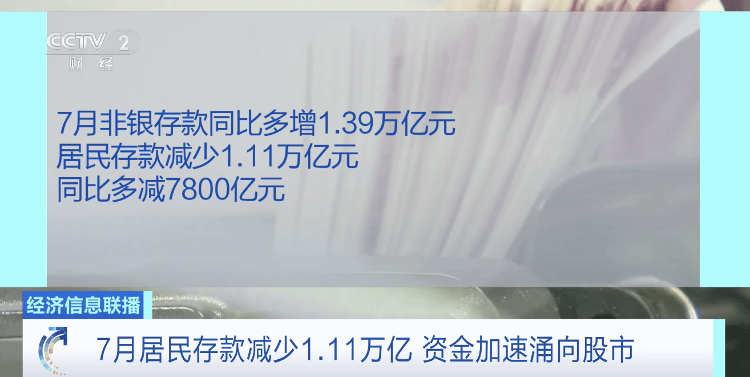
7月居民存款减少1.11万亿 资金加速涌向股市
Sou Hu Cai Jing· 2025-08-18 03:16
Group 1 - Non-bank deposits increased significantly in July, with a year-on-year increase of 1.39 trillion yuan, while resident deposits decreased by 1.11 trillion yuan, indicating a clear "seesaw effect" [3] - The continuous decline in deposit rates, a strong stock market, and rising demand for wealth management among residents have driven funds from resident deposits to non-bank institutions [3] - The balance of resident deposits in China has exceeded 160 trillion yuan, and with the recent rate cuts, maturing fixed-term deposits are less likely to be renewed, potentially flowing into bank wealth management products or directly into the capital market [5] Group 2 - The A-share market has been steadily rising since the beginning of the year, with the Shanghai Composite Index increasing by 3.74% in July and trading volume surging over 40% month-on-month, indicating a significant increase in market activity [7] - As the "slow bull" market becomes a consensus among investors, there is an acceleration in the reallocation of resident wealth, with funds likely to flow more into institutional equity products or directly into the stock market [7] - Long-term trends suggest that the shift of deposits will become a norm, providing continuous liquidity to the capital market, while more quality innovative enterprises will be listed for financing, creating wealth for residents [9]