牛熊证

Search documents
香港交易所:港交所2月份跟踪:联储降息预期下降致使海外流动性收紧,港股交投仍然维持历史高-20260313
Changjiang Securities· 2026-03-13 00:40
Investment Rating - The report maintains a "Buy" rating for the company [5][51]. Core Views - As of March 9, 2026, the company's PE ratio is 29.06x, which is at the 12th percentile historically since 2016, indicating a certain level of value for allocation. It is expected that with the continuous enhancement of the mutual access policy in the Hong Kong capital market, liquidity in the Hong Kong stock market will continue to rise, leading to an increase in overall market activity and valuation. The company is projected to achieve revenue and other income of HKD 365 billion, 391 billion, and 413 billion for 2026, 2027, and 2028 respectively, with net profit attributable to shareholders of HKD 226 billion, 241 billion, and 256 billion, corresponding to PE valuations of 22.9x, 21.4x, and 20.2x respectively [2][51]. Summary by Sections Market Environment - The Hong Kong stock market remains active, with the overall trading volume at historical highs. In February, the average daily trading (ADT) for the Hong Kong Stock Exchange was HKD 2,468 billion, reflecting a month-on-month decrease of 9.4% and a year-on-year decrease of 17.0%. The Northbound trading ADT was HKD 3,807 billion, down 16.1% month-on-month but up 45.2% year-on-year, while Southbound trading ADT was HKD 1,142 billion, down 14.1% month-on-month and down 28.6% year-on-year [6][16]. Derivatives Market - In February, both futures and options trading volumes increased month-on-month. The average daily volume (ADV) for futures was 68.4 million contracts, up 3.8% month-on-month but down 25.5% year-on-year. The ADV for options was 105.0 million contracts, up 0.2% month-on-month but down 21.9% year-on-year [19][20]. Primary Market - The IPO scale in the Hong Kong stock market saw significant growth in February, with a total of 24 new stocks listed, raising a total of HKD 923 billion, which is a year-on-year increase of 1052.4%. The average size of each IPO was HKD 38.5 billion, up 332.2% year-on-year. Notably, 42% of the new listings were from the information technology sector, contributing 48% of the total fundraising [31][32]. Investment Income - As of the end of February, the relevant interest rates for investment income showed a general decline. The 6-month HIBOR was 2.73%, the 1-month HIBOR was 2.41%, and the overnight HIBOR was 2.55%, reflecting month-on-month changes of -0.16 percentage points, -0.20 percentage points, and +0.37 percentage points respectively [41].

香港交易所(0388.HK):市场高景气 交投活跃助推盈利高增
Ge Long Hui· 2026-03-03 05:56
Core Viewpoint - Hong Kong Stock Exchange (HKEX) reported strong growth in revenue and profit for the year 2025, driven by high market activity and a favorable economic environment [1] Group 1: Financial Performance - HKEX achieved a total revenue of HKD 23.745 billion, representing a year-over-year increase of 37% [1] - The net profit attributable to shareholders reached HKD 17.754 billion, up 36% year-over-year [1] - The return on equity (ROE) for the year was 30.5%, an increase of 6.3 percentage points year-over-year [1] Group 2: Revenue Breakdown - Revenue from trading fees and trading system usage increased by 44%, while clearing and settlement fees rose by 49% [1] - Revenue from various segments showed diverse growth: cash equities up 58%, equity securities and derivatives up 18%, commodities up 13%, and market data fees up 8% [1] - The revenue from the cash equities segment was particularly strong, with daily average trading volume increasing by 93% to HKD 231.5 billion [2] Group 3: IPO Market and Trading Volume - The IPO market in Hong Kong was robust, with 119 IPOs raising HKD 645.9 billion, a 236% increase year-over-year [2] - Daily average trading volume for the Shanghai-Hong Kong Stock Connect was HKD 212.4 billion, up 42% year-over-year, while the Hong Kong Stock Connect averaged HKD 121.1 billion, up 151% [2] Group 4: Derivatives and Investment Income - The derivatives segment saw a daily average trading volume of HKD 18.3 billion, a 55% increase year-over-year, with trading fees rising by 48% [3] - Investment income for HKEX reached HKD 5.111 billion, a 4% increase year-over-year, driven by higher margins and increased fund sizes [4] Group 5: Future Outlook - HKEX is expected to maintain its position as a key player in the primary market, supported by the recovery of IPO activities from mainland companies [5] - Despite short-term fluctuations in the secondary market, the long-term outlook remains positive, with expectations of increased liquidity and market recovery [5] - Profit forecasts for 2026-2028 have been slightly adjusted, with projected net profits of HKD 19.1 billion, HKD 20 billion, and HKD 21 billion respectively, reflecting year-over-year growth [5]
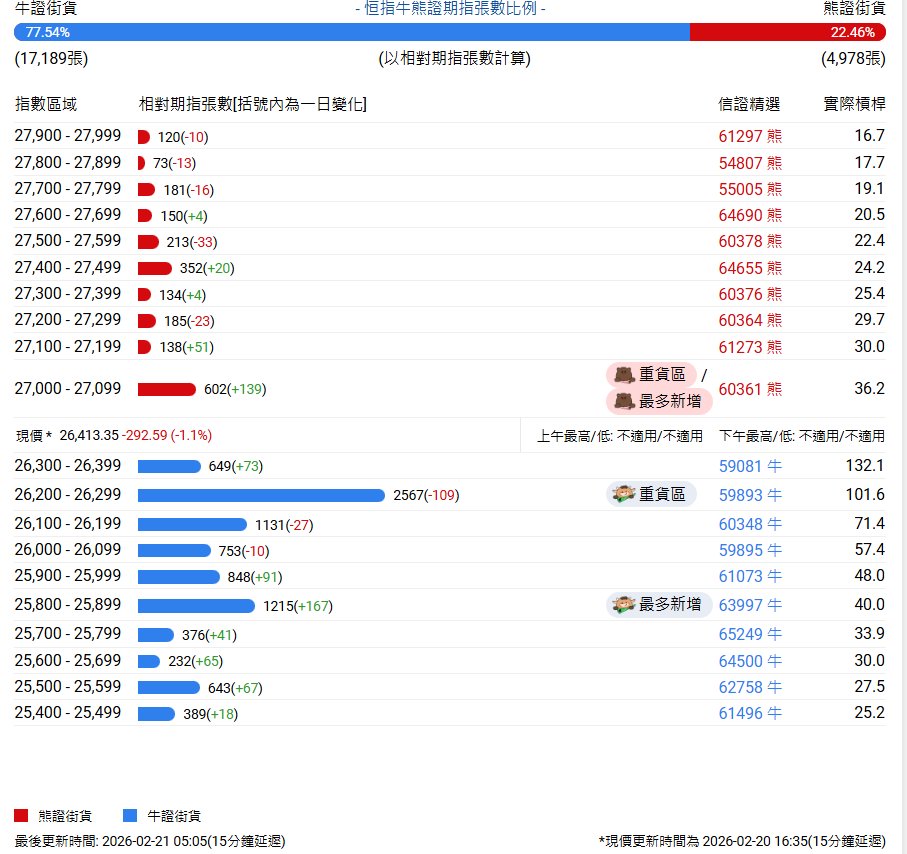
恒指牛熊街货比(78:22)︱2月21日
智通财经网· 2026-02-20 23:59
Core Viewpoint - The latest bull-bear ratio for the Hang Seng Index (HSI) is 78:22, indicating a predominance of bearish sentiment among investors [1]. Group 1: Bull and Bear Certificates Distribution - The heavy zone for bear certificates is in the range of 27,000 - 27,099, with a total of 602 bear certificates, an increase of 139 from the previous trading day [1]. - The heavy zone for bull certificates is in the range of 26,200 - 26,299, with a total of 2,567 bull certificates, a decrease of 109 from the previous trading day [1]. - The most significant increase in bull certificates occurred in the range of 25,800 - 25,899, totaling 1,215 certificates, an increase of 167 from the previous trading day [1]. Group 2: Market Data Overview - The current price of the Hang Seng Index is 26,413.35, reflecting a decrease of 292.59 points or 1.1% [2]. - The distribution of bull and bear certificates shows that 77.54% are bear certificates while 22.46% are bull certificates, based on relative index certificate numbers [2]. - The range of 27,000 - 27,099 has the highest concentration of bear certificates at 36.2%, while the range of 25,800 - 25,899 has the highest increase in bull certificates [2].

港交所:1月首次公开招股集资金额为393亿港元 较去年同期暴涨5.55倍
智通财经网· 2026-02-05 13:07
Market Overview - As of January 2026, the total market capitalization of the Hong Kong securities market reached HKD 50.8 trillion, a 44% increase from HKD 35.4 trillion in the same period last year [1] - In January 2026, the Hong Kong Stock Exchange welcomed 13 new listings, a 63% increase compared to 8 new listings in January 2025 [1] - The total fundraising amount in January 2026 was HKD 531 billion, up 318% from HKD 127 billion in January 2025 [1] Trading Activity - The average daily trading amount in January 2026 was HKD 2,723 billion, an 89% increase from HKD 1,438 billion in January 2025 [1] - The average daily trading amount for derivative warrants was HKD 78 billion, a 77% increase from HKD 44 billion in January 2025 [1] - The average daily trading amount for bull and bear certificates was HKD 142 billion, a 100% increase from HKD 71 billion in January 2025 [1] - The average daily trading amount for exchange-traded funds was HKD 359 billion, a 69% increase from HKD 212 billion in January 2025 [1] - The average daily trading amount for leveraged and inverse products was HKD 31 billion, a 19% increase from HKD 26 billion in January 2025 [1] Derivatives Market - The average daily trading volume for futures and options in January 2026 was 1,706,438 contracts, an 18% increase from 1,452,108 contracts in January 2025 [2] - The average daily trading volume for stock options was 900,960 contracts, a 19% increase from 759,565 contracts in January 2025 [2] Historical Records - On January 29, 2026, the trading volume of the Hang Seng Tech Index options reached a historical high of 39,229 contracts [3] - On January 28, 2026, the trading volume of the Hang Seng Biotech Index futures reached a historical high of 1,013 contracts [4]
2025,港股年度盘点
Sou Hu Cai Jing· 2026-02-05 06:15
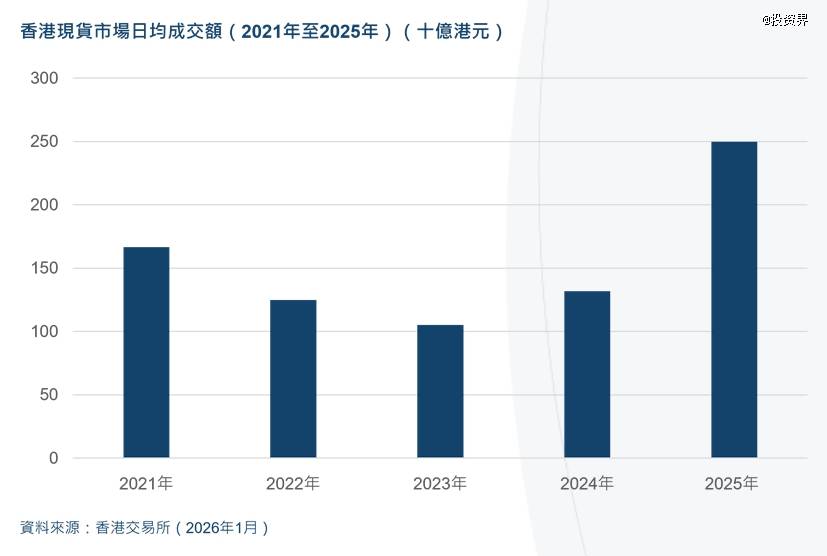
Core Insights - The Hong Kong financial market demonstrated significant activity in 2025, setting multiple trading records in both the primary and secondary markets, reinforcing its status as a leading international financial center in Asia [1] Group 1: Market Performance - The average daily turnover in the cash market reached a record high of HKD 249.8 billion, representing a year-on-year increase of 89.5% [2] - Hong Kong regained its position as the world's top IPO market in 2025, with 119 new listings raising a total of HKD 285.8 billion, including three companies that ranked among the top ten global IPOs of the year [4] - The derivatives market also saw a record average daily trading volume of 1.66 million contracts, an increase of 7% year-on-year [5] Group 2: Product Innovations and Growth - Stock options became one of the most actively traded products, with an average daily trading volume rising by 22% to 879,831 contracts [8] - The offshore RMB deposits and cross-border settlement volumes increased, leading to a rise in RMB currency futures trading, with an average daily volume of 103,626 contracts, up 8.7% from 2024 [9] - The average daily turnover for ETFs reached HKD 33 billion, a 108% increase from 2024, with several innovative products launched [10] Group 3: Trading Infrastructure and Services - The Central Clearing System processed an average of 3.8 million transactions daily, a 67% increase from 2024, reflecting the market's resilience and the effectiveness of infrastructure investments [14] - The trading volume for structured products like bull-bear certificates and warrants was robust, with bull-bear certificates achieving an average daily turnover of HKD 10.5 billion, up 59% year-on-year [12]
1月21日【港股Podcast】恒指、嗶哩嗶哩、舜宇光學、百度、山東黃金、中海油
Ge Long Hui· 2026-01-22 05:19
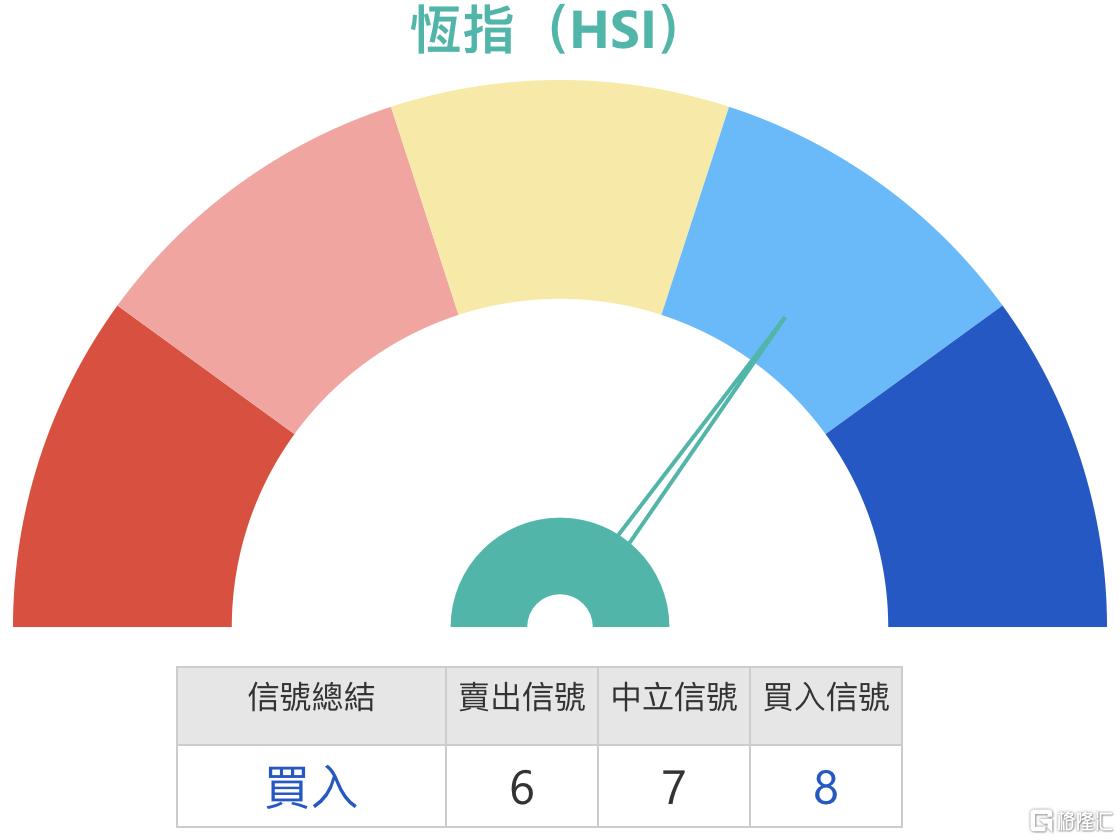
Group 1: Hang Seng Index (HSI) Overview - The Hang Seng Index (HSI) has shown a slight recovery, closing at approximately 26,585 points, although it has not yet reached the 20,000 points mark [1] - There is a divergence in market sentiment, with some investors optimistic about the index reaching 27,000 points, while others are cautious and prefer bearish products [1][2] - Current support level is around 25,900 points, and investors are advised to choose products with a redemption price below this level for safety [2] Group 2: Technical Signals and Product Selection - There are currently 8 buy signals and 6 sell signals for the HSI, indicating a slightly positive short-term outlook [2] - Investors are encouraged to compare different product terms, including leverage and redemption prices, to minimize risks [2] - The resistance level for the HSI is approximately 27,000 points, with the next resistance at 27,500 points [2] Group 3: Bilibili (09626.HK) Stock Analysis - Bilibili's stock price has rebounded, closing at 248.8 HKD, with a potential upward target of 253 HKD if it breaks through 247 HKD [5] - The technical signals indicate a predominance of sell signals, with 9 sell signals compared to 6 buy signals [5] Group 4: Sunny Optical Technology (02382.HK) Stock Analysis - Sunny Optical's stock price has shown recovery, closing at 63.95 HKD, with mixed investor sentiment regarding future price movements [7] - Technical signals show 11 buy signals and 4 sell signals, suggesting a potential upward movement if the price holds above 63 HKD [7] Group 5: Baidu Group (09888.HK) Stock Analysis - Baidu's stock has performed well, closing at 153.7 HKD, but there are concerns about a potential correction after recent gains [13] - The technical signals indicate 9 sell signals and 6 buy signals, suggesting caution for short-term investors [13] Group 6: Shandong Gold (01787.HK) Stock Analysis - Shandong Gold's stock has reached 46.1 HKD, raising concerns about a potential peak and subsequent adjustments [19] - The technical signals show 11 sell signals and 4 buy signals, indicating a bearish outlook [19] Group 7: CNOOC (00883.HK) Stock Analysis - CNOOC's stock has shown a positive trend, closing at 22.1 HKD, with a slight edge in buy signals [25] - The support level is at 21.3 HKD, and investors may consider buying at lower levels for a long-term position [25]
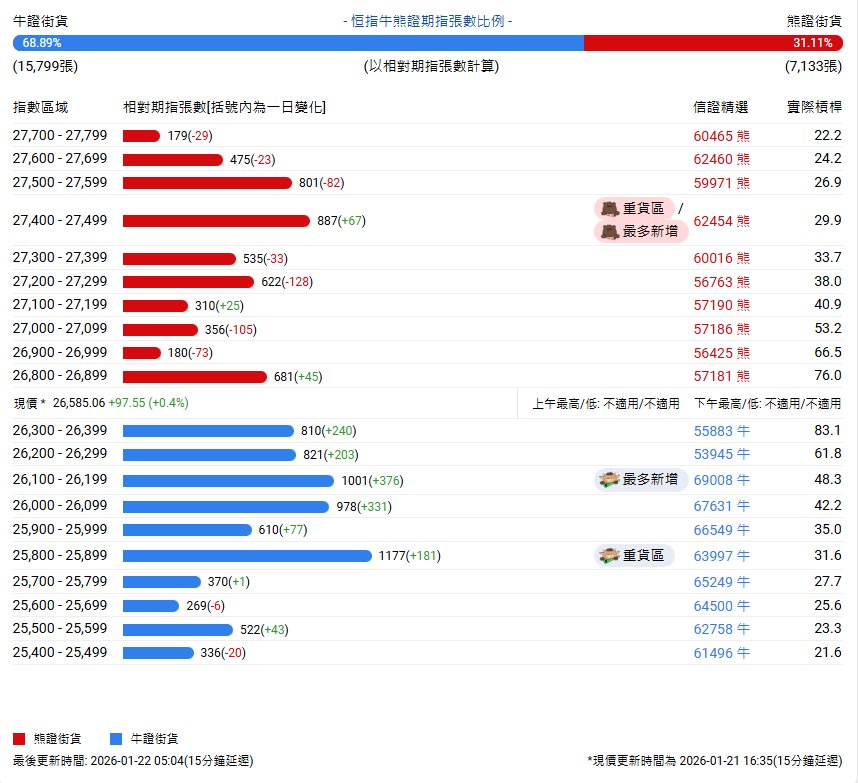
恒指牛熊街货比(69:31)︱1月22日
智通财经网· 2026-01-21 22:19
Group 1 - The latest bull-bear ratio for the Hang Seng Index is 69:31 as of January 22 [1] - The distribution of bear certificates shows that the heaviest concentration is in the range of 27,400-27,499, with 887 certificates, an increase of 67 from the previous trading day [1] - The bull certificates are concentrated in the range of 25,800-25,899, with 1,177 certificates, which is an increase of 181 from the previous trading day [1] Group 2 - The highest increase in bull certificates is observed in the range of 26,100-26,199, with 1,001 certificates, an increase of 376 from the previous trading day [2] - The bear certificates in the range of 27,400-27,499 have seen a notable increase, indicating a potential bearish sentiment in that price range [2] - The overall market sentiment is reflected in the increase of both bull and bear certificates, suggesting active trading and speculation [2]
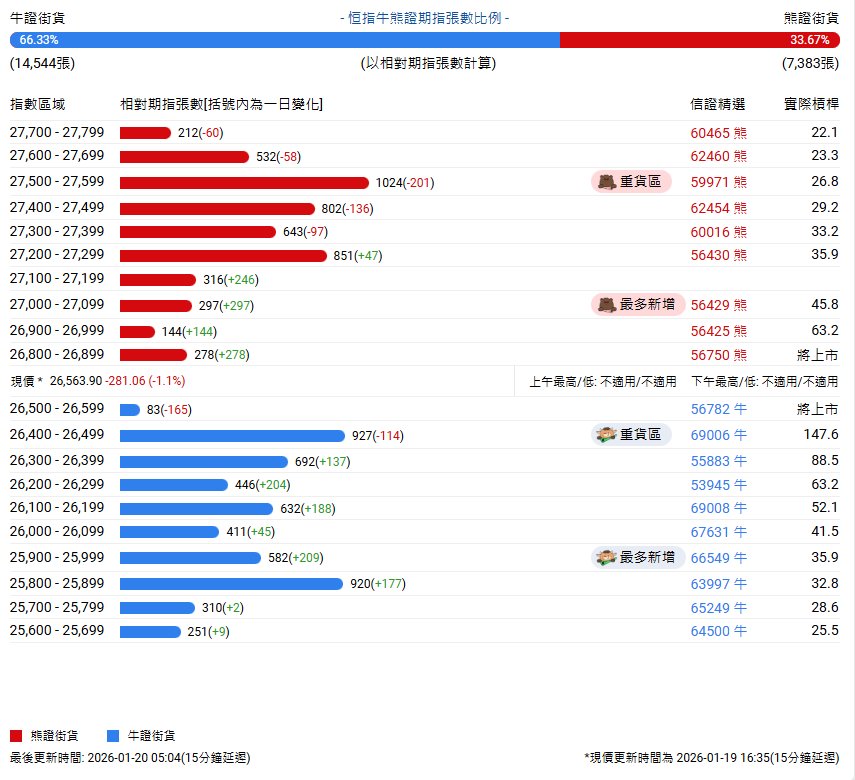
恒指牛熊街货比(66:34)︱1月20日
Zhi Tong Cai Jing· 2026-01-19 22:24
Group 1 - The core viewpoint of the news indicates a significant shift in the distribution of bull and bear certificates, with notable changes in the number of certificates in specific price ranges [1][2] - The bear certificates are concentrated in the range of 27,500 to 27,599, with a total of 1,024 certificates, a decrease of 201 from the previous trading day [1][2] - The most significant increase in bear certificates occurred in the range of 27,000 to 27,099, where the number rose by 297 to reach 297 certificates [1][2] Group 2 - The bull certificates are primarily found in the range of 26,400 to 26,499, totaling 927 certificates, which is a decrease of 114 from the previous trading day [1][2] - The most substantial increase in bull certificates was observed in the range of 25,900 to 25,999, where the number increased by 209 to reach 582 certificates [1][2] - The overall ratio of bull to bear certificates is 66.33% to 33.67%, with 14,544 bull certificates compared to 7,383 bear certificates [2]
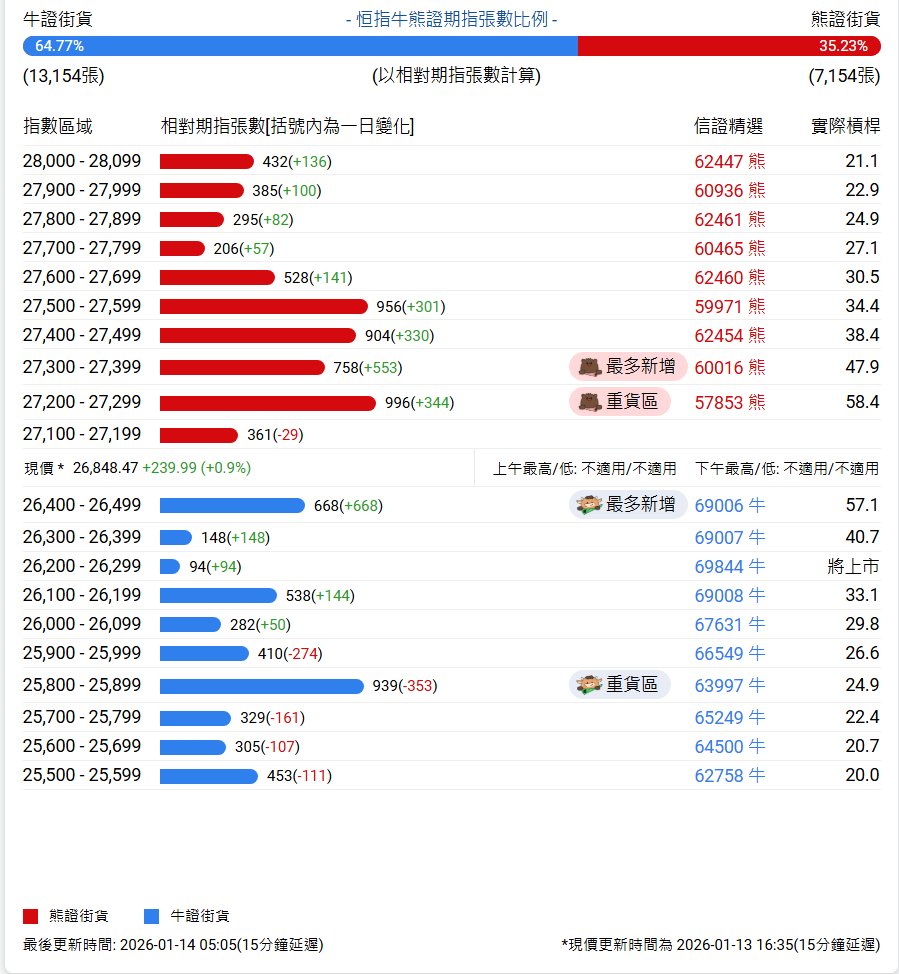
恒指牛熊街货比(65:35)︱1月14日
Zhi Tong Cai Jing· 2026-01-13 22:46
Core Viewpoint - The distribution of bull and bear certificates indicates a significant increase in bear certificates in specific price ranges, while bull certificates show a mixed trend with some decreases and increases in different ranges [1][2]. Group 1: Bear Certificates - The heavy concentration of bear certificates is found in the price range of 27,200-27,299, with a total of 996 certificates, an increase of 344 from the previous trading day [1]. - The most significant increase in bear certificates occurred in the range of 27,300-27,399, where the total reached 758 certificates, up by 553 from the previous day [1][2]. Group 2: Bull Certificates - The heavy concentration of bull certificates is in the range of 25,800-25,899, totaling 939 certificates, which is a decrease of 353 from the previous trading day [1]. - The most significant increase in bull certificates was noted in the range of 26,400-26,499, where the total reached 668 certificates, an increase of 668 from the previous day [1][2].
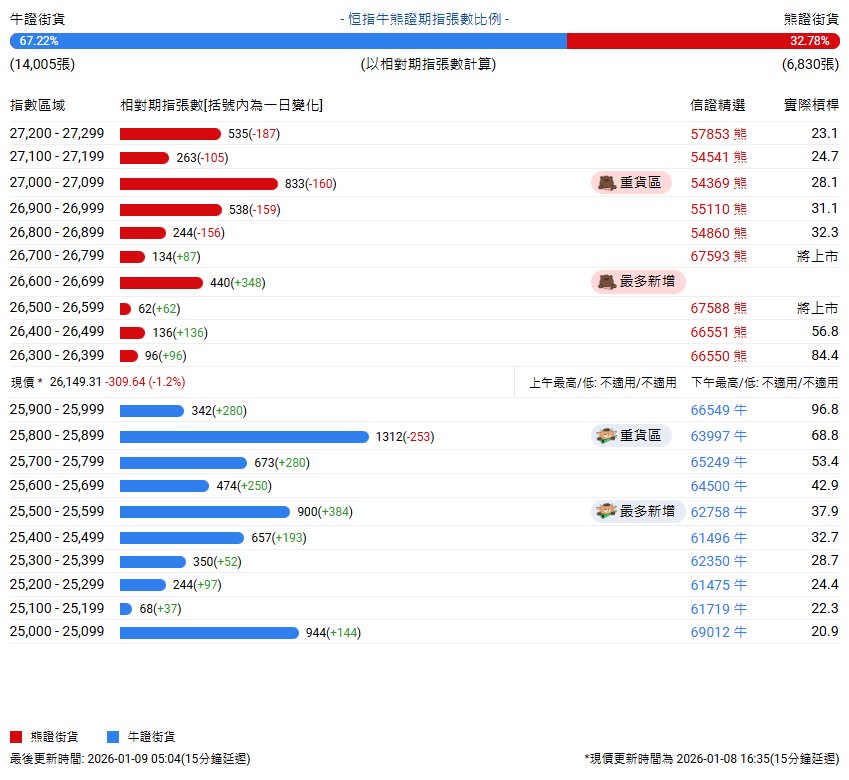
恒指牛熊街货比(67:33)︱1月9日
智通财经网· 2026-01-08 22:22
Core Viewpoint - The distribution of bull and bear certificates indicates a shift in market sentiment, with a notable increase in bear certificates in lower price ranges and a decrease in higher price ranges, suggesting potential bearish sentiment among investors [1][2]. Group 1: Bear Certificates - The heavy concentration of bear certificates is in the 27,000-27,099 range, with a total of 833 certificates, which is a decrease of 160 from the previous trading day [1][2]. - The most significant increase in bear certificates occurred in the 26,600-26,699 range, where the number rose to 440, an increase of 348 from the previous day [1][2]. Group 2: Bull Certificates - The heavy concentration of bull certificates is in the 25,800-25,899 range, totaling 1,312 certificates, which is a decrease of 253 from the previous trading day [1][2]. - The most significant increase in bull certificates was observed in the 25,500-25,599 range, where the number rose to 900, an increase of 384 from the previous day [1][2]. Group 3: Market Statistics - The overall market price is reported at 26,149.31, reflecting a decrease of 309.64, or 1.2% [2]. - The ratio of bull to bear certificates stands at 67.22% to 32.78%, indicating a predominance of bull certificates in the market [2].