
水污染防治

Search documents
水质监测仪器迎来新机遇:《生态环境法典》即将施行
仪器信息网· 2026-03-18 09:02
Core Viewpoint - The newly published "Ecological Environment Code" systematically integrates various regulations in the field of ecological environment protection, marking a new phase of legal and systematic governance in China's ecological environment management [2][10]. Group 1: Regulatory Responsibilities - The Code provides a comprehensive definition of "ecological environment," covering various natural elements and their interactions, including air, water, marine, land, forests, wetlands, wildlife, and urban-rural areas [3]. - It establishes a principle of "unified supervision management" combined with "division of responsibilities," where local governments are responsible for unified supervision of ecological environment protection within their jurisdictions [3]. Group 2: Water Resource Management - Water resource protection and management are core components of the Code, which implements a rigid water resource management system, emphasizing the need to align urban and industrial development with water resource capacity [4]. - The Code promotes water conservation and the establishment of a groundwater reserve system, with strict controls on water usage and the encouragement of recycled water in sectors like landscaping and sanitation [4]. Group 3: Water Pollution Prevention - A dedicated chapter on "water pollution prevention" prioritizes the protection of drinking water sources and imposes strict controls on industrial and urban pollution, as well as agricultural non-point source pollution [5]. Group 4: Drinking Water Source Protection - The Code mandates the delineation of drinking water source protection areas, requiring risk assessments and pollution prevention measures around these zones [7]. - Local governments are required to monitor and publicly disclose drinking water safety information at least quarterly, ensuring public awareness [7]. Group 5: Targeted River Basin Management - The Code emphasizes comprehensive, systematic, and source-oriented governance for key river basins, allowing local governments to set stricter emission standards for specific pollutants and industries [8]. - It prohibits the transfer of heavily polluting enterprises upstream in key river basins [8]. Group 6: Monitoring Network Development - The Code outlines the establishment of a comprehensive water quality monitoring network, including specific regulations for industrial parks and river discharge outlets, aiming for full coverage of monitoring by 2028 [9]. - A digital management system for river discharge outlets will be implemented, with water quality data becoming a key assessment criterion for river basin management [9]. Group 7: Legal Foundation for Environmental Improvement - The introduction of the "Ecological Environment Code" provides a solid legal foundation for improving ecological environment quality and ensuring national water security, emphasizing source prevention, full-process supervision, and social governance [10].


西安航空基地水污染防治成效显著 水环境质量迈上新台阶
Xin Lang Cai Jing· 2026-01-20 03:29
Core Insights - The article emphasizes the importance of water environment in regional high-quality development and highlights the key role of water pollution prevention in improving water quality at the Xi'an Aviation Base [1][2] - By 2025, the Xi'an Aviation Base aims to achieve significant progress in water pollution control, contributing to the construction of a "Beautiful Yanliang" [1] Group 1: Water Quality Improvement - Water quality has steadily improved, with four core indicators (COD, ammonia nitrogen, total phosphorus, total nitrogen) meeting standards for six months, surpassing municipal assessment requirements and achieving Class III surface water standards [1] - The water quality at exit monitoring points has consistently outperformed that at entry points, establishing a positive ecological cycle with enhanced regional ecological carrying capacity [1] Group 2: Pollution Control Measures - The Xi'an Ecological Environment Bureau's Aviation Base Division has implemented targeted measures for river water quality improvement, including comprehensive inspections that identified 10 rainwater and sewage mixing points and conducted four rounds of river discharge outlet remediation [2] - The division has adopted a proactive approach to pollution control, shifting from reactive remediation to active prevention, resulting in stable compliance with water quality standards throughout the year [2] Group 3: Future Strategies - The Aviation Base will continue to consolidate water management achievements, focusing on key aspects of water quality improvement and optimizing governance strategies to establish a long-term mechanism for ecological protection [2]
贵阳贵安推进河湖治理提质增效
Ren Min Wang· 2025-12-31 01:11
Group 1 - The core focus is on the continuous improvement of river and lake ecological environments in Guiyang and Gui'an through precise strategies and comprehensive efforts in water resource protection and pollution prevention [1][2] Group 2 - Significant achievements in water pollution prevention include the construction and renovation of 132.57 kilometers of sewage pipelines and the cleaning of 497,201 drainage facilities this year [1] - The second phase of the Maijia River sewage treatment plant has added a processing capacity of 50,000 tons per day, which is now operating stably [1] - A total of 527 river discharge outlets have been rectified, with 4 remaining expected to be completed by the end of the year [1] - The goal is to achieve over 80% rural sewage treatment rate by the end of the year, with 26 rural sewage treatment projects completed [1] Group 3 - The ecological restoration efforts include the completion of 35,000 acres of degraded forest restoration projects in the Wujiang River basin and 4,000 acres of state-owned degraded forest restoration [2] - A total of 39,000 acres of afforestation has been completed, achieving a 100% completion rate [2] Group 4 - Water law enforcement has intensified, with 1,723 water administration inspections conducted and 2,343 inspections of pollution sources in the "Two Lakes" area [2] - A total of 3,958 minor violations were corrected on-site, and 73 notices were issued to stop or correct illegal activities [2]
紫牛热点∣罐车向大夏河排放紫色不明液体?当地:正在按程序依法调查处理
Yang Zi Wan Bao Wang· 2025-11-10 09:12
Core Viewpoint - A video surfaced on social media showing a vehicle allegedly discharging wastewater into the Daxia River in Gansu's Linxia City, prompting an investigation by local authorities [1][3]. Group 1: Incident Details - The vehicle in question is a fish transport truck with a Sichuan license plate, which was found discharging a pinkish-purple liquid [3]. - The Linxia State Environmental Protection Bureau confirmed that the vehicle was located and that water quality samples were taken for testing [3][5]. Group 2: Investigation Findings - Initial investigations revealed that the truck's operators, Yang and Du, used potassium permanganate to clean the tank after transporting different fish species to prevent cross-contamination [5]. - Approximately 6 cubic meters of residual water was discharged into a drainage channel connected to the Daxia River, which was classified as general wastewater according to the "Comprehensive Wastewater Discharge Standards" [5]. - Environmental tests indicated that the surrounding water quality met the Class III standard for surface water, but the discharge was deemed a violation of the "Water Pollution Prevention and Control Law" of the People's Republic of China [5].
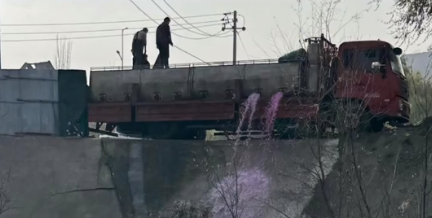
甘肃临夏官方通报“罐车在大夏河排放不明液体”:水质为一般污水,当事人被调查
Yang Shi Wang· 2025-11-10 07:32
Core Points - The incident involves a suspected pollution event in the Daxia River, a first-level tributary of the Yellow River, reported by a netizen on November 8 [1] - The local government promptly organized an investigation involving multiple departments, including ecological environment, water affairs, and public security [1] - Initial findings indicate that two individuals from Lintao County used a fish transport vehicle to clean and disinfect the tank with potassium permanganate, leading to the discharge of wastewater into a drainage channel connected to the Daxia River [1] Environmental Impact - The wastewater discharged was classified as general sewage based on the "Comprehensive Sewage Discharge Standards" (GB8978—1996) [1] - Water quality tests in the surrounding environment met the Class III standard of the "Surface Water Environmental Quality Standards" (GB3838—2002) [1] - The actions of the individuals involved are suspected to violate the "Water Pollution Prevention and Control Law of the People's Republic of China," and legal proceedings are underway [1]
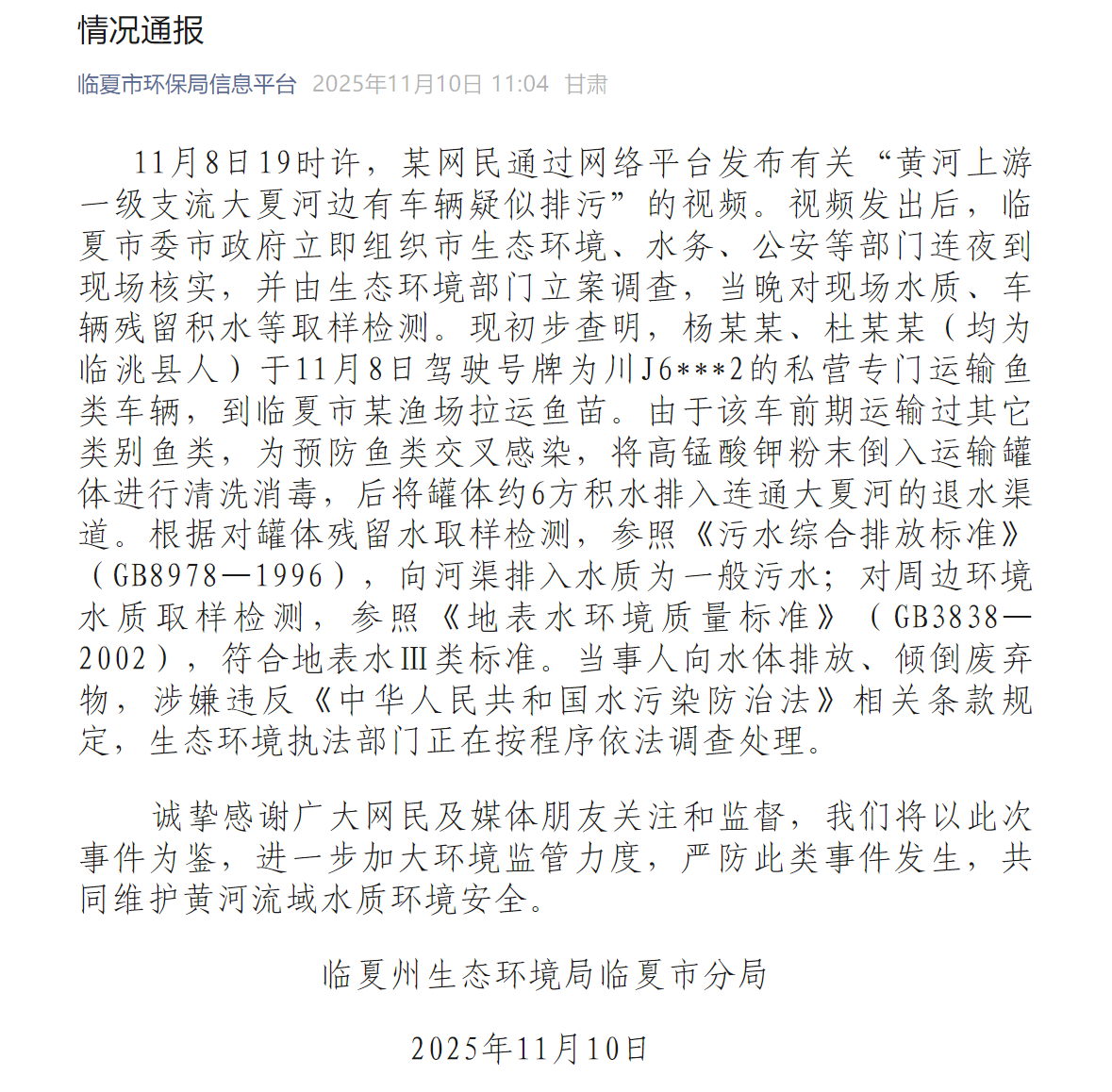
网传甘肃临夏一货车向河道排污 当地通报称正在调查处理
Yang Shi Xin Wen· 2025-11-10 06:46
Core Points - A video was posted online regarding suspected wastewater discharge into the Daxia River, prompting immediate investigation by local authorities [1] - Initial findings indicate that a vehicle transporting fish inadvertently discharged wastewater containing potassium permanganate into a drainage channel connected to the Daxia River [3] - The discharged water was classified as general wastewater, while surrounding water quality met Class III surface water standards [3] - The individuals involved are suspected of violating the Water Pollution Prevention and Control Law of the People's Republic of China, and legal proceedings are underway [3]
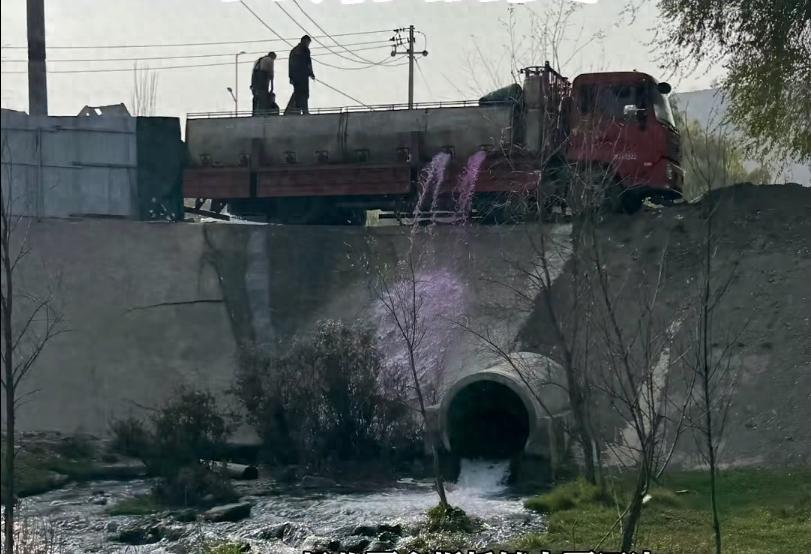
网传甘肃临夏一货车向河道排污,当地通报!
中国能源报· 2025-11-10 06:44
Core Viewpoint - The article discusses an incident in Gansu Province where a truck allegedly discharged wastewater into a river, prompting an investigation by local authorities [1][3]. Group 1: Incident Details - On November 8, a video surfaced online showing a vehicle suspected of discharging pollutants into the Daxia River, leading to immediate action from local government and environmental departments [1]. - The truck involved was identified as a private vehicle transporting fish, which had previously carried different species. To prevent cross-contamination, potassium permanganate was used for cleaning, and approximately 6 cubic meters of residual water was discharged into a drainage channel connected to the Daxia River [3]. Group 2: Environmental Impact and Response - Initial investigations revealed that the discharged water was classified as general wastewater according to the "Comprehensive Discharge Standard for Wastewater" (GB8978-1996), while surrounding water quality met the Class III standard of the "Surface Water Environmental Quality Standard" (GB3838-2002) [3]. - The local ecological environment bureau indicated that the actions of the individuals involved may violate the "Water Pollution Prevention and Control Law of the People's Republic of China," and legal proceedings are underway [3].
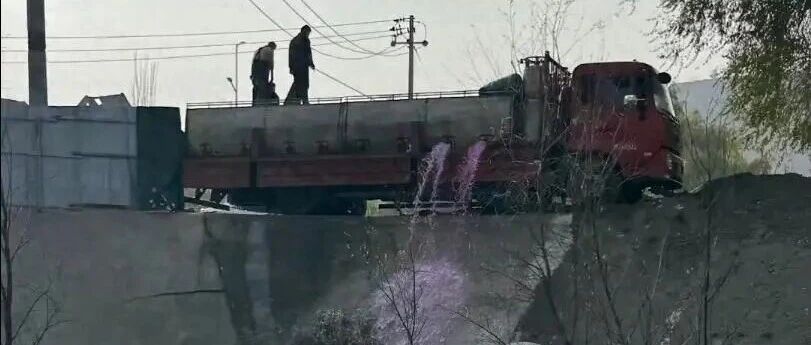
在水源地放生猫,对水对猫都不好
Ren Min Wang· 2025-11-05 11:17
Core Viewpoint - The incident of releasing a large number of cats in the water source protection area of Qingyuan City raises significant concerns about ecological protection and the potential risks to water quality [1][2] Group 1: Incident Overview - A large number of cats were released in the Yingshu Reservoir area, causing some to climb trees and others to drown [1] - The local government confirmed the incident and stated that water quality testing showed all major indicators met standards [1] - The government plans to conduct ongoing environmental monitoring, site disinfection, and investigation of the incident, with legal actions against violators [1] Group 2: Environmental Impact - The release of cats poses a serious threat to the water source, with previous reports indicating the presence of dead cats carrying feline panleukopenia virus, which could contaminate the reservoir [1] - The Water Pollution Prevention Law prohibits activities that may pollute drinking water sources, highlighting the need for tailored and updated measures to protect water resources [1] Group 3: Long-term Protection Strategies - Water source protection requires a collaborative effort from the government, social organizations, and the public, focusing on proactive prevention rather than reactive measures [2] - Recommendations include improving regulations to prohibit improper releases, enhancing monitoring and patrols around water sources, and increasing public awareness of the ecological dangers of well-intentioned actions [2] - The incident prompts reflection on how to enhance ecological literacy and ensure that goodwill does not come at the expense of environmental health [2]
生态环境法典两编草案五大看点
Xin Hua Wang· 2025-10-31 02:02
Core Points - The legislative process of the Ecological Environment Code in China has advanced, with the second draft of the Pollution Prevention and Control section and the Legal Responsibilities and Supplementary Provisions section submitted for review by the National People's Congress Standing Committee on October 24 [1] Group 1: Air Pollution Prevention - The second draft of the Pollution Prevention and Control section focuses on addressing weaknesses in air pollution prevention, enhancing standards for volatile organic compounds, and strengthening regulations on emissions from heavy-duty trucks and ships [1][2] - The draft expands the definition of "organic solvents" to include "raw and auxiliary materials and products containing volatile organic compounds," thereby broadening the scope of regulation [2] Group 2: Water Pollution Prevention - The draft further details regulations on water pollution prevention, including provisions for groundwater condition surveys and stricter standards for wastewater discharge from inland vessels [3] - It emphasizes the need for clear responsibilities among government levels, regulatory bodies, and enterprises, enhancing technical support and standards for effective water pollution control [3] Group 3: Agricultural Non-Point Source Pollution - The draft strengthens regulations on agricultural non-point source pollution, addressing issues related to financial support, management of agricultural inputs, and disposal of agricultural waste [4][5] Group 4: Principle of Proportionality in Penalties - The draft implements the principle of proportionality in penalties, optimizing fine regulations to avoid excessive penalties for minor infractions and vice versa [6][7] Group 5: Combating Fraudulent Practices - The draft imposes strict penalties for fraudulent practices in environmental monitoring, including falsifying data and reports, to ensure data integrity and enhance public trust [8]
新华视点丨生态环境法典2编草案五大看点
Xin Hua Wang· 2025-10-25 06:08
Core Viewpoint - The legislative process of the Ecological Environment Code has advanced, with the second draft of the pollution prevention section and legal responsibilities being submitted for review by the National People's Congress Standing Committee, addressing key social concerns and enhancing environmental protection measures [1]. Group 1: Air Pollution Prevention - The draft emphasizes addressing shortcomings in air pollution prevention, including stricter standards for volatile organic compounds and enhanced regulation of emissions from heavy-duty trucks and ships [2][3]. - The draft expands the definition of "organic solvents" to include "raw and auxiliary materials and products containing volatile organic compounds," thereby broadening the scope of regulation [3]. - It also strengthens the oversight of emissions from mobile sources, such as vehicles and ships, reflecting the changing landscape of air pollution sources [4]. Group 2: Water Pollution Prevention - The draft includes more detailed regulations for water pollution prevention, such as conducting assessments of groundwater conditions and enhancing pollution control for ships entering inland rivers [5][6]. - It establishes management requirements for groundwater pollution prevention and sets higher standards for wastewater discharge from inland vessels [6]. Group 3: Agricultural Non-Point Source Pollution - The draft strengthens regulations on agricultural non-point source pollution, focusing on financial support, management of agricultural inputs, and disposal of agricultural waste [7][8]. - This reflects a shift in focus from point source pollution, which has seen significant improvements, to addressing the rising share of non-point source pollution in overall pollution levels [8]. Group 4: Principle of Proportionality in Penalties - The draft reinforces the principle of proportionality in penalties, optimizing fine regulations to avoid excessive penalties for minor infractions and insufficient penalties for serious violations [9][10]. - This adjustment aims to provide a more balanced approach to environmental enforcement, addressing concerns raised during the initial review of the Ecological Environment Code [10][11]. Group 5: Combating Fraudulent Practices - The draft imposes strict penalties for fraudulent practices in vehicle and ship emissions testing, as well as for falsifying monitoring data [12][13]. - It emphasizes the importance of accurate environmental monitoring data to ensure effective policy implementation and risk management [13].