治安管理处罚法修订

Search documents
明晰构成要件准确把握“制止不法侵害”
Xin Lang Cai Jing· 2026-02-06 23:02
Core Viewpoint - The revised Public Security Administration Punishment Law, particularly Article 19, establishes the legal attributes and consequences of actions taken to stop ongoing unlawful infringements, filling a regulatory gap in public security law [2][11]. Summary by Sections General Positioning of the Stopping Unlawful Infringement Clause - Article 8(2) of the Public Security Administration Punishment Law establishes that criminal acts violating public security must be pursued criminally, affirming the principle of criminal priority [3]. - The law serves as a general norm within the administrative law system, addressing core issues such as unlawful behavior and stopping unlawful infringements, while related laws like the Road Traffic Safety Law and Environmental Protection Law are specific norms [3]. Thought Process for Recognizing Stopping Unlawful Infringement - The recognition process follows a two-step approach: first, assess if the damage caused meets the conditions for public security punishment; second, if it does, analyze whether it meets the criteria for stopping unlawful infringement [4]. - If the damage does not meet the punishment criteria, it is not evaluated under the stopping unlawful infringement clause [4]. Objective and Subjective Requirements - Objective requirements include the reality, illegality, and harmfulness of the unlawful infringement, emphasizing that the infringement must be ongoing and pose a real danger [6]. - Subjective requirements necessitate that the individual has the intention to stop the unlawful infringement, which must be assessed based on specific case contexts [7]. Administrative Responsibility Division for Stopping Unlawful Infringement - Administrative responsibility is categorized into no responsibility and responsibility based on whether the stopping action exceeds necessary limits [8]. - Actions that meet the criteria for stopping unlawful infringement are not subject to punishment, while those that exceed necessary limits may incur penalties but can be mitigated [8]. Connection with Criminal and Civil Law - The scope of stopping unlawful infringement is limited to the infringer and their direct accomplices, with third-party actions falling under emergency avoidance provisions [9]. - The relationship between stopping unlawful infringement and self-defense in criminal law creates a three-tier regulatory system that collectively safeguards citizens' rights [10]. Importance of the Revised Law - The revisions to Article 19 provide a clear legal basis for recognizing self-defense in public security management, emphasizing the need for precise application and continuous refinement of recognition rules through practical cases [11].


新治安管理处罚法明确正当防卫不属违法
Jing Ji Guan Cha Wang· 2025-12-31 06:47
Core Viewpoint - The newly revised "Public Security Administration Punishment Law of the People's Republic of China" will take effect on January 1, 2026, introducing a clause on legitimate defense that exempts individuals from punishment for actions taken to prevent ongoing illegal harm [1] Group 1 - The law includes a new provision that clarifies actions taken in legitimate defense against ongoing illegal acts will not be considered violations of public security management [1] - The implementation date of the revised law is set for January 1, 2026, indicating a future regulatory change that may impact legal interpretations and enforcement [1]
明年向好友发不雅照算违法?央视的解读来了
猿大侠· 2025-12-26 04:11
Core Viewpoint - The recent discussions surrounding the new amendments to the Public Security Administration Punishment Law have led to widespread misinterpretations, particularly the claim that sending inappropriate photos to friends will be illegal starting January 1, 2026, which has been clarified as a misunderstanding by legal experts [6][8]. Summary by Sections Misinterpretation of the Law - The claim that sending inappropriate photos constitutes a violation of the law is a misinterpretation; this behavior has been illegal since the original law was enacted in 2005 [6][7]. - The amendments primarily update terminology and increase penalties, but do not introduce new prohibitions regarding private communications [7][8]. Legal Clarifications - Legal experts emphasize that "inappropriate" and "obscene" are not synonymous; the latter requires judicial determination and has a clearer legal definition [8]. - The law has always prohibited the use of communication tools to disseminate obscene materials, and the amendments do not change this fundamental aspect [7][8]. Focus on Minor Protection - A significant aspect of the new law is the increased penalties for offenses involving minors, reflecting a heightened focus on protecting this vulnerable group [10][11]. - The law now explicitly states that distributing obscene materials involving minors will result in harsher penalties, aligning with the objectives of the Minor Protection Law [11][12]. Legislative Intent and Public Perception - The law aims to maintain social order while also safeguarding citizens' rights, indicating a balance between enforcement and civil liberties [12][13]. - The adjustments in penalties suggest a nuanced approach, where some provisions may actually relax previous restrictions, reflecting a "temperature" in legislation that considers public sentiment [13].

哪些情况下“发送私密信息”可能违法,律师详解
第一财经· 2025-12-24 00:53
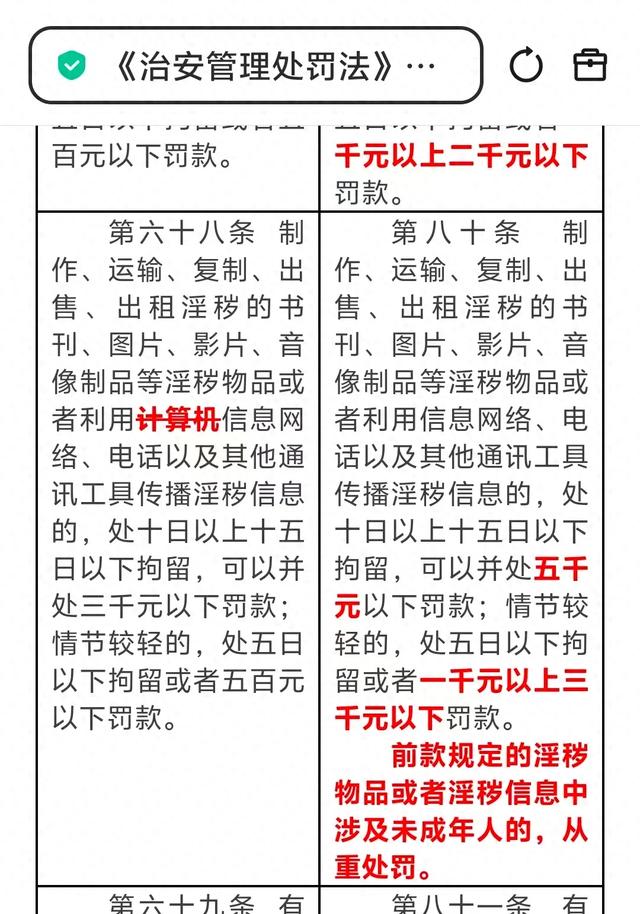
Core Viewpoint - The new regulations regarding the transmission of obscene information, effective from January 1, are not entirely new but rather an update to existing laws to better address modern communication methods and fill legal gaps [3][5]. Summary by Sections Legal Changes - The revised Public Security Administration Punishment Law, Article 80, stipulates that producing, transporting, copying, selling, renting obscene materials, or disseminating obscene information via information networks or other communication tools can result in detention of 10 to 15 days and fines up to 5,000 yuan; lighter offenses may incur detention of up to 5 days or fines between 1,000 and 3,000 yuan [3][4]. - Compared to the previous law, the new version broadens the scope from "computer information networks" to "information networks," reflecting advancements in technology and the need for updated legal language [3][4]. Enforcement and Penalties - The new law increases penalties for violations, raising the maximum fine for general offenses from 3,000 yuan to 5,000 yuan, and for lighter offenses from 500 yuan to between 1,000 and 3,000 yuan, enhancing legal deterrence [5]. - There is a specific emphasis on harsher penalties for offenses involving minors, aligning with the principles established in the revised Minor Protection Law [5]. Public Concerns and Clarifications - Concerns have arisen regarding the potential criminalization of private exchanges of intimate content between partners. However, legal experts clarify that the law distinguishes between "obscene information" and "private information," indicating that consensual sharing of non-obscene content is generally not subject to legal penalties [6]. - The law adheres to a principle of restraint, suggesting that private behaviors that do not disrupt social order are not overly regulated, although unauthorized sharing of private content could lead to privacy violations or criminal charges [6].

向好友发不雅照算违法?新修订的治安管理处罚法解读
Yang Shi Xin Wen· 2025-12-23 23:28
Core Viewpoint - The revised "Public Security Administration Punishment Law of the People's Republic of China" will take effect on January 1, 2026, and recent media reports misinterpret that sending inappropriate photos or videos to friends will be illegal, which is not a new addition to the law [1][2]. Summary by Sections Legal Interpretation - Legal experts clarify that the act of sending inappropriate photos has been illegal since the original law was enacted in 2005, and the recent amendments do not introduce new prohibitions regarding private communications [2][3]. - The law's revision includes a change from "computer information network" to "information network" to reflect technological advancements, but this does not expand the scope of the law [2]. Public Reaction and Misunderstanding - The misinterpretation has sparked public debate, particularly regarding the distinction between "inappropriate" and "obscene," with experts noting that "inappropriate" is subjective and not legally defined [2][3]. - Concerns have been raised about the allocation of law enforcement resources to private interactions, questioning the practicality of reporting intimate exchanges between couples [3]. Key Amendments - The revised law emphasizes stricter penalties for distributing obscene materials involving minors, reflecting a significant focus on protecting underage individuals [4][5]. - The law aims to maintain social order and protect citizens' rights, indicating a shift towards a more balanced approach in law enforcement [6]. Legislative Context - The law serves as a "small criminal law" addressing behaviors that disrupt social order without constituting a crime, and it connects with the Criminal Law regarding the distribution of obscene materials for profit [4][6]. - The first article of the law has been adjusted to emphasize constitutional awareness, indicating a broader perspective on civil rights rather than merely punitive measures [6].
夫妻之间发私密照也算违法是误读
Xin Lang Cai Jing· 2025-12-23 15:59
Core Viewpoint - The recent media reports suggesting that sharing intimate photos between couples constitutes a violation of the law are a misunderstanding. The new regulations set to take effect on January 1, 2026, are a revision of existing laws rather than a new rule [1] Summary by Relevant Sections Legal Framework - The revised Public Security Administration Punishment Law includes provisions against the dissemination of obscene materials via information networks, with penalties ranging from detention of 10 to 15 days and fines up to 5,000 yuan [1] - The law emphasizes that any individual who produces or disseminates obscene content, without constituting a crime, will face administrative penalties [1] Changes in Regulations - The new law modifies the terminology from "computer information network" to "information network," which some interpret as broadening the scope to include private messages and group shares. However, similar cases have already been penalized under existing laws [1] - The revised law increases the fines and stresses stricter penalties for violations involving minors [1] Misinterpretations and Clarifications - Claims that sharing inappropriate photos between friends or spouses is illegal are deemed inaccurate. Legal repercussions arise primarily when such content is shared with others or leads to widespread dissemination [1] - Distinctions are made between "inappropriate" and "obscene" content, with legal standards in place to determine what constitutes obscenity [1] Enforcement and Privacy Concerns - There are concerns about police monitoring of private conversations; however, law enforcement does not actively surveil private chats. Legal action is typically initiated based on reports and must rely on legally obtained evidence [1] - The essence of the law is to prohibit the creation, transportation, and dissemination of obscene content, targeting behaviors that disrupt social order without criminalizing private exchanges between individuals [1]
“私聊发送小黄图违法”系误读, 极端个案不会成为普遍适用的“惊悚故事”
Mei Ri Jing Ji Xin Wen· 2025-12-23 13:22
Core Viewpoint - The recent revision of the Public Security Administration Punishment Law in China, set to take effect in 2026, has sparked public concern over the implications for personal communication and the potential overreach of state power into private matters. However, a closer examination reveals that the core change is a technical update rather than an intrusion into private communication [1]. Group 1: Legal Changes - The key change in the revised law is the shift from "computer information network" to "information network," reflecting a "technological neutrality" that aligns with the current digital landscape where smartphones and wearable devices dominate [2]. - The law has never explicitly mentioned "private chat" or "group chat," indicating that the revision is not aimed at regulating private conversations but rather at ensuring legal language accurately reflects technological realities [2]. Group 2: Misinterpretation of Cases - Reports citing extreme cases, such as individuals being sentenced for sending numerous videos, should not be generalized to imply that private messaging is illegal. These cases fall under criminal law for severe offenses and do not represent typical interactions among ordinary citizens [3]. - The law maintains a degree of restraint in private spaces, suggesting that unless there is substantial social harm, state intervention should be cautious and limited [3]. Group 3: Focus on Youth Protection - A significant aspect of the law is the enhanced penalties for offenses involving minors, with fines for lesser offenses increased from below 500 yuan to above 1,000 yuan, and the upper limit raised to 5,000 yuan. This aims to raise the cost of violations significantly [4]. - The law emphasizes strict penalties for any dissemination of obscene materials involving minors, marking a critical step in protecting youth from online exploitation [4]. - The revision represents a legislative advancement that adapts to technological changes while reinforcing societal safeguards, particularly for vulnerable populations [4].

明年起向好友发不雅视频就违法?别误读!
Xin Lang Cai Jing· 2025-12-23 08:47
Core Viewpoint - The revised Public Security Administration Punishment Law of the People's Republic of China will take effect on January 1, 2026, with significant changes to the penalties for disseminating obscene information, leading to widespread discussion and some misunderstandings among the public [1][4]. Summary by Relevant Sections Key Differences Between New and Old Laws - The new law expands the scope of application by changing "computer information network" to "information network" and increases the maximum fines while introducing harsher penalties for offenses involving minors [3]. Scope of Application - The new law clarifies that private messaging is not exempt from regulation, addressing the misconception that sending obscene information privately is legal. It covers both public and private dissemination behaviors [4][7]. Legal Interpretation of Private Messaging - There are currently no specific exemptions for private exchanges between couples or spouses. The determination of legality will typically focus on the social harm caused by the content shared [5][6]. Enforcement Considerations - In practice, private exchanges of sexual content between couples are unlikely to be prosecuted unless they involve social harm, coercion, or dissemination to third parties. The law allows for non-punishment in cases where the behavior is deemed to have minimal social harm [6][7]. Focus of Law Enforcement - The primary aim of the revised law is to strengthen the governance of online obscene information, particularly targeting public dissemination, group sharing, and offenses involving minors. Normal intimate interactions between couples are not the focus of enforcement [7].
时隔近20年首次“大修”,应对新型社会治安问题 治安管理处罚法 哪些修订与你我密切相关(法治聚焦)
Ren Min Ri Bao· 2025-07-01 21:55
Core Viewpoint - The revised Public Security Administration Punishment Law will take effect on January 1, 2026, aiming to adapt to the changing social security landscape and improve legal frameworks for public security management [1][2]. Group 1: Key Changes in Law - The new law clarifies that actions taken to prevent ongoing illegal harm will not be penalized, promoting the concept of legitimate defense [2][3]. - For minors aged 14-16 and 16-18, the law now allows for detention in cases of serious initial violations, addressing concerns about repeat offenders [3][4]. - Specific provisions against bullying in schools have been established, mandating penalties for acts of bullying and requiring schools to report serious incidents [4]. Group 2: Animal Management Regulations - The law introduces penalties for failing to secure animals, leading to harm to others, including fines or detention [5][6]. - It also addresses the sale and breeding of dangerous animals, establishing a legal framework for enforcement [6]. Group 3: Record Management and Enforcement - The law stipulates that records of administrative violations can be sealed and not disclosed to any entity, enhancing privacy for individuals [7][8]. - It includes provisions for humane treatment of individuals facing detention, allowing for deferment under certain circumstances [7]. Group 4: New Offenses Added - New offenses have been added to the law, including actions that disrupt public transport, high-altitude throwing of objects, and unauthorized drone flights, which will now be subject to penalties [9]. - Other behaviors such as harassment, abuse of vulnerable individuals, and identity fraud have also been classified as punishable offenses [9].
焦点访谈|新修订的治安管理处罚法明年起实施,聚焦哪些社会关切?
Yang Shi Wang· 2025-06-28 13:57
Core Viewpoint - The newly revised Public Security Administration Punishment Law addresses emerging social issues and enhances legal frameworks to ensure public safety and order, effective from January 1, 2026 [1][3]. Summary by Relevant Sections Major Changes in the Law - The law has been updated to include new social issues such as high-altitude throwing, student bullying, and unauthorized drone flights, which were not addressed in the previous version from 2005 [1][3]. - Specific penalties for actions like seizing a driver's steering wheel during transit have been established, with fines up to 1,000 yuan or detention for up to 10 days for severe cases [3][4]. Focus on Minors - The law introduces provisions for punishing minors aged 14-18 for serious violations, allowing for administrative detention under certain circumstances [8][9]. - Measures for educational correction will be applied to minors who do not fall under the detention criteria, ensuring that they are still held accountable [8][9]. Addressing Campus Bullying - The law explicitly categorizes campus bullying as a public security violation, mandating penalties for severe cases and requiring schools to take action against known incidents [9][10]. - Schools are held responsible for failing to report or address bullying, with potential consequences from law enforcement [10][11]. Legal Procedures and Enforcement - The revised law emphasizes the need for standardized enforcement procedures, including mandatory recording of law enforcement actions to enhance accountability [11][13]. - It also clarifies the conditions under which citizens can exercise self-defense, aiming to protect lawful actions while preventing abuse [11][12]. Overall Impact - The updated law expands from 119 to 144 articles, reflecting a comprehensive approach to modern public security challenges and enhancing legal protections for citizens [13].