
AI to C

Search documents
夸克与文库,AI的另类战场
3 6 Ke· 2025-05-21 03:42
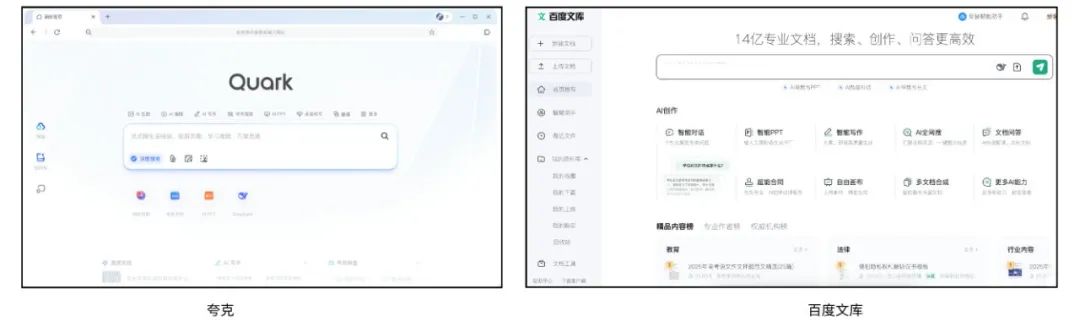
Core Insights - The AI industry is shifting towards an integrated approach with the emergence of "super apps" that combine various AI functionalities, moving away from standalone applications [1][4][20] - Major companies like Alibaba and Baidu are leveraging their existing tools, such as Quark and Baidu Wenku, to capture consumer traffic and enhance user experience [1][3][18] Group 1: Super App Strategy - The era of relying solely on application layers is over, with companies now integrating AI models and agent modules into a single entry point to meet diverse user needs [1][4] - The "super box" concept enhances user experience by transforming passive AI applications into proactive solutions that address various demands [4][12] - Quark has become a leading player in the AI product landscape, achieving a monthly active user (MAU) count of 149.1 million, while Baidu Wenku has over 90 million MAUs [6][10] Group 2: Product Development and User Engagement - Quark's strategy focuses on a no-advertising model supported by a membership system, integrating multiple functionalities such as AI writing, health assistance, and academic search [7][6] - Baidu Wenku has undergone a transformation to enhance its C-end AI capabilities, emphasizing user testing and gradual rollout of new features [8][10] - Both Quark and Baidu Wenku face challenges of feature redundancy and user experience complexity, as they attempt to cater to a wide range of user needs [13][15] Group 3: Market Dynamics and Competition - The competition for C-end users is intensifying, with major players like ByteDance and Tencent also entering the AI agent space, leveraging their existing user bases [18][20] - The AI application market is projected to reach $134.8 billion by 2025, with a compound annual growth rate (CAGR) of 29.2%, indicating significant growth potential [19] - The success of these super apps will depend on their ability to attract and retain users, as the market becomes increasingly crowded [20]


突然“爆了”!超4400亿
Zhong Guo Ji Jin Bao· 2025-04-27 10:48
Group 1 - Public funds' heavy holdings in Hong Kong stocks exceeded 440 billion yuan, marking a continuous increase for five consecutive quarters [1][2] - As of the end of Q1 2025, public funds held 19.968 billion shares of Hong Kong stocks, a year-on-year increase of 27%, with the total market value rising to 445.408 billion yuan, a year-on-year increase of 124% [2] - The average position of actively managed equity funds in Hong Kong stocks reached 23.95%, an increase of 4.24 percentage points from the previous quarter, with over 70% of products increasing their holdings [2][3] Group 2 - The technology sector in Hong Kong is expected to see further revaluation, with leading companies still having relatively low valuation metrics [3] - The influence of "Northbound funds" is expected to continue to rise, with more incremental capital likely to flow into Hong Kong stocks due to lower funding costs in mainland China [3][4] - The recovery of the macro environment, along with positive trends in AI industry performance and global liquidity, is anticipated to support the growth of Hong Kong stocks [3][4] Group 3 - Three main reasons for the increased investment in Hong Kong stocks include improved profitability in the internet sector, the attractiveness of dividend-paying stocks, and the growing competitiveness of domestic new energy vehicles and innovative pharmaceuticals [4][5] - The long-term investment value of Hong Kong stocks remains promising despite short-term fluctuations due to external factors like tariffs [6][7] - Public funds' increased investment in Hong Kong stocks is expected to enhance market liquidity, diversify the investor base, and provide more funding support for key industries [7]


大厂AI to C,进攻是最好的防守
Hu Xiu· 2025-04-10 07:07
Group 1 - The article discusses the competitive landscape of AI-generated content (AIGC) and highlights that traditional internet giants are not the primary players leading the current wave of AIGC technology [1] - Companies like Baidu and ByteDance have quickly launched their AI products, but smaller firms exhibit greater agility and cost control compared to larger corporations [2][3] - The uncertain commercial prospects of chatbot products lead larger companies to be more cautious in resource allocation, as these products do not generate the same addictive engagement as mobile games or short videos [3][4] Group 2 - The emergence of DeepSeek has prompted major companies to reassess the commercial value of AI to consumer (AI to C) applications [5][6] - Tencent views DeepSeek as a starting point for scaling AI, while other major players are also heavily investing in AI technologies [6][7] - The article emphasizes that the competition among large companies will intensify as they strive to develop better technologies and products in the AI to C space [8] Group 3 - Despite launching later than competitors, ByteDance's chatbot product, Doubao, achieved significant user engagement through effective marketing strategies [15][16] - Tencent's AI assistant, Tencent Yuanbao, has seen rapid user growth after integrating DeepSeek, indicating a shift in its AI strategy [19][20] - Alibaba's Quark has been upgraded to become the group's flagship AI application, aiming to integrate various user functions through AI [24][25] Group 4 - The article raises questions about the commercial viability of AI to C applications, noting that the subscription model used by OpenAI may not be applicable in the domestic market [29][30] - The current focus for AI applications is on building market recognition and user retention rather than immediate monetization [30][31] - Major companies are exploring the potential of AI applications, with significant investments in GPU procurement to support their AI initiatives [33][34] Group 5 - The competition for AIGC market share is likened to previous battles for digital traffic, with companies needing to establish brand recognition to attract users [35][37] - The article notes that while there is no clear commercial model for consumer-level AI applications, the demand for customized industry models is growing [36] - Companies are rapidly iterating their AI products to enhance functionality and user experience, with Tencent's Yuanbao undergoing frequent updates [39][41]