
AI医疗

Search documents
京东健康(06618):25H1业绩超预期,首发产品矩阵仍在扩容,AI医疗多维度布局
Xinda Securities· 2025-08-18 12:01
Investment Rating - The investment rating for JD Health (6618.HK) is not explicitly stated in the provided documents, but the report indicates a positive outlook based on performance metrics and growth potential [1][12]. Core Viewpoints - JD Health reported a revenue of approximately 35.29 billion yuan for H1 2025, representing a year-on-year increase of 24.5%. The pre-tax profit was 2.864 billion yuan, up 17.4% year-on-year, and the net profit attributable to shareholders was about 2.591 billion yuan, reflecting a 27.4% increase [2][3]. - The growth in revenue is driven by an increase in active user numbers, improved penetration rates, and an expansion of product categories. The active user count exceeded 200 million, with an average of over 500,000 daily consultations in H1 2025 [3][4]. - The company continues to expand its product launch lineup, including innovative drugs and non-pharmaceutical products, which are expected to enhance sales and user engagement [3][4]. Financial Summary - For the fiscal years 2024A to 2027E, total revenue is projected to grow from 58.16 billion yuan in 2024 to 93.737 billion yuan in 2027, with year-on-year growth rates of 9%, 21%, 15%, and 16% respectively [5][6]. - The pre-tax profit is expected to increase from 4.797 billion yuan in 2024 to 7.13 billion yuan in 2027, with corresponding growth rates of 78.13%, 14.93%, 12.10%, and 15.37% [5][6]. - The gross margin is anticipated to improve from 22.88% in 2024 to 25.18% in 2027, indicating enhanced profitability [5][6]. User Engagement and AI Integration - The company has integrated AI into its healthcare services, with the "AI Jingyi" platform serving over 50 million users by June 30, 2025. This includes various AI-driven services for patients and healthcare professionals [3][4]. - JD Health is also enhancing its specialized medical capabilities, focusing on areas such as dermatology, mental health, and traditional Chinese medicine, which have collectively served over 20 million patients [4].

马云出手!
Zhong Guo Ji Jin Bao· 2025-08-18 10:17
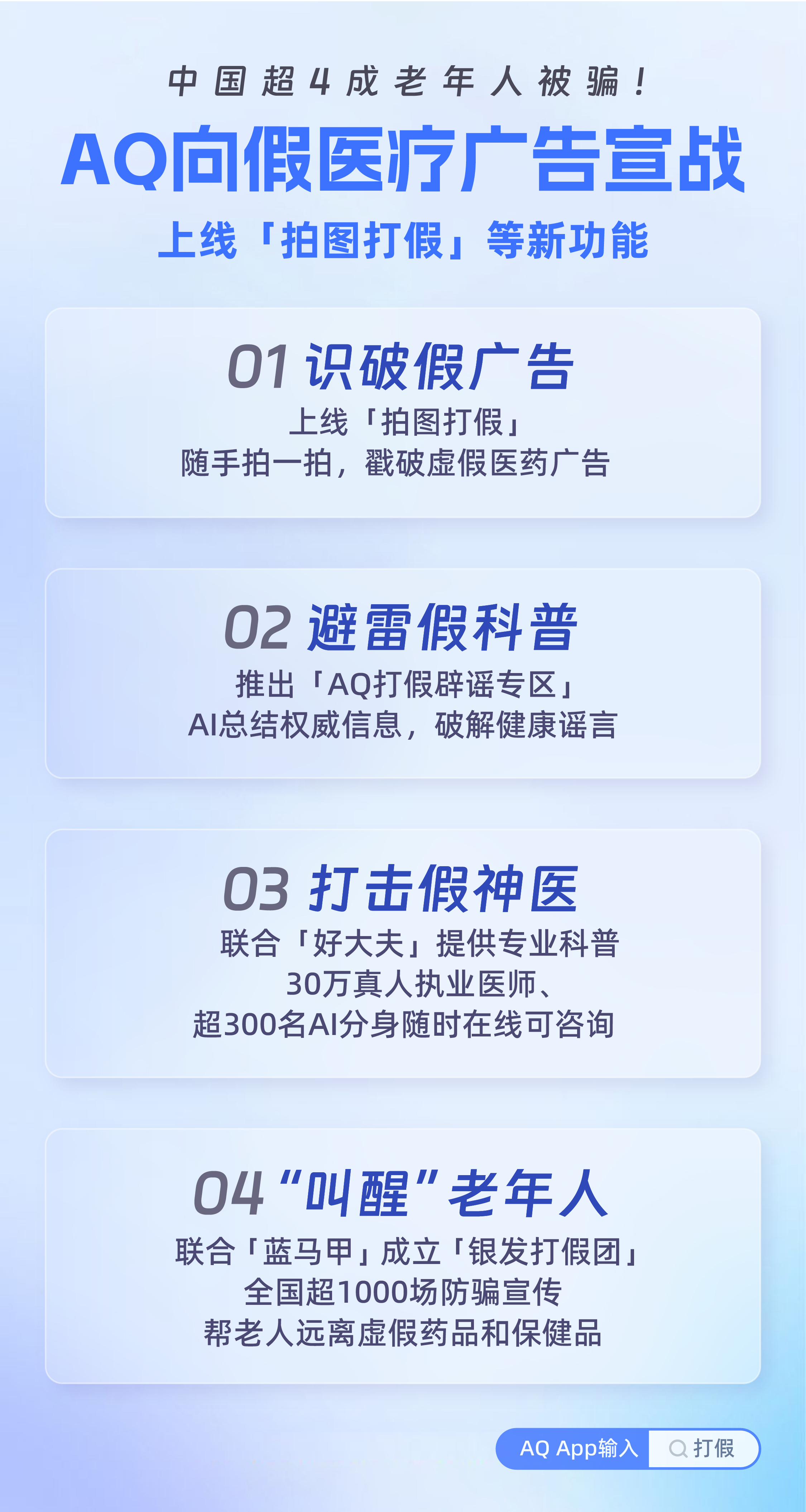
Core Viewpoint - Ant Group has officially declared war on fake medical advertisements, with its AI health application AQ launching four major initiatives to combat medical fraud and misinformation [1][2]. Group 1: Initiatives Launched by AQ - AQ has introduced the industry's first AI medical fraud refutation zone, allowing users to activate features by entering "fraud" in the AQ App, including "AI photo fraud detection" and "AI phone verification" [5][19]. - The application has partnered with over 300 top-tier doctors to provide AI avatars and connect with more than 300,000 real practicing physicians for in-depth consultation and education [19][20]. - AQ has formed a "Silver Anti-Fraud Team" in collaboration with the Blue Vest Public Welfare Action Group, conducting over 1,000 anti-fraud activities nationwide aimed at protecting the elderly from scams [5][20]. Group 2: Background and Context - Over 30,000 elderly individuals have been defrauded of more than 1 billion yuan due to misleading advertisements for "special health wines," highlighting the severe impact of fake medical ads on vulnerable populations [5]. - Recent government efforts have intensified to combat fake medical advertisements, prompting Ant Group to take proactive measures through AQ [5][19]. - The application aims to provide low-threshold, trustworthy digital tools to help the public identify medical fraud, particularly benefiting the elderly demographic [6][19]. Group 3: Technology and Functionality - AQ's technology engine utilizes a medical model trained on over a trillion tokens of professional medical data, integrating authoritative medical literature for in-depth analysis [18]. - The app's "AI photo fraud detection" feature allows users to upload images of suspicious products, which AQ analyzes to provide warnings about potential risks and illegal claims [6][18]. - The platform emphasizes the importance of evidence-based principles in its model's learning and the continuous enhancement of its anti-fraud capabilities [18].

马云出手!
中国基金报· 2025-08-18 10:12
Core Viewpoint - Ant Group has officially declared war on fake medical advertisements, with its AI health application AQ launching four major initiatives to combat medical fraud and misinformation [2][4]. Group 1: Initiatives Launched by AQ - AQ has introduced the industry's first AI medical fraud refutation zone, allowing users to activate features like "AI photo fraud detection" and "AI phone verification" by entering "fraud detection" in the app [6][7]. - The application has partnered with over 300 real doctors and AI avatars of renowned physicians to provide in-depth health education and consultation services [9][10]. - AQ has formed a "Silver Anti-Fraud Team" in collaboration with the Blue Vest Public Welfare Action to conduct thousands of anti-fraud activities for the elderly across the country [7][8]. Group 2: Technology and Data Utilization - AQ's technology engine, the Ant Medical Model, has learned from over a trillion tokens of professional medical data, integrating authoritative medical literature for deep analysis to provide reliable health information [8][9]. - The app's "AI photo fraud detection" feature allows users to upload images of suspicious products, which are then analyzed to provide warnings about potential risks and illegal claims [8][9]. - In 2022, over 40% of consumer complaints from the elderly were related to false advertising of health products, highlighting the urgent need for tools like AQ to protect vulnerable populations [7][8].
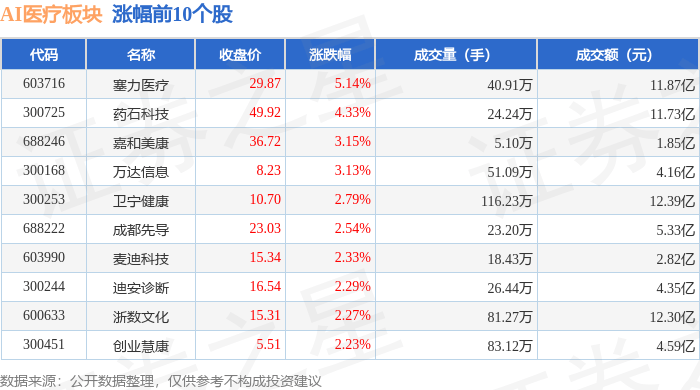
AI医疗板块8月18日涨1.59%,塞力医疗领涨,主力资金净流出7568.36万元
Sou Hu Cai Jing· 2025-08-18 09:16
证券之星消息,8月18日AI医疗板块较上一交易日上涨1.59%,塞力医疗领涨。当日上证指数报收于 3728.03,上涨0.85%。深证成指报收于11835.57,上涨1.73%。AI医疗板块个股涨跌见下表: | 代码 | 名称 | 收盘价 | 涨跌幅 | 成交量(手) | 成交额(元) | | --- | --- | --- | --- | --- | --- | | 603716 | 塞力医疗 | 29.87 | 5.14% | 40.91万 | 11.87亿 | | 300725 | 药石科技 | 49.92 | 4.33% | 24.24万 | 11.73亿 | | 688246 | 嘉和美康 | 36.72 | 3.15% | 5.10万 | 1.85亿 | | 300168 | 万达信息 | 8.23 | 3.13% | 51.09万 | 4.16亿 | | 300253 | 卫宁健康 | 10.70 | 2.79% | 116.23万 | 12.39亿 | | 688222 | 成都先导 | 23.03 | 2.54% | 23.20万 | 5.33亿 | | 603990 | 麦迪科技 | 15 ...


春立医疗:髋关节、膝关节、单髁手术机器人已获注册证
Jin Rong Jie· 2025-08-18 08:45
Core Viewpoint - The company is actively innovating in the field of AI medical technology, particularly in surgical robotics for hip and knee procedures, and is committed to continuous product iteration and performance enhancement [1] Summary by Categories Company Innovations - The company has developed and received registration for various surgical robots, including those for hip joint surgery, knee joint surgery, and unicompartmental knee surgery [1] Future Plans - The company aims to integrate innovative technologies to drive product upgrades and breakthroughs in performance [1]

这项业务马云亲自取名,和AI有关
Di Yi Cai Jing· 2025-08-18 08:37
Core Insights - Ant Group's AI health application AQ has launched a series of AI anti-fraud features aimed at combating false medical advertisements, particularly to protect the elderly from scams [1][2] - The initiative aligns with Jack Ma's vision of integrating AI with health, as he believes that health issues will be a significant concern in the future [1] - The global AI in healthcare market is projected to grow from $11 billion in 2021 to $194 billion by 2028, with a compound annual growth rate (CAGR) exceeding 41% [2] Group 1 - Ant Group's AQ app offers over a hundred AI functionalities, including health education, consultation, and report interpretation, positioning AI healthcare as a key future direction for the company [1] - The name "AQ" was inspired by Jack Ma, who envisions the product to embody AI, IQ, and EQ, aiming to eliminate misleading medical information [1] - Ant Group's Vice President Zhang Junjie stated that the company is focused on user value rather than immediate commercialization of AI healthcare products [9] Group 2 - The AQ app features the first AI medical anti-fraud verification area, allowing users to report false advertisements through AI image recognition and phone verification [9] - Ant Group plans to collaborate with 300,000 verified doctors from "Good Doctor" to provide in-depth health education and conduct anti-fraud activities for the elderly [9] - The company aims to explore more user needs and scenarios in AI healthcare, indicating a long-term investment strategy in this sector [9]
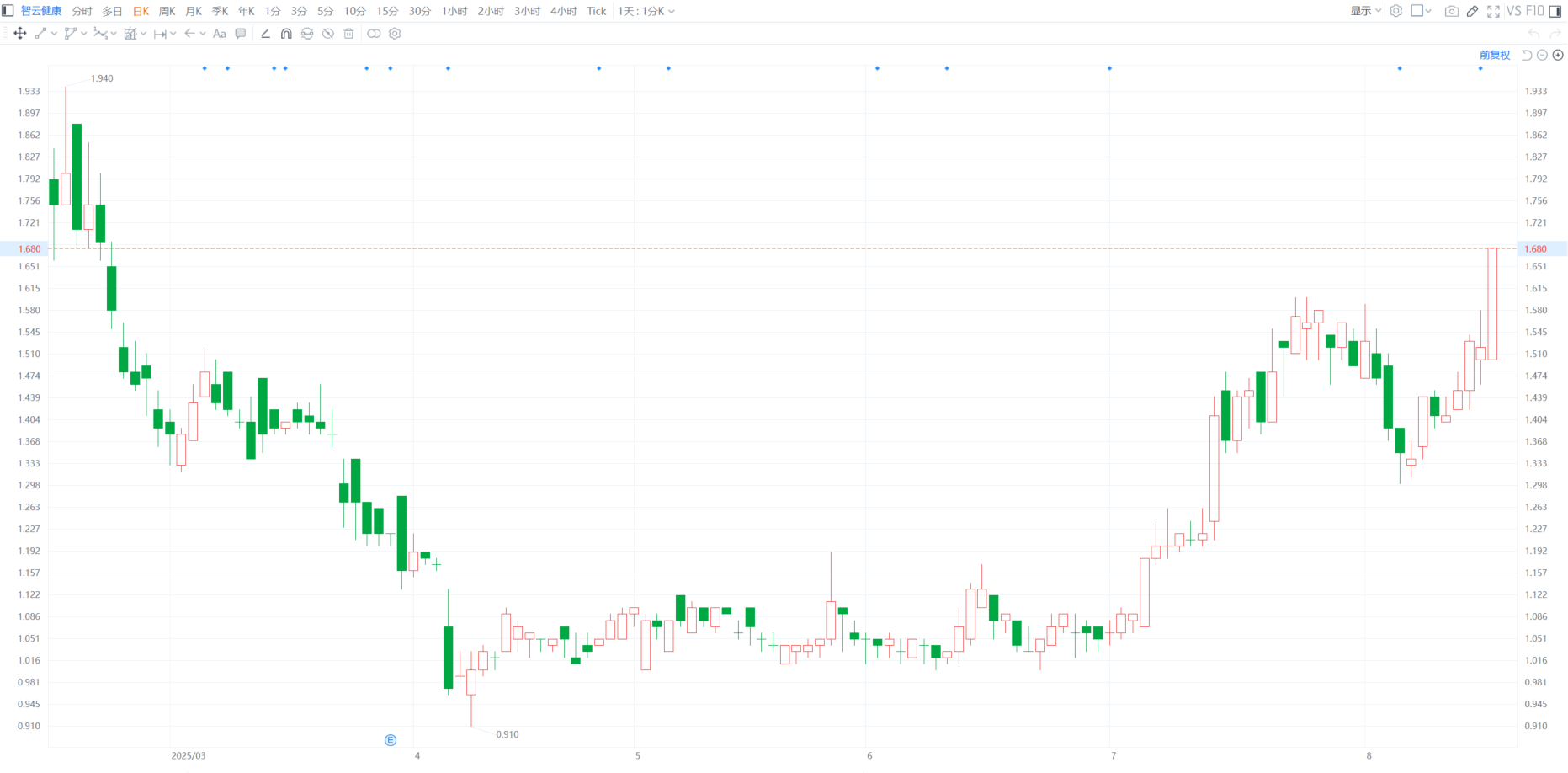
港股异动丨智云健康大涨10% 股价创近半年新高 较年内低点反弹超84%。
Ge Long Hui· 2025-08-18 06:07
消息面上,智云健康AI大模型取得新突破。7月底有消息称,由智云健康首席医学官刘红樱博士带领的医学团队,借助公司自主研发的医疗大模型Cloud DTx,成功解锁了妊娠糖尿病(GDM)治疗的新方案,该研究已被国际顶级医学信息期刊JMIR收录,标志着智云健康在内分泌和女性健康领域的科研能力实 现了进一步飞跃。 银河证券研报认为,建议仍聚焦人工智能主赛道,重点把握硬核底座、出海龙头、场景货币化能力预期兑现的AI+应用龙头公司等三条主线,关注AI+医疗 龙头。方正证券亦指,"人工智能+"驱动医疗产业革命性发展,脑机接口、手术机器人等高端创新设备加速落地和应用拓展,国产企业加速自研与合作布 局,AI医疗进入百花盛开时刻。(格隆汇) 智云健康(9955.HK)今日盘中一度涨10.53%至1.68港元,股价创2月25日以来近半年新高,市值重回10亿港元上方。该股今年4月9日盘中曾触及年内低点0.91 港元,迄今逾4个月的时间,股价已累涨超84%。 ...
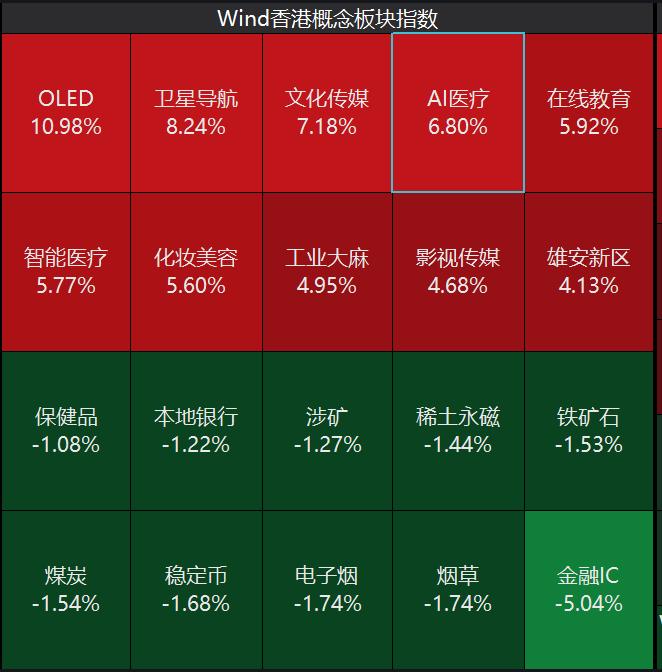
港股医疗ETF(159366)成交额3.57亿!第二大成分股京东健康涨超10%
Xin Lang Cai Jing· 2025-08-18 05:47
Group 1: Market Performance - The CSI Hong Kong Stock Connect Medical Theme Index (932069) has risen by 2.27% as of August 18, 2025, with notable increases in constituent stocks such as JD Health (06618) up 9.88% and Yiyang Sunshine (02522) up 8.90% [1] - The Hong Kong Medical ETF (159366) has increased by 1.93%, reaching a latest price of 1.64 HKD, and has seen a cumulative increase of 8.71% over the past week as of August 15, 2025 [1] - The average daily trading volume of the Hong Kong Medical ETF over the past month is 311 million HKD, with the latest fund size reaching a record high of 2.93 billion HKD [1] Group 2: Company Performance - JD Health reported a 22.7% year-on-year increase in sales revenue for pharmaceuticals and health products, reaching 29.3 billion HKD in the first half of 2025, driven by an increase in annual purchasing users exceeding 200 million and higher average spending per user [2] - The platform, advertising, and other service revenues for JD Health grew by 34.4% to 5.96 billion HKD, attributed to sustained growth in advertising revenue and an expanding commission scale supported by transaction growth [2] - JD Health launched over 30 innovative drugs online in the first half of 2025 and has seen a significant increase in the number of merchants on its platform, exceeding 150,000 compared to over 100,000 at the end of 2024 [2] Group 3: Industry Trends - The global AI medical investment and financing landscape is thriving, with significant breakthroughs in AI medical research, including FDA approval for the first AI wearable treatment device and advancements in AI drug development [3] - The Hong Kong Medical ETF (159366) is noted for having the highest CXO content in the market, focusing on internet medical services, CXO, and medical devices, and closely tracks the CSI Hong Kong Stock Connect Medical Theme Index [3] - The CSI Hong Kong Stock Connect Medical Theme Index includes 50 listed companies involved in medical devices, medical services, and pharmaceutical sectors, reflecting the overall performance of the medical sector within the Hong Kong Stock Connect [3] Group 4: Index Composition - As of June 30, 2025, the top ten weighted stocks in the CSI Hong Kong Stock Connect Medical Theme Index include WuXi Biologics (02269) at 14.58% and JD Health (06618) at 10.83%, collectively accounting for 56.9% of the index [4]
股市必读:联影医疗(688271)8月15日董秘有最新回复
Sou Hu Cai Jing· 2025-08-17 19:48
Core Viewpoint - The company is actively leveraging artificial intelligence (AI) technology to enhance its medical imaging and radiation therapy capabilities, focusing on improving diagnostic efficiency and patient experience while navigating complex global trade environments [2][3][5]. AI Strategy and Applications - AI technology is becoming a key driver for innovation in medical imaging and radiation therapy, with hospitals increasingly favoring AI-enabled products for tasks such as lung nodule detection and brain hemorrhage screening [2][3]. - The company has developed several AI platforms across its product lines, including the uSense platform for CT, uAIFI for MR, and uExcel for molecular imaging, which enhance diagnostic accuracy and operational efficiency [5][11]. - Specific advancements include the uMRJupiter 5.0T MRI system, which improves imaging speed by 40% and enhances detection capabilities for small lesions, and the uMIPanvivo PET/CT system, which reduces full-body scan time to one minute [2][5]. Market Position and Global Strategy - The company has established a strong presence in the European market, with over 500 high-end medical devices serving more than half of EU member states, and is adapting its strategy in response to new EU procurement policies [2][3]. - The company aims to diversify its global supply chain and enhance local operations to mitigate risks associated with geopolitical factors, having set up subsidiaries in Poland and the Netherlands [2][3]. Financial Performance and Investment - The company reported fluctuations in operating cash flow due to macroeconomic factors and strategic investments, with R&D expenditures reaching 22.61 billion yuan, accounting for 21.95% of revenue [2][4]. - Despite short-term cash flow challenges, the company is focused on long-term value creation through innovation and global expansion, with a significant increase in overseas marketing and service teams [4][12]. Product Development and Innovation - The company is addressing common MRI challenges such as noise and scan duration through innovations like the QScan technology, which reduces noise levels by up to 97% and the ACS technology that cuts scan times by 80% [7][10]. - The introduction of the uMRUltra 3.0T MRI system and the uMROMEGA 3.0T system with advanced features aims to enhance patient comfort and diagnostic capabilities [8][10]. Shareholder Engagement and Dividends - The company has implemented a stable dividend policy, having distributed over 5.3 billion yuan since its IPO, and is committed to enhancing shareholder returns while balancing the need for reinvestment in high-tech medical equipment [12][14].

“羲和一号”AI医疗大模型破解临床实际痛点
Zheng Quan Ri Bao Wang· 2025-08-17 11:42
Core Insights - The 31st China International Medical Instrument and Equipment Exhibition showcased over 300 companies and highlighted innovations in various medical fields, including AI healthcare solutions [1] - The "Xihe No.1" medical AI model was officially launched, developed by a collaboration between Peking University Third Hospital, Peking University AI Institute, and Boya Quanjian Technology, with a focus on enhancing healthcare in Africa [2][1] Group 1: AI Model Development - The "Xihe No.1" model took nearly 10 years to develop, utilizing 1 million real clinical cases to create a model with over 100 billion parameters, achieving a medical knowledge coverage rate of 98% and precision rate above 90% [2][3] - The model's training data comes from 18 medical institutions, ensuring high reliability and ethical compliance, with all data processed and labeled by clinical doctors [3] Group 2: Differentiation Strategy - The model differentiates itself by relying on rigorous clinical data rather than internet-sourced information, which may lack clinical validation [3] - The accuracy of "Xihe No.1" is significantly higher than models trained on less reliable data, with an error output rate that is extremely low [3] Group 3: Demand-Driven R&D - The development philosophy of "Xihe No.1" is centered on addressing clinical needs rather than merely applying technology, which is seen as crucial for effective AI healthcare solutions [4] - The model aims to tackle specific clinical challenges, such as high misdiagnosis rates and inadequate diagnostic capabilities in primary care settings [4][5] Group 4: Commercialization Path - The commercialization strategy involves a "1+N" hierarchical diagnosis model, validating the technology in top-tier hospitals before extending it to primary care facilities, thus addressing resource shortages in grassroots healthcare [5]