光储一体化

Search documents
曹仁贤“掰腕”曾毓群
2 1 Shi Ji Jing Ji Bao Dao· 2025-06-20 13:03
Core Viewpoint - The relationship between CATL and Sungrow has evolved from collaboration to competition, as both companies seek to dominate the energy storage market amidst growing demand and supply chain challenges [1][6][9]. Company Overview - CATL, founded by Zeng Yuqun, has become a leader in the lithium battery industry, achieving a total revenue of 362 billion yuan in 2024, with a net profit of 50.7 billion yuan, marking a 15% year-on-year increase [4][5]. - Sungrow, led by Cao Renxian, has established itself as a top player in the solar energy storage sector, reporting a revenue of 77.86 billion yuan in 2024, with a 40.21% increase in its energy storage business revenue [4][5]. Market Dynamics - The energy storage market is experiencing significant growth, with a notable increase in demand for storage systems, particularly in the Middle East, where Sungrow secured a 7.8 GWh project, the largest single order globally at the time [9][12]. - Both companies have faced challenges due to rising battery cell prices and supply bottlenecks, prompting them to adjust their strategies and explore new partnerships [6][9]. Strategic Moves - CATL has begun to compete directly with its former clients by developing its own energy storage systems, such as the "Tianheng" system, indicating a shift towards vertical integration [9][10]. - Sungrow is set to launch a new energy storage container system featuring a 684Ah battery cell, marking a significant technological advancement in the industry [14][15]. Competitive Landscape - The competition between CATL and Sungrow is intensifying, with both companies aiming to establish their dominance in the energy storage market. CATL's focus on large-scale production capabilities contrasts with Sungrow's innovative approaches to battery technology [16]. - The market is witnessing a shift towards diversifying supply chains, as Sungrow seeks to reduce reliance on single suppliers, potentially reshaping the competitive dynamics in the energy storage sector [15][16].


海泰新能王用:户用储能产品正向“家用化”“家电化”趋势发展 | 对话能源大咖
Hua Xia Shi Bao· 2025-06-16 23:46
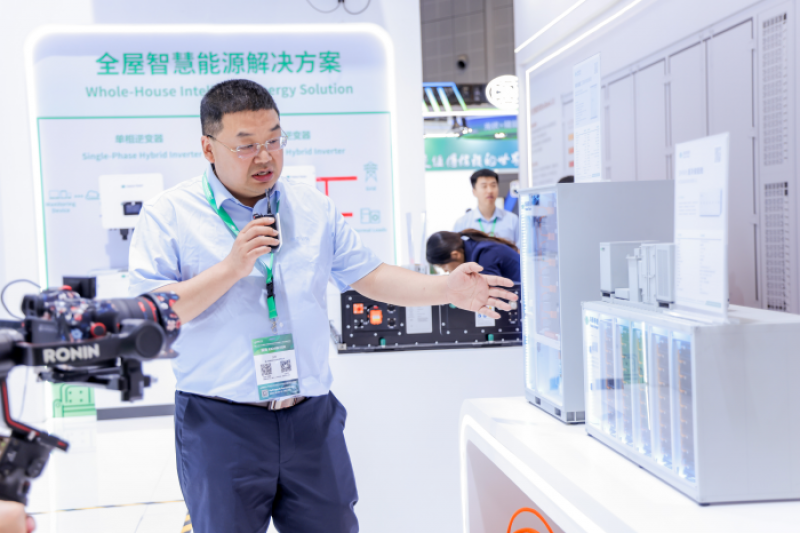
Core Viewpoint - The annual SNEC photovoltaic exhibition highlighted the growing importance of energy storage solutions, with companies like Haitai New Energy focusing on integrated solar and storage solutions to enhance profitability and user experience [3][4]. Industry Trends - The trend towards integrated solar and storage solutions is becoming more pronounced, catering to various applications such as residential, commercial, and large-scale power plants [3]. - Energy storage systems are increasingly adopting AI for intelligent operation and management, enhancing their value in peak shaving and power regulation [3]. Company Developments - Haitai New Energy introduced a new 5MWh energy storage container at the SNEC exhibition, designed for both generation and grid-side storage needs, featuring high energy density and comprehensive safety systems [4]. - The company is focusing on making home energy storage systems more user-friendly and appliance-like, despite increasing technical complexity [6]. Market Insights - The domestic energy storage market is primarily focused on containerized and commercial storage solutions, while the overseas market, particularly in Europe, has a higher proportion of residential energy storage [7]. - Certification is a significant barrier for entering overseas markets, with stringent local certification requirements such as CE and UL standards [7]. Synergy Between Solar and Storage - Haitai New Energy leverages its experience in solar component manufacturing to enhance the synergy between solar and storage solutions, addressing the growing demand for self-consumption of generated electricity [8]. - The company's integrated solar-storage systems are designed to improve electricity utilization and system stability, helping users manage electricity costs and efficiency [8].

天合光能增资8.07亿元 储能业务有望大幅提升
Zhong Guo Jin Rong Xin Xi Wang· 2025-06-16 01:27
Core Viewpoint - Trina Solar is enhancing its capital strength in the energy storage sector through a capital increase of 807 million yuan, reflecting its strategic intent to strengthen its energy storage business as a second growth engine following photovoltaic components [1][2]. Group 1: Capital Increase and Ownership - Trina Solar plans to invest a total of 807 million yuan in its subsidiary, Trina Energy Storage, with Trina Solar contributing 527 million yuan, increasing its ownership from 53.38% to 58.72% [1]. - This marks the third significant capital increase for Trina Energy Storage in two years, totaling 2.4 billion yuan, indicating a strong commitment to the energy storage sector [2]. Group 2: Market and Product Development - The energy storage segment is expected to achieve a shipment volume of 4.3 GWh in 2024, representing over 100% year-on-year growth, with significant expansion in overseas high-end markets [1]. - Trina Energy Storage has established three system integration centers in China, Europe, and North America, aiming for a shipment target of 8-10 GWh in 2025, maintaining over 100% growth [1][2]. Group 3: Technological Advancements - Trina Energy Storage is set to launch new products in 2024, including the Elementa series and Nexeos home energy storage solutions, showcasing advancements in technology and safety [2]. - The company has developed a "10,000-cycle" liquid-cooled energy storage system, which has gained recognition in the generation-side storage market due to its long cycle life and cost advantages [3]. Group 4: Strategic Integration - Trina Solar is focusing on building core competitiveness in energy storage by integrating technologies from battery cells to full system solutions, emphasizing the importance of energy storage for energy stability [4]. - The company is pursuing a comprehensive solution strategy that includes energy storage and photovoltaic integration, aiming to create a stable energy ecosystem through smart energy management [4].

产业周跟踪:SNEC聚焦新技术,国家能源局组织氢能试点
Huafu Securities· 2025-06-15 13:49
Investment Rating - The report maintains an "Outperform" rating for the industry [6] Core Views - The report highlights significant growth in the new energy vehicle sector, with a year-on-year increase of 17 percentage points in export penetration rate for new energy vehicles in May [2][10] - The SNEC exhibition showcased new photovoltaic technologies, indicating a shift towards performance enhancement and multi-scenario applications rather than just peak power [3][20][22] - The offshore wind sector is set to see the launch of the UK's seventh round of Contracts for Difference (CfD) in August, with domestic deep-sea demonstration projects gradually starting [4][32][34] - The energy storage sector experienced a remarkable increase in installed capacity, exceeding 200% in May, with a trend towards integrated solar and storage solutions [4][39][42] - The electricity equipment sector is focused on ensuring power supply during peak summer demand, with the first batch of power projects from the "Xinjiang Electricity to Chongqing" initiative coming online [4][49][51] Summary by Sections New Energy Vehicles and Lithium Battery Sector - The automotive industry is implementing measures to reduce internal competition, with major companies committing to shorten supplier payment terms [10] - In May, the retail sales of new energy vehicles reached 1.021 million units, a year-on-year increase of 28.2% [11] - The report suggests focusing on companies with cost advantages and those leading in fast-charging and high-voltage technologies [12][13] Photovoltaic Sector - The SNEC exhibition highlighted new products from leading companies, with significant advancements in component efficiency and power output [20][21] - The report emphasizes the importance of matching generation curves with pricing curves as a new value metric in the industry [22] - Recommendations include focusing on companies benefiting from supply-side reforms and those with price elasticity in the battery segment [28][29] Wind Power Sector - The UK is preparing for the seventh round of offshore wind CfD, with a significant number of projects eligible to participate [32][33] - The report suggests monitoring companies in the offshore wind supply chain that are expected to see performance improvements [36] Energy Storage Sector - The report notes a substantial increase in new energy storage installations, driven by market demand and regulatory incentives [39][40] - It highlights the trend towards integrated energy solutions and the importance of AI in energy management [42][45] - Investment recommendations focus on quality storage integrators and companies benefiting from the growth of solar-storage solutions [46] Electricity Equipment Sector - The report outlines measures taken by the State Grid to ensure power supply during peak summer, with a focus on enhancing grid capacity [49][50] - It highlights the significance of the "Xinjiang Electricity to Chongqing" project in supporting regional energy needs [51][52] - Investment suggestions include companies involved in overseas expansion and digital grid solutions [56] Industrial Control and Robotics Sector - The report notes a recovery in manufacturing PMI, indicating improved demand for industrial control components [59] - It highlights innovations in robotics, particularly in humanoid robots and their applications in various sectors [60] - Recommendations include focusing on automation leaders and companies involved in humanoid robotics [61] Hydrogen Sector - The report discusses the initiation of hydrogen energy pilot projects by the National Energy Administration, emphasizing the development of a complete hydrogen supply chain [65][66] - It highlights the rapid advancements in hydrogen production technologies showcased at the SNEC exhibition [67] - Investment suggestions focus on companies involved in hydrogen production and fuel cell systems [67]
直击上海光伏展:BC技术风靡行业,储能企业势头强劲
Hua Xia Shi Bao· 2025-06-14 01:44
Core Insights - The 18th International Solar Photovoltaic Exhibition in Shanghai showcased a significant increase in the presence of energy storage companies, indicating a growing trend towards integrated solar and storage solutions [1] - Major industry players like TCL Zhonghuan, JinkoSolar, and Tongwei showcased BC technology products, although most are still in the preparation stage for mass production [2][3] - The exhibition highlighted the trend of solar storage integration, with many companies presenting differentiated solar-storage solutions [6] Group 1: Technology and Product Innovations - BC technology products were prominently featured by industry giants, with TCL Zhonghuan planning to start mass production in Q3, while only a few companies like Longi Green Energy and Aiko Solar have achieved this [2] - TOPCon technology remains the mainstream product, accounting for over 70% of the global market, while BC technology is primarily targeted at price-insensitive regions like Northern and Western Europe [3] - New solar products such as solar tiles and flexible modules were introduced, with companies like Trina Solar and LONGi showcasing innovations that cater to aesthetic and functional needs [4][5] Group 2: Market Trends and Competition - The solar storage market is becoming increasingly competitive, with many solar companies diversifying into storage to improve profitability, as standalone solar products have been unprofitable [6] - Companies are exploring overseas markets due to saturation in the domestic market, with many reporting that international sales are more profitable [8][9] - The demand for storage solutions is rising, particularly in overseas markets, with companies like Suzhou Guding noting that 60% of their orders now come from abroad [8] Group 3: Challenges and Future Outlook - The solar industry is facing intense competition, leading to price wars that have affected profitability across the board, particularly in the component sector [10][11] - The solar glass industry is struggling with many companies operating at breakeven due to price pressures from the component market [11] - Despite the challenges, the overall demand for solar and storage solutions continues to grow, with companies adapting to market conditions and exploring new opportunities [7][10]




“光伏春晚”释放多重积极信号
Zheng Quan Ri Bao· 2025-06-12 16:43
Core Insights - The SNEC Photovoltaic Exhibition serves as a significant platform for showcasing the solar industry, reflecting its development trends and innovations [1] Group 1: Industry Confidence - Despite challenges such as declining prices and losses among some companies, the exhibition attracted over 3,600 exhibitors from 95 countries, covering nearly 400,000 square meters, with 30% being international exhibitors [2] - Emerging markets in Southeast Asia, Latin America, and the Middle East are becoming focal points for Chinese solar companies, providing new opportunities for international expansion [2] Group 2: Technological Innovation - The exhibition highlighted advancements in technologies like TOPCon, HJT, and BC, which are expected to reduce costs and enhance efficiency, thereby expanding application scenarios [3] - Companies showcased next-generation technologies aimed at improving conversion efficiency and lowering costs, contributing to the diversification and competitiveness of the solar industry [3] Group 3: Cross-Industry Integration - There is a notable trend of deep integration between the solar industry and sectors such as energy storage, artificial intelligence, and big data, with a focus on integrated solar-storage solutions [4] - Companies like Huawei Digital Energy introduced solutions that support high proportions of renewable energy in the grid, enhancing energy management and utilization [4] Group 4: Industry Self-Regulation - The exhibition served as a platform for industry reflection, with calls for self-regulation to address price competition and explore pathways for healthy development [5] - Suggestions from industry leaders included market-driven mergers and acquisitions, technological elimination mechanisms, and policy constraints to manage capacity and stimulate demand [5] - The solar industry is transitioning from internal competition to collaborative growth, with a clear path emerging for overcoming challenges through innovation and resilience [5]
实探2025 SNEC光伏展:产业链持续焕“新” 追“光”者破局前行
Zheng Quan Ri Bao· 2025-06-12 16:37
Core Viewpoint - The 2025 SNEC Photovoltaic Exhibition in Shanghai showcased the resilience and innovation within the photovoltaic industry, despite current challenges, with a focus on technological advancements and collaborative development to drive cost reduction and efficiency improvements [1][6]. Group 1: Technological Innovations - Companies are leveraging various advanced technologies such as TOPCon, BC, and heterojunction technologies to enhance efficiency and reduce costs [2][3]. - Longi Green Energy introduced a 700W component based on HIBC technology, which is smaller in area by 0.4m² while achieving a power density increase of 34W/m² [2]. - JinkoSolar's Tiger Neo component is designed for high-temperature and high-irradiation areas, effectively reducing lifecycle costs through improved temperature coefficients and lower degradation rates [3]. Group 2: Differentiated Products - Manufacturers are launching differentiated products tailored to various application scenarios, such as Yingli's new N-type products designed for diverse environments including plateaus and deserts [4]. - The focus on lifecycle cost reduction is driving the development of next-generation technologies like tandem solar cells, which were showcased at the exhibition [5]. Group 3: Industry Challenges and Opportunities - The photovoltaic industry is currently facing supply-demand mismatches and is at a cyclical low, necessitating collective efforts for transformation [6]. - The integration of energy storage solutions is seen as crucial for addressing the intermittency of solar power and ensuring sustainable development [6][7]. Group 4: AI and Energy Storage Integration - The exhibition highlighted the importance of integrating AI with energy storage solutions to optimize renewable energy management and address power demand fluctuations [8]. - Companies like TBEA are developing modular energy storage systems that enhance safety and efficiency, significantly reducing installation and debugging times [7].
TCL电子20250609
2025-06-09 15:30
Summary of TCL Electronics Conference Call Company Overview - **Company**: TCL Electronics - **Industry**: Consumer Electronics, specifically Television Manufacturing Key Points and Arguments Sales Performance - **Domestic Market Growth**: TCL's main brand TV sales grew by 15%-20% in Q1 2025, contributing to an overall domestic market growth of 10.8% [2][3][12] - **Mini LED Sales**: Domestic Mini LED TV shipments increased by 300%, with a market share rising from 4% to 18% in Q1 2025. The annual target for Mini LED sales is set at 1.5 million units, aiming for a market share of 20%-25% [2][3][25] - **Overseas Market Growth**: Overall overseas sales grew by 11.6%, with Europe seeing a 16% increase and emerging markets growing by 20%-25%. North America experienced a slight decline of 4% [2][4][13] Market Dynamics - **North America**: The North American market generated approximately $10 billion in revenue in 2024, accounting for 10% of total revenue, but has not yet achieved profitability. The company aims to turn this around by improving product and channel structures [2][8][13] - **Tariff Management**: TCL has strategically positioned its manufacturing in countries like Vietnam and Mexico to mitigate tariff impacts, ensuring supply chain stability [6][32][33] Product Strategy - **Focus on High-End Products**: TCL is concentrating on high-end Mini LED products with over 1,000 zones, which are expected to maintain a gross margin advantage of over 10% compared to standard LCD TVs [2][25][37] - **Consumer Preferences**: The impact of national subsidy policies on Mini LED sales is limited, as consumers prioritize picture quality improvements over subsidies [5][9][30] Financial Outlook - **Profitability Goals**: TCL aims to achieve profitability in the North American market by 2025 through improved channel structures and product offerings [2][13][21] - **Gross Margin Trends**: The average gross margin for TCL's main brand is around 23%-25%, significantly higher than the 15%-18% margin for the Thunderbird brand [16][29] Competitive Landscape - **Market Positioning**: TCL's pricing strategy positions its products approximately 30% lower than comparable Samsung models, with an average TV price of $400 compared to Samsung's $800 [26] - **Mini LED Technology**: The Mini LED technology is gaining traction in overseas markets, with a significant increase in market share, particularly in Europe and North America [23][24] Future Growth Drivers - **Mini LED Expansion**: The company plans to leverage Mini LED technology as a key growth driver, with a global sales target of 3.5 million units in 2025, split between 2 million units overseas and 1.5 million units domestically [22][23] - **European Market Focus**: TCL is targeting ten key European countries for market share growth, with a current market share of about 10% and significant room for improvement [17][20] Risks and Challenges - **Tariff Fluctuations**: Ongoing changes in tariffs, particularly in North America, pose a risk to profitability and market performance [6][36] - **Market Competition**: The competitive landscape, especially against established brands like Samsung and LG, requires continuous innovation and strategic marketing efforts [15][26] Additional Important Information - **Shareholder Dynamics**: The second-largest shareholder's stake has decreased to approximately 3.5%, with minimal impact on stock performance [11] - **Independent Director Appointment**: The appointment of a new independent director with a strong background in overseas mergers and acquisitions aligns with the company's strategic needs [10]
高泰昊能零代码架构光储一体机,推动储能产品从“标准化”走向“场景化”
中关村储能产业技术联盟· 2025-06-09 10:23
Core Viewpoint - The Chinese energy storage industry is entering a phase of large-scale development driven by the "dual carbon" strategy, with significant growth in installed capacity and energy scale, surpassing pumped storage for the first time [1] Group 1: Industry Growth and Policy Support - By the end of 2024, China's new energy storage cumulative installed capacity is expected to reach 78.3GW/184.2GWh, with power and energy scale increasing by 126.5% and 147.5% respectively [1] - The new operational scale added in 2024 is projected to be 43.7GW/109.8GWh, maintaining a doubling growth for three consecutive years [1] - An action plan for high-quality development of the new energy storage manufacturing industry has been jointly released by eight departments, aiming for high-end, intelligent, and green development by 2027 [1] Group 2: Challenges in the Industry - Homogeneous competition is becoming a significant constraint on development, with products showing high similarity in capacity upgrades and liquid cooling technology applications [2] - The price of energy storage cells is on a downward trend, with the lowest transaction price dropping below 0.3 yuan/Wh, and system integrators' quotes generally falling to 0.5-0.6 yuan/Wh [2] - This homogeneity leads to compressed profit margins and persistent issues for end users, such as high electricity costs and fragmented energy management [2] Group 3: Innovative Solutions - High Taihao Energy has developed a zero-code architecture platform, 4S+C, to create innovative energy storage solutions, breaking traditional development constraints [2][4] - The platform allows for seamless integration of third-party devices, reducing the time for protocol development from 2-3 weeks to 0.5-1 day [4] - The flexible customization of process strategies enables users to define charging and discharging logic without code development, reducing delivery time from 1-2 weeks to within 1 day [5] Group 4: Product Features and Advantages - The zero-code architecture supports the integration of photovoltaic generation, energy storage, and charging functions, creating a closed-loop ecosystem [8] - The system is designed for full-scene adaptability, supporting multiple photovoltaic connections and quick switching between grid-connected and off-grid modes [11] - The intelligent energy dispatch system prioritizes photovoltaic power generation and optimizes peak-valley arbitrage, potentially reducing overall electricity costs by 30%-40% [12] Group 5: Future Outlook - The zero-code architecture is driving the transformation of energy storage products from standardization to scene-based customization, with predictions of cumulative installed capacity reaching 313.9GW by 2030 [16] - Companies with rapid customization capabilities are expected to gain a competitive edge in the market [16] - High Taihao Energy aims to continue leveraging technological innovation to enhance the adaptability of solutions and support the green low-carbon goals [16]
注资40亿!中创新航又有新动作
鑫椤锂电· 2025-05-29 08:03
Core Viewpoint - 中创新航 has entered into a joint venture agreement with Handan City Investment Group and Handan City Urban Operation Group to establish a new company with a registered capital of RMB 4 billion, marking a significant strategic move in its business expansion [6][7]. Group 1: Joint Venture Agreement - The joint venture will have a registered capital of RMB 4 billion, with 中创新航 holding 60% and contributing RMB 2.4 billion, while the Handan parties will hold 40% and contribute RMB 1.6 billion [6]. - The new company will be considered a subsidiary of 中创新航, and its financial performance will be consolidated into the group's financial statements [6]. Group 2: Recent Developments - On May 24, 中创新航 announced its involvement in the large-scale solar-storage integrated project in Latin America, specifically the Chile Tarapacá Aurora project, which is expected to deliver 600 GWh of renewable electricity annually [7]. - This project is one of the largest solar-storage projects in Latin America and aims to meet the annual electricity needs of 200,000 households, serving as a benchmark for energy transition in Chile [7]. - The project utilizes 中创新航's 314Ah Gen2.0 energy storage cells, which were first showcased at the 2025 Munich Energy Storage Exhibition, highlighting the company's global technology integration [7].