
多边主义

Search documents
刚果(金)媒体:全球治理倡议为动荡变革中的世界指明方向
Xin Hua Wang· 2025-09-28 09:13
文章指出,中国一直主张所有国家应得到同等对待,不论其大小、强弱或贫富,都拥有同样的权利参与 国际事务。联合国宪章宗旨和原则,以及普遍承认的其他规范国际关系的基本准则,必须被完全、充分 和彻底地遵守,必须确保国际法和国际规则平等统一适用,避免采取双重标准或将某些国家的"国内规 则"强加于他国。 文章认为,全球治理关乎各国切身利益,需要的是协调与合作,而不是单边主义和恫吓。中国践行多边 主义理念,目标是构建人类命运共同体。从全球发展倡议、全球安全倡议、全球文明倡议到全球治理倡 议,中国持续打造全球公共产品,为人类未来指明方向。 文章说,当今世界正面临新的动荡与转型,全球治理正处于新的十字路口。观察人士认为,中国提出的 全球治理倡议恰逢其时,为世界指明方向,其核心理念是奉行主权平等、遵守国际法治、践行多边主 义、倡导以人为本、注重行动导向。 新华社金沙萨9月27日电(记者史彧 郑扬子)刚果(金)主流媒体《尖子论坛报》日前刊登文章说, 中国提出的全球治理倡议为动荡变革中的世界指明方向。 ...
为“大金砖合作”高质量发展注入新动能
Ren Min Ri Bao Hai Wai Ban· 2025-09-28 09:13
Group 1 - The core viewpoint emphasizes China's role in international cooperation, particularly through the BRICS mechanism, which serves as a platform for emerging markets and developing countries to unite and collaborate [2][3] - The 2025 China International Service Trade Fair attracted over 60 countries and 20 international organizations, showcasing products from developing countries, indicating a strong platform for global trade [2] - The BRICS summit discussed the current international economic environment and the importance of multilateralism, aiming to enhance cooperation among member countries [2][3] Group 2 - The Global Governance Initiative proposed by China outlines five core principles that resonate with the interests of the Global South, including sovereignty equality and multilateralism [3][4] - The initiative aims to address the ongoing global governance deficit characterized by disorder, imbalance, and inefficiency in current international systems [4][5] - The BRICS countries are focusing on enhancing cooperation in trade, finance, and technology to create more substantial outcomes that benefit all member nations [9][10] Group 3 - The summit highlighted the need to counter unilateral trade measures, particularly from the U.S., which have adversely affected international trade rules and BRICS nations [6][8] - There is a consensus among BRICS nations to maintain a multilateral trade system centered around the World Trade Organization, emphasizing collective action against protectionism [7][8] - The BRICS countries are encouraged to strengthen their economic ties, reduce trade barriers, and enhance mutual investments to foster a more integrated market [11]


【环球财经】阿尔克明:巴西将在年底前与欧盟签署南共市自贸协定
Xin Hua Cai Jing· 2025-09-28 06:08
Group 1 - Brazil's Vice President Fernando Alckmin stated that Brazil aims to sign a free trade agreement with the European Union by the end of this year [1] - Brazil has already reached agreements with Singapore and the European Free Trade Association (EFTA) and expects to finalize the EU agreement within the next two months [1] - Brazil is also negotiating a trade partnership with the United Arab Emirates, reflecting its commitment to multilateralism and free trade [1] Group 2 - During the recent US-Brazil presidential meeting at the UN General Assembly, Brazil expressed hopes to reduce tariffs imposed by the US on Brazilian products and expand the range of duty-free goods [1] - Key topics for future US-Brazil trade discussions may include mineral resources and data centers [1] - In response to the US imposing high tariffs, the Brazilian government is implementing measures to help businesses mitigate the impact, including launching the "Brazil Sovereignty Plan" and accelerating foreign trade agreements to access larger markets [1]
新华时评:以多边主义之光照亮全球治理新未来
Xin Hua She· 2025-09-28 05:29
Core Points - The 80th United Nations General Assembly is addressing the challenges facing the international order and the erosion of multilateralism [1] - Geopolitical conflicts, such as the Israel-Palestine conflict and the Ukraine crisis, highlight the inadequacies of the global governance system [1] - The need for a return to genuine multilateralism and the strengthening of the UN's authority is emphasized [1][3] Group 1 - The international community must enhance the representation and voice of developing countries in global governance [2] - Despite accounting for over 40% of the global economy, developing countries lack sufficient representation in international systems [2] - The concept of "selective multilateralism" undermines true multilateralism and contributes to the current challenges in the global governance system [2] Group 2 - China has made significant contributions to global southern development and governance reform through initiatives like the Belt and Road Initiative [3] - The concept of a community with a shared future for mankind has gained international consensus, reflecting China's commitment to global cooperation [3] - China's announcement of comprehensive national contributions to address climate change demonstrates its role as a responsible major power [3] Group 3 - The deep integration of multilateralism into the fabric of international society over the past 80 years is irreversible [4] - The international community is urged to uphold the principles of the UN Charter and defend multilateral mechanisms for a better future in global governance [4]
美国难建关税“新秩序”
Zhong Guo Xin Wen Wang· 2025-09-28 02:03
Group 1 - The G7 and EU are considering setting a price floor for rare earths and imposing tariffs on certain Chinese rare earth exports to encourage production and investment [1][4] - There is internal disagreement within the G7 regarding whether to directly confront China, as China controls approximately 70% of global rare earth production and 90% of refining capacity [3][4] - Recent attempts by the U.S. to impose tariffs on imports from India and China have also faced resistance from allies, indicating a lack of consensus on trade strategies [5][6] Group 2 - The U.S. aims to establish a unilateral trade order that primarily serves its own interests rather than creating a new consensus for global trade [6][7] - The current global trade system is complex and cannot be shaped unilaterally by the U.S., as allies like the EU and Japan are closely tied to the Chinese market [7][8] - The U.S. faces challenges domestically with its tariff policies, as they are increasingly difficult to sustain due to their negative impact on the U.S. economy and industries [9][10]
新华时评丨以多边主义之光照亮全球治理新未来
Xin Hua Wang· 2025-09-28 00:50
Group 1 - The article emphasizes the need for a return to genuine multilateralism to address global challenges and maintain the authority of the United Nations [2][3] - It highlights the erosion of multilateralism due to geopolitical conflicts and unilateral actions, which have led to a weakened global governance system [1][2] - The article calls for increased representation and voice for developing countries in international affairs, acknowledging their significant contribution to global economic output [2][3] Group 2 - The concept of "pseudo-multilateralism" is criticized, as it serves specific geopolitical goals and undermines the fairness and effectiveness of international rules [3] - China's initiatives, such as the Belt and Road Initiative and various global governance proposals, are presented as efforts to enhance collective voice and development opportunities for the Global South [4] - The article asserts that multilateralism is deeply embedded in international relations and calls for a collective commitment to uphold the principles of the UN Charter [4]
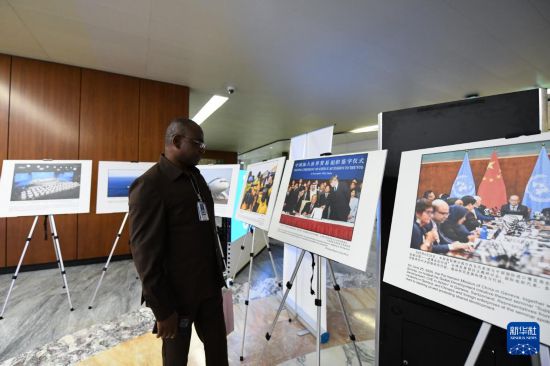
通讯丨“这些倡议与我们心意相通”——记“大道同行——中国倡议与全球贡献”图片展
Xin Hua Wang· 2025-09-28 00:50
Core Points - The exhibition titled "Together on the Road: China's Initiatives and Global Contributions" showcases China's commitment to international cooperation and multilateralism through 38 photographs [2][3][4] - The event took place at the World Intellectual Property Organization headquarters in Geneva, Switzerland, on September 25, with around 700 attendees, including diplomats from approximately 100 countries [4][6] Summary by Relevant Sections International Cooperation - The exhibition highlights China's role in international cooperation, as evidenced by a photograph of a water well built by China in Ghana, which provides clean drinking water to local residents [2] - Various representatives from countries such as Angola and Cambodia expressed appreciation for China's contributions to global development and the importance of maintaining multilateralism [3][4] Diplomatic Engagement - Attendees noted China's constructive role in international affairs, with specific mentions of its active participation in the United Nations and its collaborative efforts in human rights [4] - The exhibition was co-hosted by China's permanent mission to the UN in Geneva and Xinhua News Agency, emphasizing China's diplomatic outreach [4]
用行动促进南南合作,反霸权引起多国共鸣,中方在联大捍卫多边主义
Huan Qiu Shi Bao· 2025-09-27 22:39
Core Points - Chinese Premier Li Qiang emphasized the need for unity, peace, and common prosperity during his speech at the 80th United Nations General Assembly, calling for the defense of multilateralism and cooperation amid global turmoil [1][2] - The Chinese government reiterated its support for the United Nations' central role in global affairs and advocated for "true multilateralism," aiming to reduce U.S.-centric global policy-making [2][4] - A new China-UN South-South Development Support Mechanism was announced, with an initial funding of $10 million to promote sustainable development goals through practical South-South cooperation [3] Group 1 - The speech marked the first time in a decade that a high-ranking Chinese official addressed the UN General Assembly in person, highlighting China's commitment to global governance [2] - The Chinese leadership criticized unilateralism and protectionist measures, implicitly targeting the U.S. while positioning China as a defender of global order [3][4] - The call for multilateralism resonated with leaders from developing countries, indicating a growing alignment against unilateral actions and sanctions [4][5] Group 2 - The global governance initiative proposed by China emphasizes sovereign equality, adherence to international law, and a people-centered approach, aiming to create a fairer global governance system [2][3] - The remarks from various leaders at the UN, including those from Brazil and Kazakhstan, underscored a collective demand for a credible multilateral system to address pressing global issues [5]
全球瞭望丨刚果(金)媒体:全球治理倡议为动荡变革中的世界指明方向
Xin Hua She· 2025-09-27 12:46
文章认为,全球治理关乎各国切身利益,需要的是协调与合作,而不是单边主义和恫吓。中国践行 多边主义理念,目标是构建人类命运共同体。从全球发展倡议、全球安全倡议、全球文明倡议到全球治 理倡议,中国持续打造全球公共产品,为人类未来指明方向。 责编:张振、刘强 新华社金沙萨9月27日电(记者史彧 郑扬子)刚果(金)主流媒体《尖子论坛报》日前刊登文章 说,中国提出的全球治理倡议为动荡变革中的世界指明方向。 文章说,当今世界正面临新的动荡与转型,全球治理正处于新的十字路口。观察人士认为,中国提 出的全球治理倡议恰逢其时,为世界指明方向,其核心理念是奉行主权平等、遵守国际法治、践行多边 主义、倡导以人为本、注重行动导向。 文章指出,中国一直主张所有国家应得到同等对待,不论其大小、强弱或贫富,都拥有同样的权利 参与国际事务。联合国宪章宗旨和原则,以及普遍承认的其他规范国际关系的基本准则,必须被完全、 充分和彻底地遵守,必须确保国际法和国际规则平等统一适用,避免采取双重标准或将某些国家的"国 内规则"强加于他国。 ...
新华时评|以多边主义之光照亮全球治理新未来
Xin Hua She· 2025-09-27 12:21
Core Points - The article discusses the challenges facing the international order, emphasizing the erosion of multilateralism and the impact of geopolitical conflicts such as the Israel-Palestine conflict and the Ukraine crisis [2][3] - It highlights the need for the international community to return to genuine multilateralism and strengthen the authority of the United Nations, which is seen as the cornerstone of post-World War II international order [2][4] - The article calls for increased representation and voice for developing countries in international affairs, noting that despite accounting for over 40% of the global economy, their influence remains insufficient [3][4] Group 1 - The current international order is facing severe challenges, with unilateralism and protectionism on the rise, leading to a sluggish global economy [2][3] - The authority and effectiveness of the United Nations are under multiple pressures, hindering its ability to play a core role in international affairs [2][4] - The article stresses the importance of recognizing the equal rights of all countries and providing institutional platforms for developing nations to participate in global governance [3] Group 2 - China is portrayed as a key player in promoting the development of the Global South and advocating for reforms in the global governance system [4] - Initiatives proposed by China, such as the concept of a community with a shared future for mankind and various global initiatives, are highlighted as contributions to addressing global challenges [4] - The article concludes by emphasizing the deep integration of multilateralism into the fabric of international society and the need for collective adherence to the principles of the UN Charter [4]