
自动驾驶商业化

Search documents
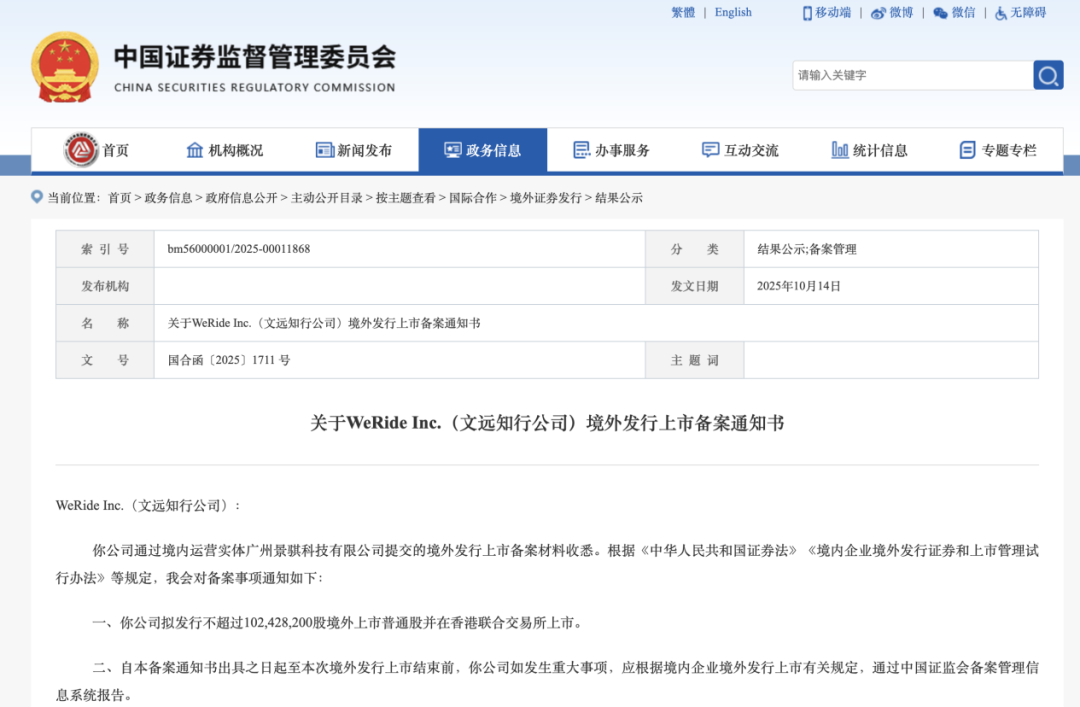
两大自动驾驶龙头,同日获港股IPO备案
Shang Hai Zheng Quan Bao· 2025-10-14 13:56
Core Insights - The dual listing of Hesai Technology on both US and Hong Kong stock exchanges has led to two major autonomous driving companies, WeRide Inc. and Pony AI Inc., receiving approval from the China Securities Regulatory Commission (CSRC) for their IPOs in Hong Kong [1][2] WeRide Inc. Summary - WeRide plans to issue up to 102,428,200 shares for its overseas listing on the Hong Kong Stock Exchange [1] - The company reported a revenue of 127 million yuan in Q2 2025, marking a year-on-year growth of 60.8% [2] - The autonomous taxi business generated 45.9 million yuan in revenue during the same quarter, a significant increase of 836.7%, setting a new quarterly record for the company [2] - The gross profit increased by 40.6% year-on-year, indicating a steady growth trend [2] Pony AI Inc. Summary - Pony AI plans to issue up to 102,146,500 shares for its overseas listing on the Hong Kong Stock Exchange [1] - The company achieved a total revenue of 154 million yuan in Q2 2025, reflecting a year-on-year increase of 75.9% and a quarter-on-quarter increase of 53.5% [3] - As of Q2 2025, Pony AI's cash and cash equivalents, along with short-term investments, amounted to 5.356 billion yuan (748 million USD) [3] Global Expansion Efforts - WeRide has been actively expanding its global footprint, with its first batch of Robotaxi vehicles arriving in Singapore for testing [2] - The company has received regulatory approval to conduct driverless public road passenger services in Shanghai [2] - Pony AI has also announced partnerships in Qatar and Singapore to advance autonomous driving technology and services [4] Industry Trends - The autonomous driving sector is experiencing rapid development, supported by favorable policies in major cities like Beijing and Shanghai [4] - The market for autonomous driving is projected to grow significantly, with an estimated size of approximately 158.3 billion USD in 2023, expected to reach 273.8 billion USD by 2025 [5]

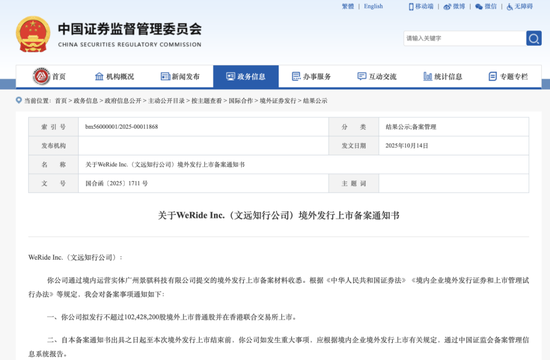
两大自动驾驶龙头 同日获港股IPO备案
Shang Hai Zheng Quan Bao· 2025-10-14 13:54
Core Insights - WeRide Inc. and Pony AI Inc. have received approval from the China Securities Regulatory Commission (CSRC) for their overseas listings in Hong Kong, indicating a growing trend of Chinese autonomous driving companies seeking international capital markets [1][6]. WeRide Inc. (文远知行) - WeRide plans to issue up to 102,428,200 shares for its listing on the Hong Kong Stock Exchange [1]. - The company reported a revenue of 127 million yuan (approximately 17.5 million USD) in Q2 2025, marking a year-on-year increase of 60.8% [3]. - The revenue from its autonomous taxi business reached 45.9 million yuan (approximately 6.3 million USD), a significant increase of 836.7% year-on-year, setting a new quarterly record since its establishment [3]. - WeRide has expanded its global presence, having obtained autonomous driving licenses in seven countries and operating in over 30 cities across 11 countries [2][3]. Pony AI Inc. (小马智行) - Pony AI plans to issue up to 102,146,500 shares for its listing on the Hong Kong Stock Exchange [1]. - The company reported total revenue of 154 million yuan (approximately 21.5 million USD) in Q2 2025, reflecting a year-on-year growth of 75.9% and a quarter-on-quarter increase of 53.5% [8]. - Pony AI's Robotaxi business generated revenue of 10.9 million yuan (approximately 1.5 million USD) in Q2 2025, with a year-on-year growth of 157.8%, driven by increased user demand and expansion of its operational fleet [8]. - The company has established operations in major cities like Beijing, Shanghai, Guangzhou, and Shenzhen, covering over 2,000 square kilometers [8]. Industry Trends - The autonomous driving industry is experiencing rapid growth, with significant policy support from various cities in China, including the issuance of new operational licenses and standards [11][12]. - The global autonomous driving market is projected to reach approximately 273.8 billion USD by 2025, growing from about 158.3 billion USD in 2023, indicating a compound annual growth rate of nearly 30% [13].
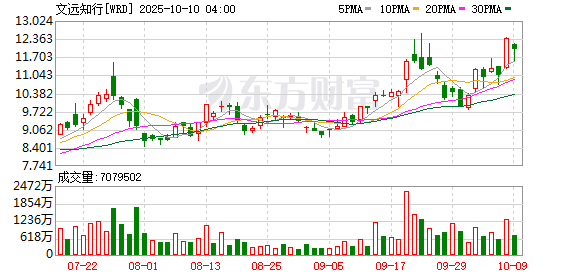
花旗上调文远知行目标价至18.2美元,启动30日上行催化剂观察期
IPO早知道· 2025-10-14 03:31
Core Insights - Citigroup raised the target price for WeRide (NASDAQ: WRD) to $18.2 and initiated a 30-day upward catalyst observation period, reflecting positive overseas progress and growth potential from its international operations [3] Group 1: Overseas Expansion - WeRide's daily operational volume in the UAE is increasing due to the expansion of its Robotaxi fleet and ongoing collaboration with Uber [3] - The company is expected to enter a fully autonomous commercial operation phase soon, indicating significant advancements in its service capabilities [3] Group 2: Fleet Growth Projections - WeRide's Robotaxi fleet in the Middle East is projected to expand to 200 vehicles by the end of 2025 and reach 500-700 vehicles by 2026 [3] - This fleet expansion is a critical factor in Citigroup's positive outlook on WeRide's growth potential [3] Group 3: Analyst Ratings - Citigroup initially covered WeRide on September 28, giving it a buy rating with a target price of $15.5, which was later increased by approximately 17% [3] - The sustained buy rating reflects confidence in WeRide's overseas business development and growth trajectory [3]


花旗:上调文远知行目标价至18.2美元 启动30日上行催化剂观察期
Ge Long Hui· 2025-10-13 08:08
Core Viewpoint - Citigroup has raised the target price for WeRide (NASDAQ: WRD) to $18.2 and initiated a 30-day upward catalyst observation period, highlighting the company's positive developments in the Robotaxi sector in the UAE [1] Group 1: Company Developments - WeRide's daily operational volume in the UAE is continuously increasing due to the expansion of its local Robotaxi deployment and ongoing collaboration with Uber [1] - The company is expected to soon enter a phase of fully autonomous commercial operations [1] Group 2: Fleet Expansion - WeRide plans to expand its Robotaxi fleet in the Middle East, with expectations to reach 200 vehicles by the end of 2025 and 500-700 vehicles by 2026 [1] Group 3: Analyst Ratings - Citigroup initially covered WeRide on September 28, giving it a buy rating with a target price of $15.5, and has now increased the target price by approximately 17% while maintaining the buy rating [1] - The positive outlook is based on the favorable progress of WeRide's overseas operations and the growth potential associated with its international business expansion [1]
文远知行:自动驾驶网约车迎来商业化规模运营重要拐点
Xin Hua Cai Jing· 2025-10-10 02:26
Core Insights - The company, WeRide, has achieved significant milestones in the autonomous driving sector, holding licenses for autonomous ride-hailing services in seven countries and moving towards large-scale commercialization [2][7] - The global autonomous ride-hailing market is projected to be a trillion-dollar industry, with estimates suggesting it could reach $10 trillion by 2030, supported by advancements in technology and reduced costs [3][4] Group 1: Technology and Operations - WeRide's autonomous ride-hailing vehicles have been operational for over 2,200 days, demonstrating technological maturity essential for commercial operations [3][4] - The company has developed a diverse product matrix, including autonomous ride-hailing cars, minibuses, freight vehicles, and sanitation vehicles, covering smart mobility, freight, and sanitation applications [3] - The average prediction error for moving object trajectory is maintained within 0.2 meters, with detection accuracy reaching 99% [4] Group 2: Cost Reduction and Commercial Viability - The cost of components for autonomous vehicles has significantly decreased, with the price of LiDAR dropping from several thousand dollars to a few thousand yuan, enabling broader commercial viability [5][6] - The introduction of the HPC 3.0 high-performance computing platform has reduced the cost of the autonomous driving suite by 50%, further accelerating large-scale commercial applications [6] Group 3: Market Expansion and Financial Performance - WeRide has obtained autonomous driving licenses in multiple countries and is actively testing and operating in 30 cities across 11 countries, indicating a maturing business model [7] - In Q2, WeRide reported revenue of 127 million yuan, a year-on-year increase of 60.8%, with the autonomous ride-hailing segment achieving a record revenue of 45.9 million yuan, up 836.7% year-on-year [7]
小马智行(PONY.US)大涨12% 获得迪拜自动驾驶路测许可
Zhi Tong Cai Jing· 2025-09-29 14:03
Core Viewpoint - Pony.ai (PONY.US) experienced a significant increase of 12%, closing at $23.71, following the announcement of obtaining a self-driving road test permit in Dubai, which lays the groundwork for achieving fully autonomous commercial services by 2026 [1] Company Developments - On September 26, Pony.ai announced the commencement of road tests for its first batch of Robotaxi vehicles in Dubai [1] - The company's expansion in the Middle East has shown notable progress this year, including a partnership with Uber to launch autonomous driving services in May, marking the first deployment in the region [1] - In early September, Pony.ai collaborated with Qatar National Transport Company to conduct Robotaxi road tests in Doha [1]
美股异动 | 小马智行(PONY.US)大涨12% 获得迪拜自动驾驶路测许可
智通财经网· 2025-09-29 14:02
Core Viewpoint - Pony.ai (PONY.US) experienced a significant stock increase of 12%, reaching $23.71, following the announcement of obtaining a self-driving road test permit in Dubai, which lays the groundwork for fully autonomous commercial services by 2026 [1] Company Developments - On September 26, Pony.ai announced the commencement of road tests for its first batch of Robotaxi vehicles in Dubai [1] - The company's expansion in the Middle East has shown notable progress this year, including a partnership with Uber to launch autonomous driving services in May, marking the first deployment in the region [1] - In early September, Pony.ai collaborated with Qatar National Transport Company to conduct Robotaxi road tests in Doha [1]
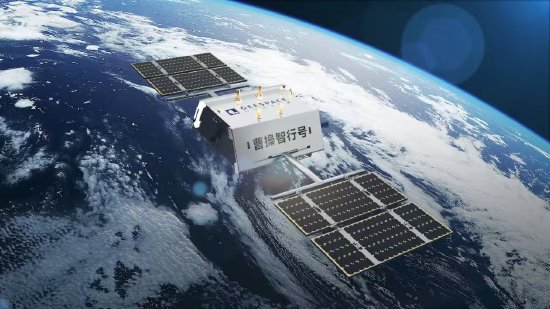
“曹操智行号”卫星成功发射,未来将服务Robotaxi车队运营
Xin Lang Ke Ji· 2025-09-25 02:26
Core Insights - The successful launch of the "Cao Cao Intelligent Travel" satellite marks a significant milestone for Geely's Robotaxi operations, enhancing the capabilities of its autonomous driving platform [1] - The deployment of the Geely constellation aims to provide reliable satellite communication services, particularly in areas where traditional ground networks are insufficient [1] Group 1: Satellite Launch and Deployment - The "Cao Cao Intelligent Travel" satellite was successfully launched and is now in orbit, completing the first phase of the Geely constellation deployment [1] - The Geely constellation currently consists of 64 satellites, enabling real-time communication coverage for any location on Earth, except for the polar regions [1] Group 2: Autonomous Driving Platform - The Cao Cao Intelligent Travel autonomous driving platform was launched in February, with pilot operations starting in Suzhou and Hangzhou [1] - The new generation of Robotaxi vehicles incorporates Geely's latest redundant architecture design and integrates various capabilities such as automatic dispatching and remote safety assurance [1] Group 3: Strategic Partnerships - A strategic partnership was established between Cao Cao Travel and Time Space Dao Yu to explore the application of satellite communication and high-precision positioning technologies in managing autonomous vehicle fleets [1] - The collaboration aims to enhance operational safety and connectivity between vehicles and control centers, particularly in remote areas [1]

小马智行:2026年初将实现关键盈利目标,今年Robotaxis产量有望达到1000辆
Hua Er Jie Jian Wen· 2025-09-19 10:38
Core Insights - The company aims to achieve breakeven on a per-vehicle basis by the end of 2025 or early 2026, marking a significant milestone in the competitive Robotaxis market [1][3] - The CFO revealed that the company has produced 400 Robotaxis and plans to deploy 1,000 vehicles globally by the end of this year [1][2] - The Chinese Robotaxis industry is at a critical point of commercialization, with expectations of a tenfold increase in fleet size from thousands to tens of thousands of vehicles between the second half of 2025 and 2026 [1][4] Company Strategy - The company’s strategy to achieve profitability relies on three main aspects: expanding fleet size to dilute fixed costs, optimizing technology to reduce insurance and operational costs, and increasing user base to enhance vehicle utilization [3][4] - The company is focusing on major Chinese cities such as Beijing, Shanghai, Guangzhou, and Shenzhen for initial large-scale commercialization, while being cautious about overseas expansion [3][4] Industry Outlook - Analysts predict that the Chinese Robotaxis market could reach a size of $183 billion by the late 2030s, with the global market estimated at approximately $394 billion [4] - The industry is experiencing advancements due to technological progress, regulatory support, and increased public acceptance, positioning it for significant growth [4] Challenges - The company faces challenges, including increased losses in Q2 due to one-time R&D investments for next-generation Robotaxis, with expectations of continued losses for the year [4] - Winning consumer trust is deemed crucial for success in the Robotaxis race, necessitating a substantial operational fleet in cities to provide convenient services akin to traditional taxis [4]
美股异动|小马智行盘前涨超1.4%,CFO预计明年初将达成关键利润目标
Ge Long Hui· 2025-09-19 08:08
Core Viewpoint - Pony.ai (PONY.US) is expected to achieve key profitability targets by early 2026 and plans to launch 1,000 autonomous taxis globally by the end of 2025, indicating a strong push towards commercialization and revenue generation [1] Group 1 - The company's stock rose over 1.4% to $17.72 in pre-market trading [1] - The CFO of Pony.ai publicly stated the company's profitability goals and expansion plans [1] - Pony.ai is accelerating its commercialization efforts by scaling up the deployment of its autonomous vehicle fleet to enhance operational revenue [1]