自动驾驶网约车

Search documents
“木头姐”周一抛售特斯拉股票 预估套现2967万美元
Ge Long Hui A P P· 2025-12-23 13:23
Core Viewpoint - Cathie Wood and her firm Ark Invest continue to reduce their Tesla stock holdings while Tesla's stock price reaches a new all-time high [1] Group 1: Stock Transactions - Ark Invest's ETFs sold a total of 60,715 shares of Tesla on Monday, realizing approximately $29.67 million [1] - Tesla remains a significant holding in Ark Invest's portfolios, with a 11.9% share in the Ark Innovation ETF, 9.71% in the Ark Next Generation Internet ETF, and 12.5% in the Ark Autonomous Technology ETF [1] Group 2: Future Predictions - Ark Invest predicts that Tesla's stock price could rise to $2,600 by 2029, with approximately 90% of its enterprise value and earnings expected to come from the autonomous ride-hailing business [1] Group 3: Investment Strategy - Cathie Wood has indicated that part of the realized gains from Tesla stock sales will be allocated to the cryptocurrency sector [1]

马斯克瞧不上的对手 Waymo拟融资逾150亿美元估值近千亿
Feng Huang Wang· 2025-12-16 23:48
Core Insights - Waymo is negotiating a new funding round aiming to raise over $15 billion at a valuation close to $100 billion, led by its parent company Alphabet [1] - The previous funding round in October 2024 valued Waymo at over $45 billion, indicating a significant increase in valuation [1] - Waymo's annualized revenue has surpassed $350 million, highlighting its growth in the autonomous driving sector [1] Funding and Valuation - Waymo is in discussions with external investors and Alphabet for a substantial equity financing [1] - There were considerations to increase the valuation to $110 billion, but the final amount and valuation are still to be determined [1] Market Position - Waymo is recognized as a leader in the autonomous driving technology field, significantly ahead of competitors like Tesla in terms of fully autonomous driving mileage, paid passenger numbers, and operational areas [1] - The company is actively expanding its autonomous vehicle fleet and accelerating business expansion into new cities [1] Competitor Response - Tesla's CEO Elon Musk has expressed skepticism regarding Waymo's claims of superiority in autonomous driving metrics, suggesting that Waymo has not had a fair opportunity to compete with Tesla [2]


美银自动驾驶深度报告:无人网约车规模可达万亿,每英里成本2美元将是引爆点
Hua Er Jie Jian Wen· 2025-12-10 08:26
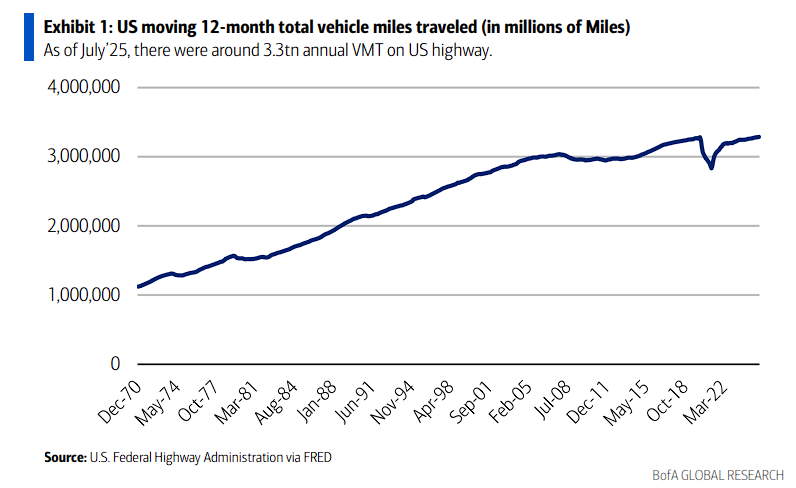
Core Insights - The current ride-hailing services account for only 1% of the annual driving mileage in the U.S., which is approximately 3 trillion miles, highlighting a significant growth opportunity for tech giants like Tesla, Google, and Amazon in the autonomous vehicle market [1][5][18] - If autonomous driving technology can reduce the cost per mile to $1.5-$2.0, the market size could reach $0.9-$1.2 trillion within 15 years, assuming a 20% penetration rate [1][8] - The cost per mile for current ride-hailing services is around $2.5-$3.0, while private car ownership costs range from $0.70 to $1.06, indicating a substantial price gap that limits the adoption of ride-hailing services [1][6][7] Market Potential - The U.S. total driving mileage is projected to be about 3.3 trillion miles by July 2025, with passenger vehicles accounting for approximately 3 trillion miles after excluding large trucks [2] - In 2024, ride-hailing mileage is expected to remain at only 1% of the total, based on assumptions regarding Uber and Lyft's order distribution and average trip length [5][6] Cost Structure and Profitability - The average cost per mile for private car ownership is significantly lower than that of ride-hailing services, which creates a barrier for consumer adoption [6][7] - A critical threshold for the widespread adoption of autonomous ride-hailing is achieving a cost per mile below $2.00 [7][8] - The report analyzes three business models: ownership, leasing, and agency, detailing the break-even points for each model under various cost scenarios [11][13][15][16] Business Model Analysis - In the ownership model, a cost of $1.95 per mile is needed to maintain a 10% profit margin, assuming a vehicle cost of $75,000 [13] - The leasing model requires a pricing of $2.08 per mile to achieve the same profit margin, with a baseline leasing fee of $0.54 per mile [15] - The agency model necessitates a price of $2.15 per mile to sustain profitability, with a payout to vehicle owners of $1.5 per mile [16] Competitive Landscape - Uber currently holds a market share of 70%-80% in the U.S. ride-hailing market, with projections indicating that even if its share drops to 50%, its order volume could still grow to $589 billion by 2040 [18][21] - The entry of well-funded competitors like Waymo, Tesla, and Zoox poses a risk of market share erosion for Uber [18][27] - The report highlights the potential for a price war among major players, as they may leverage aggressive pricing strategies to capture market share [27] Future Outlook - The report suggests that despite competitive pressures, the ride-hailing industry benefits from significant network effects, which may limit the number of viable competitors and support sustainable profit margins [25] - Early data from California indicates that the presence of autonomous vehicles may expand the overall market rather than cannibalize existing services, as seen with Waymo's growth [26]

文远知行(WRD.US)涨逾6% 正式进入港股上市冲刺阶段
Zhi Tong Cai Jing· 2025-10-23 14:13
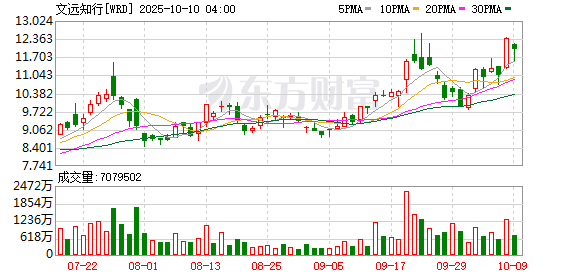
Core Viewpoint - The company, WeRide (WRD.US), has entered the IPO phase in Hong Kong after passing the Hong Kong Stock Exchange hearing, aiming to establish a dual capital platform in both the US and Hong Kong markets, solidifying its leading position in the trillion-dollar autonomous driving market [1] Group 1: Company Developments - WeRide's stock rose over 6% to $10.47 following the news of its IPO progress [1] - The company has obtained autonomous driving licenses in seven countries, including China, the US, France, UAE, Singapore, Saudi Arabia, and Belgium, and is conducting tests and operations in 30 cities across 11 countries [1] - WeRide has achieved over 2,200 days of safe operation with its autonomous driving services [1] Group 2: Financial Performance - In Q2, WeRide reported revenue of 127 million yuan, a year-on-year increase of 60.8% [1] - Revenue from the autonomous driving ride-hailing business reached 45.9 million yuan, a staggering year-on-year increase of 836.7%, marking the highest quarterly revenue since the company's inception [1] - The size of WeRide's autonomous vehicle fleet in Abu Dhabi has tripled compared to 2024 projections [1]

美股异动 | 文远知行(WRD.US)涨逾6% 正式进入港股上市冲刺阶段
智通财经网· 2025-10-23 14:05
Core Viewpoint - The company, WeRide (WRD.US), has entered the IPO phase on the Hong Kong Stock Exchange after passing the hearing, aiming to establish a dual capital platform in both the US and Hong Kong markets, thereby strengthening its leading position in the trillion-dollar autonomous driving market [1] Financial Performance - In Q2, WeRide reported revenue of 127 million yuan, representing a year-on-year increase of 60.8% [1] - Revenue from the autonomous ride-hailing business reached 45.9 million yuan, a staggering year-on-year growth of 836.7%, marking the highest quarterly revenue since the company's inception [1] Market Position and Global Expansion - WeRide has obtained autonomous driving licenses in seven countries, including China, the USA, France, UAE, Singapore, Saudi Arabia, and Belgium, establishing significant barriers to entry in the global autonomous driving sector [1] - The company operates in 30 cities across 11 countries, with over 2,200 days of safe operation [1] - The scale of its autonomous vehicle fleet in Abu Dhabi has reached three times that of 2024 projections [1]
文远知行:自动驾驶网约车迎来商业化规模运营重要拐点
Xin Hua Cai Jing· 2025-10-10 02:26
Core Insights - The company, WeRide, has achieved significant milestones in the autonomous driving sector, holding licenses for autonomous ride-hailing services in seven countries and moving towards large-scale commercialization [2][7] - The global autonomous ride-hailing market is projected to be a trillion-dollar industry, with estimates suggesting it could reach $10 trillion by 2030, supported by advancements in technology and reduced costs [3][4] Group 1: Technology and Operations - WeRide's autonomous ride-hailing vehicles have been operational for over 2,200 days, demonstrating technological maturity essential for commercial operations [3][4] - The company has developed a diverse product matrix, including autonomous ride-hailing cars, minibuses, freight vehicles, and sanitation vehicles, covering smart mobility, freight, and sanitation applications [3] - The average prediction error for moving object trajectory is maintained within 0.2 meters, with detection accuracy reaching 99% [4] Group 2: Cost Reduction and Commercial Viability - The cost of components for autonomous vehicles has significantly decreased, with the price of LiDAR dropping from several thousand dollars to a few thousand yuan, enabling broader commercial viability [5][6] - The introduction of the HPC 3.0 high-performance computing platform has reduced the cost of the autonomous driving suite by 50%, further accelerating large-scale commercial applications [6] Group 3: Market Expansion and Financial Performance - WeRide has obtained autonomous driving licenses in multiple countries and is actively testing and operating in 30 cities across 11 countries, indicating a maturing business model [7] - In Q2, WeRide reported revenue of 127 million yuan, a year-on-year increase of 60.8%, with the autonomous ride-hailing segment achieving a record revenue of 45.9 million yuan, up 836.7% year-on-year [7]
《湖南省网约车市场全景分析报告(2025)》
Sou Hu Cai Jing· 2025-10-09 08:03
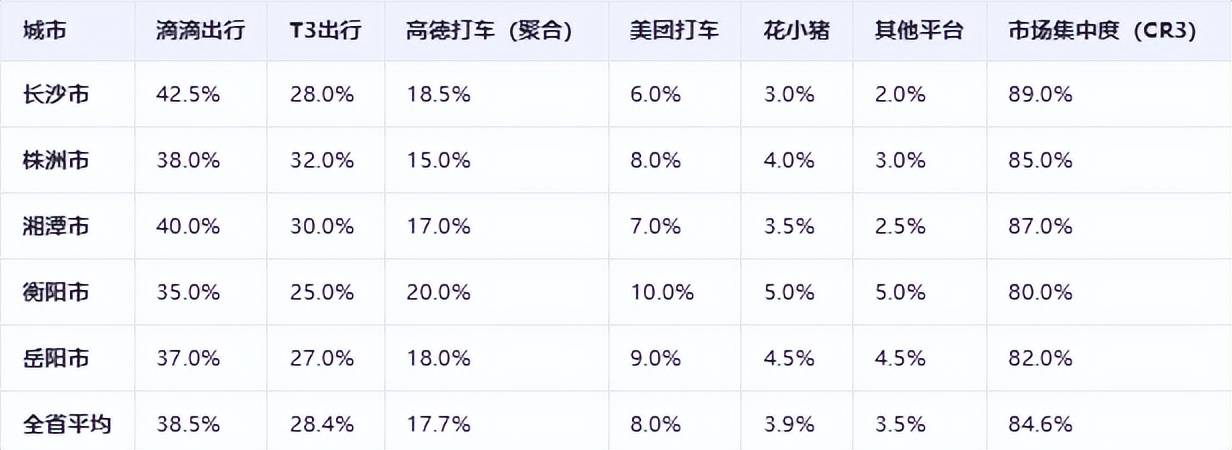
Core Insights - The Hunan Province ride-hailing market is experiencing rapid growth, with 208 licensed companies and 62,028 compliant vehicles as of June 2025, and an expected order volume of 3.5 billion in 2024, indicating strong market demand [1][2]. Market Overview - The ride-hailing industry in Hunan has transitioned from disorderly expansion to regulated development, with compliance rates increasing from 33.81% in 2021 to 69.52% in 2024, reflecting enhanced government oversight [2]. - The market is characterized by a national platform dominance and regional competition, with Changsha, the provincial capital, accounting for nearly half of the province's capacity and order volume [2][11]. Competitive Landscape - The competition between traditional taxis and ride-hailing services is intense, with ride-hailing orders surpassing those of traditional taxis in Changsha [3][10]. - Major challenges for traditional taxis include high operational costs and poor user experience, while ride-hailing platforms leverage technology to optimize operations and reduce idle time [3][6]. Platform Market Share - In Changsha, the market share of major ride-hailing platforms is concentrated, with the top three platforms accounting for 89% of the market [4][5]. Compliance and Regulation - The compliance rate for ride-hailing services in Changsha is 72.27%, ranking second in the province, indicating a high level of regulatory adherence [11][31]. - The Hunan government has implemented measures to ensure compliance and protect driver rights, including the cancellation of low-price products to prevent predatory pricing [6][25]. Service Innovations - The ride-hailing market is diversifying its service offerings, including customized transport for specific scenarios, night services, and special discounts during off-peak hours [22][23]. - Digital technologies are being utilized to enhance operational efficiency, such as real-time demand heat maps for drivers [21][37]. Future Trends - The market is expected to see a gradual increase in order volume, with projections of approximately 3.8 billion orders in 2025 and 4.4 billion by 2027, reflecting a moderate growth rate [28][29]. - The penetration of electric vehicles in the ride-hailing sector is anticipated to rise, with expectations of over 30% by 2026 due to policy incentives [30][27]. Regional Disparities - There are significant regional disparities in the ride-hailing market, with first-tier cities like Changsha experiencing robust growth, while third-tier cities face saturation and declining driver incomes [18][31].
狂拒20位人类司机后,我终于坐上了“无人车”
阿尔法工场研究院· 2025-08-19 06:47
Core Viewpoint - Uber is expanding its autonomous vehicle services in multiple cities, including Atlanta, to compete with rivals like Tesla and Lyft, as consumer interest in self-driving cars grows [1][5]. Group 1: Uber's Autonomous Vehicle Services - Uber has started offering rides in Waymo's autonomous vehicles in Atlanta since June, allowing users to opt for self-driving cars [1]. - Users have reported needing to cancel multiple human driver requests to successfully match with a Waymo autonomous vehicle, indicating a growing demand for this service [1][3]. - Uber's spokesperson mentioned that the fleet of autonomous vehicles in Atlanta will increase to "hundreds" in the coming years, with dozens currently operational [5]. Group 2: User Experience and Preferences - Users like Nate Galesich have taken numerous rides in Waymo's autonomous vehicles, with some reporting an average of 35 rides since the service began [1][2]. - The rides are typically short, averaging 4 miles and costing under $12, primarily on city streets rather than highways [5]. - Users are encouraged to avoid peak hours and select non-highway routes to increase their chances of matching with an autonomous vehicle [5]. Group 3: Public Perception and Concerns - Despite the growing interest, many potential passengers still express safety concerns regarding autonomous vehicles, influenced by negative news about accidents [6]. - A survey indicated that 17% of Americans are unwilling to use fully or semi-autonomous vehicles, although urban residents show more openness to trying them [6]. - Galesich believes that acceptance of autonomous vehicles will grow over time, similar to the gradual adoption of smartphones after the launch of the iPhone [6].

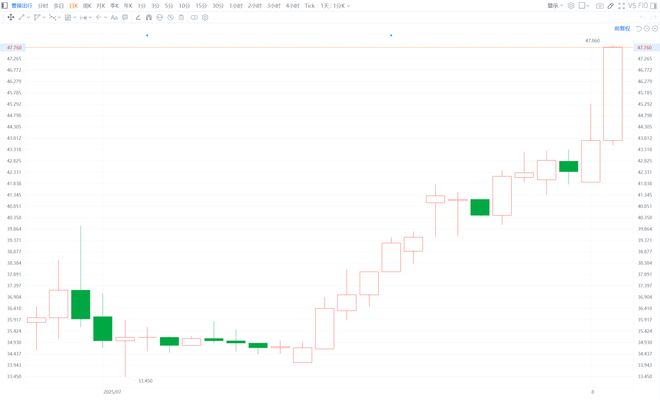
港股异动丨Robotaxi催化叠加有望纳入港股通 曹操出行涨近10% 股价续创上市新高
Ge Long Hui· 2025-08-04 07:53
Industry Insights - The recent World Artificial Intelligence Conference (WAIC) highlighted the issuance of demonstration operation licenses for intelligent connected vehicles in Shanghai, indicating a supportive regulatory environment for the industry [1] - According to Zheshang Securities, 2025 is expected to be the year of mass production for Robotaxi, with multiple catalysts anticipated for the global Robotaxi industry, including accelerated commercialization, rapid revenue growth for leading companies, and improved profitability per vehicle [1] - The operational scope of global Robotaxi services is expected to continue expanding, suggesting a growing market opportunity [1] Company Developments - Caocao Travel (2643.HK) saw its stock price rise by 9.52% to HKD 47.86, reaching a new high since its listing, with a market capitalization exceeding HKD 26 billion [1] - The company plans to leverage Geely Group's resources to enhance its ride-hailing service through customized vehicle development, optimizing vehicle performance and service features, and advancing the research and launch of autonomous ride-hailing vehicles [2] - Caocao Travel aims to build a more comprehensive travel ecosystem focusing on battery swapping, circular remanufacturing, alcohol-hydrogen energy ride-hailing operations, and AI management [2]
Uber:自动驾驶真能杀死“美版滴滴”?
海豚投研· 2025-04-08 14:16
Core Viewpoint - The article discusses the impact of autonomous driving technology on the ride-hailing industry, particularly focusing on Uber's current valuation and market position amidst the evolving landscape of autonomous vehicles [1][3]. Group 1: Impact of Autonomous Driving on Ride-Hailing Demand - Autonomous driving technology primarily reduces the labor and associated costs of driving, but it is unlikely to significantly increase the overall demand for ride-hailing services [5][6]. - The structure of ride-hailing demand is expected to change, with private car usage increasing and public transport declining, while ride-hailing's share remains stable [9][10]. - The pandemic has shifted commuting patterns, with a notable increase in remote work, affecting the demand for various transportation modes [7][9]. Group 2: Market Dynamics and Competition - The introduction of autonomous ride-hailing services is anticipated to capture a significant portion of public transport usage, potentially increasing the market size for ride-hailing by approximately 40% [17][18]. - The competition landscape will shift as autonomous vehicle technology providers may either compete directly with existing platforms or collaborate with them [27][31]. - The pricing strategies of ride-hailing platforms will be crucial, as lower prices could lead to increased usage but may compress profit margins [23][24]. Group 3: Uber's Valuation and Future Outlook - Current estimates suggest that Uber's valuation does not reflect a significant discount, with projected net profits for 2025 and 2026 indicating a neutral market sentiment [50][51]. - The potential impact of autonomous driving on Uber's business model includes a decrease in average revenue per ride and a shift in profit distribution between platforms and vehicle operators [58][59]. - The article posits that Uber's market share may stabilize around 60% by 2031, with the emergence of new competitors in the autonomous ride-hailing space [55][56].