Scaling Law

Search documents
实测阿里万亿参数大模型:开源路线跑通了吗?
Tai Mei Ti A P P· 2025-09-06 11:32
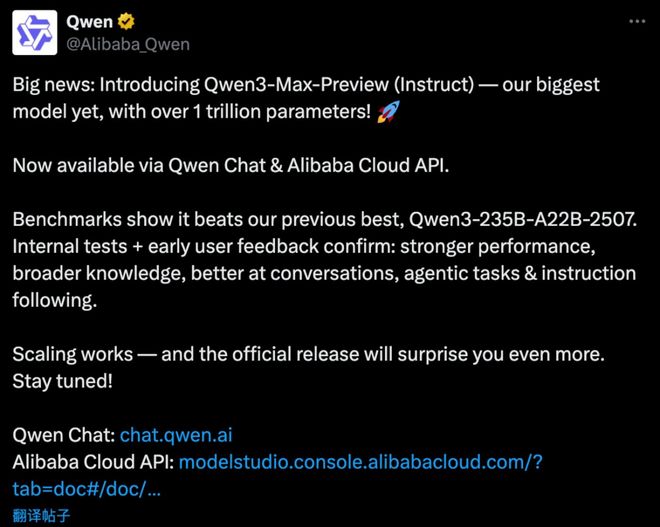
Core Insights - Alibaba has launched its largest model to date, Qwen3-Max-Preview, with over 1 trillion parameters, surpassing Claude in programming capabilities, demonstrating the effectiveness of Scaling Law [1][4][17] - The "model + cloud" strategy has created the shortest path from technology development to commercialization, which is a key factor in Qwen's success as a latecomer [1][19] - The core challenge of Alibaba's open-source model lies in balancing openness with profitability, requiring continuous technological breakthroughs and proof of commercial viability [1][20] Model Performance - Qwen3-Max-Preview has outperformed competitors in various benchmark tests, including SuperGPQA, AIME2025, LiveCodeBench V6, Arena-Hard V2, and LiveBench [2] - In programming capabilities, Qwen3-Max-Preview has achieved significant improvements, surprising many users with its performance [4][15] Development Strategy - Alibaba's approach to model development has been characterized by rapid open-sourcing of multiple model versions, from 7 billion to 1 trillion parameters, fostering a strong developer community [16][17] - The company has made substantial investments in computing infrastructure and AI engineering, which have been crucial for training large models like Qwen3-Max-Preview [17][18] Cloud Integration - Alibaba Cloud plays a vital role in supporting Qwen's development by providing a stable and efficient computing infrastructure, which reduces the engineering burden on development teams [18] - The MaaS strategy allows Qwen to penetrate various industries quickly, enabling businesses to utilize Qwen's API without starting from scratch [18][19] Challenges Ahead - The open-source model presents both opportunities and challenges, as it may hinder the ability to maintain a significant technological edge over competitors [20] - Retaining top AI talent is critical for Alibaba, as the departure of key personnel could impact team morale and project continuity [21][22] Conclusion - Overall, Alibaba's Qwen is a leading force in the global AI model landscape, leveraging a clear strategy of open-source and self-research, supported by Alibaba Cloud's ecosystem [22] - The release of the trillion-parameter model highlights the company's commitment to Scaling Law, but the sustainability of its business model and talent retention will be crucial for future success [22]


他们在1993年就提出了Scaling Law
量子位· 2025-09-02 06:17
Core Viewpoint - The article highlights that the concept of Scaling Law was proposed 32 years ago by Bell Labs, not by recent AI advancements, emphasizing the historical significance of this research in machine learning [1][6]. Group 1: Historical Context - The paper titled "Learning Curves: Asymptotic Values and Rate of Convergence" introduced a predictive method for training errors and testing errors converging to the same asymptotic error value as training size increases, following a power-law form [4][6]. - The authors of the 1993 paper included notable figures such as Vladimir Vapnik and Corinna Cortes, who contributed significantly to the field of machine learning [6][25]. Group 2: Methodology and Findings - The research aimed to save computational resources when training classifiers by predicting their performance on larger datasets based on smaller training sets [8][10]. - The study found that as the training set size increases, both training and testing errors converge to a common asymptotic value, denoted as 'a', which typically falls between 0.5 and 1 [10][16]. - The proposed method allows for the estimation of classifier performance on larger datasets without complete training, thus conserving computational resources [10][14]. Group 3: Implications and Applications - The findings indicated that the predictive model was highly accurate for linear classifiers, demonstrating its potential to optimize resource allocation in training models [15][24]. - The research also revealed that the more difficult the task, the higher the asymptotic error and the slower the convergence rate, indicating a relationship between task complexity and learning efficiency [22].

深度|Anthropic CEO:AI技术潜力巨大,但无序扩张才是风险所在,我将引导其走向正轨
Z Potentials· 2025-08-28 03:51
Core Insights - The article discusses the rapid growth and potential of Anthropic, a leading AI company focused on developing safe and reliable AI systems with human welfare at its core. The company has achieved a recurring annual revenue exceeding $4 billion, making it one of the fastest-growing enterprises in history [12][24]. Group 1: Company Structure and Trust - Anthropic was founded by seven co-founders, which is often viewed skeptically by outsiders. However, the long-standing trust and familiarity among the founders have allowed the company to maintain cohesion and core values during rapid expansion [11][10]. - The unique dynamic of sibling co-founders, Dario and Daniela Amodei, enhances the company's strategic execution and operational management, allowing them to focus on their strengths [9][10]. Group 2: AI Applications and Market Potential - The fastest-growing application of AI is in programming, driven by the close relationship between developers and AI model creators, leading to rapid adoption [10][12]. - AI's potential extends beyond programming, with applications in customer service, biology, and pharmaceuticals, showcasing its versatility across various sectors [13][14]. Group 3: Business Model and Growth Expectations - Anthropic positions itself as a platform company, focusing on broad enterprise services rather than solely vertical-specific products. This approach allows for better understanding of user needs and market demands [15][16]. - The company has experienced exponential growth, with revenue projections that have consistently exceeded initial expectations, indicating a strong market demand for AI solutions [24][25]. Group 4: Investment and Financial Dynamics - The financial model of AI companies involves significant upfront investment in model training, with expectations of high returns over time. This cyclical investment pattern is common in venture capital, where initial losses are expected before profitability is achieved [34][35]. - The current capital expenditures may obscure the underlying profitability of individual models, which can be profitable when analyzed independently [43][44]. Group 5: Talent and Competitive Advantage - The competition for talent in the AI industry is intense, but Anthropic maintains a high employee retention rate due to its strong mission and commitment to its values, which helps in retaining skilled personnel [51][53]. - The company's approach to knowledge protection involves complex engineering capabilities and a culture that balances openness with necessary information security measures [48][49]. Group 6: Future of AI and Market Structure - The future market structure for AI is expected to consist of a few dominant players capable of building cutting-edge models, with the potential for new entrants targeting specific use cases [33]. - The article suggests that AI's growth trajectory may continue to extend, with the possibility of AI companies becoming some of the largest enterprises globally [25][24].

OpenAI史上最大失误:放走这位MIT学霸,美国AI「三朝元老」,现实韦小宝
3 6 Ke· 2025-08-21 00:39
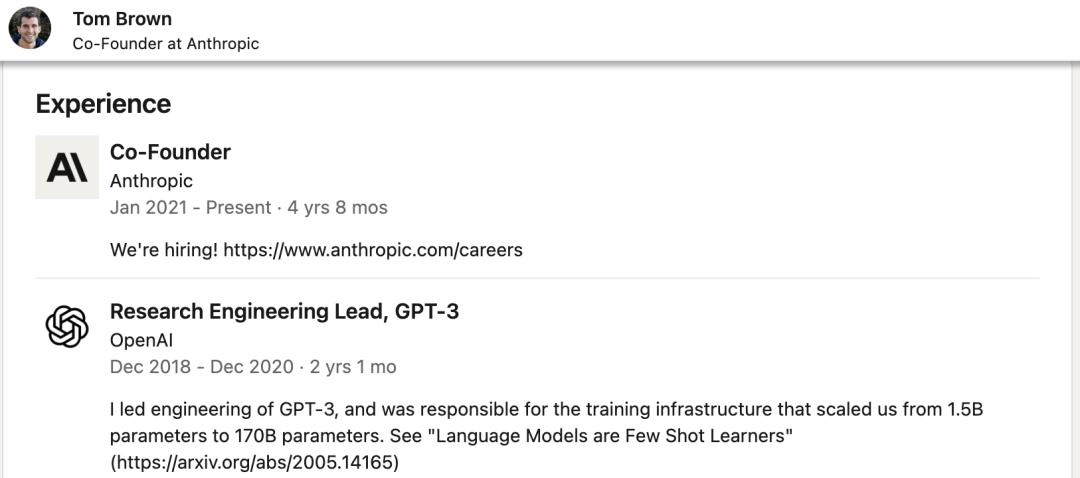
Group 1 - The core argument of the article emphasizes that the scale of AI infrastructure development is unprecedented, surpassing both the Apollo and Manhattan projects [1][7] - The investment in AGI computing power is experiencing explosive growth, with an annual increase of up to three times [2] - Tom Brown, co-founder of Anthropic, is highlighted as a key figure in the AI field, having transitioned from a self-taught background to a leader in the development of general artificial intelligence [3][4] Group 2 - Anthropic's Claude has become the preferred choice for developers globally, marking a significant achievement in AI infrastructure [7] - The article details Tom Brown's journey from entrepreneurship to AI research, including his experiences at OpenAI and the founding of Anthropic [9][10] - The scaling law's impact on AI development is discussed, noting that increased computational power leads to significant advancements in intelligence [31][32] Group 3 - The article outlines the competitive landscape, where Anthropic's Claude is gaining market share, particularly in programming applications, with preferences shifting towards Claude over competitors like ChatGPT [37][40] - The success of Claude Code is attributed to its unexpected emergence as a superior product, driven by a user-centered approach in its development [41][42] - Tom Brown's advice for young engineers emphasizes the importance of pursuing meaningful projects over traditional career paths, advocating for risk-taking and intrinsic motivation [46][49]
GPT-5暴写“屎山代码”,14个Prompt,看穿GPT-1到GPT-5七年智商进化史
3 6 Ke· 2025-08-19 08:56
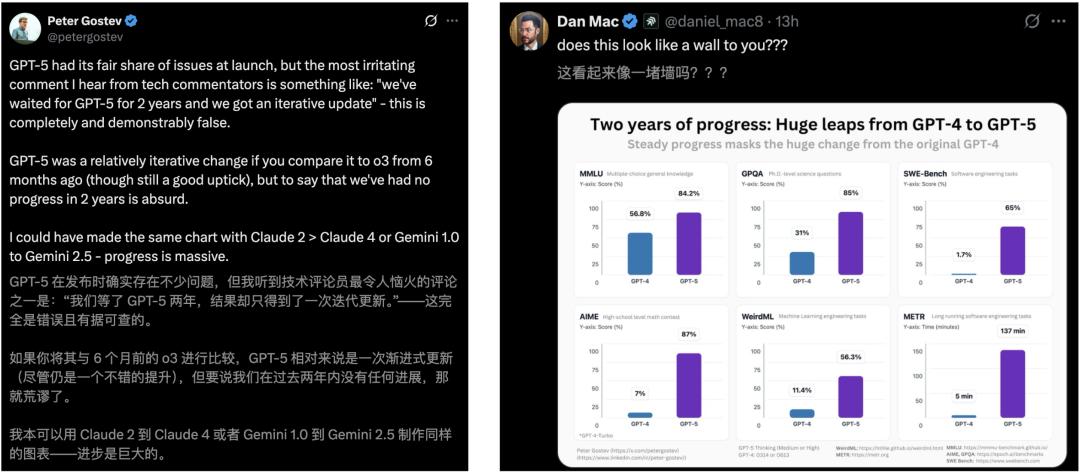
Group 1 - The core viewpoint of the articles is that GPT-5 has been released but has received criticism for not meeting expectations compared to its predecessor, GPT-4, despite the advancements in AI capabilities over the years [1][3][5]. - A comparison of performance metrics between GPT-4 and GPT-5 shows that the Scaling Law has not hit a wall, indicating ongoing improvements in AI models [3][5]. - The evolution of the GPT family from GPT-1 to GPT-5 over seven years highlights significant advancements in AI capabilities, with various prompts demonstrating the models' growing sophistication [5][7][8]. Group 2 - The articles provide examples of how each version of GPT has improved in generating creative content, such as poetry, with GPT-5 producing more coherent and human-like responses compared to earlier versions [19][20][40]. - In terms of technical tasks, GPT-5 has shown a marked improvement in writing Python code, moving from nonsensical outputs in earlier versions to producing complex yet humorous code in GPT-5 [53][54]. - The ability of GPT-5 to explain complex concepts, such as integration by parts in mathematics, has also improved significantly, making it more effective as a teaching tool compared to its predecessors [57][64][69]. Group 3 - The articles discuss how GPT-5 can now provide structured and detailed plans for various tasks, such as building a running habit, showcasing its capability to act as a personal coach or advisor [125][126][127]. - The transition from GPT-1 to GPT-5 reflects a shift from generating random or irrelevant responses to providing logical, structured, and contextually relevant answers to user queries [70][75][90]. - GPT-5's responses are characterized by a more professional tone and comprehensive information, indicating its advancement in handling complex inquiries compared to earlier models [75][90].
李建忠:关于AI时代人机交互和智能体生态的研究和思考
AI科技大本营· 2025-08-18 09:50
Core Insights - The article discusses the transformative impact of large models on the AI industry, emphasizing the shift from isolated applications to a more integrated human-machine interaction model, termed "accompanying interaction" [1][5][60]. Group 1: Paradigm Shifts in AI - The transition from training models to reasoning models has significantly enhanced AI's capabilities, particularly through reinforcement learning, which allows AI to generate synthetic data and innovate beyond human knowledge [9][11][13]. - The introduction of "Agentic Models" signifies a shift where AI evolves from merely providing suggestions to actively performing tasks for users [16][18]. Group 2: Application Development Transformation - "Vibe Coding" has emerged as a new programming paradigm, enabling non-professionals to create software using natural language, which contrasts with traditional programming methods [19][22]. - The concept of "Malleable Software" is introduced, suggesting that future software will allow users to customize and personalize applications extensively, leading to a more democratized software development landscape [24][26]. Group 3: Human-Machine Interaction Evolution - The future of human-machine interaction is predicted to be dominated by natural language interfaces, moving away from traditional graphical user interfaces (GUIs) [36][41]. - The article posits that the interaction paradigm will evolve to allow AI agents to seamlessly integrate various services, eliminating the need for users to switch between isolated applications [45][48]. Group 4: Intelligent Agent Ecosystem - The development of intelligent agents is characterized by enhanced capabilities in planning, tool usage, collaboration, memory, and action, which collectively redefine the internet from an "information network" to an "action network" [66][68]. - The introduction of protocols like MCP (Model Context Protocol) and A2A (Agent to Agent) facilitates improved interaction between agents and traditional software, enhancing the overall ecosystem [70].

Dario Amodei:账面亏损?大模型照样生钱!
机器之心· 2025-08-18 09:22
Group 1 - The core argument presented by Dario Amodei is that accounting losses do not equate to business failure, and each generation of AI models should be viewed as an independent profit unit to understand the true health of the business [1][5][8] - Amodei suggests that the future AI market will likely consist of three to six major players with cutting-edge technology and substantial capital, emphasizing that both technology and capital are essential [5][6] - The traditional view of increasing R&D expenses leading to worsening business conditions is challenged; instead, Amodei argues that each model can be seen as a startup with significant upfront investment but profitability over its lifecycle [8][9][10] Group 2 - Amodei illustrates a financial model where a company spends $100 million to train a model in 2023, generates $200 million in revenue in 2024, and then invests $1 billion in the next generation model, which brings in $20 billion in 2025 [6][7] - He emphasizes that the key to determining when to train a model is not based on a calendar but rather on the specific data from the previous model, highlighting the importance of data-driven decision-making [10][11] - The concept of "capitalistic impulse" is introduced, where the leap in model capabilities naturally drives investments in capital, computing power, and data, thus amplifying economic value [13] Group 3 - Amodei asserts that as long as Scaling Law remains effective, the embedded venture capital cycle will continue to drive growth and profitability, positioning the company among the top players in the market [12][11] - The discussion also touches on the challenges of existing AI interfaces, which have yet to fully unlock the potential of models, indicating a gap in interface design that needs to be addressed [4]

这些公司想在这里“狙击”英伟达
Hu Xiu· 2025-08-18 06:22
Core Insights - Nvidia holds a dominant position in the AI chip market, particularly in training chips, but faces increasing competition in the rapidly growing AI inference market from both tech giants and startups [1][5][6] - The AI inference market is experiencing explosive growth, with its size projected to reach $90.6 billion by 2030, up from $15.8 billion in 2023 [3] - Startups like Rivos are emerging as significant challengers, seeking substantial funding to develop specialized AI chips that can effectively compete with Nvidia's offerings [1][9] Market Dynamics - The AI inference phase is becoming a lucrative business, with average profit margins exceeding 50% for AI inference factories, and Nvidia's GB200 chip achieving a remarkable 77.6% profit margin [5][6] - The cost of AI inference has dramatically decreased, with costs per million tokens dropping from $20 to $0.07 in just 18 months, and AI hardware costs declining by 30% annually [3][4] Competitive Landscape - Major tech companies are investing in their own inference solutions to reduce reliance on Nvidia, with AWS promoting its self-developed inference chip, Trainium, offering a 25% discount compared to Nvidia's H100 chip [6][7] - Startups like Groq are also challenging Nvidia by developing specialized chips for AI inference, raising over $1 billion and securing significant partnerships [10] Technological Innovations - New algorithms and architectures are emerging, allowing for more efficient AI inference, which is less dependent on Nvidia's CUDA ecosystem [4][12] - Rivos is developing software to translate Nvidia's CUDA code for its chips, potentially lowering user migration costs and increasing competitiveness [9] Emerging Opportunities - The demand for edge computing and diverse AI applications is creating new markets for inference chips, particularly in smart home devices and wearables [11] - The AI inference market is expected to continue evolving, with startups focusing on application-specific integrated circuits (ASICs) to provide cost-effective solutions for specific tasks [9][10]


AI产品们,有哪些“反常识”趋势?
Hu Xiu· 2025-08-17 14:30
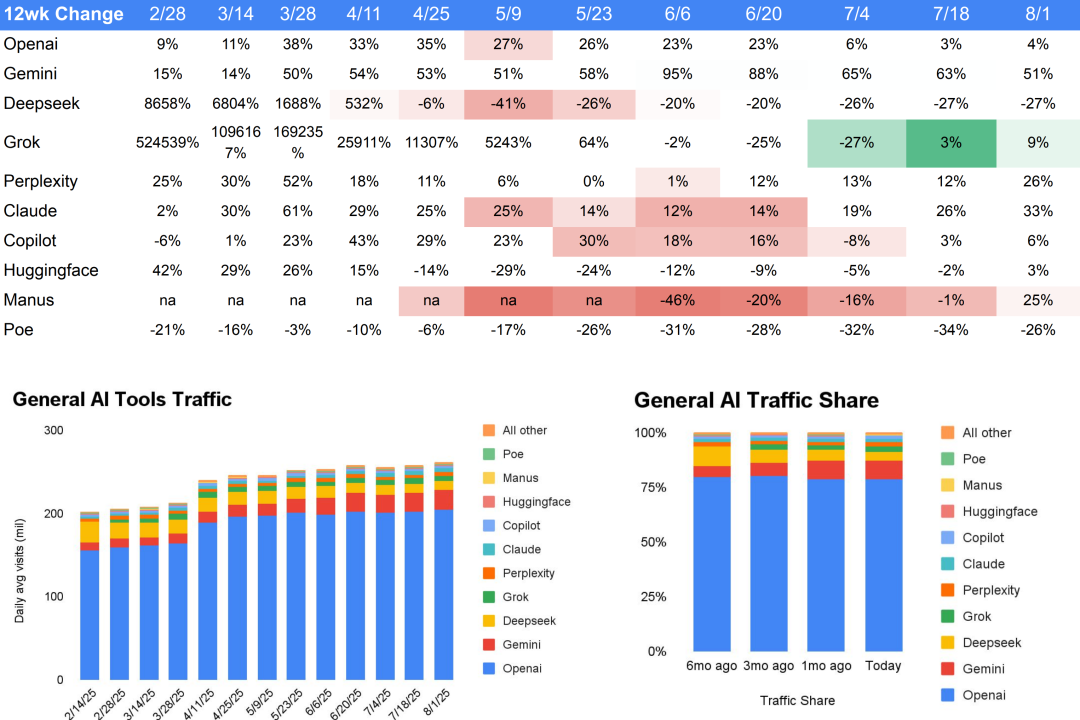
Core Insights - The AI industry is experiencing a shift from explosive growth to a new phase characterized by user preference changes and declining traffic for many vertical tools [4][5][59]. Group 1: User Trends and Market Dynamics - General-purpose AI models are squeezing the survival space of specialized tools, leading to a decline in traffic for AI writing and content tools by 12% and 8% over the past three months [5][33]. - Video and voice generation products are also facing growth bottlenecks, with video generation growth dropping from nearly 20% at the beginning of the year to just 1% [6][37]. - In the overseas market, while many vertical products are cooling off, travel-related products like Mindtrip have seen a remarkable increase of 153% in the last three months [7][40]. - The "plugin" model has become mainstream in the domestic market, with an average of 2.1 AI features integrated into each app [8][54]. - The total number of active mobile AI users in China reached 680 million, but native app growth is slow, with a significant decline in PC web applications [9][54]. Group 2: Competitive Landscape - AI search remains the leading segment, with over half of the users lost by DeepSeek migrating to Baidu [10][58]. - The impact of AI on traditional industries is evident, with significant traffic declines in sectors like education technology, where platforms like Quora saw nearly a 50% drop year-over-year [11][59]. - OpenAI dominates the market, with a clear advantage over smaller players, leading to a pronounced "Matthew effect" where the rich get richer [12][13]. Group 3: Performance Metrics - The overall traffic for global AI tools has stabilized after rapid growth earlier in the year, with a notable decline in many vertical categories [13][24]. - The traffic for AI writing tools has been consistently declining, with many well-known tools like Jasper and Wordtune experiencing significant drops [33][34]. - The travel category has shown remarkable resilience, with a 90% increase in traffic over the last 12 weeks, likely driven by seasonal demand [40][41]. Group 4: Future Outlook - The industry is moving towards embedding AI deeply into existing workflows and applications, rather than relying solely on standalone AI apps [60][62]. - The expectation for AI development is shifting from merely increasing model size to focusing on practical usability and user experience [63][66]. - The future of AI innovation is anticipated to be more complex and diversified, with a focus on genuinely useful applications [68].

LLM+Tool Use 还能撑多久?下一代 AI Agent 在 self-evolving 的技术探索上行至何方?
机器之心· 2025-08-17 01:30
Group 1 - The article discusses the increasing demand for self-evolving capabilities in AI agents, highlighting the limitations of static models in adapting to new tasks and dynamic environments [6][8][10] - It emphasizes the need for a systematic theoretical framework to guide the exploration of self-evolving agents, with contributions from multiple research institutions [8][10] - The article outlines three key dimensions for analyzing and designing self-evolving agents: what to evolve, when to evolve, and how to evolve, each addressing different aspects of the evolution process [9][10][11] Group 2 - The article raises questions about the ability of AI application companies to replicate or surpass the commercial successes of the mobile internet era, focusing on new monetization models [2][3] - It explores the differences in user ecosystems and commercial boundaries between AI and the mobile internet era, questioning the necessity of multiple apps as AI becomes a platform capability [2][3] - The article discusses the varying attitudes of Chinese and American internet giants towards AI investments and how this may impact future competitiveness [2][3] Group 3 - The article presents insights from Dario Amodei on the profitability of large models despite significant accounting losses, suggesting that each generation of large models can be viewed as independent startups [3] - It discusses the natural drive for funding, computing power, and data investment that comes with advancements in large model capabilities [3] - The article highlights the implications of Scaling Law for AI enterprise growth and the potential consequences if it were to fail [3]