
投资者保护

Search documents
雷电微力:公司始终高度重视市值管理与投资者保护工作
Sou Hu Cai Jing· 2025-11-28 07:53
雷电微力回复:您好,股价波动受宏观环境、行业动态、市场情绪等诸多复杂因素影响。良好的市值表 现是我们和全体股民的共同期盼。公司始终高度重视市值管理与投资者保护工作,二者的核心在于扎实 做好主业,增强与投资者沟通,并适时运用合适的市值管理工具,以实现公司内在价值与市值的合理匹 配与共同提升。感谢您的关注,谢谢。 以上内容为证券之星据公开信息整理,由AI算法生成(网信算备310104345710301240019号),不构成 投资建议。 证券之星消息,雷电微力(301050)11月28日在投资者关系平台上答复投资者关心的问题。 投资者提问:公司市值又准备年内新低了,请问公司什么时候才开始肯做投资者保护工作?公司是没有 相关市值保护预案的吗?任由市值随意被做空蒸发,这就是你们口中的管理层很重视市值管理和保护投 资者? ...
一夜之间,两家A股公司退市,监管释放重要信号
2 1 Shi Ji Jing Ji Bao Dao· 2025-11-27 06:38
Core Viewpoint - The A-share market is demonstrating a "zero tolerance" attitude towards major illegal delisting behaviors, as evidenced by the recent forced delisting of *ST Dongtong and *ST Suwu due to severe violations [2][9] Summary by Sections Major Violations and Delisting - *ST Dongtong and *ST Suwu have been forced to suspend trading due to serious violations, marking a significant shift in regulatory enforcement [2][7] - Since 2025, the number of companies facing major illegal delisting has reached 13, a historical high [9] Specific Violations - *ST Dongtong engaged in financial fraud through its subsidiary for four consecutive years, inflating profits significantly, with a peak of 124 million yuan in 2022, representing 219.43% of its total profit for that year [5][6] - *ST Suwu concealed its actual controlling party and inflated revenues, with related party non-operating fund occupation reaching 1.693 billion yuan, nearly depleting the company's net assets [6][7] Regulatory Changes - The new delisting regulations specify that companies with continuous fraud for three years or more will be decisively removed from the market, lowering the thresholds for identifying fraudulent activities [10][12] - The updated standards include three tiers for recognizing fraud, with specific monetary thresholds and percentage criteria [10] Enforcement and Accountability - The regulatory environment has intensified, with a comprehensive system for punishing financial fraud being established, including administrative, civil, and criminal penalties [12][13] - The regulatory body emphasizes the importance of holding not only the companies accountable but also those who collude with them in fraudulent activities [12] Investor Protection - Measures are being implemented to enhance investor protection, particularly in cases of major illegal delisting, encouraging companies to compensate affected investors [13] - Technological advancements such as AI and big data are being utilized to improve regulatory oversight and detect hidden illegal activities [13]


一夜之间,两家A股公司退市,监管释放重要信号
21世纪经济报道· 2025-11-27 06:34
Core Viewpoint - The A-share market is demonstrating a "zero tolerance" attitude towards major illegal delisting behaviors, as evidenced by the recent forced delisting of *ST Dongtong and *ST Suwu due to severe violations of regulations [1][5][9] Summary by Sections Major Violations and Delisting - On November 25, *ST Dongtong and *ST Suwu received administrative penalty decisions from the China Securities Regulatory Commission (CSRC), leading to their stocks being suspended from trading starting November 26 [1][5] - Since 2025, the number of companies facing major illegal delisting has reached 13, marking a historical high [1][6] - *ST Dongtong engaged in financial fraud through its subsidiary for four consecutive years and used false data in a 2022 private placement, constituting fraudulent issuance [3][4] - *ST Suwu concealed its actual controlling shareholder and systematically inflated revenue, with related party fund occupation reaching 1.693 billion yuan, accounting for 96.09% of the company's net assets [1][5] Regulatory Changes and Enforcement - The recent delistings reflect a significant change in regulatory attitudes, driven by the continuous improvement of delisting systems, which now clearly state that companies with three or more years of fraud will be decisively removed [1][6] - New regulations have lowered the thresholds for identifying fraudulent activities, allowing more companies with long-term fraudulent behaviors to be exposed [6][10] - The updated standards for financial fraud delisting include specific thresholds for fraudulent amounts and their proportions relative to financial indicators [6][10] Comprehensive Governance System - A comprehensive governance system is being established to combat financial fraud, including holding accomplices accountable and utilizing technology for "penetrating" regulatory networks [2][9] - The regulatory framework emphasizes a three-pronged punishment system (administrative, civil, and criminal) for financial fraud cases, showcasing a firm stance against illegal activities in the capital market [7][9] Investor Protection and Market Ecology - The increase in major illegal delisting cases reflects the regulatory body's commitment to a "zero tolerance" policy towards financial fraud and the determination to dismantle the fraud "ecosystem" [9][10] - The CSRC has issued guidelines to enhance investor protection, particularly in cases of major illegal delisting, encouraging companies to take proactive measures to compensate affected investors [9][10]

停牌!600200,重大违法强制退市
Zhong Guo Ji Jin Bao· 2025-11-26 03:01
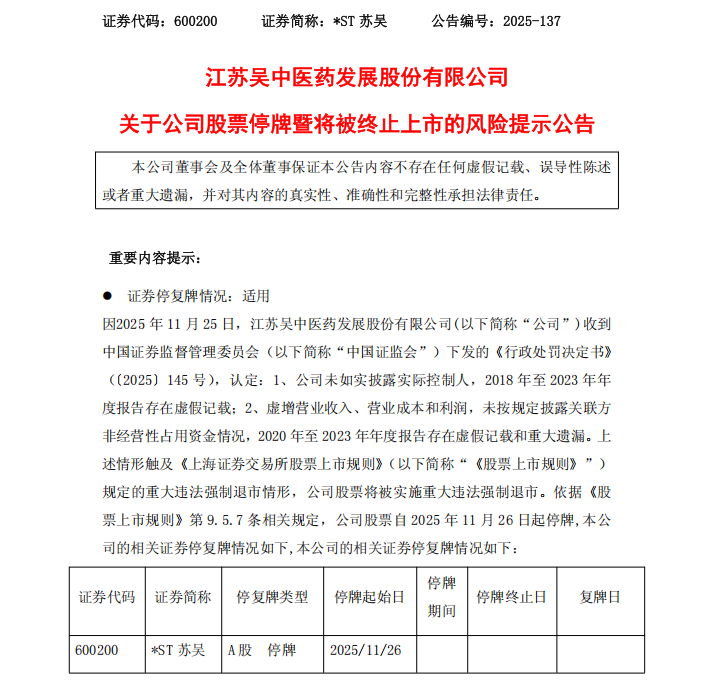
Core Viewpoint - *ST Suwu has been identified by the China Securities Regulatory Commission (CSRC) for three major violations, leading to a mandatory delisting situation, with trading suspension starting from November 26 [1][5]. Group 1: Violations Identified - The CSRC's administrative penalty decision outlines three violations by *ST Suwu and related parties: failure to disclose the actual controller accurately, false reporting of revenue, costs, and profits from 2020 to 2023, and significant omissions regarding non-operating fund occupation by related parties from 2020 to 2023 [2][3]. - Specifically, after a change in shareholding in February 2018, the actual controller was identified as Qian Qunshan, but the company continued to report Qian Qunying as the controller in its annual reports from 2018 to 2023, constituting false records [3]. Group 2: Penalties Imposed - The CSRC has ordered *ST Suwu to correct its violations, issued a warning, and imposed a fine of 10 million yuan [3]. - Additionally, penalties totaling 20.5 million yuan have been imposed on Qian Qunshan, Qian Qunying, Chen Yi, Sun Xi, and Luo Xiao, with Qian Qunshan facing a 10-year ban from the securities market due to his role in the violations [4]. Group 3: Trading Suspension and Delisting Process - Following the CSRC's findings, *ST Suwu's stock is subject to mandatory delisting as per the Shanghai Stock Exchange's regulations, with trading suspension effective from November 26 [5]. - The company will enter a delisting transition period lasting 15 trading days, after which its stock will be delisted [7]. Group 4: Investor Compensation - Investors may seek compensation through various means, including advance compensation and legal actions, as the company faces delisting due to financial fraud [8][9].


停牌!600200,重大违法强制退市
中国基金报· 2025-11-26 02:58
Core Viewpoint - *ST Suwu has been identified by the China Securities Regulatory Commission (CSRC) for three major violations, leading to a mandatory delisting situation, with trading suspension starting from November 26 [2][5][14]. Summary by Sections Regulatory Violations - The CSRC issued an administrative penalty decision on November 25, confirming three violations by *ST Suwu and related parties: 1. Failure to disclose the actual controller truthfully, with false records in annual reports from 2018 to 2023 [9]. 2. Inflating revenue, operating costs, and profits, with false records in annual reports from 2020 to 2023 [10]. 3. Not disclosing the non-operational occupation of funds by related parties, with significant omissions in annual reports from 2020 to 2023 [11]. Penalties Imposed - The CSRC has ordered *ST Suwu to correct its violations, issued a warning, and imposed a fine of 10 million yuan. Additionally, fines totaling 20.5 million yuan were levied against individuals involved, including a 10-year market ban for the actual controller, Qian Qunshan [11][12]. Stock Suspension and Delisting Process - Following the CSRC's decision, *ST Suwu's stock will be suspended from trading starting November 26, as it falls under the mandatory delisting criteria set by the Shanghai Stock Exchange [14][16]. The stock will enter a delisting adjustment period of 15 trading days, after which it will be delisted [16]. Investor Protection Measures - In light of the financial fraud leading to delisting, investors may seek compensation through various means, including pre-compensation and legal actions, supported by recent regulatory measures aimed at enhancing investor protection [17].
一周10家公司集体踩雷!监管、立案、警示函齐发,投资者如何见招拆招
Sou Hu Cai Jing· 2025-11-23 17:07
Core Viewpoint - The A-share market in 2025 is experiencing an intensified regulatory storm, with multiple companies facing investigations and warnings, highlighting governance issues and a market environment where "bad money drives out good" [1] Regulatory Developments - In the third week of November, the China Securities Regulatory Commission (CSRC) issued multiple investigation notices to listed companies, including Haosai and Jushi Chemical, due to information disclosure violations, leading to significant stock price declines [3] - A total of 100 listed companies or executives have been investigated in 2025, with over 90% of cases involving financial fraud and information disclosure violations [5] - 15 companies have received formal penalties, with ST Yundong facing the highest fine of 6 million yuan for false financial reporting [7] Company-Specific Risks - ST Changyao is at high risk of delisting due to negative net assets and numerous lawsuits, while ST Lifang faces potential delisting if financial fraud is confirmed [3][5] - ST Yuancheng has become the first case of "market value delisting" in 2025, with its market value falling below 500 million yuan for 20 consecutive trading days [7] Systemic Regulatory Changes - The regulatory environment is tightening, with a focus on improving the structure of listed companies and protecting investors, as emphasized by CSRC Vice Chairman Li Chao [9] - Recent policies aim to strengthen risk prevention and regulation, extending enforcement to intermediary institutions, with 13 brokerages penalized for various violations [9] Market Trends - There is a notable trend of long-term capital entering the market, with social security, insurance, and pension funds net buying over 200 billion yuan of A-shares in 2025 [9] - Regulatory encouragement for dividends and buybacks has led to significant capital returns to shareholders, with 4.2 trillion yuan in dividends and 230 billion yuan in buybacks from 2024 to July 2025 [9]


证监会:更大力度推动制度建设 优化上市公司结构 上市公司要用实干实绩赢得市场信任
Sou Hu Cai Jing· 2025-11-20 23:47
Core Viewpoint - The China Securities Regulatory Commission (CSRC) emphasizes the importance of enhancing the quality of listed companies and strengthening regulatory measures to ensure high-quality development in the capital market [1][2]. Group 1: Regulatory Measures - The CSRC will intensify efforts in institutional construction and optimize the structure of listed companies [1]. - There will be a focus on precise and efficient risk prevention and control, along with comprehensive chain regulation [1]. - The implementation of the new "National Nine Articles" and the "1+N" policy framework aims to strengthen regulation and promote high-quality development [1]. Group 2: Responsibilities of Listed Companies - Listed companies are expected to be role models in honesty and integrity, emphasizing the importance of truthful communication and real achievements to gain market trust [2]. - Companies should establish effective governance structures as a foundation for sustainable development, embedding governance awareness into corporate culture [2]. - There is a call for innovation and development, encouraging companies to align with national strategies and market trends while fostering deep integration of technology, industry, and capital [2]. - Companies are urged to prioritize investor returns, establishing effective communication mechanisms and adopting an investor-centric approach for sustainable high-quality growth [2]. Group 3: Role of the China Listed Companies Association - The association aims to enhance professional service quality, cultivate a healthy market ecosystem, and strengthen internal and external collaboration to better promote high-quality development of listed companies [2].
证监会:更大力度推动制度建设优化上市公司结构
Zheng Quan Shi Bao· 2025-11-20 18:38
Core Points - The China Securities Regulatory Commission (CSRC) aims to enhance institutional construction and optimize the structure of listed companies, focusing on risk prevention and investor protection [1][2][3] Group 1: Regulatory Focus - The CSRC emphasizes the importance of listed companies as the foundation of the capital market and has implemented strict regulations to purify the market ecosystem [1] - The introduction of the new "National Nine Articles" and the "1+N" policy framework has reinforced the focus on risk prevention, strong regulation, and promoting high-quality development [1][2] Group 2: Responsibilities of Listed Companies - Listed companies are expected to take on the primary responsibility for high-quality development, which includes being honest and trustworthy, ensuring effective corporate governance, and fostering innovation [3] - Companies should prioritize long-term returns for investors and establish effective communication mechanisms to achieve sustainable high-quality development [3] Group 3: Role of the China Listed Companies Association - The China Listed Companies Association is tasked with enhancing professional service quality, cultivating a healthy market ecosystem, and strengthening internal and external collaboration to promote high-quality development [4] - The association has outlined five key areas for improvement, including governance, compliance, resource allocation, shareholder returns, and risk prevention [4]
证监会:上市公司必须扛起主体责任
Bei Jing Shang Bao· 2025-11-20 16:30
Core Viewpoint - The China Securities Regulatory Commission (CSRC) aims to enhance institutional construction, optimize the structure of listed companies, and strengthen risk prevention and investor protection to boost investor confidence and trust [1] Group 1: Regulatory Focus - The CSRC emphasizes the importance of listed companies as the foundation of the capital market and has been implementing market-oriented and legal measures to strengthen oversight and purify the market environment [1] - The introduction of the new "National Nine Articles" and the "1+N" policy framework has reinforced the focus on risk prevention, stringent regulation, and promoting high-quality development [1] - The CSRC is committed to improving information disclosure and corporate governance, conducting special actions against financial fraud, and enhancing the foundational institutional framework [1] Group 2: Responsibilities of Listed Companies - Listed companies are seen as both the main bearers of high-quality development responsibilities and the largest beneficiaries of such developments [2] - Companies are urged to maintain honesty and integrity, ensuring that truthfulness is a fundamental requirement rather than an additional quality standard [2] - Effective corporate governance is highlighted as essential for long-term stability, with a focus on embedding governance awareness into corporate culture and ensuring accountability among executives [2] Group 3: Innovation and Investor Relations - Listed companies are encouraged to align with national strategies and market trends, fostering deep integration between technology, industry, and capital [2] - The importance of creating long-term returns for investors is emphasized, with companies urged to adopt an "investor-centric" approach and establish effective communication mechanisms [2] - The China Listed Companies Association is tasked with enhancing professional service quality, cultivating a healthy market ecosystem, and strengthening internal and external collaboration to promote high-quality development [2]
证监会副主席李超:上市公司应扛起主体责任 当好“四个表率”
2 1 Shi Ji Jing Ji Bao Dao· 2025-11-20 12:30
Core Viewpoint - The Vice Chairman of the China Securities Regulatory Commission (CSRC), Li Chao, emphasized the importance of honesty and integrity for listed companies, stating that they must earn market trust through practical achievements [1][2]. Group 1: High-Quality Development of Listed Companies - The CSRC is focused on promoting high-quality development of listed companies, which are considered the foundation of the capital market [2]. - The implementation of the new "National Nine Articles" and the "1+N" policy framework has reinforced regulatory measures aimed at risk prevention, strong oversight, and promoting high-quality development [2]. - Li Chao highlighted the need for improved institutional inclusiveness and adaptability in the capital market, as well as a coordinated investment and financing function [2]. Group 2: Responsibilities of Listed Companies - Listed companies are expected to take on the primary responsibility for high-quality development and must adhere to four key standards: 1. Be a model of honesty and integrity, ensuring truthful communication and avoiding deception [2][3]. 2. Be a model of standardized governance, embedding governance awareness into corporate culture and ensuring effective oversight [3]. 3. Be a model of innovative development, aligning with national strategies and focusing on deepening industry advantages [3]. 4. Be a model of positive returns to investors, fostering a "shareholder-first" philosophy and establishing effective communication mechanisms [3]. Group 3: Role of the China Listed Companies Association - The China Listed Companies Association is tasked with enhancing professional service quality, fostering a healthy market ecosystem, and strengthening internal and external collaboration to support high-quality development [3]. - The Association's president, Song Zhiping, outlined five areas for improvement: solidifying governance foundations, enhancing compliance effectiveness, focusing on core responsibilities, optimizing resource allocation, and reinforcing risk prevention measures [3].