
市盈率

Search documents
A股冰火两重天!当宽基指数估值超过100倍,该如何选择?
Xin Lang Cai Jing· 2026-01-17 23:35
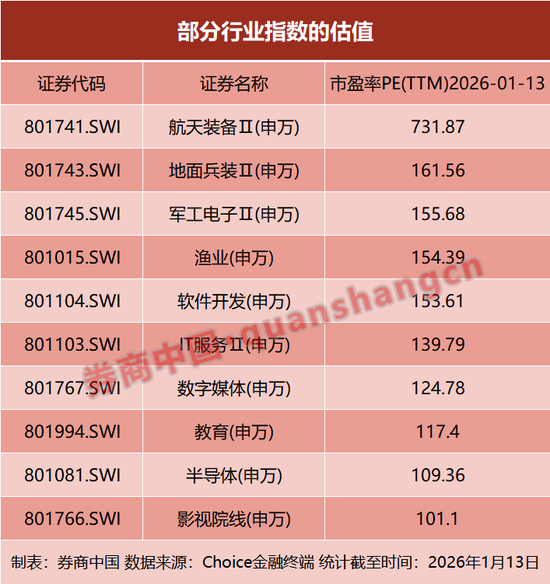
Core Viewpoint - The current market shows a significant disparity in valuations, with certain indices exceeding 100 times earnings, indicating potential risks for investors as historical patterns suggest that such high valuations are unsustainable [1][10]. Group 1: Market Valuation Insights - The valuations of the Sci-Tech 100, Sci-Tech 50, and CSI 2000 indices have surpassed 150 times earnings, with the Sci-Tech 100 and Sci-Tech 50 at 217 times and 172 times respectively, and the CSI 2000 at 164 times as of January 13, 2026 [3][10][16]. - Historical data indicates that when broad market indices exceed 100 times earnings, it often leads to significant market corrections, as seen with the Nikkei 225 and Nasdaq indices in previous decades [10][12]. - The current A-share market presents a dichotomy, with large-cap value and dividend indices showing earnings multiples below 10 times, suggesting that these stocks are undervalued compared to the high-flying indices [10][11]. Group 2: Investment Strategy and Market Behavior - Investors are advised to adopt a cautious approach when market valuations exceed 100 times, as this is a signal to be wary of potential downturns [2][10]. - The phenomenon of irrational market behavior is noted, where undervalued stocks may decline further while overvalued stocks can continue to rise temporarily, but such conditions are not sustainable in the long run [12][5]. - The concept of a valuation anchor is emphasized, suggesting that most stocks should ideally be valued around 20 times earnings, which can help investors gauge market temperature [4][11]. Group 3: Sector-Specific Valuations - Certain sectors are experiencing extreme valuations, with some industry indices showing earnings multiples exceeding 100 times, such as aerospace equipment at 731.87 times and military electronics at 155.68 times [8][14]. - The micro-cap stock index has seen substantial growth, with a rise of 3.1 times since February 2024, despite a significant portion of its constituents being loss-making [11][16].

三维通信:预计2025年亏损1000万元-1500万元
Sou Hu Cai Jing· 2026-01-16 14:45
Group 1 - The company is primarily engaged in wireless coverage, wireless network, wireless security, satellite communication, communication facility leasing, and internet marketing businesses [7] - During the reporting period, the domestic traditional communication industry is experiencing a phase adjustment, leading to a slowdown in overall growth, which has resulted in a decline in the company's domestic communication business revenue and gross profit [7] - To adapt to market changes, the company is continuously optimizing its business structure and gradually reducing some low-margin service projects, which has had a temporary impact on current revenue scale [7] Group 2 - The company's foreign sales are primarily settled in US dollars, and the depreciation of the US dollar against the Chinese yuan due to fluctuations in the international foreign exchange market has negatively impacted the company's exchange gains and losses [7] - The company will continue to monitor market dynamics and actively promote business optimization and upgrades to strengthen its operational foundation and enhance long-term development quality [7]


PNC Financial Services Group, Inc. (NYSE:PNC) Quarterly Earnings Preview
Financial Modeling Prep· 2026-01-15 10:00
Core Viewpoint - PNC Financial Services Group is expected to report strong quarterly earnings driven by increased net interest income, although fee income may decline due to pressures on mortgage revenues [2][4]. Group 1: Earnings Expectations - PNC is set to release its quarterly earnings on January 16, 2026, with Wall Street estimating earnings per share (EPS) of $4.23 and projected revenue of approximately $5.95 billion [1][6]. - The company has a strong track record of surpassing earnings estimates, having done so in the last four quarters [4][6]. Group 2: Financial Performance - An anticipated increase in net interest income (NII) for the fourth quarter is expected due to Federal Reserve rate cuts and reduced funding costs, positively impacting earnings [2][6]. - In the previous quarter, PNC exceeded the Zacks Consensus Estimate, supported by higher NII and fee income, alongside rising loan and deposit balances [3]. Group 3: Financial Metrics - PNC's financial metrics indicate a price-to-earnings (P/E) ratio of approximately 12.88, a price-to-sales ratio of about 2.46, and an enterprise value to sales ratio of around 3.16 [5]. - The debt-to-equity ratio is approximately 1.06, indicating financial leverage, while the current ratio is around 0.25, suggesting potential liquidity challenges [5].


First Horizon Corporation (NYSE: FHN) Earnings Preview: Anticipated Growth in Q4
Financial Modeling Prep· 2026-01-14 12:00
First Horizon Corporation is expected to report a 7% increase in EPS and a revenue rise to approximately $862.8 million for Q4.Analysts have revised the consensus EPS estimate upward by 3.1%, indicating potential investor interest and possible stock price movements.Despite a positive earnings outlook, First Horizon's shares recently saw a slight decline, with a Hold rating from TD Cowen analyst Janet Lee.First Horizon Corporation (NYSE:FHN), based in Memphis, Tennessee, is preparing to release its fourth-qu ...


重庆至信实业股份有限公司 首次公开发行股票并在主板上市上市公告书提示性公告
Zhong Guo Zheng Quan Bao - Zhong Zheng Wang· 2026-01-14 00:34
Core Viewpoint - Chongqing Zhixin Industrial Co., Ltd. is set to list its ordinary shares on the Shanghai Stock Exchange on January 15, 2026, following approval from the exchange [1] Group 1: Listing Information - The company will have a total share capital of 226,666,667 shares after the initial public offering (IPO), with 56,666,667 shares being newly issued [4] - The stock will be traded under the name "Zhixin Shares" and the stock code will be 603352 [4] Group 2: Pricing and Valuation - The IPO price is set at 21.88 yuan per share, which corresponds to a price-to-earnings (P/E) ratio of 18.24 times based on the earnings per share (EPS) for 2024 before non-recurring gains and losses [4][5] - The diluted P/E ratio based on the lower of the pre- and post-non-recurring gains and losses for 2024 is 26.85 times, which is lower than the average P/E ratio of 28.68 times for the automotive manufacturing industry [5][6] Group 3: Trading Risks - The stock will have no price limit for the first five trading days, which may lead to significant price volatility [2] - The initial liquidity risk is highlighted due to a limited number of circulating shares, with only 44,422,372 shares available for trading, representing 19.60% of the total share capital post-IPO [3] - The stock will be eligible for margin trading from the first day of listing, which may introduce additional price fluctuation risks [7]
腾远钴业:预计2025年净利10.28亿元-11.64亿元 同比增长50.02%-69.87%
Zhong Guo Zheng Quan Bao· 2026-01-13 10:27
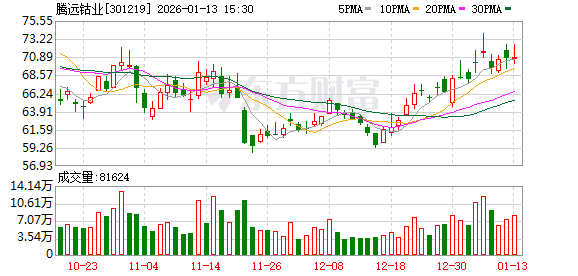
Core Viewpoint - Tengyuan Cobalt Industry (301219) expects a significant increase in net profit for the year 2025, projecting a growth of 50.02% to 69.87% compared to the previous year, driven by various operational improvements and favorable market conditions [4]. Financial Performance - The company forecasts a net profit attributable to shareholders of between 1.028 billion to 1.164 billion yuan for 2025, with a non-recurring net profit expected to be between 0.991 billion to 1.127 billion yuan, reflecting a year-on-year growth of 47.67% to 67.94% [4]. - As of January 13, the company's price-to-earnings ratio (TTM) is approximately 17.93 to 20.3 times, with a price-to-book ratio (LF) of about 2.3 times and a price-to-sales ratio (TTM) of around 2.82 times [4]. Operational Drivers - The increase in profit is attributed to several factors: 1. The gradual release of production capacity from fundraising projects, leading to a year-on-year increase in total metal output of cobalt, copper, nickel, lithium, and manganese, enhancing economies of scale [14]. 2. Continuous implementation of lean management reforms and cost control measures, which have improved operational efficiency and overall profitability [14]. 3. The enhancement of the secondary resource recovery system, which has increased the proportion of recycled materials in the raw material structure, thereby improving supply chain resilience and self-sufficiency in raw materials [14]. 4. Benefiting from the year-on-year price increase of metals like cobalt and copper, the profitability of the company's products has significantly improved [14].
浙文互联:公司GEO业务尚未形成收入
Xin Lang Cai Jing· 2026-01-13 10:19
浙文互联公告,公司股票价格自2026年1月5日以来收盘价累计涨幅43.99%,股价短期涨幅较大,同期 上证指数累计涨幅为4.28%。公司的最新动态市盈率为132.13,根据申万行业分类,公司所属"传媒行 业"市盈率为53.13,公司市盈率明显高于行业平均水平。2025年前三季度,公司实现营业收入56.05亿 元,实现归属于上市公司股东的净利润1.27亿元,同比下降19.68%,实现归属于上市公司股东的扣除非 经常性损益的净利润1869.48万元,同比下降78.62%。公司GEO业务尚未形成收入。 ...

A Look Into Viavi Solutions Inc's Price Over Earnings - Viavi Solutions (NASDAQ:VIAV)
Benzinga· 2026-01-09 21:00
Core Viewpoint - Viavi Solutions Inc. has shown a significant annual stock price increase of 77.87%, despite a slight monthly decrease of 1.97%, leading to questions about potential overvaluation [1]. Group 1: Stock Performance - The current share price of Viavi Solutions is $17.64, reflecting a 3.13% increase in the current market session [1]. - Over the past month, the stock has decreased by 1.97%, but it has increased by 77.87% over the past year [1]. Group 2: P/E Ratio Analysis - Viavi Solutions has a P/E ratio of 285.17, which is significantly higher than the aggregate P/E ratio of 69.25 for the Communications Equipment industry [4]. - A higher P/E ratio may suggest that Viavi Solutions is expected to perform better in the future compared to its industry peers, although there are indications that the stock may be overvalued [4][5]. Group 3: Limitations of P/E Ratio - The P/E ratio is a useful metric for assessing market performance but has limitations; a lower P/E can indicate undervaluation or lack of expected future growth [7]. - It is advised that the P/E ratio should not be used in isolation, as other factors such as industry trends and business cycles also influence stock prices [7].


分析师:网飞市盈率虽低过往昔 却仍领跑流媒体板块
Ge Long Hui A P P· 2026-01-09 12:13
Core Viewpoint - Netflix's stock has experienced a significant decline of 27% since October, when it was rumored to be a potential acquirer of Warner Bros. Discovery, yet it remains perceived as too expensive for investors [1] Valuation Comparison - Netflix's current expected price-to-earnings (P/E) ratio is approximately 28 times, which is higher than competitors such as Walt Disney, Amazon, and Alphabet, as well as the S&P 500 and Nasdaq 100 indices [1] - In contrast, Paramount Global, which is also bidding for Warner Bros. and operates Paramount+, has an expected P/E ratio of less than 13 times [1] Historical Context - Despite the current valuation, Netflix's stock can be considered "cheap" relative to its historical trading levels, with an average P/E ratio of 34 times over the past five years [1] - Since reaching a peak on June 30, Netflix's market capitalization has decreased by one-third [1]

市场平静下暗流涌动 黄金震荡聚焦非农与关税裁决
Jin Tou Wang· 2026-01-09 06:04
Market Overview - The global market is showing strong performance as of the beginning of 2026, but a key test is approaching with the release of the U.S. December non-farm payroll report and a potential Supreme Court ruling on Trump's tariff policies [1][2] Non-Farm Payroll Report - The consensus expectation for the December non-farm payroll is an addition of approximately 60,000 jobs, down from a previous value of 64,000, with the unemployment rate expected to decrease from 4.6% to 4.5% [2] - The report is seen as a critical indicator, with potential risks regardless of whether the data is strong or weak, as the S&P 500's forward P/E ratio has exceeded 22, nearing the market peak level seen in January 2022 [2] Gold Market Analysis - Gold prices were influenced by calls from Federal Reserve Governor Milan for a 150 basis point rate cut this year, leading to a rise of over $20 on Thursday, with a 0.48% increase [3] - The current gold price is $1,001.46 per gram, down $3.58 from the previous trading day, with a daily high of $1,006.19 and a low of $999.27 [1] - The market is awaiting the non-farm payroll data, which could significantly impact gold prices depending on the legality of Trump's tariffs, with potential bullish or bearish outcomes [3]