十四五规划

Search documents
“十五五”新蓝图·新机遇丨锚定协调发展——以布局优化激活区域经济新动能
Sou Hu Cai Jing· 2025-11-06 02:25
Core Insights - The article emphasizes the importance of optimizing regional economic layouts to activate new economic dynamics, particularly in the context of China's 14th and upcoming 15th Five-Year Plans [1][4]. Group 1: Regional Economic Development - In the Chengdu-Chongqing area, the collaboration between Sichuan and Chongqing has led to the establishment of significant economic and technological centers, enhancing overall regional competitiveness [2]. - The Chengdu-Chongqing economic circle has seen the creation of four trillion-level industrial clusters, including electronic information and advanced manufacturing, with an industrial added value projected to reach 24,230.1 billion yuan by 2024, a 40% increase from 2019 [2]. - The Yangtze River Delta region has experienced a substantial GDP increase from 27.6 trillion yuan in 2021 to over 33 trillion yuan in 2024, with 26 national advanced manufacturing clusters contributing significantly to this growth [3]. Group 2: Policy and Strategic Initiatives - The 15th Five-Year Plan suggests a clear direction for regional development, focusing on coordinated strategies and optimizing major productivity layouts to enhance high-quality economic development [1][4]. - Guangdong's "Hundred-Thousand-Ten Thousand Project" aims to address regional development imbalances, facilitating industrial transfers and activating county-level economic vitality [3][4]. - The article outlines a series of measures to enhance regional coordination, promote innovation, and optimize economic layouts, which are expected to be implemented during the 15th Five-Year Plan period [4][5]. Group 3: Industrial Collaboration - The integration of the automotive industry in the Sichuan-Chongqing region is highlighted, with significant collaboration in battery production and vehicle manufacturing [2]. - The article notes the formation of a "community of industries" in the Yangtze River Delta, where multiple industrial chains, including large aircraft and new energy vehicles, are advancing together [3]. - The article indicates that the optimization of resource allocation across regions will enhance economic resilience and efficiency, supporting high-quality development and modernization efforts [5].
杭州拟实施“润苗计划”,陪伴式扶持科技型初创企业
Huan Qiu Wang· 2025-11-06 01:16
Group 1 - The core objective of Hangzhou's "Run Seed Plan" is to support the high-quality development of technology-based startups, aiming to cultivate 50,000 technology SMEs, 3,000 "good seed" companies, 20,000 high-tech enterprises, 300 "new eagle" companies, and 100 leading technology firms by 2027 [1] - "Good seed" companies are defined as those with at least 10% of employees in R&D, R&D expenses accounting for no less than 5% of revenue, and financing not exceeding 20 million yuan or a valuation of no more than 200 million yuan, with some flexibility for companies with independent intellectual property and disruptive technological innovations [1] - The "Private Economy Promotion Law" passed in April aims to curb exploitative practices against private enterprise owners and ensure fair market competition and protection of legal rights [1][2] Group 2 - The private sector is a backbone of China's real economy, contributing over 50% of tax revenue, over 60% of GDP, over 70% of technological innovations, over 80% of urban employment, and over 90% of the number of enterprises [2]
学习贯彻党的二十届四中全会精神丨学习贯彻党的二十届四中全会精神中央宣讲团在四川宣讲
Xin Hua Wang· 2025-11-05 11:47
Core Points - The report meeting on the spirit of the 20th Central Committee's Fourth Plenary Session was held in Chengdu, Sichuan Province, emphasizing the significance and impact of the session [1] - The report highlighted major achievements during the "14th Five-Year Plan" period and the importance of the upcoming "15th Five-Year Plan" for economic and social development [1] - The guiding principles, major goals, strategic tasks, and significant measures outlined in the session reflect Xi Jinping's Thought on Socialism with Chinese Characteristics for a New Era [1] Summary by Sections - **Significance of the Plenary Session** - The session's major significance and far-reaching impact were deeply explained [1] - **Achievements and Future Plans** - Major achievements during the "14th Five-Year Plan" period were discussed, along with the significance of the "15th Five-Year Plan" [1] - **Guiding Principles and Strategic Tasks** - The guiding thoughts, major principles, and strategic tasks were emphasized as integral to Xi Jinping's ideology [1]
学习贯彻党的二十届四中全会精神|学习贯彻党的二十届四中全会精神中央宣讲团在四川宣讲
Xin Hua She· 2025-11-05 11:37
Core Points - The report by Han Jun emphasized the significance and impact of the Fourth Plenary Session of the 20th Central Committee, highlighting major achievements during the 14th Five-Year Plan and the importance of the upcoming 15th Five-Year Plan [1] - Han Jun stressed the need to integrate the study of the session's spirit with the understanding of Xi Jinping's Thought on Socialism with Chinese Characteristics for a New Era, advocating for a comprehensive grasp of the guidelines and strategic tasks outlined [1] Group 1 - The report detailed the major achievements of China's development during the 14th Five-Year Plan period [1] - It outlined the guiding principles, main objectives, strategic tasks, and significant measures for the 15th Five-Year Plan [1] - Han Jun highlighted the importance of using scientific theory to guide practice and promote work [1] Group 2 - Han Jun engaged with grassroots officials and community representatives in Yongfeng Village, Tahe Town, Meishan City, to promote the session's spirit [2]
金元证券周晔:立根基而强寰宇 从“高水平自立”迈向“高质量自强”的“十五五”征程
Zheng Quan Shi Bao Wang· 2025-11-04 08:16
Core Viewpoint - The transition from the "14th Five-Year Plan" to the "15th Five-Year Plan" represents a significant leap in China's modernization, focusing on enhancing technological self-reliance and quality self-strengthening [1][5]. Summary by Sections 14th Five-Year Plan Achievements - The "14th Five-Year Plan" positioned innovation at the core of China's modernization, emphasizing technological self-reliance as a strategic support for national development [2]. - It recognized the profound changes in international circumstances and technological landscapes, necessitating the mastery of key technologies and core capabilities through independent innovation [2][3]. - Major achievements in various fields such as manned spaceflight, lunar exploration, and quantum information reflect a significant enhancement in China's technological capabilities [4]. Transition to the 15th Five-Year Plan - The "15th Five-Year Plan" aims to significantly improve the level of technological self-reliance and self-strengthening, enhancing the overall effectiveness of the national innovation system [5][6]. - The focus will shift from merely having capabilities to evaluating the quality and strength of these capabilities, aiming for leadership in more sectors [5][6]. - The plan emphasizes the need for a new growth model driven by original innovation and high-value-added technologies, moving away from traditional resource inputs [6][10]. Key Areas of Focus - Quantum technology is highlighted as a critical area for observing the transition from self-reliance to self-strengthening, with significant investments and advancements in quantum computing and communication [7][8]. - The plan outlines the need to explore future industries such as quantum technology, biomanufacturing, and hydrogen energy, aiming to transform cutting-edge technologies into new economic growth points [8][9]. Collaborative Mechanisms - A comprehensive mechanism integrating education, technology, and talent is proposed to cultivate high-level talent aligned with national strategic needs [9]. - The role of enterprises in technological innovation will be strengthened, encouraging them to lead national technological challenges and enhance their investment in basic research [9][10]. Future Directions - The "15th Five-Year Plan" is seen as a new chapter in China's modernization, requiring a balance between maintaining safety through self-reliance and enhancing global competitiveness through quality self-strengthening [10][11]. - The plan aims to transform foundational achievements from the "14th Five-Year Plan" into comprehensive national competitiveness, focusing on controllable key areas and autonomous core technologies [11].
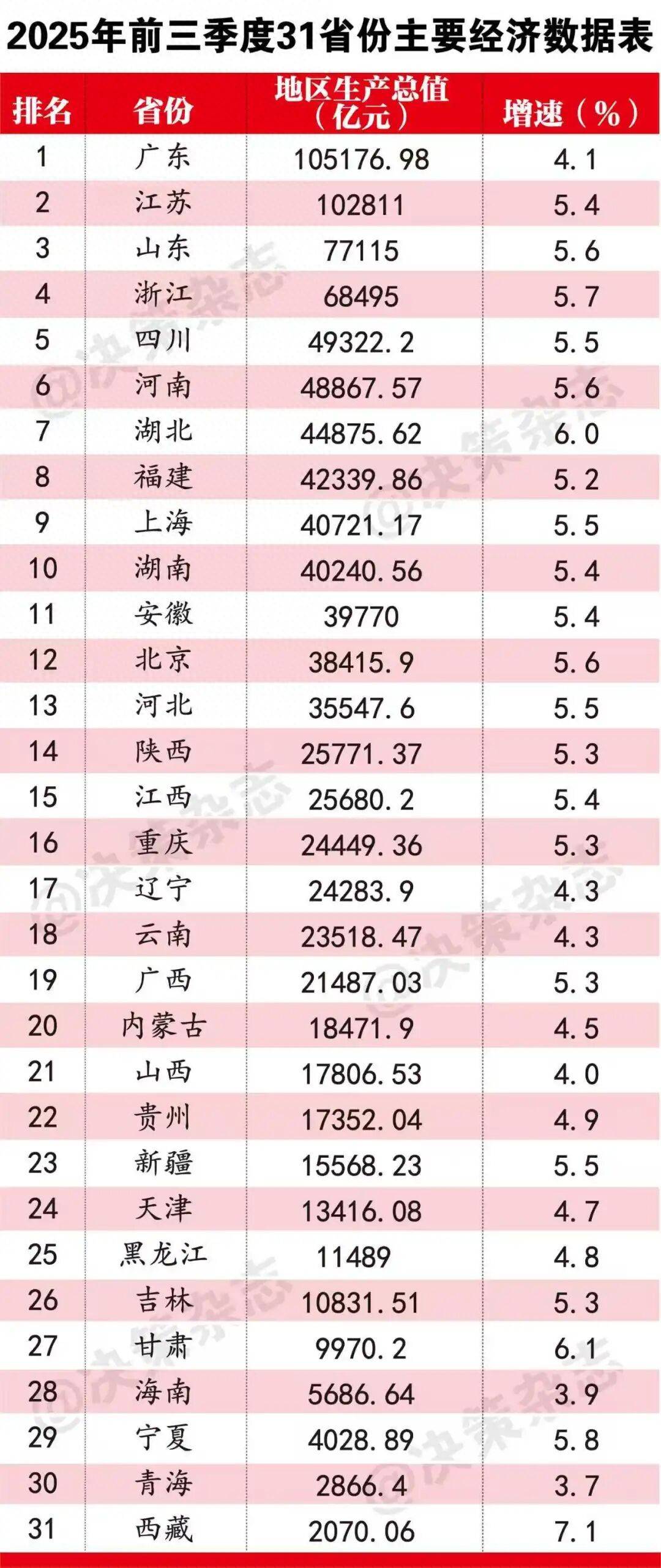
2025前三季度31省份GDP大揭秘:粤苏破10万亿,西藏领跑,这些趋势影响未来格局!
Sou Hu Cai Jing· 2025-11-03 10:40
Economic Overview - The economic data for the first three quarters of 2025 has been released, showcasing the performance of all 31 provinces in China, revealing new economic trends and highlighting which provinces are emerging as "dark horses" [1][4]. GDP Rankings - Guangdong and Jiangsu have both surpassed the 10 trillion yuan mark, with GDPs of 105176.98 billion yuan and 102811 billion yuan respectively, while Shandong is expected to join this club soon [2][3]. - The top ten provinces all have GDPs exceeding 4 trillion yuan, with Shanghai and Hunan entering the "4 trillion club" for the first time [3]. Growth Rates - Tibet leads the nation with a growth rate of 7.1%, followed by Gansu at 6.1% and Hubei at 6% [4]. - A total of 20 provinces have growth rates exceeding 5.2%, indicating a robust economic performance across various regions [4]. Industrial and Consumption Trends - The top ten provinces account for nearly 60% of the national GDP, with eight provinces outpacing the national growth rate, driven by industrial, consumption, and foreign trade dynamics [5]. - Notable industrial growth includes Jiangsu's high-end manufacturing and Zhejiang's surge in new product supply, such as industrial robots [5]. Regional Highlights - The Yangtze River Delta region, comprising Shanghai, Jiangsu, Zhejiang, and Anhui, has shown significant innovation-driven growth, contributing to 24.81% of the national GDP [5]. - The central region, including provinces like Henan, Hubei, and Hunan, is demonstrating a strong upward trend in economic performance [5]. Future Outlook - As provinces aim to meet their annual targets, there is a focus on ensuring the successful completion of the 14th Five-Year Plan while laying the groundwork for the 15th Five-Year Plan [5].

市政府召开第170次常务会议:深入学习贯彻习近平总书记重要讲话重要文章精神,听取市《政府工作报告》目标任务完成情况
Chang Jiang Ri Bao· 2025-11-02 00:44
Core Points - The meeting emphasized the importance of understanding the historical context and strategic planning for the "14th Five-Year Plan" period, as outlined by General Secretary Xi Jinping, to guide the development of Wuhan [1][2] - The city government aims to ensure the completion of the annual and "14th Five-Year Plan" goals through a focus on practical actions and performance [2] Group 1 - The city government work report serves as an authoritative guiding document for government operations and a solemn commitment to the citizens [2] - The meeting highlighted the need to maintain focus on target tasks, strengthen scheduling, and address key challenges to ensure high-quality completion of goals [2] - The introduction of the "commitment to start construction" system in the engineering construction sector is seen as a significant step in deepening government service reform and optimizing the business environment [2] Group 2 - The meeting called for a scientific approach to drafting the city's "14th Five-Year Plan" outline, emphasizing the importance of gathering consensus and wisdom to implement major projects and policies [1] - There is a focus on enhancing the efficiency and quality of project approvals to accelerate construction and improve outcomes [2]
市委办系统召开会议深入学习领会党的二十届四中全会精神
Zhen Jiang Ri Bao· 2025-11-01 23:52
Core Points - The meeting emphasized the importance of studying and implementing the spirit of the 20th Central Committee's Fourth Plenary Session as a major political task for the current and future periods [1] - The meeting highlighted the need for the office system to deeply understand and fully grasp the significance, rich connotations, and practical requirements of the plenary session [1] - The focus is on integrating the study of the plenary session's spirit with current work, planning the city's 14th Five-Year Plan, and ensuring the completion of key reform tasks [1] Summary by Categories Political Significance - The meeting identified the study and implementation of the plenary session's spirit as a significant political task [1] - The office system is tasked with understanding the major significance and practical requirements of the plenary session [1] Implementation Strategies - The meeting called for aligning actions with the plenary session's deployment and finding entry points to serve the central tasks [1] - Emphasis was placed on high-quality "three services" to ensure the plenary session's spirit is effectively implemented [1] Future Planning - The meeting stressed the importance of integrating the plenary session's spirit with the current work and scientifically planning the city's 14th Five-Year Plan [1] - There is a focus on completing key reform tasks and achieving the annual targets to ensure a successful conclusion to the 14th Five-Year Plan [1]
民航局空管局党委学习贯彻党的二十届四中全会精神
Zhong Guo Min Hang Wang· 2025-11-01 06:24
Group 1 - The meeting emphasized the importance of studying and implementing the spirit of the Fourth Plenary Session of the 20th Central Committee as a major political task for the current and future period [2][3] - The meeting highlighted the need for all levels of the air traffic management system to take swift action, organize effectively, and develop detailed learning plans to ensure comprehensive understanding of the session's spirit [3] - The meeting pointed out the necessity to accurately grasp the strategic deployment for the "15th Five-Year Plan" period, aligning the air traffic management system's planning with the guiding principles and main goals outlined in the recommendations [3] Group 2 - The meeting stressed the importance of ensuring operational safety during complex weather conditions such as strong winds, low temperatures, and low visibility, while maintaining a focus on the air traffic management safety baseline [3] - The meeting called for enhancing awareness and accountability to ensure the completion of tasks set at the beginning of the year and a smooth conclusion to the "14th Five-Year Plan" [3] - The meeting urged for early planning of key tasks for the next year to ensure a good start for the "15th Five-Year Plan" [3]

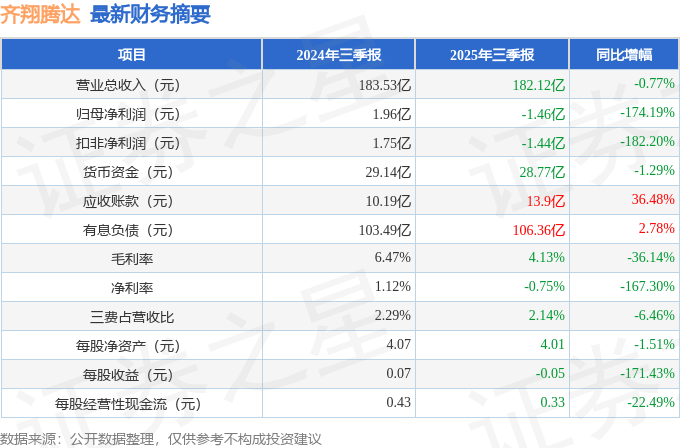
齐翔腾达(002408)2025年三季报简析:净利润同比下降174.19%,应收账款上升
Sou Hu Cai Jing· 2025-10-30 22:50
Core Viewpoint - Qixiang Tengda (002408) reported disappointing financial results for Q3 2025, with total revenue of 18.212 billion yuan, a year-on-year decrease of 0.77%, and a net profit attributable to shareholders of -146 million yuan, a decline of 174.19% compared to the previous year [1] Financial Performance - Total revenue for Q3 2025 was 6.004 billion yuan, an increase of 6.75% year-on-year [1] - The gross profit margin decreased to 4.13%, down 36.14% year-on-year [1] - The net profit margin was -0.75%, a decrease of 167.3% year-on-year [1] - Accounts receivable increased by 36.48% year-on-year, reaching 1.39 billion yuan [1] - Earnings per share dropped to -0.05 yuan, a decline of 171.43% year-on-year [1] Business Model and Strategy - The company relies on R&D, marketing, and capital expenditure for its performance, necessitating careful evaluation of capital projects and spending [3] - The company is focusing on expanding its product lines into new materials and high-value fine chemicals, leveraging partnerships for R&D [4] - The company is also developing its "15th Five-Year Plan," emphasizing optimization and expansion of existing product lines [4] Market Outlook - The price of acetone is expected to rise again after September due to seasonal demand, following a previous spike in prices [5] - The government’s policies aimed at eliminating outdated production capacities are expected to benefit leading companies in the industry by accelerating market consolidation [5] Export Performance - In the first half of 2025, the company exported 315,600 tons of products, generating 212 million USD in revenue, indicating a growing export business [6] - Major export markets include East Asia, Southeast Asia, West Asia, Europe, and South America [6]