科技牛

Search documents
机构:本轮科技牛方兴未艾,金融科技ETF(516860)逆市涨超1%,四方精创涨超11%
Sou Hu Cai Jing· 2025-04-18 02:11
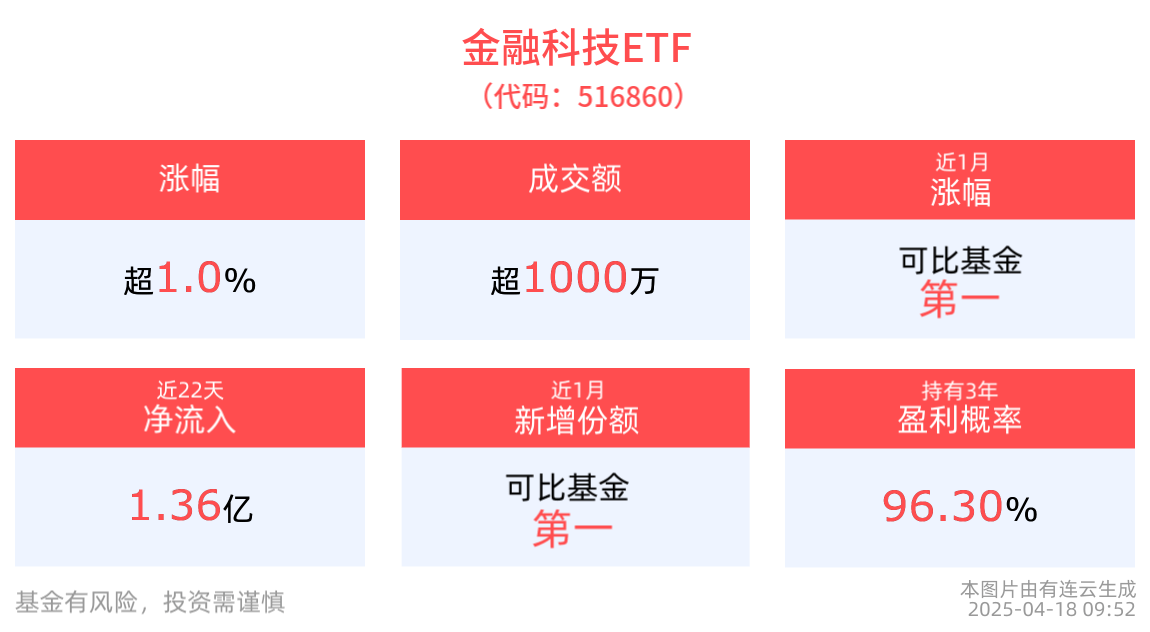
Core Viewpoint - The financial technology sector is experiencing a strong upward trend, with significant gains in key stocks and ETFs, indicating a positive outlook for the industry in the medium to long term [3][4]. Market Performance - As of April 18, 2025, the China Securities Financial Technology Theme Index (930986) rose by 1.10%, with notable increases in constituent stocks such as Sifang Jingchuang (300468) up 11.68% and Jingbeifang (002987) up 10.02% [3]. - The Financial Technology ETF (516860) increased by 1.06%, with a latest price of 1.15 yuan and a turnover rate of 1.44%, totaling a transaction volume of 12.07 million yuan [3]. Fund Flows and Growth - The Financial Technology ETF saw a significant increase in shares, growing by 67 million shares in the past month, ranking in the top third among comparable funds [4]. - Over the last 22 trading days, the ETF attracted a total of 136 million yuan in inflows, with leveraged funds showing continued interest [4]. Performance Metrics - As of April 17, 2025, the Financial Technology ETF's net value increased by 54.89% over the past year, ranking first among comparable funds [4]. - The ETF has a historical average monthly return of 10.57% and a year-to-date return of 66.67%, with a 96.30% probability of profit over a three-year holding period [4]. Risk and Fee Structure - The Financial Technology ETF has a management fee of 0.50% and a custody fee of 0.10%, which are among the lowest in its category [5]. - The ETF's tracking error for the year to date is 0.044%, indicating the highest tracking precision among comparable funds [5]. Industry Trends - The AI and robotics sectors are entering a localization phase, with domestic models like DeepSeek and Yushu showing potential for future growth, although large-scale applications are still developing [3]. - The current macroeconomic environment is characterized by a "bottoming economy and proactive policies," with a focus on more aggressive fiscal policies and a generally accommodative monetary stance [3].


三轮历史行情借鉴:科技长牛是怎样炼成的
HUAXI Securities· 2025-04-17 05:28
Macroeconomic Environment - The three technology bull markets occurred during periods of "economic bottoming and policy stimulus," characterized by proactive fiscal and loose monetary policies[2] - Each bull market was supported by significant government policies aimed at promoting the technology industry, alleviating business pressures, and encouraging capital expenditure[2] Industry Development - The development of core industries followed a three-stage process: "overseas mapping, localization, and unknown fields" during the three technology bull markets[3] - The smartphone boom from 2009-2010 was driven by Apple's rise, leading to a strong A-share market performance linked to the Apple supply chain[3] - The mobile internet boom from 2013-2015 was catalyzed by the issuance of 4G licenses, resulting in a surge in portable device sales and software applications[3] - The new energy market from 2020-2021 saw the commercialization of electric vehicles, with Tesla proving the feasibility of electric cars[3] Future Outlook - The current macroeconomic environment aligns with the characteristics of a technology bull market, with more aggressive fiscal policies confirmed in March 2025[4] - The AI and robotics industries are entering the localization stage, with significant growth potential despite the distance to large-scale application[4] - Short-term uncertainties may exist, but the medium to long-term outlook for the technology market remains promising, warranting continuous monitoring of industry developments[4] Risk Factors - Potential risks include unexpected geopolitical events, greater-than-expected domestic economic downturns, ineffective fiscal policy implementation, and slower-than-expected technology industry growth[4]


机构研究周报:“新核心资产”蓄势,稳增长或需加力
Wind万得· 2025-03-23 22:35
Core Viewpoints - The A-share and Hong Kong stock markets are seen as having strategic allocation value, particularly in high-end manufacturing, AI, innovative pharmaceuticals, and smart vehicles, referred to as "new core assets" [1][2] - The domestic economy is expected to experience marginal slowdown in the second quarter, with a focus on the allocation value of ultra-long bonds [1][16] Equity Market - CITIC Securities believes that A-share "new core assets" are gearing up for an upward trend, suggesting a focus on high-end manufacturing, AI, innovative pharmaceuticals, and smart vehicles [2] - CITIC Jiantou emphasizes that "AI+" remains a core theme in the medium term, with the A-share market showing independent performance despite declines in the US market [3] - UBS predicts that the US stock market will underperform compared to European and emerging markets in the next 1-3 months, with risks of further declines in the S&P 500 index [4] Industry Research - Huashan Fund suggests a cautious approach to gold investments, emphasizing the need for rational investment strategies amid uncertain future market conditions [8][9] - Yinhua Fund highlights the promising prospects of the AI healthcare market, projecting a growth rate exceeding 25%, with the market size approaching 30 billion yuan by 2028 [10] - Zhonggeng Fund notes that the home appliance sector has seen significant gains, driven by government support for consumption and the integration of AI technologies [11] Macro and Fixed Income - Huaxia Fund indicates that the bond market's fluctuations are tied to the re-evaluation of economic recovery and policy rhythms, advocating for a diversified approach to bond investments [14] - Huashang Fund points out improvements in the supply-demand dynamics for convertible bonds, suggesting a defensive strategy while capturing structural opportunities [15] - Boshi Fund anticipates a marginal slowdown in the domestic economy in the second quarter, recommending a focus on the allocation value of ultra-long bonds [16] Asset Allocation - Fuguo Fund observes a shift from a "technology bull" market to a "consumption bull" market, driven by policy stimuli that encourage investment in consumer sectors [18]