财政收支

Search documents
前七月广西财政支出增速创近五年新高
Guang Xi Ri Bao· 2025-08-18 01:59
Group 1 - The core viewpoint of the articles highlights the positive growth in fiscal revenue and expenditure in Guangxi, indicating a stable economic environment that supports growth and improves livelihoods [1][2] Group 2 - From January to July, the general public budget revenue reached 1104.37 billion yuan, a year-on-year increase of 2.6%, while general public budget expenditure was 3746.79 billion yuan, up 6.1% year-on-year [1] - Tax revenue growth has been consistently improving, with corporate income tax and individual income tax both achieving double-digit growth, maintaining positive growth for seven consecutive months [1] - Fiscal expenditure growth has reached a five-year high, exceeding the annual budget target by 3.1 percentage points and surpassing the same period last year by 4 percentage points [1] Group 3 - In terms of social welfare, expenditures in key areas such as education, employment, health, energy conservation, transportation, commercial services, and finance have all seen double-digit growth, with total social spending reaching 2990.42 billion yuan, a 7.0% increase year-on-year [1] Group 4 - All 14 prefecture-level cities in Guangxi achieved positive expenditure growth from January to July, with 12 cities maintaining positive growth for seven consecutive months [2] - The total increase in expenditure across the 14 cities amounted to 186.7 billion yuan, with significant contributions from cities like Yulin, Guilin, and Liuzhou [2]
拉萨市2025年上半年财政收支企稳向好
Sou Hu Cai Jing· 2025-08-13 01:45
Group 1 - The core viewpoint of the news is that Lhasa's fiscal revenue and expenditure showed a stable and positive trend in the first half of 2025, with significant growth in both revenue and expenditure [1][2]. Group 2 - In terms of fiscal revenue, Lhasa's total revenue reached 7.287 billion yuan, representing a year-on-year increase of 8.17%. The general public budget revenue accounted for 6.615 billion yuan, making up 43.4% of the total revenue in the region [1]. - The structure of Lhasa's fiscal revenue is gradually optimizing, with tax revenue constituting 85.75% of the general public budget revenue. The main tax sources, including value-added tax, corporate income tax, and personal income tax, showed mixed performance [1]. Group 3 - Regarding fiscal expenditure, Lhasa's total expenditure was 26.729 billion yuan, with a year-on-year growth of 7.47%. The general public budget expenditure was 24.868 billion yuan, which is 54.82% of the total fiscal capacity [2]. - Expenditure in key areas such as education, technology, health, environmental protection, and social security increased by 1.447 billion yuan, with over 84.72% of the general public budget expenditure allocated to livelihood-related areas [2]. Group 4 - The Lhasa Municipal Finance Bureau plans to enhance budget planning and fiscal policy development, focusing on resource integration and expanding revenue sources to support high-quality development [3].
透视财政收支数据的变化:增减之间有深意
Xin Hua Wang· 2025-08-12 06:30
Group 1 - The core viewpoint of the articles highlights the balance between increased fiscal spending and tax reductions, indicating a focus on enhancing people's livelihoods while managing government expenditures effectively [1][4][7] - Fiscal spending is set to increase by over 2 trillion yuan this year, with a significant portion directed towards grassroots initiatives to support employment, education, and healthcare [2][3] - The proportion of spending on people's livelihoods is substantial, with education, social security, and employment accounting for 15.5% and 14% of the general public budget, respectively [2][3] Group 2 - Central government transfers to local governments will increase by approximately 1.5 trillion yuan, marking an 18% growth, the largest increase in recent years [3] - The government is implementing a combination of tax reductions, with an estimated total of 2.5 trillion yuan in tax refunds and reductions expected this year, more than doubling last year's figures [4][5] - The focus on optimizing expenditure structure aims to ensure that funds are allocated to critical areas while controlling general expenditures, reflecting a commitment to fiscal prudence [7][9]
新华社权威快报丨超14万亿元!上半年全国财政支出持续增长
Xin Hua Wang· 2025-08-12 06:22
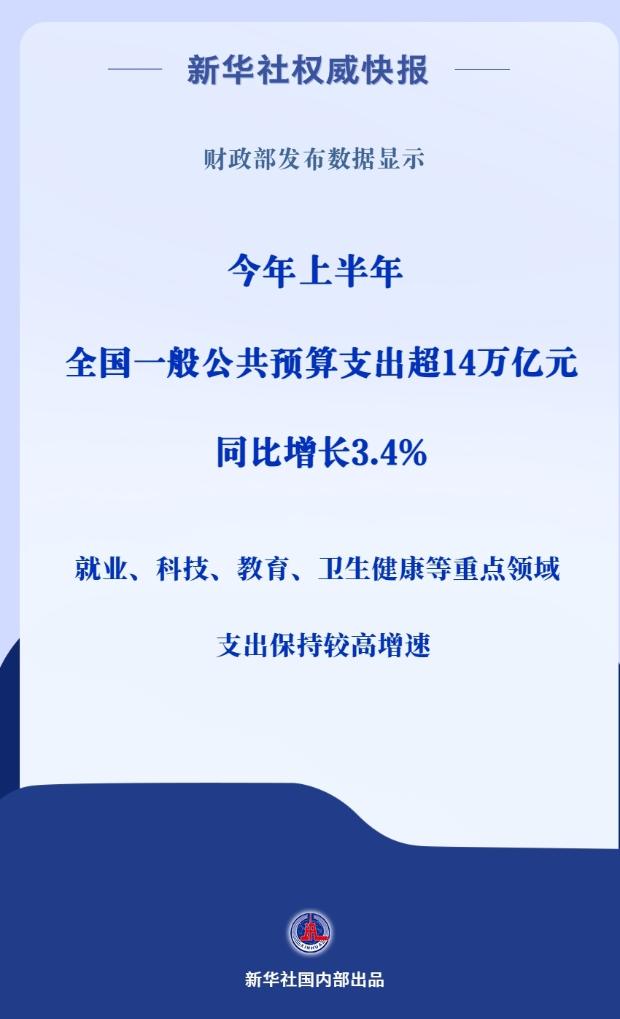
财政部发布数据显示 新华社权威快报 各级财政部门持续加强对重点领域的支出保障。其中,社会保障和就业支出同比增长9.2%;科学 技术支出同比增长9.1%;教育支出同比增长5.9%;卫生健康支出同比增长4.3%。 收入方面,今年上半年,全国一般公共预算收入115566亿元,同比下降0.3%。部分行业税收表现 良好。 记者:申铖 海报制作:申铖 今年上半年 全国一般公共预算支出超14万亿元 同比增长3.4% 就业、科技、教育、卫生健康等重点领域 支出保持较高增速 新华社国内部出品 财政部7月25日发布数据显示,2025年上半年,全国一般公共预算支出141271亿元,同比增长 3.4%。 新华社国内部出品 【纠错】 【责任编辑:王頔】 ...

中国经济半年报|运行总体平稳 支出力度加大——详解上半年全国财政收支运行
Xin Hua Wang· 2025-08-12 06:21
Summary of Key Points Core Viewpoint - The overall fiscal operation in China is stable in the first half of the year, with increased fiscal spending and good performance in certain industries' tax revenues [1][2]. Revenue - National general public budget revenue reached 115,566 billion yuan, a year-on-year decrease of 0.3%, with the decline narrowing by 0.8 percentage points compared to the first quarter [1]. - Tax revenue showed a gradual recovery, totaling 92,900 billion yuan, down 1.2% year-on-year, but monthly tax revenue has been growing for three consecutive months since April [1]. - Central general public budget revenue was 48,589 billion yuan, down 2.8%, while local general public budget revenue was 66,977 billion yuan, up 1.6%, with 27 out of 31 provinces reporting revenue growth [1]. Expenditure - National general public budget expenditure was 141,271 billion yuan, an increase of 3.4% year-on-year [2]. - Key areas of expenditure included: - Education: 21,483 billion yuan, up 5.9% - Science and technology: 4,790 billion yuan, up 9.1% - Social security and employment: 24,504 billion yuan, up 9.2% - Health: 11,004 billion yuan, up 4.3% [2]. - The central government allocated 667.4 billion yuan for employment subsidies and 1,566.8 billion yuan for assistance to vulnerable groups [2]. Government Fund Budget - National government fund budget revenue was 19,442 billion yuan, down 2.4%, while expenditure was 46,273 billion yuan, up 30% [2]. - The issuance and use of special bonds by local governments accelerated, with 24,300 billion yuan spent from special bonds in the first half of the year, contributing to the 30% growth in government fund budget expenditure [3]. - New local government special bonds issued amounted to 21,600 billion yuan, a 45% increase year-on-year, with 1,917 billion yuan used as project capital, up 16% [3].
新华社权威快报丨重点支出有力度!前5个月财政支出超11万亿元
Xin Hua Wang· 2025-08-12 05:50
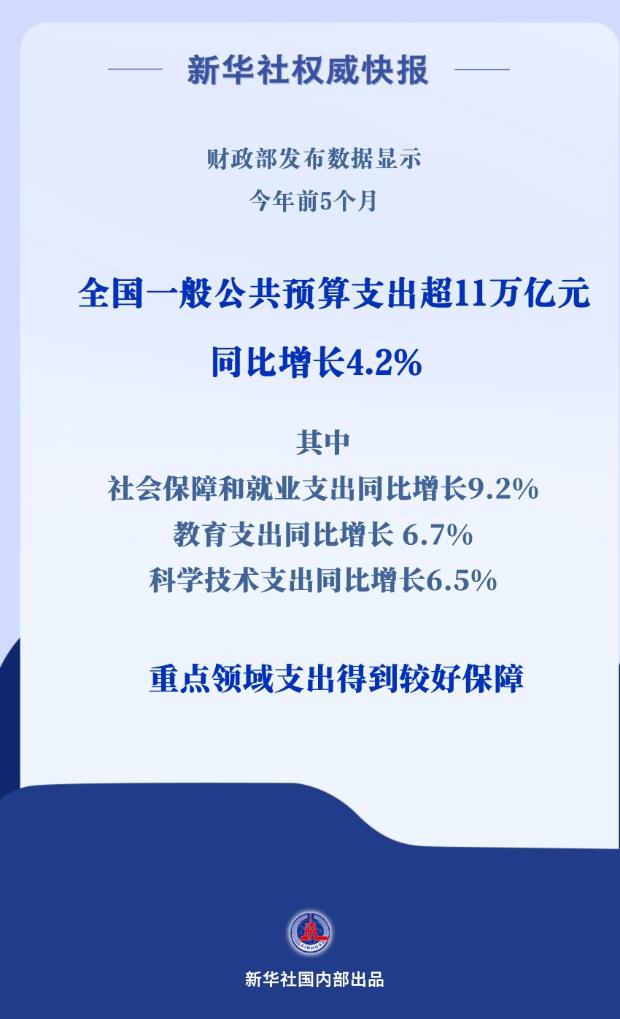
财政部6月20日发布前5个月财政收支运行情况。 数据显示,全国一般公共预算支出持续增长,前5个月达112953亿元,同比增长4.2%。各级财政部门加 大支出强度,优化支出结构,持续加强对重点领域的支出保障。 收入方面,全国财政收入累计降幅略有收窄,前5个月全国一般公共预算收入达96623亿元,同比下降 0.3%。部分行业税收持续良好表现。 记者:申铖 海报制作:申铖 新华社国内部出品 【纠错】 【责任编辑:焦鹏】 ...
权威数读·经济半年报丨持续加强重点领域支出保障
Xin Hua Wang· 2025-08-12 05:42
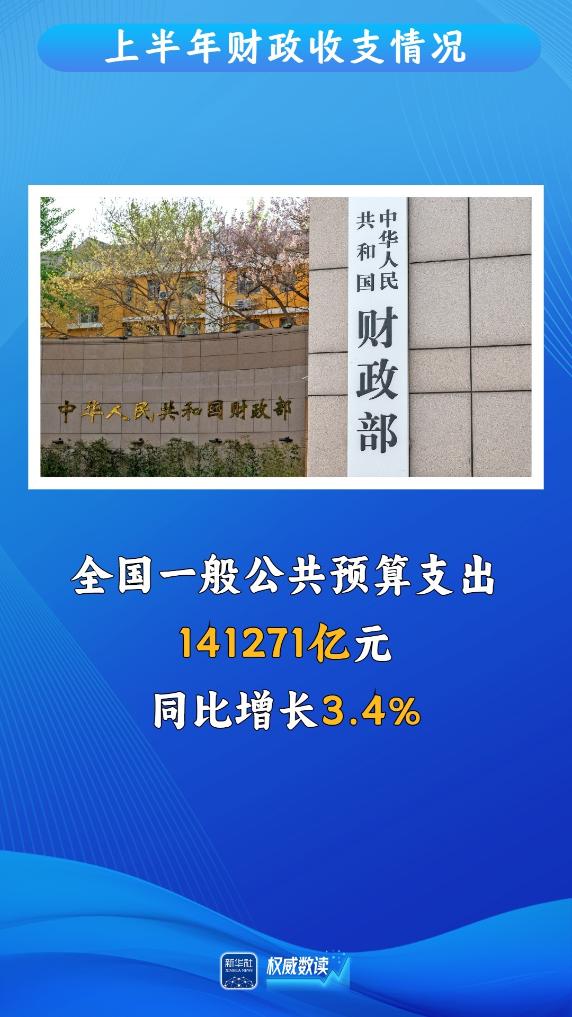
财政部7月25日发布数据显示,今年上半年,全国一般公共预算支出141271亿元,同比增长3.4%。 各级财政部门持续加强对重点领域的支出保障。跟随这组海报,一起了解下吧。 权履行漢 上半年财政收支情况 十年 和货 国民 财 IFA A 系共和國財政部 部 全国一般公共预算支出 141271亿元 同比增长3.4% 权威数读 新华社 上半年财政收支情况 各级财政部门 常委副正案 XTEET ISTORDS HATS 社会保障和就业支出同比增长9.2% 科学技术支出同比增长9.1% 教育支出同比增长5.9% 卫生健康支出同比增长4.3% 策划:令伟家 文案:曹建礼 制作:缪异星 【纠错】 【责任编辑:张欣然】 ...
财政部:督促地方加快专项债发行使用进度
Zhong Guo Zheng Quan Bao· 2025-08-08 07:28
Core Insights - The Ministry of Finance reported that from January to July 2024, the national general public budget revenue reached 135,663 billion yuan, with a comparable growth of approximately 1.2% after excluding special factors [1][2] - National general public budget expenditure for the same period was 155,463 billion yuan, reflecting a year-on-year increase of 2.5% [1][3] Revenue Analysis - The overall national general public budget revenue decreased by 2.6% year-on-year, but when adjusted for special factors, it showed a growth of 1.2% [2] - Tax revenue was impacted by various factors, with a 5.4% decline in total tax revenue. Notably, domestic value-added tax fell by 5.2%, while domestic consumption tax increased by 5.5% due to growth in sales of refined oil, cigarettes, and alcohol [2] - Export tax rebates amounted to 12,824 billion yuan, an increase of 1,632 billion yuan year-on-year, supporting foreign trade growth [2] Expenditure Analysis - National general public budget expenditure increased by 2.5% year-on-year, with significant growth in social security and employment (4.3%), agriculture, forestry, and water (8.2%), and urban and rural community spending (7.2%) [3] - The Ministry of Finance anticipates stable growth in public budget expenditure in the coming months, supported by macroeconomic policies and the gradual fading of special factors [3] Local Government Debt Management - From January to July, local governments issued 17,749 billion yuan in new special bonds, primarily for infrastructure projects in key areas identified by the central government [4] - The Ministry of Finance is working with relevant departments to accelerate the issuance and utilization of special bonds to enhance investment efficiency and support economic development [4] - Overall, local government debt risks are considered manageable, with a gradual reduction in hidden debt levels [5]
8月全国一般公共预算收入12043亿元
Xin Hua Cai Jing· 2025-08-08 06:59
前8个月累计,全国一般公共预算支出149925亿元,同比下降2.1%。其中,中央一般公共预算本级支出 21276亿元,同比下降4.1%;地方一般公共预算支出128649亿元,同比下降1.7%。 政府性基金预算收支方面,前8个月累计,全国政府性基金预算收入47030亿元,同比增长2.3%;全国政 府性基金预算支出63889亿元,同比增长21.1%。 从主要税收收入项目来看,前8个月累计,国内增值税38086亿元,同比下降15.2%;国内消费税9822亿 元,同比下降5.7%;企业所得税29382亿元,同比下降5.3%;个人所得税7640亿元,同比增长5.9%;进口货 物增值税、消费税9552亿元,同比下降11.5%;关税1653亿元,同比下降12.8%。 财政支出方面,8月份,全国一般公共预算支出16426亿元,同比增长8.7%,主要是各地抓紧推进重大 项目实施,直达资金支出进度进一步加快。 财政部18日发布数据显示,8月份,全国一般公共预算收入达12043亿元,同比增长5.3%,增幅较7月份 提高1个百分点,连续3个月实现正增长。 前8个月累计,全国一般公共预算收入126768亿元,同比下降7.5%。其中,中 ...
国金证券:预计将动用财政政策的储备空间,以弥补发放育儿补贴和养老服务消费补贴带来的收支缺口
Sou Hu Cai Jing· 2025-08-07 01:25
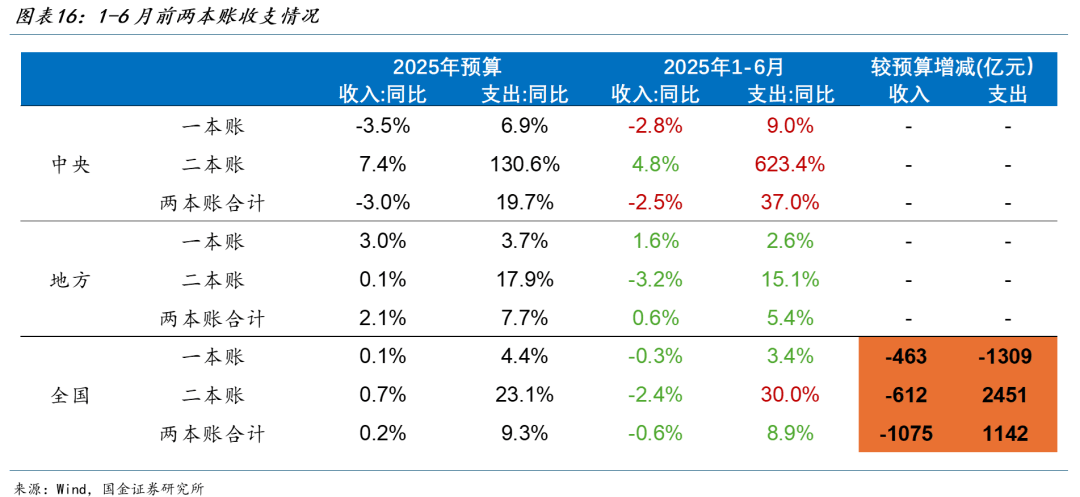
Core Viewpoint - The fiscal revenue and expenditure in the second half of the year are under pressure, but the probability of additional deficits is low. The government is expected to utilize fiscal policy reserves to cover the revenue gap caused by childcare and elderly service subsidies [1][5][11]. Fiscal Revenue and Expenditure Analysis - In the first half of the year, the national fiscal revenue and expenditure deviated slightly from the initial budget, with revenue falling short by 463 billion yuan and expenditure by 1309 billion yuan for the general public budget [2][6]. - The central government's general public budget revenue decreased by 3.5% year-on-year, while expenditure increased by 6.9%. Local governments showed a revenue increase of 3.0% and expenditure increase of 3.7% [3][6]. - For the second half of the year, the expected year-on-year growth rates for the general public budget are -4.5% for revenue and 1.5% for expenditure, leading to a projected revenue shortfall of 516.6 billion yuan and an expenditure shortfall of 547.2 billion yuan compared to the budget [5][11]. Budget Execution and Adjustments - Historically, the completion rate for the general public budget has been over 98%, and significant deviations typically necessitate budget adjustments or additional deficits. However, the flexibility of the special fund budget allows for a completion rate of 80%-90% without strict requirements [2][5]. - The government plans to cover the expected 1200 billion yuan revenue gap from subsidies without increasing the budget by utilizing reserves, including the budget stabilization fund and profits from central financial enterprises [11][12]. Central Financial Enterprises' Role - The profits from central financial enterprises are crucial for offsetting revenue shortfalls. In 2024, these enterprises contributed significantly to the budget, with non-tax revenue showing substantial increases in late 2024 [7][12]. - The central budget stabilization fund had a balance of 2739.22 billion yuan at the end of 2024, with plans to allocate 1000 billion yuan in 2025, leaving a remaining balance of 1739.22 billion yuan [12].