科技金融

Search documents
北京银行霍学文:坚持数据驱动 向VC、PE学习看企业未来
2 1 Shi Ji Jing Ji Bao Dao· 2025-09-06 06:55
Core Viewpoint - Beijing Bank positions technology finance as its "first strategy" and focuses on specialized and innovative enterprises as its "number one project" to become the leading bank in this sector [2] Group 1: Technology Finance Strategy - As of the end of June, the balance of technology finance loans reached 434.6 billion yuan, an increase of 70.3 billion yuan from the beginning of the year, representing a growth rate of 19% [2] - The bank serves over 26,000 specialized and innovative enterprises, an increase of nearly 6,000 from the beginning of the year, further enhancing customer coverage [2] Group 2: Business Approach - The bank aims to transform the soft power of technology into hard currency for financing, shifting focus from traditional financial statements to future potential of enterprises [2] - Beijing Bank adopts a proactive approach by delivering services and loans directly to clients, while also emphasizing data-driven methods and plans to utilize big data and artificial intelligence for risk assessment and evaluation of technological capabilities [2]

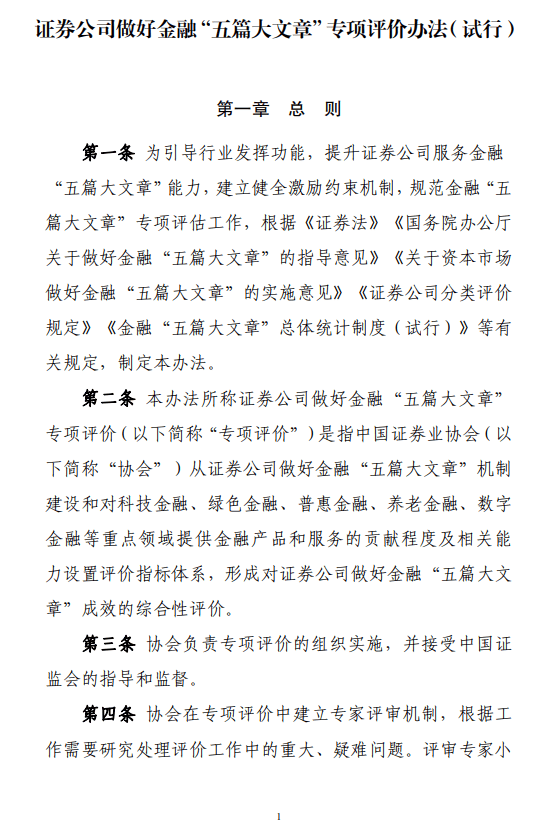
券商“五篇大文章”评价办法出炉!科技金融占50分
Sou Hu Cai Jing· 2025-09-05 23:07
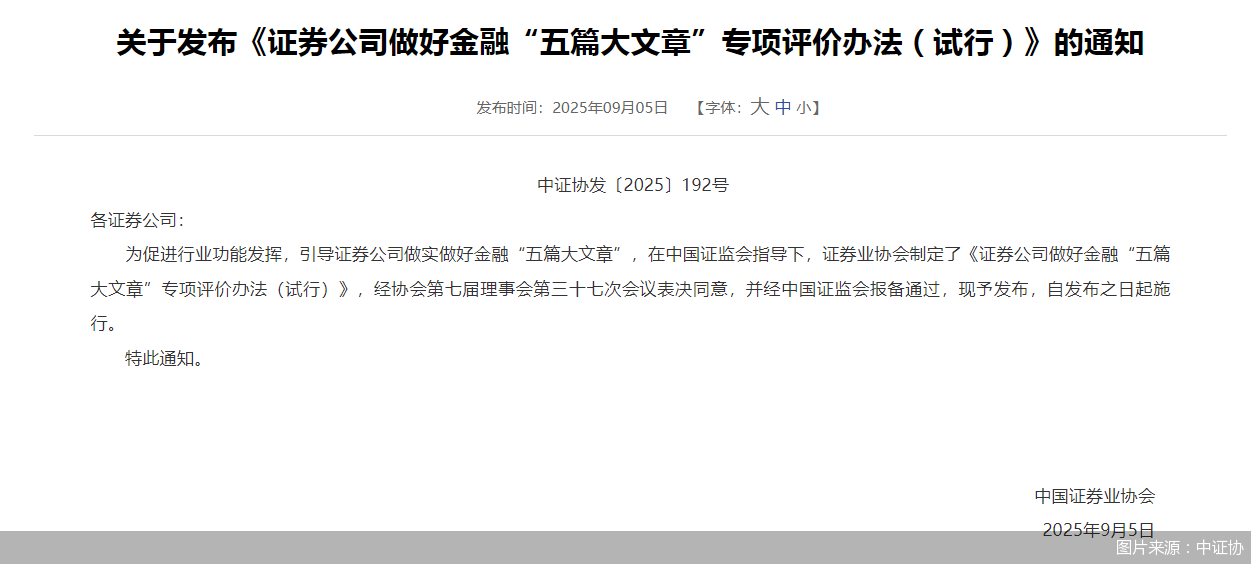
Core Viewpoint - The China Securities Association has released a trial evaluation method for securities companies to enhance their contributions to the financial "Five Major Articles" [1] Group 1: Evaluation Indicators - The evaluation method consists of 25 articles divided into four chapters: general principles, evaluation indicators and scoring methods, implementation and results application, and supplementary provisions [1] - Quantitative indicators include technology finance, green finance, inclusive finance, pension finance, and digital finance, reflecting the company's contributions and capabilities in these key areas [1][10] - Qualitative indicators assess the establishment of mechanisms and continuous investment in business resources, including whether the company integrates the financial "Five Major Articles" into its strategic development [5][10] Group 2: Scoring Method - The scoring system emphasizes the importance of technology finance, assigning it a higher score (50 points total) compared to other areas, which each receive 10 points [6] - Companies ranked in the top 50 for most indicators will receive additional points, with small score differences to encourage participation from various companies [6] - The evaluation considers both monetary amounts and quantities, ensuring a balanced assessment that avoids overemphasis on absolute scale [6] Group 3: Implementation and Results - The evaluation will be conducted annually, covering the previous year's performance from January 1 to December 31 [12] - Securities companies are responsible for accurately reporting their contributions to the financial "Five Major Articles" and ensuring the authenticity of the data submitted [12]

稳中提质显韧性 交通银行书写高质量发展答卷
Zhong Guo Jing Ying Bao· 2025-09-05 18:29
Core Viewpoint - The Bank of Communications reported a stable and positive performance in the first half of 2025, with key operating indicators showing growth and improved asset quality, reflecting its commitment to shareholder returns and robust management [2][3][4]. Financial Performance - As of June 30, 2025, the total assets of the group reached 15.44 trillion yuan, an increase of 3.59% compared to the end of the previous year [2][3]. - The bank achieved operating income of 1333.68 billion yuan and a net profit attributable to shareholders of 460.16 billion yuan, representing year-on-year growth of 0.77% and 1.61%, respectively [2][3][4]. - The net interest income was 852.47 billion yuan, with a year-on-year increase of 1.20%, and the net interest margin remained at 1.21% [4]. Asset Quality and Risk Management - The non-performing loan ratio was 1.28%, a decrease of 0.03 percentage points from the end of the previous year, while the provision coverage ratio increased to 209.56%, up by 7.62 percentage points [5]. - The bank disposed of non-performing loans totaling 378.3 billion yuan, a year-on-year increase of 27.9%, with substantial recoveries indicating effective risk management [5]. Strategic Focus Areas - The bank is committed to enhancing its service to the real economy, with a customer loan balance of 9 trillion yuan, reflecting a growth of 5.18% year-on-year [4][7]. - The bank's focus on technology, green finance, inclusive finance, pension finance, and digital finance is evident, with significant growth in loans across these sectors [7][8][9]. Capital Management and Shareholder Returns - The bank successfully raised 120 billion yuan through the issuance of approximately 14.1 billion A-shares, enhancing its core tier one capital and risk resilience [6]. - The bank proposed a cash dividend of 1.563 yuan per 10 shares, totaling 13.811 billion yuan, which represents 30% of the net profit attributable to shareholders for the first half of 2025 [6]. Future Development Plans - The bank aims to align with national development strategies, focusing on enhancing capital efficiency, expanding green finance, and improving digital services [11][12]. - It plans to strengthen its customer base and risk management while maintaining its commitment to serving the real economy and contributing to national economic goals [12].


券商如何做好金融“五篇大文章”,评价规则发布
Zheng Quan Shi Bao· 2025-09-05 15:15
Core Viewpoint - The China Securities Association has released a trial evaluation method for securities companies to enhance their contributions to the financial "Five Major Articles," focusing on both quantitative and qualitative indicators to promote high-quality development in the securities industry [1][5]. Group 1: Evaluation Methodology - The evaluation method includes both quantitative and qualitative indicators, reflecting the contribution and capabilities of companies in key areas of the financial "Five Major Articles" [2][3]. - Quantitative indicators cover various sectors, including technology finance, green finance, inclusive finance, pension finance, and digital finance, with specific metrics such as bond underwriting amounts and equity financing for technology enterprises [2][3]. - Qualitative indicators assess the establishment of mechanisms and continuous investment in business resources, including whether companies incorporate the financial "Five Major Articles" into their strategic development [3][5]. Group 2: Scoring and Incentives - The scoring system assigns higher points to technology finance, with a total of 50 points available, while other sectors like green finance and digital finance are assigned 10 points each [4]. - The evaluation encourages participation from various types of companies by providing a broad range of scoring and minimizing score differences among the top 50 ranked companies [4]. - A baseline score is established to prevent significant score disparities, promoting differentiated development and specialized operations among industry players [4]. Group 3: Implementation Principles - The evaluation method adheres to three main principles: focusing on key areas, enhancing coordination, and ensuring comprehensive and fair assessments [5]. - It aims to streamline the evaluation process by integrating with existing assessments related to social responsibility, bond practice quality, and digital capability, thereby reducing the reporting burden on companies [5].

券商如何做好金融“五篇大文章”,评价规则发布
证券时报· 2025-09-05 15:13
Core Viewpoint - The China Securities Association has released a trial evaluation method for securities companies to enhance their contributions to the financial "Five Major Articles" and promote high-quality development in the securities industry [1]. Group 1: Evaluation Method Overview - The evaluation method focuses on both quantitative and qualitative indicators, covering various fields of the financial "Five Major Articles" [2][3]. - The evaluation indicators include contributions to key areas and capabilities, as well as mechanisms and resource investments [3][4]. Group 2: Quantitative Indicators - Quantitative indicators include technology finance metrics such as the amount and number of technology innovation bond underwriting, equity financing for technology enterprises, and significant asset restructuring transactions [3]. - Green finance indicators cover the amount and number of green bonds and low-carbon transition bonds underwritten [3]. - Inclusive finance indicators include support for small and micro enterprises through bond underwriting [3]. Group 3: Qualitative Indicators - Qualitative indicators assess whether companies incorporate the financial "Five Major Articles" into their strategic development and establish relevant organizational structures and incentive mechanisms [4]. - Continuous investment in business resources is measured by the comprehensive growth rate of investments in the financial "Five Major Articles" [4]. Group 4: Scoring and Incentives - The evaluation method assigns a higher score to technology finance, with a total of 50 points allocated across various technology-related financing activities [6]. - The scoring system allows for a broad range of additional points and small score differences among the top 50 companies, encouraging participation from various institutions [7]. - A baseline score is set to avoid significant score disparities, promoting differentiated development and specialized operations among companies [7]. Group 5: Implementation and Principles - The evaluation is conducted annually, focusing on the previous year's performance, and aligns with existing evaluation methods of the China Securities Association [8]. - The evaluation principles emphasize focusing on key areas, enhancing coordination with other evaluations, and ensuring fairness and objectivity in the assessment process [8].

如何做好金融“五篇大文章”?中证协,最新发布!
Zheng Quan Shi Bao Wang· 2025-09-05 15:08
Core Viewpoint - The China Securities Association has released a trial evaluation method for securities companies to enhance their contributions to the financial "Five Major Articles" and promote high-quality development in the securities industry [1][5]. Group 1: Evaluation Methodology - The evaluation method combines quantitative and qualitative indicators, focusing on the contributions and capabilities of companies in key areas of the financial "Five Major Articles" [2][6]. - Quantitative indicators include metrics related to technology finance, green finance, inclusive finance, pension finance, and digital finance, with a significant emphasis on technology finance [2][4]. - Qualitative indicators assess the establishment of mechanisms and the continuous investment of business resources by securities companies [3][6]. Group 2: Scoring and Incentives - The scoring system allocates a higher weight to technology finance, with a total of 50 points available in this category, while other categories like green finance and digital finance are assigned 10 points each [4]. - The evaluation encourages participation from various types of companies by providing a broad range of additional scoring opportunities and minimizing score differences among top-ranking companies [4]. - A foundational score is established to account for the high business concentration in the industry, promoting differentiated development and specialized operations among companies [4][5]. Group 3: Implementation and Principles - The evaluation will be conducted annually in the first half of the year, covering the previous calendar year's performance [5]. - The method emphasizes focusing on core business areas, optimizing dynamically, and ensuring fair and objective assessments through 14 representative evaluation indicators [5][6].
如何做好金融“五篇大文章”?中证协,最新发布!
券商中国· 2025-09-05 15:02
Core Viewpoint - The China Securities Association has released a trial evaluation method for securities companies to enhance their contributions to the financial "Five Major Articles" and promote high-quality development in the securities industry [1][2]. Group 1: Evaluation Methodology - The evaluation method incorporates both quantitative and qualitative indicators, focusing on the contributions and capabilities of companies in key areas of the financial "Five Major Articles" [3][4]. - Quantitative indicators include metrics related to technology finance, green finance, inclusive finance, pension finance, and digital finance, with a significant emphasis on technology finance [3][4]. - Qualitative indicators assess the establishment of mechanisms and the continuous investment of business resources in the financial "Five Major Articles" [4]. Group 2: Scoring and Incentives - The evaluation method assigns higher scores to technology finance, with a total of 50 points allocated across various subcategories, while other areas like green finance, inclusive finance, pension finance, and digital finance each receive 10 points [5]. - The scoring system allows for a broad range of additional points, encouraging companies to actively participate based on their resource endowments [5]. - A foundational score is established to prevent excessive score disparities among companies, promoting differentiated development and specialized operations [5]. Group 3: Implementation and Principles - The evaluation is conducted annually, covering the previous year's performance, and aligns with existing evaluation methods of the China Securities Association [6]. - The evaluation method adheres to three main principles: focusing on key areas, enhancing coordination with existing evaluations, and ensuring a comprehensive and fair assessment [6].

券商做好金融“五篇大文章”评价办法来了,科技金融赋分最高
Bei Jing Shang Bao· 2025-09-05 13:29
Core Viewpoint - The China Securities Association has released a new evaluation method for securities companies to enhance their contributions to the financial sector, focusing on five key areas of finance [2][3] Group 1: Evaluation Framework - The evaluation method consists of 25 articles divided into four chapters: general principles, evaluation indicators and scoring methods, implementation and results application, and appendices [2] - The evaluation indicators include both quantitative and qualitative measures, reflecting the company's contributions and capabilities in key financial areas [2] Group 2: Quantitative Indicators - Quantitative indicators cover various aspects such as technology finance, green finance, inclusive finance, pension finance, and digital finance, with specific metrics for each category [2][3] - For technology finance, metrics include the amount and number of technology innovation bond underwriting, equity financing for tech companies, and direct investments in non-listed tech firms [2] - Green finance metrics focus on the underwriting amounts and numbers of green bonds and low-carbon transition bonds [2] - Inclusive finance metrics include amounts and numbers related to bonds supporting small and micro enterprises and private enterprise bonds [2] - Pension finance metrics involve the scale of personal pension product sales, while digital finance metrics assess the maturity of digital capabilities and awards in securities technology [2] Group 3: Qualitative Indicators - Qualitative indicators assess the establishment of mechanisms, including whether the financial "five articles" are integrated into the company's strategic development and the existence of a specialized organizational structure [3] - Continuous investment in business resources is evaluated through the comprehensive growth rate of investments supporting the financial "five articles" [3] - Additional indicators reflect the company's functional roles and adherence to annual policy priorities [3] Group 4: Scoring Methodology - The scoring system emphasizes practical relevance, with a higher score allocation for technology finance (50 points) and lower for other areas (10 points each for green, inclusive, pension, and digital finance) [3] - The scoring method includes both monetary and numerical standards to balance the impact of absolute scale on evaluation results [3] - A basic score is set to encourage differentiated development among companies, considering the high concentration of business in the securities industry [3]
哈尔滨银行发布2025年中期业绩:深度服务实体经济 经营业绩再上新台阶
Zhong Guo Jin Rong Xin Xi Wang· 2025-09-05 12:46
Core Viewpoint - Harbin Bank reported a stable growth in its mid-year performance for 2025, focusing on asset and liability restructuring, risk management, and deepening service to the real economy, achieving improvements in scale, quality, structure, and efficiency [2][4]. Financial Performance - As of June 30, 2025, the total assets of the group reached RMB 9,275.275 billion, an increase of RMB 112.956 billion, or 1.23% from the end of the previous year [2]. - Total customer loans and advances amounted to RMB 3,975.663 billion, up RMB 184.724 billion, or 4.87% [2]. - Total customer deposits were RMB 6,950.559 billion, with a slight increase of RMB 13.765 billion, or 0.20% [2]. - The group achieved operating income of RMB 73.855 billion, a year-on-year increase of 2.59% [2]. - Net profit reached RMB 9.921 billion, up RMB 1.462 billion, or 17.28% year-on-year [2]. - Return on average total assets was 0.22%, up 0.02 percentage points year-on-year [2]. - Return on average equity was 2.07%, an increase of 0.57 percentage points year-on-year [2]. Asset Quality - The non-performing loan balance was RMB 112.697 billion, with a non-performing loan ratio of 2.83%, down 0.01 percentage points from the end of the previous year [3]. - The provision coverage ratio was 209.95%, up 7.36 percentage points [3]. - The loan impairment loss provision ratio was 5.95%, an increase of 0.20 percentage points [3]. Support for Real Economy - The group emphasized financial support for the real economy, focusing on sectors such as technology finance, green finance, and inclusive finance [4]. - Company loans totaled RMB 2,332.248 billion, representing 58.7% of total loans, with an increase of RMB 278.198 billion [4]. Inclusive Finance Initiatives - The group launched a new digital retail credit product "Qian Dao Jia," enhancing online management and digital operations for small and micro enterprises [5]. - Inclusive finance loans for small and micro enterprises reached RMB 169.18 billion, up RMB 16.2 billion year-on-year, with a balance of RMB 411.98 billion, growing at 11.72% [5]. Retail Banking Development - Retail deposits totaled RMB 5,099.701 billion, an increase of RMB 99.931 billion, or 2.0% [7]. - The group maintained a 19.58% market share in retail deposits in Harbin, ranking first in the local market [7]. Cross-Border Business Growth - The group established partnerships with over a hundred financial institutions in 13 Belt and Road countries, promoting cross-border RMB payment services [10]. - Cross-border settlement business volume saw significant growth, enhancing the quality of cross-border financial services [10]. Digital Transformation - The group is advancing its "Digital Harbin Bank" initiative, focusing on enhancing operational security and technology-driven capabilities [12]. - The group is committed to optimizing its international settlement systems and improving efficiency in cross-border financial services [11].

科技金融有何布局?如何展望全年息差走势?北京银行管理层回应
Bei Jing Ri Bao Ke Hu Duan· 2025-09-05 12:43
Core Viewpoint - Beijing Bank aims to become a world-class digital bank, emphasizing the importance of technology in driving its development and services [1] Group 1: Financial Performance - In the first half of 2025, Beijing Bank reported operating income of 36.218 billion yuan, a year-on-year increase of 1.02% [4] - The net profit attributable to shareholders reached 15.053 billion yuan, up 1.12% year-on-year [4] - Basic earnings per share were 0.69 yuan, reflecting a year-on-year growth of 1.47% [4] - As of mid-2025, total assets amounted to 4.75 trillion yuan, a growth of 12.53% since the beginning of the year [4] - The total amount of loans and advances was 2.39 trillion yuan, increasing by 8.18% year-to-date [4] - Total liabilities reached 4.36 trillion yuan, up 12.94% from the start of the year [4] - Deposits totaled 2.65 trillion yuan, reflecting an 8.39% increase since the beginning of the year [4] Group 2: Strategic Initiatives - The bank's technology financial loan balance reached 434.6 billion yuan, with a year-to-date increase of 70.3 billion yuan, representing a growth rate of 19% [1] - The bank serves over 26,000 specialized and innovative enterprises, an increase of nearly 6,000 since the beginning of the year [1] - Future plans include upgrading the technology innovation evaluation system and enhancing intellectual property evaluation capabilities [1] - The bank aims to improve service efficiency through an investment banking-driven approach, focusing on technology innovation bonds and mergers and acquisitions [1] Group 3: Market Conditions - In the first half of 2025, the overall trend of deposit and loan interest rates continued to decline due to multiple factors [2] - The net interest margin for commercial banks was 1.42%, down 10 basis points from the beginning of the year [2] - Beijing Bank's cost of liabilities was 1.72%, a year-on-year decrease of 37 basis points, indicating effective cost management [2] - The bank anticipates continued downward pressure on asset yields due to factors such as corporate bond replacement and loan competition [2]