个人成长

Search documents
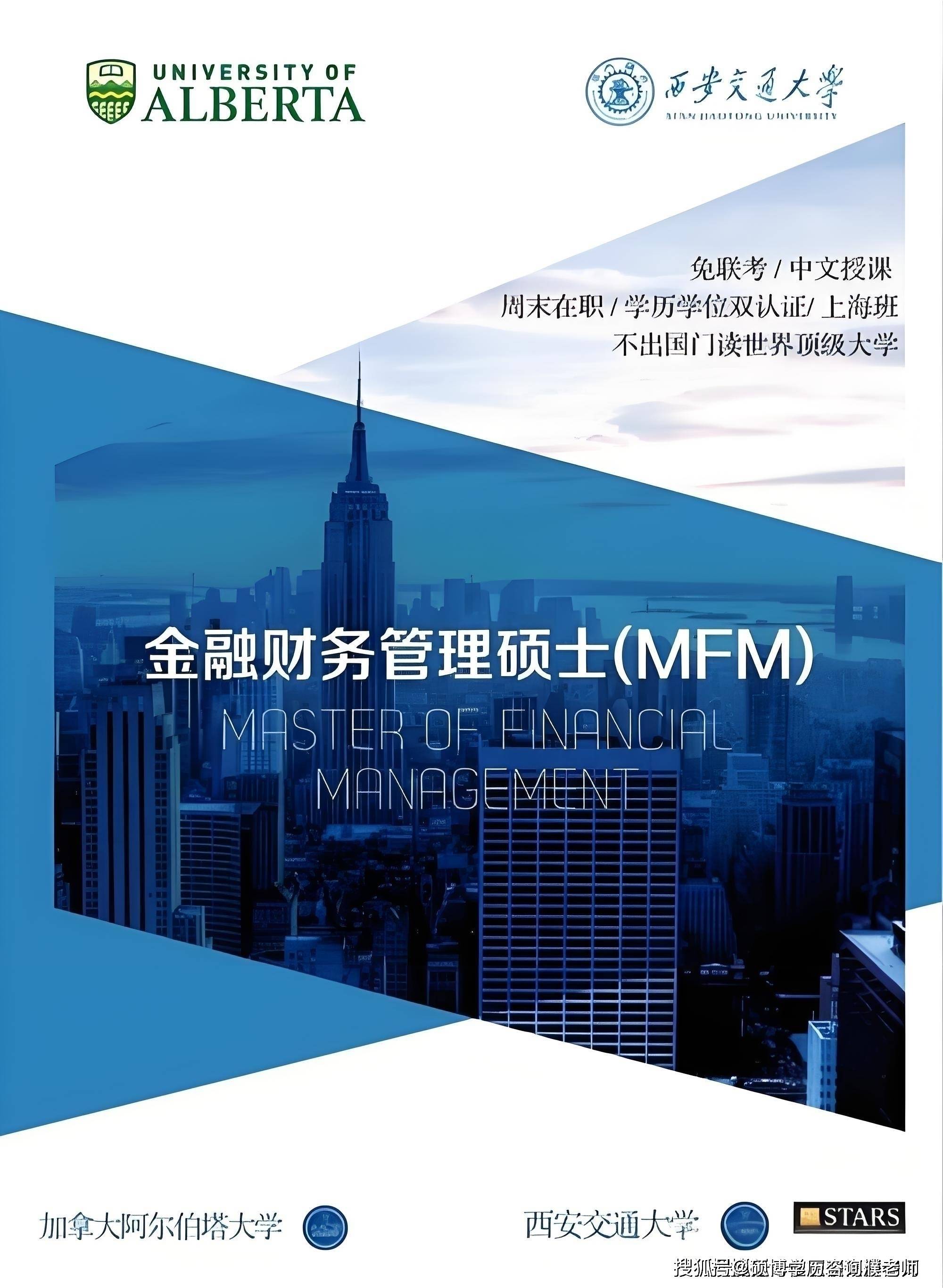
西安交大加拿大阿尔伯塔大学金融财务硕士MFM把自己当作产品打造
Sou Hu Cai Jing· 2025-07-13 04:00
Group 1: Program Overview - The Master of Financial Management (MFM) program is a collaboration between Xi'an Jiaotong University and the University of Alberta, Canada, aimed at professionals in finance, accounting, or related fields [6][13]. - The program offers a dual degree, providing a Master of Financial Management from the University of Alberta and a certification from the Chinese Ministry of Education [14][11]. - The program has been approved by the Ministry of Education and has a validity period until December 31, 2027 [13]. Group 2: Program Advantages - The program does not require a national entrance examination, allowing for a more accessible admission process [11]. - It features a high-quality curriculum taught by experienced professors from both universities, ensuring a strong educational foundation [24][20]. - The program is designed for working professionals, with classes held on weekends to accommodate their schedules [22]. Group 3: University Rankings and Recognition - The University of Alberta is ranked 89th globally and 4th in Canada according to the 2023 Shanghai Ranking [8]. - Xi'an Jiaotong University is a key national university in China, recognized for its historical significance and academic excellence [10]. - The program is associated with AACSB accreditation, a prestigious recognition held by only 5% of business schools worldwide [20]. Group 4: Enrollment and Outcomes - Since its inception in 2012, the program has enrolled 967 students, with 742 graduates contributing to the finance and management sectors [26]. - The program aims to cultivate professionals with an international perspective, enhancing their leadership potential in the industry [26].

责任、专注、自律……聪明人这样做能量管理 | 红杉Library
红杉汇· 2025-06-12 09:30
Core Viewpoint - Personal growth is a lifelong journey that many struggle to understand, and Steve Pavlina outlines seven principles to guide individuals in achieving a fulfilling life [2][3]. Group 1: Energy Principle - Energy is defined as the ability to consciously create one's surrounding world, and developing personal energy is crucial for fulfilling needs and achieving meaningful goals [6][10]. - The lack of energy leads to neglecting one's needs and desires, resulting in diminished self-awareness [6][9]. - The six components of energy include responsibility, desire, autonomous choice, focus, effortful action, and self-discipline [6][10]. Group 2: Responsibility - Individuals must accept full responsibility for their lives, as avoiding this leads to a lack of energy and personal growth [7][9]. - Complaining about circumstances does not solve problems; acceptance of reality is essential for maintaining energy [8][9]. - Taking responsibility means being willing to put in the necessary effort to create the desired life [9][10]. Group 3: Desire - Desire serves as the driving force of energy, allowing individuals to pursue a life aligned with their true wants [9][10]. - It is important to acknowledge and embrace genuine desires, regardless of how unrealistic they may seem [10][11]. - Many people fail to connect with their true desires, leading to a lack of energy and happiness [10][11]. Group 4: Autonomous Choice - Autonomous choice involves the freedom to decide what one truly wants without seeking approval from others [11][12]. - Making conscious choices, especially during challenging times, is vital for energy management [11][12]. Group 5: Focus - True energy exists only in the present moment, and individuals must concentrate on the now to achieve their goals [12][13]. - Setting goals should enhance present focus rather than serve as a means to control the future [12][13]. - Goals that bring clarity and motivation in the present are more valuable than those that promise future happiness [12][13]. Group 6: Effortful Action - Transforming desired goals into reality requires taking action, driven by genuine motivation [13][14]. - The concept of the "law of attraction" is misunderstood; action is necessary to realize goals [14][15]. Group 7: Self-Discipline - Motivation and self-discipline are essential pillars of energy, with self-discipline being crucial for achieving long-term success [15][16]. - High levels of self-discipline enable individuals to overcome obstacles and maintain focus on their goals [15][16].

李想认为自己真正成年是在27岁
理想TOP2· 2025-05-17 15:41
Core Viewpoint - The article discusses the personal growth and maturity of Li Xiang, emphasizing the lessons learned from the 2008 financial crisis and how it shaped his understanding of responsibility, collaboration, and the importance of knowledge, wisdom, and trust in achieving personal and professional success [1][4][6]. Group 1: Personal Growth and Responsibility - The 2008 financial crisis was a pivotal moment for Li Xiang, marking his transition into adulthood and a deeper understanding of personal responsibility [4][6]. - Li Xiang faced significant challenges during the crisis, including cash flow issues and difficulties in securing financing, which led to internal conflicts with co-founders [2][3]. - The experience taught Li Xiang that personal capability directly influences outcomes, leading to a mindset shift where he accepted full responsibility for both successes and failures [2][3]. Group 2: Key Lessons from 2008 - Li Xiang identified three key markers of adulthood: the ability to learn and grow, clarity on personal desires and responsibilities, and the capacity to collaborate effectively with others [5][6]. - The realization that personal value is derived from the multiplication of knowledge, wisdom, and trust was a significant insight for Li Xiang, shifting his focus from solely knowledge to a more holistic view of personal development [3][6]. - The understanding that both operational efficiency and capital management are equally important for a company's success was a crucial lesson learned post-crisis [3].

从沉重卡顿,到轻盈流动:Spark培养营带你重拾创造的生命力
混沌学园· 2025-05-16 09:53
Core Insights - The Spark Training Camp aims to ignite creativity and personal growth through immersive experiences rather than traditional knowledge transfer [1][2][4] - It emphasizes real-life interactions and co-creation among participants, fostering a supportive community [10][11][14] Group 1: Program Structure - The program consists of 50% course content and 50% real-time interactions, allowing participants to engage deeply with each other [5][19] - It is designed as a three-month high-density co-creation workshop, where participants are seen as co-creators rather than mere listeners [10][11] Group 2: Participant Experience - Participants are encouraged to express their true selves and share their experiences without the pressure of performance anxiety [20][22] - The program has a high referral rate of over 90%, indicating strong participant satisfaction and community support [13] Group 3: Long-term Engagement - Spark Training Camp offers ongoing support through retraining, sharing sessions, and online co-creation groups, promoting continuous learning and connection [14][15] - It is not just a short-term training but a journey of reconstructing awareness and upgrading action models [16] Group 4: Unique Selling Proposition - The program uniquely combines inner belief exploration with practical business model application, making it suitable for entrepreneurs and practitioners [18][26] - It provides a safe environment where participants can be themselves, regardless of their current state [20][22]