
中小金融机构减量提质

Search documents
从三个关键词,看新一年货币政策如何“灵活高效”
Sou Hu Cai Jing· 2026-01-16 11:17
Core Viewpoint - The People's Bank of China has implemented a series of monetary policy measures aimed at supporting economic stability and growth, including a 0.25 percentage point reduction in various structural monetary policy tool rates and increased funding for agricultural and small enterprises [1][2]. Group 1: Moderate Easing - The monetary policy has shifted to a "moderate easing" stance, focusing on maintaining liquidity while addressing economic challenges [2][4]. - The average interest rates for new corporate loans and personal housing loans are approximately 3.1% as of December 2025, reflecting a decrease in financing costs [2]. - The central economic work conference emphasizes the importance of balancing growth, risk prevention, and reform in monetary policy, avoiding excessive liquidity [3][4]. Group 2: Flexible and Efficient - The new monetary policy emphasizes "flexible and efficient" use of tools, allowing for timely adjustments based on economic conditions [6][7]. - Structural tools are highlighted as key to directing financial resources towards innovation, consumption, and support for small and medium enterprises [6][8]. - The financial "five articles" framework has seen a loan balance of 107.7 trillion yuan by November 2025, with a year-on-year growth of 12.8%, indicating improved financing accessibility [7][8]. Group 3: Reduction and Quality Improvement - The central economic work conference has initiated reforms to reduce the number of small financial institutions while enhancing their quality and stability [11][12]. - The focus is on market-driven and legal methods to phase out high-risk institutions, while improving governance and risk management capabilities [12]. - The capital market is expected to undergo reforms to better support the transformation of the real economy, with an emphasis on multi-layered financing systems and attracting long-term investments [12].
一年之内,超300家村镇银行“消失”,啥情况?
Xin Lang Cai Jing· 2026-01-16 05:15
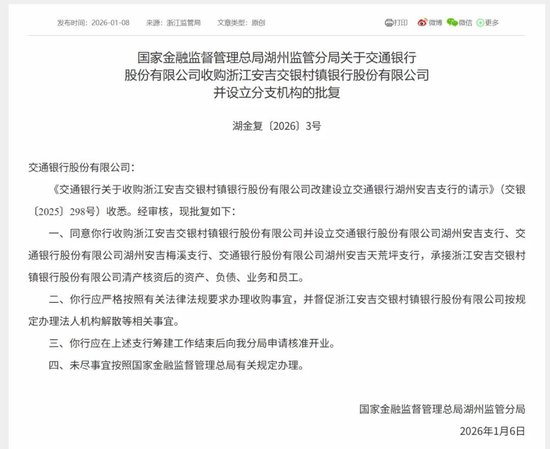
Core Viewpoint - The restructuring of village banks is accelerating, with state-owned banks actively converting village banks into branches, reflecting a trend of market exit and consolidation in the rural banking sector [1][10]. Group 1: Recent Developments - On January 6, 2026, the China Banking Regulatory Commission approved the acquisition of Zhejiang Anji Jiaoyin Village Bank by Bank of Communications, which will be converted into three branches [2][10]. - Since 2025, Bank of Communications has completed multiple "village-to-branch" conversions, including acquisitions in Qingdao and Sichuan [2][10]. - A total of 300 village banks have exited the market since 2025, with "village-to-branch" and "village-to-subsidiary" becoming the mainstream exit strategies [10][11]. Group 2: Participation of State-Owned Banks - State-owned banks, including Industrial and Commercial Bank of China and Agricultural Bank of China, have also engaged in "village-to-branch" conversions, with ICBC being the first to do so in June 2025 [3][11]. - By the end of 2025, state-owned banks had completed conversions for 10 village banks, indicating a significant trend in the industry [3][11]. Group 3: Strategic Implications - The "village-to-branch" strategy aims to integrate rural financial resources and enhance operational efficiency, driven by the need for state-owned banks to expand their reach in rural areas [4][13]. - Analysts suggest that merging village banks into branches can improve service capabilities and risk management, while also allowing for potential expansion in areas lacking existing branches [5][12]. Group 4: Regulatory Environment - The 2025 Central Document No. 1 emphasized the need for rural small and medium-sized banks to focus on agricultural support, leading to a significant increase in market exits among village banks [6][14]. - As of 2026, over 430 village banks have been listed for exit since 2010, with 310 exiting in 2025 alone, representing over 70% of the total exits [6][14]. Group 5: Future Outlook - The ongoing trend of "reduction and quality improvement" in small and medium-sized banks is expected to continue, with a focus on effective measures to prevent the emergence of high-risk institutions [16][17]. - The emphasis on optimizing the financial institution system and enhancing governance is crucial for the sustainable development of the rural banking sector [17].




2025年超300家村镇银行退出市场 村镇银行“减量提质”成常态
Jin Rong Shi Bao· 2026-01-16 02:04
Group 1 - The core viewpoint of the articles highlights the acceleration of structural reorganization of village banks, with state-owned banks actively converting village banks into branch institutions as a mainstream exit strategy since 2025 [1][2][4] - The China Banking and Insurance Regulatory Commission approved the acquisition of Zhejiang Anji Jiaoyin Village Bank by Bank of Communications, marking the first case of a state-owned bank's "village-to-branch" initiative in 2026 [1][2] - Since 2025, over 300 village banks have exited the market, with "village-to-branch" and "village-to-subsidiary" becoming the primary methods for these exits [1][7] Group 2 - Bank of Communications has previously executed similar "village-to-branch" operations in Qingdao and Sichuan, acquiring multiple village banks and converting them into branches [2][3] - Other state-owned banks, including Industrial and Agricultural Banks, have also participated in the "village-to-branch" operations, with a total of 10 village banks converted by state-owned banks since 2025 [2][3] - The restructuring of village banks is seen as a strategy to enhance service capabilities and risk resistance, while also allowing acquiring banks to expand their operational scope in areas lacking existing branches [5][6] Group 3 - The acceleration of village bank exits is attributed to regulatory policies and internal demands, with 310 village banks exiting in 2025 alone, accounting for over 70% of the total exits since 2010 [7][8] - The central government's focus on "reducing quantity and improving quality" for small and medium-sized financial institutions is expected to continue, emphasizing the need for effective measures to prevent deterioration in quality during the reduction process [8]
开年有60多家村镇银行消失
第一财经· 2026-01-12 14:00
Core Viewpoint - The article discusses the recent approval of the Bank of Communications to acquire a rural bank and convert it into a branch, marking a significant step in the ongoing reform of small and medium-sized financial institutions in China, with a focus on reducing and improving the quality of these institutions [3][4]. Group 1: Recent Developments in Rural Bank Reforms - The Bank of Communications has been approved to acquire Zhejiang Anji Jiaoyin Rural Bank and establish several branches, becoming the first state-owned bank to implement the "village to branch" reform in the new year [5]. - Since 2025, major state-owned banks like the Industrial and Commercial Bank of China and Agricultural Bank of China have also begun similar reforms, with a total of ten rural banks undergoing this transformation [6][7]. - In 2025, over 450 small and medium-sized banks exited the market, with more than 280 being rural banks, particularly in regions like Inner Mongolia, Shandong, and Hubei [3][9]. Group 2: Trends in the Banking Sector - The article highlights a trend of consolidation and restructuring among small and medium-sized banks, with provincial-level rural commercial banks emerging to facilitate this process [8]. - In the first half of January 2026 alone, 65 rural banks have been approved for mergers, dissolutions, or business cancellations, nearing ten times the number from the same period in 2025 [9]. - The focus on reducing the number of high-risk institutions, particularly among rural banks, is emphasized, with calls for effective measures to optimize the development environment for these banks [10].

回望2025,盘点银行业十大关键词
Xin Lang Cai Jing· 2026-01-04 01:17
Core Viewpoint - In 2025, the Chinese banking industry is entering a transformative phase focused on high-quality development, with a clear strategic direction to accelerate the construction of a financial powerhouse and empower new productive forces [1] Policy Level Summary - The government has implemented targeted measures for risk resolution and transformation of local small and medium financial institutions, emphasizing market-oriented and legal approaches [1] - The Financial Regulatory Bureau has intensified efforts to address "involution" competition, guiding the industry to shift from "scale competition" to "value creation" [1] - The Central Economic Work Conference has set priorities for 2026, focusing on the "reduction and quality improvement" of small and medium financial institutions [1] Industry Practice Summary - State-owned banks are experiencing a new wave of capital replenishment supported by special government bonds, enhancing their risk resistance and credit issuance capabilities [2] - The adjustment of deposit interest rates has deepened, entering the "1 era," with high-interest long-term products gradually being phased out [2] - The governance structure of banks has undergone historic reforms, with many banks abolishing supervisory boards and transferring oversight functions to audit committees [2] - The banking sector has seen a significant revaluation of undervalued bank stocks, with a notable increase in stock prices across the board [2] Financial for the People Summary - Policies aimed at improving financial services for the public have been implemented, such as exempting large cash withdrawals from registration, enhancing service efficiency and safeguarding individual financial autonomy [2] - A personal credit repair policy has been introduced to assist individuals with credit damage due to non-malicious overdue situations, facilitating their reintegration into economic activities [2] Key Terms Summary - **Involution Competition Rectification**: The banking industry has reached a consensus on combating "involution," with associations issuing self-regulatory agreements to promote healthy development [3] - **Reduction and Quality Improvement of Small Financial Institutions**: Over 400 financial institutions have exited the market in 2025, with a focus on optimizing structure and enhancing service capabilities [4] - **Bank Stock Value Revaluation**: The banking sector has seen a significant increase in stock prices, with 35 out of 42 A-share listed banks reporting positive growth [5] - **Declining Deposit Rates**: The net interest margin for commercial banks has decreased to 1.42%, leading to a widespread reduction in deposit rates [6][7] - **Exit of Supervisory Boards**: A wave of governance reforms has led to the abolition of supervisory boards in favor of audit committees, enhancing governance efficiency [8][9] - **Core Capital Supplementation for Major Banks**: Major state-owned banks have initiated a new round of capital replenishment, with plans to raise significant funds through stock issuance [10] - **Expansion of AIC**: The issuance of AIC licenses has resumed, allowing more banks to establish financial asset investment companies [11][12] - **Exemption from Registration for Withdrawals Over 50,000**: New regulations will simplify the process for large withdrawals, balancing financial security and service convenience [13] - **Personal Credit Repair Policy Implementation**: A one-time credit repair policy has been introduced to support individuals with overdue credit issues [14][15] - **Deepening the "Five Major Articles"**: The financial sector has made significant progress in implementing the "Five Major Articles" strategy, with a notable increase in loans to key areas [16][17]
中小金融机构“提质”闯关
Guo Ji Jin Rong Bao· 2025-12-31 12:54
Core Viewpoint - The reform of small and medium-sized financial institutions in China is accelerating, with a focus on reducing quantity while improving quality, as highlighted by the central economic work conference's directive for 2025 [1][5]. Group 1: Reform Progress - By the end of 2025, over 100 small and medium-sized banks are expected to close, paving the way for reform, with seven provincial-level "giant" banks opening [1]. - As of December 30, 2025, 13 provincial-level associations have completed the establishment of provincial legal entities, with seven provinces launching new financial institutions [2]. - The restructuring of village banks has led to a significant reduction, with 99 village banks closed in 2024, accounting for nearly 50% of the total reduction in banking institutions that year [2]. Group 2: Challenges and Strategies - The small and medium-sized banks face challenges such as high risk concentration in economically lagging regions, with some institutions still having high non-performing loan rates [4]. - The government emphasizes a dual approach of risk management and transformation for local small and medium-sized financial institutions, aiming for both quantity reduction and quality enhancement [5]. - Experts suggest that successful reform hinges on improving corporate governance and operational stability within these institutions [5][6]. Group 3: Future Outlook - The reform of small and medium-sized banks is expected to deepen in 2026, with a focus on risk prevention becoming a regular practice [5]. - Recommendations for 2026 include completing provincial-level association reforms, optimizing ownership structures, and enhancing risk monitoring mechanisms [5]. - There is a call for a collaborative financial ecosystem where various types of financial institutions work together effectively, avoiding the pitfalls of focusing solely on larger entities [6].
中小金融机构“提质”闯关 | 前瞻2026
Guo Ji Jin Rong Bao· 2025-12-31 10:26
Core Viewpoint - The reform of small and medium-sized financial institutions in China is accelerating, with a focus on reducing quantity while improving quality, as highlighted by the central economic work conference's emphasis on "deepening the reduction and quality improvement of small and medium financial institutions" [1][7]. Group 1: Reform Progress - By the end of 2025, over a hundred small and medium-sized banks are expected to close, paving the way for reform, with seven provincial-level "giant" banks opening [1]. - As of December 30, 2025, 13 provincial-level associations have completed the establishment of provincial legal entities, with significant progress in reforms across various provinces [3]. - The restructuring of village banks has led to a reduction of 99 village banks in 2024, accounting for nearly 50% of the total reduction in banking institutions that year [3]. Group 2: Risk Management and Structural Reforms - The reform paths for small and medium-sized financial institutions are becoming increasingly diverse, with various models being tested, such as the "village reform branch" initiated by major banks [4]. - The central government has set higher requirements for the reform of small and medium-sized financial institutions, emphasizing the need for both quantity reduction and quality enhancement [7]. - Experts suggest that the key to improving quality lies in enhancing the institutions' operational stability and service capabilities, with a focus on sound corporate governance [7][8]. Group 3: Future Outlook - The reform of small and medium-sized banks is expected to deepen in 2026, with ongoing risk prevention becoming a norm [7]. - Recommendations for future reforms include optimizing the ownership structure of small banks, enhancing risk monitoring mechanisms, and improving policy support to create a favorable external environment [7].
新疆农商银行挂牌开业 自治区中小金融机构实现“减量提质”
Zhong Guo Jing Ying Bao· 2025-12-30 16:44
Core Insights - Xinjiang Rural Commercial Bank officially opened on December 29, 2025, becoming the sixth provincial-level unified legal person rural commercial bank in China [1] - The reform of provincial-level rural credit cooperatives is accelerating, with 7 new banks established in 2025, indicating that over half of the national rural credit reform has been implemented [1][4] - The central economic work conference emphasized the need to "deeply promote the reduction and quality improvement of small and medium-sized financial institutions" in 2026 [1][4] Summary by Sections Establishment and Capitalization - Xinjiang Rural Commercial Bank has a registered capital of 34.888 billion RMB, with 9,525 individual shareholders holding 41.69% and 849 corporate shareholders holding 58.31% of the total capital [2] - The establishment of Xinjiang Rural Commercial Bank involved the dissolution of 56 local legal entities, consolidating their assets, liabilities, and operations into the new bank [2] Financial Strength and Market Impact - The bank's asset scale is projected to reach 760 billion RMB, significantly enhancing its risk resistance and overall strength, thereby addressing the previous weaknesses of rural financial institutions in Xinjiang [3] - The establishment of the bank is expected to effectively promote the reduction and quality improvement of small financial institutions in the region [3] Reform Progress and Future Outlook - As of now, 13 out of 25 provincial-level rural credit cooperatives have completed their reforms, with expectations for continued acceleration in 2026 [4] - The ongoing reforms are driven by regulatory policies and the successful reform paths established by earlier adopters, which are expected to facilitate further consolidation and risk management in the sector [4] - The focus for 2026 will be on restructuring governance, risk management, and enhancing service capabilities, with an emphasis on digital transformation and improving financial inclusion [5]
深入推进“减量提质” 中小金融机构迎发展新局
Xin Lang Cai Jing· 2025-12-26 19:02
Core Viewpoint - The transformation of small and medium-sized financial institutions in China from "passively managing risks" to "actively improving quality" is a significant development highlighted in the 2025 Central Economic Work Conference, emphasizing the importance of these institutions in supporting the real economy and rural revitalization [1][2]. Group 1: Policy Evolution and Risk Management - The policy focus has shifted from risk prevention to structural optimization and sustainable development for small and medium-sized financial institutions, indicating a significant upgrade in financial reform [2]. - The National Financial Regulatory Administration has prioritized the management of risks in small financial institutions, implementing tailored reform plans for key regions [2][3]. - The number of high-risk institutions and high-risk asset scales has significantly decreased, with many provinces achieving "dynamic zero" for high-risk small institutions [3]. Group 2: Current Challenges and Risks - Small and medium-sized financial institutions face operational pressures due to high asset concentration, unstable liability structures, and weak risk control capabilities [3][4]. - The ongoing economic pressures, such as narrowing interest margins and insufficient credit demand, continue to challenge weaker regional banks [3][4]. - The need for effective risk management is emphasized, focusing on both immediate risk mitigation and long-term capacity building [4]. Group 3: Reform Directions and Strategies - The 2025 Central Economic Work Conference calls for a "reduction in quantity and improvement in quality" for small financial institutions, which includes reducing the number of institutions and enhancing their operational quality [5][6]. - The reduction in the number of institutions is evident, with significant decreases in various types of rural financial institutions over the past year [5]. - The focus on improving quality involves enhancing core functions such as supporting agriculture and small enterprises, thereby avoiding homogenization with larger banks [7]. Group 4: Future Development Paths - Small financial institutions are expected to achieve differentiated development through local engagement, technological empowerment, and improved governance [7]. - Strategies for enhancing quality include deepening local service, leveraging financial technology for better risk management, and optimizing governance structures to ensure long-term stability [7].
中小金融机构减量提质
Jing Ji Ri Bao· 2025-12-25 22:04
Core Viewpoint - The recent Central Economic Work Conference emphasizes the need to deepen the reduction and quality improvement of small and medium-sized financial institutions in China, addressing weaknesses in credit asset quality and risk prevention while enhancing their service to the real economy's high-quality development [1][2]. Group 1: Reform and Integration of Small and Medium-sized Banks - The integration reform of small and medium-sized banks has accelerated this year, with various regions adopting measures such as mergers and introducing strategic investors to optimize local financial institutions [2][3]. - Experts believe these reforms effectively address issues like excessive numbers of institutions, small scales, and severe homogenized competition, thereby improving credit asset quality and the ability to serve the real economy [2][3]. - The regulatory framework supports these reforms, with the National Financial Supervision Administration emphasizing tailored reform plans for different regions, utilizing various methods such as mergers and market exits [2][3]. Group 2: Challenges in Reform Implementation - Despite the progress, challenges remain due to varying economic development levels across regions, including high historical burdens, weak corporate governance, excessive local government intervention, and a shortage of skilled personnel [3][4]. - The need for a differentiated reform path is highlighted, with recommendations for local governments to establish supportive policies and funding mechanisms while avoiding excessive interference [4]. Group 3: Focus on Agricultural Financing - Small and medium-sized financial institutions have increased their agricultural loan supply, with rural financial institutions holding approximately 7.2 trillion yuan in inclusive agricultural loans as of Q3 this year [5][6]. - These institutions play a crucial role in serving local farmers and small enterprises, leveraging their understanding of local industries and credit conditions [5][6]. - Regulatory policies emphasize the importance of maintaining a focus on agricultural financing to support rural revitalization strategies, with various regions enhancing their credit supply to meet local agricultural needs [6][7]. Group 4: Risk Management and Governance - The core of the reduction and quality improvement strategy is not merely to reduce the number of financial institutions but to enhance internal governance and risk control through mergers and restructuring [8][9]. - The financial system has seen a significant reduction in high-risk institutions and assets, with many provinces achieving a "dynamic clearing" of high-risk small institutions [8][9]. - Continuous monitoring and support mechanisms are necessary to manage potential risks during the reform process, with a focus on improving corporate governance and establishing effective risk monitoring systems [9][10].