
云网融合

Search documents
北京浩瀚深度信息技术股份有限公司 关于对外投资暨签署股权/财产份额收购协议的公告
Zhong Guo Zheng Quan Bao - Zhong Zheng Wang· 2026-01-07 23:06
Core Viewpoint - The company, Beijing Haohan Deep Information Technology Co., Ltd., is set to acquire a 34% stake in Yunbianyun Technology (Shanghai) Co., Ltd. for a total cash consideration of RMB 83.3 million, which will allow the company to control 54% of the voting rights in the target company, thereby gaining control over it [1][5][32]. Group 1: Transaction Overview - The acquisition involves the company and its wholly-owned subsidiary Hefei Haohan Deep Information Technology Co., Ltd. signing a share/property acquisition agreement with several parties, including Kang Junyan and Zhongyu Lianyun Computing Service (Shanghai) Co., Ltd. [1][5] - The total valuation of the target company, Yunbianyun, is set at RMB 245 million, with the acquisition price for the 34% stake being RMB 85.75 million [20][22]. - The transaction has been approved by the company's board and does not require shareholder approval [3][6]. Group 2: Financial and Structural Details - The target company, Yunbianyun, focuses on cloud-network integration and has developed a product matrix centered on intelligent connectivity and edge intelligence [12][13]. - The financial data for Yunbianyun indicates a significant increase in value, with an estimated increase of RMB 221.94 million in equity value, resulting in a valuation increase rate of 962.31% [19]. - The acquisition will be financed through the company's own and raised funds, ensuring no significant pressure on cash flow or adverse effects on financial status [32]. Group 3: Governance and Commitments - Post-acquisition, the board of the target company will consist of three directors, with two nominated by the acquiring company [24]. - The transferor has committed to performance guarantees, ensuring that the net profit attributable to the parent company will meet specified targets from 2026 to 2028 [26][27]. - The agreement includes provisions for transitional arrangements and breach of contract responsibilities, ensuring the protection of the company's interests during the transition period [28][29].

浩瀚深度拟合计斥资8575万元 收购云边云35%股权并取得控制权
Zheng Quan Shi Bao Wang· 2026-01-07 14:23
Core Viewpoint - The company is acquiring a 54% controlling stake in Yunbianyun Technology (Shanghai) Co., Ltd. through a cash transaction totaling 83.3 million yuan, which is a strategic move to enhance its competitive advantage and future growth potential in the AI-driven cloud-network integration and edge intelligence sectors [1][2]. Group 1 - The company plans to acquire 34% of Yunbianyun's equity from its shareholders, along with an additional 20% voting rights through the purchase of minority stakes [1]. - Yunbianyun, established on January 2, 2024, focuses on cloud-network integration and aims to develop next-generation intelligent network solutions [1]. - The acquisition will allow the company to integrate Yunbianyun's technological expertise in AI-driven cloud-network integration and edge intelligence, enhancing its capabilities in intelligent networking, proactive security, and edge computing [2]. Group 2 - Yunbianyun has developed a product matrix centered around "intelligent connectivity" and "edge intelligence," including key products like intelligent SD-WAN and AI-enhanced SASE security access [2]. - The company's solutions are widely applied in various industries, including retail and smart manufacturing, addressing critical scenarios such as multi-branch intelligent networking and predictive maintenance for industrial equipment [2]. - The total valuation of Yunbianyun's equity before the transaction is set at 245 million yuan, with the transfer price for the 35% stake being 85.75 million yuan [2].
浩瀚深度(688292.SH):拟8330万元收购云边云34%股权并取得控制权
Ge Long Hui A P P· 2026-01-07 08:19
Group 1 - The company, through its wholly-owned subsidiary Hefei Haohan Depth Information Technology Co., Ltd., plans to acquire a 34% stake in the target company, Yunbian Cloud Technology (Shanghai) Co., Ltd., for a cash consideration of 83,300,000 yuan [1] - The company will also acquire a 5% financial interest in Shanghai Fengruicheng Enterprise Management Consulting Partnership and Shanghai Juyi Fang Enterprise Management Consulting Partnership for 2,450,000 yuan, which corresponds to a 0.5% stake in the target company [1] - Upon completion of the transaction, the company will control 54% of the voting rights of the target company, making Yunbian Cloud a subsidiary and consolidating it into the company's financial statements [1] Group 2 - This acquisition is a strategic step for the company to deepen its main business layout, strengthen competitive advantages, and cultivate future development momentum [2] - The integration of Yunbian Cloud's technology in AI-driven cloud-network convergence and edge intelligence will significantly enhance the company's capabilities in smart networks, proactive security, and edge computing [2] - The resulting integrated solution of "cloud-network + AI + security" will accelerate the company's business implementation and market expansion in this field, aligning with its overall strategic planning and long-term development needs [2]
多场景K歌系统行业研究报告
艾瑞咨询· 2025-12-23 00:06
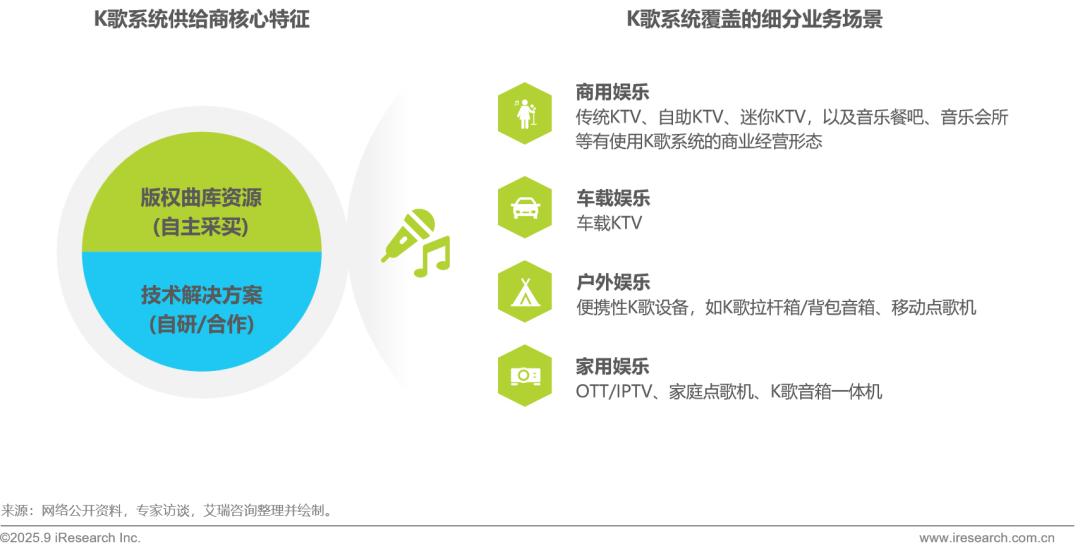
Industry Development Environment - The macroeconomic stability and rising consumer spending in China have solidified the foundation for entertainment consumption, with GDP increasing from 70.3 trillion yuan to 134.9 trillion yuan from 2015 to 2024, nearly doubling [9] - Per capita disposable income rose from 22,000 yuan to 41,000 yuan during the same period, enhancing the willingness to spend on cultural and entertainment activities [11] - The music industry has shown steady recovery, with its total scale increasing from 301.8 billion yuan to 492.9 billion yuan, averaging over 5% annual growth [17] - High user engagement in online karaoke, with 100 million monthly active devices and an average usage time of 26.5 minutes per device per day, highlights the social and health benefits of karaoke [20] - Leading karaoke system providers are increasing R&D investments, with over 100 patents filed annually from 2015 to 2024, focusing on AI and smart technologies [22] Industry Development Status - The Chinese karaoke system industry is in an ecological integration phase, evolving from a closed entertainment scene to an open ecosystem, with a market size projected to reach 1.45 billion yuan in 2024 and exceed 3 billion yuan by 2028 [2] - Traditional commercial entertainment is declining, while home, in-car, and outdoor entertainment are rapidly emerging as new growth areas [2] - The growth of paid value-added services is becoming a core driver for market expansion and structural optimization [2] Industry Development Trends - The industry is transitioning from hardware dependence to cloud-network integration, enabling light asset operations [3] - Deep integration of digitalization and AI is transforming operational intelligence, immersive experiences, and data-driven decision-making [4] - The shift from traditional closed operations to open, scenario-based services is creating a comprehensive karaoke entertainment coverage [5] Industry Structure and Ecosystem - The karaoke system industry is defined as a segment that has evolved from traditional video-on-demand services, focusing on providing song libraries and technical solutions for various entertainment scenarios [6] - The industry has a clear structure with multiple participants, including content providers, hardware manufacturers, and service integrators [33] Market Size and Growth - The karaoke system market is expected to grow steadily, reaching 1.45 billion yuan in 2024 and surpassing 3 billion yuan by 2028, driven by multi-scenario business expansion [45] - Revenue from software and hardware services is projected to reach 960 million yuan in 2024, with paid value-added services expected to grow to 440 million yuan [48] Segment Analysis - The commercial entertainment segment is recovering slowly, with a projected size of 690 million yuan by 2028, while the in-car segment is experiencing explosive growth, expected to reach 1.1 billion yuan by 2028 [55][57] - The outdoor entertainment segment is also rapidly rising, with a forecasted size of 580 million yuan by 2028, driven by new leisure trends [59] - The home entertainment segment is expected to grow steadily from 60 million yuan in 2019 to 640 million yuan by 2028, supported by increasing consumer willingness to pay for quality content and services [61] Regulatory Environment - The karaoke system industry is subject to collaborative management from the Ministry of Culture and Tourism, the China Cultural Entertainment Industry Association, and the China Audio-Video Copyright Association, focusing on content safety and copyright legality [26] - The establishment of a "two-in-one" copyright licensing mechanism is crucial for ensuring high-quality development in the karaoke scene [29]


多场景K歌系统行业研究报告
艾瑞咨询· 2025-12-07 00:05
Industry Development Environment - The macroeconomic stability and rising consumer spending in China have solidified the foundation for entertainment consumption, with GDP increasing from 70.3 trillion yuan to 134.9 trillion yuan from 2015 to 2024, and per capita disposable income rising from 22,000 yuan to 41,000 yuan, a 100% increase [9][11] - The music industry has shown steady recovery, with its total scale increasing from 301.8 billion yuan to 492.9 billion yuan during the same period, providing a rich content reserve for the karaoke system industry [17] - Leading karaoke system companies are increasing R&D investments, with an average of over 100 patent applications per year from 2015 to 2024, marking a shift towards intelligent technology [22] - The "two-in-one" copyright licensing mechanism has been established, ensuring legal compliance in the use of song libraries [26][29] Industry Development Status - The karaoke system industry in China is in an ecological integration phase, evolving from a closed entertainment scene to an open ecosystem, with a market size projected to reach 1.45 billion yuan in 2024 and exceed 3 billion yuan by 2028 [2] - Traditional commercial entertainment is declining, while home, in-car, and outdoor entertainment are rapidly rising, with in-car and outdoor segments expected to become the main growth drivers [2] Industry Development Trends - The industry is transitioning from hardware dependence to cloud-network integration, enabling light asset operations [3] - The deep integration of digitalization and AI is transforming operational intelligence, immersive experiences, and data-driven decision-making [4][66] - The shift from traditional closed operations to open scene-based services is creating a comprehensive karaoke entertainment coverage [5][69] Industry Structure and Competition - The karaoke system industry has a clear structure with various participants, including content providers, hardware manufacturers, and service providers [33] - The industry faces three barriers to entry: qualification, technology, and ecosystem, which collectively raise the entry threshold [36] - Competition is driven by policy, market demand, technology, and maturity, shaping the industry's differentiated competitiveness [39] Business Model and Market Size - The industry has developed a four-wheel-driven business model, including basic hardware sales, content licensing, operational maintenance, and value-added services [42] - The market size is expected to grow steadily, reaching 1.45 billion yuan in 2024, with significant contributions from in-car and outdoor entertainment segments [45][57][59] Segment Analysis - The commercial entertainment segment is recovering slowly, with a projected size of 690 million yuan by 2028, while the in-car segment is experiencing explosive growth, expected to reach 1.1 billion yuan by 2028 [55][57] - The outdoor entertainment segment is rapidly rising, projected to reach 580 million yuan by 2028, driven by new leisure lifestyles [59] - The home entertainment segment is steadily growing, expected to reach 640 million yuan by 2028, supported by increasing consumer willingness to pay for quality content and services [61] Future Outlook - The karaoke system industry is expected to continue evolving towards intelligent, ecological, and refined directions, driven by technological advancements and changing consumer preferences [66][69]

中国电信:云网融合发展将分两个阶段推进 全面拥抱人工智能
Nan Fang Du Shi Bao· 2025-12-06 12:29
Group 1 - The 2025 Smart Technology Ecological Conference was held in Guangzhou with the theme "Intelligent Navigation for Mutual Benefit" [1] - China Telecom aims to accelerate the development of artificial intelligence (AI) by building a comprehensive smart cloud system that integrates computing power, platforms, data, models, and applications [1][2] - The company plans to enhance digital infrastructure, promote AI applications across various industries, and establish a robust AI security framework [1][2] Group 2 - In the past year, China Telecom completed the construction of its smart cloud system, achieving a total computing power of 85 EFLOPS [2] - The company has developed over 200 intelligent service applications and 110 industry-specific models, serving more than 20,000 industry clients [2][7] - China Telecom's quantum metropolitan network now covers 25 cities, with over 6 million users utilizing quantum secure communication [2] Group 3 - China Telecom introduced the AI + "1+1+4+N" low-altitude economic capability system, launching several platforms for low-altitude detection and governance [3] - The company has implemented a low-altitude safety and service guarantee system in cities like Tianjin, Guangzhou, and Shenzhen [3] Group 4 - The integration of AI into various sectors is reshaping production and consumption patterns, with China holding 60% of global AI patents [4] - The government aims for AI to be deeply integrated into six key areas by 2027, with a target of over 70% application penetration for new intelligent terminals and models [4] Group 5 - AI applications are enhancing consumer experiences across retail and service sectors, with numerous projects successfully implemented [5] - The "Wenxin Diaolong AI Creative Platform" was showcased, focusing on AI-driven content production [5][6] Group 6 - China Telecom has launched over 80 industry-specific models and 30 intelligent applications, serving more than 20,000 clients [7] - The company is focusing on modern industry transformation, resilient cities, and green economic transitions through intelligent applications [7][8] Group 7 - The deployment of industrial IoT intelligent applications has improved production efficiency by an average of 20% and operational response speed by 60% [8] - China Telecom's payment solutions for high-demand scenarios, such as ticket sales, ensure stable and reliable transaction processes [9]

算力网络的第一个十年
Ke Ji Ri Bao· 2025-11-26 07:09
Core Insights - The article emphasizes the strategic direction for China's new round of technological revolution and industrial transformation, highlighting the importance of computing power as a key productivity force in the digital economy [1] Summary by Sections Computing Power Network Definition - The average increase of 1 point in the computing power index of 15 key countries can lead to a 3.5‰ growth in digital economy and a 1.8‰ increase in GDP [2] - Major countries are establishing national-level computing power systems, with China launching the "East Data West Computing" project in February 2022 to build eight national integrated computing power network hubs [2] - The development of high-quality communication and information infrastructure, such as 5G and cloud computing, is essential for the integration of networks and computing power [2] Characteristics of Computing Power Network - The computing power network is characterized by network-based resource allocation, enabling flexible and real-time matching of computing tasks with optimal computing resources [3] China's Leading Position in Computing Power Network - China has taken the lead in establishing standards for computing power networks and has developed a complete industrial chain for computing power network hardware and software infrastructure [4] - The upstream of the industrial chain is driven by national policies and major projects, while the midstream focuses on integrated management and operation services [4] Different Development Paths in Computing and Network Integration - Western telecom operators focus on their own network construction and often collaborate with large cloud providers for cloud capabilities, while Chinese operators are actively building intelligent digital information infrastructure [5][6] Accelerating Infrastructure Development - The construction of computing power network infrastructure requires collaboration across the industrial chain, emphasizing the need for innovation in applications and services [7] Outlook for the First Decade of Computing Power Network - The development of the computing power network in China is expected to progress through three stages: collaboration, integration, and unification, with significant advancements anticipated by 2030 [8] Impact on Industry and Global Competitiveness - The development of the computing power network is expected to enhance China's innovation capabilities and international competitiveness, contributing to the advancement of digital infrastructure and related industries [9]
多场景K歌系统行业研究报告
3 6 Ke· 2025-11-25 01:07
Industry Development Environment - The macroeconomic environment in China is stable, with GDP increasing from 70.3 trillion yuan to 134.9 trillion yuan from 2015 to 2024, and per capita disposable income rising from 22,000 yuan to 41,000 yuan, indicating a 100% increase in consumer spending power [8][11] - The music industry in China has shown steady recovery, with its total scale growing from 301.8 billion yuan to 492.9 billion yuan during the same period, maintaining an average annual growth rate of over 5% [20] - The K-song system industry benefits from high user engagement and health value, with 100 million monthly active devices and an average usage time of 26.5 minutes per device per day, enhancing social consumption vitality [23] Industry Development Status - The K-song system industry in China is transitioning to an open ecological model, with a market size projected to reach 1.45 billion yuan in 2024 and expected to exceed 3 billion yuan by 2028, driven by the expansion of multi-scenario businesses [2][51] - The industry is experiencing a structural shift, with traditional commercial entertainment declining while home, in-car, and outdoor entertainment rapidly rise, particularly in-car and outdoor segments expected to become the main growth drivers [2][61] Industry Development Trends - The industry is shifting from hardware dependence to cloud-network integration, enabling light-asset operations and driving industrial upgrades [3][78] - The integration of digitalization and AI is providing new growth opportunities through intelligent operations, immersive experiences, and data-driven decision-making [81] Research Object Description - The multi-scenario K-song system industry, derived from traditional karaoke video-on-demand services, focuses on providing a comprehensive entertainment experience across various settings, including commercial, in-car, outdoor, and home entertainment [4] Regulatory Environment - The K-song system industry is regulated by a tripartite collaboration among the Ministry of Culture and Tourism, the China Cultural Entertainment Industry Association, and the China Audio-Video Copyright Association, ensuring content safety and copyright compliance [32][34] - The "two-in-one" copyright licensing mechanism has been established to streamline copyright management and ensure legal compliance in the K-song scene [35] Market Size and Growth - The K-song system industry is projected to reach a market size of 1.45 billion yuan in 2024, with expectations to surpass 3 billion yuan by 2028, driven by the expansion of multi-scenario businesses and the integration of AI and AR/VR technologies [51][66] - Revenue from software and hardware services is expected to reach 960 million yuan in 2024, while paid value-added services are projected to grow to 440 million yuan, indicating a robust growth trajectory [55] Segment Analysis - The commercial entertainment segment is recovering slowly, with a projected business scale of 690 million yuan by 2028, while the in-car entertainment segment is experiencing explosive growth, expected to reach 1.1 billion yuan by 2028 [64][66] - The outdoor entertainment segment is also rapidly rising, with a projected business scale of 580 million yuan by 2028, driven by new leisure activities and the integration of K-song systems into outdoor settings [71][73]
多场景K歌系统行业研究报告
艾瑞咨询· 2025-11-25 00:06
Core Viewpoint - The multi-scenario karaoke system industry in China is experiencing robust growth driven by macroeconomic stability, rising consumer spending, technological advancements, and supportive policies, leading to a projected market size of 14.5 billion yuan in 2024 and over 30 billion yuan by 2028 [1][2][45]. Industry Development Environment - Economic Factors: The macroeconomic growth from 70.3 trillion yuan in 2015 to 134.9 trillion yuan in 2024, alongside a 100% increase in per capita disposable income, has solidified the foundation for entertainment consumption [9][11]. - Social Factors: The music industry has shown steady recovery, with its total scale increasing from 301.8 billion yuan to 492.9 billion yuan from 2015 to 2024, enhancing the content supply for the karaoke industry [17][20]. - Technological Factors: Leading karaoke system providers are increasing R&D investments, with over 100 patent applications annually from 2015 to 2024, focusing on AI and smart technologies [22][24]. - Policy Factors: The establishment of a "dual protection" mechanism for content and copyright by the Ministry of Culture and Tourism, along with industry associations, ensures legal compliance in the karaoke scene [26][29]. Industry Development Status - The karaoke system industry is transitioning from a closed entertainment model to an open ecosystem, with a market size expected to reach 14.5 billion yuan in 2024 and surpass 30 billion yuan by 2028, driven by the expansion of in-car and outdoor scenarios [2][45]. - The industry is witnessing a structural shift, with traditional commercial entertainment declining while home, in-car, and outdoor entertainment rapidly rise, particularly in the in-car and outdoor segments [2][53]. Industry Development Trends - The industry is shifting from hardware dependence to cloud-network integration, enabling light asset operations and enhancing flexibility [3][63]. - The deep integration of digitalization and AI is driving intelligent operations, immersive experiences, and data-driven decision-making [4][66]. - The transition from traditional closed operations to open scenario-based services is creating a comprehensive karaoke entertainment landscape [5][69]. Industry Structure and Participants - The karaoke system industry features a clear structure with various participants, including upstream content providers, midstream system providers, and downstream consumers across multiple scenarios [33][36]. Market Size and Growth Drivers - The karaoke system market is projected to grow steadily, with a market size of 14.5 billion yuan in 2024, driven by the expansion of multi-scenario businesses and the increasing willingness of users to pay for services [45][48]. - The revenue from software and hardware services is expected to reach 9.6 billion yuan in 2024, while paid value-added services are projected to grow to 4.4 billion yuan, indicating a sustainable growth trajectory [48][50]. Segment Analysis - The traditional commercial entertainment segment is recovering slowly, while the in-car segment is experiencing explosive growth, with a projected increase from 0.5 billion yuan in 2021 to 11.0 billion yuan by 2028 [55][57]. - The outdoor karaoke segment is also rapidly emerging, with expected growth from 1.1 billion yuan in 2019 to 5.8 billion yuan by 2028, driven by new leisure activities [59]. - The home karaoke segment is anticipated to grow steadily, from 0.6 billion yuan in 2019 to 6.4 billion yuan by 2028, supported by the increasing popularity of smart home devices [61]. Conclusion - The multi-scenario karaoke system industry in China is poised for significant growth, driven by economic stability, technological advancements, and evolving consumer preferences, marking a transition towards a more integrated and immersive entertainment experience [1][2][66].

园区息壤公共算力服务平台获“华彩杯”算力大赛总决赛一等奖
Su Zhou Ri Bao· 2025-11-13 22:47
Group 1 - The "Huacai Cup" computing power competition concluded with the Suzhou Industrial Park Public Computing Power Service Platform winning the first prize among 150 projects [1] - The competition, organized by multiple associations, attracted over 10,000 projects from various industries, highlighting its significance in the computing power sector in China [1] - The event emphasizes the growing importance of computing power as a key driver of new productive forces amid rapid technological and industrial changes [1] Group 2 - The "Xirang" platform, part of China Telecom's Tianyi Cloud 4.0, will support the new computing power scheduling center in Wujiang, set to launch in June 2024 [2] - The infrastructure aims to create a collaborative network system that integrates cloud, edge, and terminal computing, facilitating access to various computing resources [2] - A comprehensive AI security protection system is being developed to ensure the safe and stable operation of AI applications [2] Group 3 - The "Xirang" platform has successfully integrated computing resources from nine diverse manufacturers, achieving a resource utilization rate improvement of over 17% [3] - The platform has established a sustainable mechanism benefiting government, enterprises, and users, serving over 40 industry users with more than 600 online demands [3] - The successful resource scheduling rate remains stable at 99.99%, demonstrating the platform's effectiveness in addressing computing power interconnectivity challenges [3]