
交叉持股

Search documents
“让狐狸进入鸡舍”,丰田汽车因低价收购遭猛批
Guan Cha Zhe Wang· 2025-06-06 01:44
Core Viewpoint - Toyota's low privatization offer for Toyota Industries has faced significant backlash from shareholders, who argue that the bid undervalues their rights and the company's worth [1][3]. Group 1: Privatization Offer Details - Toyota's privatization bid for Toyota Industries is set at 4.7 trillion yen (approximately 235.1 billion yuan), which is criticized as being too low compared to the previously reported 6 trillion yen (approximately 302.2 billion yuan) offer [1][3]. - The offer price of 16,300 yen per share represents an 11% discount from Toyota Industries' closing price on the announcement day, although it is a 23% premium compared to the price before the privatization news [3][6]. - Following the announcement, Toyota Industries' stock price dropped by 12% on June 4 [3]. Group 2: Shareholder Reactions - Shareholders have expressed concerns regarding the fairness of the offer price and have requested more details on how the valuation was determined [3][4]. - Analysts suggest that a more appropriate offer would be in the range of 23,000 to 24,000 yen per share to reflect the full value of Toyota Industries, including its undervalued real estate assets [3][6]. Group 3: Corporate Governance and Historical Context - Toyota Industries was founded in 1926 and has maintained a close relationship with Toyota Motor Corporation through cross-shareholding and business collaborations [5][6]. - As of September 2024, Toyota Motor holds approximately 24% of Toyota Industries' shares, while Toyota Industries holds about 9% of Toyota Motor's shares [5]. - The recent push for corporate governance reform in Japan, including the issue of cross-shareholding, has led to Toyota Motor selling over 320 billion yen worth of cross-held shares, the highest among listed companies [6]. Group 4: Implications of the Offer - The low offer price has raised alarms among investors, who warn that it may hinder Japan's decade-long corporate governance reform efforts due to perceived unfair pricing and lack of transparency [6].


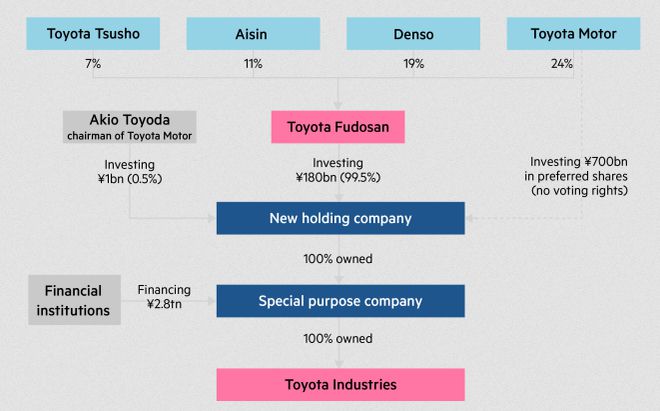
丰田汽车(TM.US)斥资260亿美元私有化核心供应商丰田工业(TYIDY.US)
智通财经网· 2025-06-03 09:31
Group 1 - Toyota Motor Corporation (TM.US) announced a privatization deal for Toyota Industries Corporation (TYIDY.US) at a price of 3.7 trillion yen (approximately 26 billion USD), highlighting the Toyota family's control over the group and reflecting a shift in Japan's corporate governance model [1] - The acquisition price offered by Toyota Real Estate is 16,300 yen per share, which is a significant discount compared to the current market price of 18,400 yen per share, representing a 12.7% decrease [1] - The deal's actual valuation is 38% lower than the previously anticipated transaction size of 42 billion USD, indicating a notable reduction in market expectations [1] Group 2 - The cross-shareholding behavior among Japanese companies is facing increasing scrutiny from regulators and investors, leading to a rise in management buyouts and corporate acquisitions [2] - The Tokyo Stock Exchange has strengthened shareholder return requirements, prompting Japanese companies to accelerate the divestiture of non-core assets, with Toyota's move potentially serving as a benchmark case for simplifying ownership structures [2] - Simplifying the ownership structure can enhance decision-making efficiency and unlock asset value that has been "frozen" due to cross-shareholding arrangements [2]
丰田(TM.US)拟收购子公司 或重塑日本企业治理结构
智通财经网· 2025-05-09 15:18
Group 1 - Toyota Motor Corporation expects a 21% decline in operating profit for the next fiscal year, attributing this to new tariffs on automobile imports imposed by the U.S. [1] - The company is reportedly planning to acquire its subsidiary, Toyota Industries, for over $40 billion, which could be one of the largest internal equity restructuring actions in Japan's history [1][2] - The complex cross-shareholding structure within the Toyota Group has raised concerns among investors regarding the independence of companies and capital flow [1][2] Group 2 - There is dissatisfaction among Toyota's independent shareholders, as evidenced by a majority vote against the re-election of Chairman Akio Toyoda, reflecting concerns over corporate governance [2] - If Toyota integrates Toyota Industries into the parent company, it would be seen as a significant improvement in corporate governance, but current rumors suggest a preference for a special purpose vehicle (SPV) structure that may reinforce family control [2] - The potential "century deal" could inspire other Japanese companies to follow suit, as approximately 30% of the Japanese market's value is tied up in cross-shareholding, significantly higher than in Western markets [2] Group 3 - Stock buybacks in Japan have tripled compared to last year, indicating a growing focus on capital efficiency among Japanese companies [3] - Despite challenges such as tariffs, global economic slowdown, and yen appreciation, there is potential for companies focused on the domestic market to benefit as Japan's long-standing deflation may be nearing an end [3] - The potential restructuring at Toyota may signal a shift in Japan towards reforming overcapitalized corporate groups, similar to the U.S. in 1982 [3]
日本最大规模收购即将问世! 丰田汽车(TM.US)拟420亿美元私有化丰田工业
智通财经网· 2025-05-07 11:42
Group 1 - Toyota Motor Corporation's chairman Akio Toyoda is advancing a plan to acquire Toyota Industries Corporation for $42 billion, which would be the largest acquisition in Japan's history [1][2] - The acquisition aims to strengthen corporate governance by eliminating cross-shareholdings within the Toyota group [1][6] - A special purpose company established by Toyota for the acquisition has appointed Nomura Holdings as its financial advisor, while Toyota Industries has engaged SMBC Nikko Securities as its advisor [1][2] Group 2 - If successful, this privatization deal will rank among the largest acquisitions globally, with Toyota Industries' market capitalization around 5.5 trillion yen (approximately $384 billion), having increased by about 27% since the acquisition news broke [2] - The complex cross-shareholding structure within the Toyota group includes Toyota Motor holding approximately 24.2% of Toyota Industries, while Toyota Industries holds about 9.1% of Toyota Motor [2][5] - The Japanese government is accelerating efforts to eliminate such cross-shareholdings to improve corporate governance and increase shareholder returns [6]
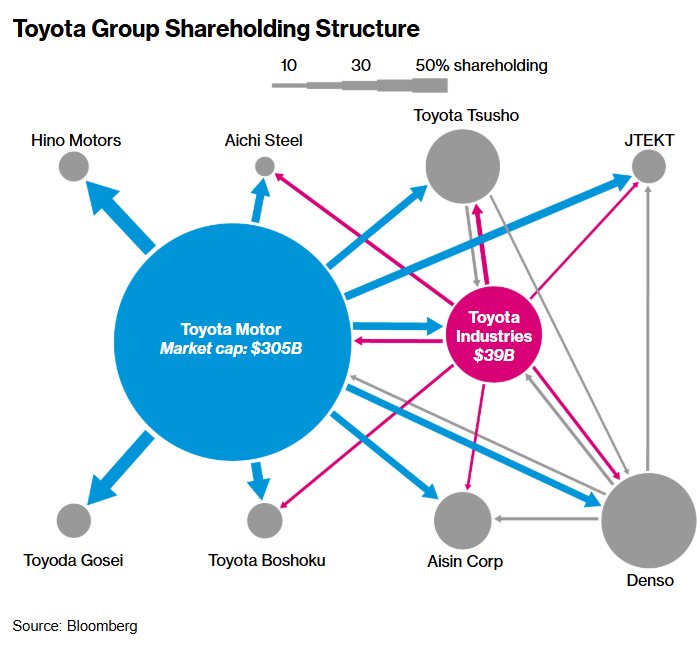
混动车需求或“护航”丰田(TM.US)Q4盈利,美关税阴影仍步步紧逼
Zhi Tong Cai Jing· 2025-05-07 07:00
Group 1 - Toyota is expected to report a 2% year-on-year increase in operating profit for Q4, reaching 1.13 trillion yen (78.6 billion USD), marking the first growth in three quarters, driven by strong demand for hybrid vehicles [1] - The company is facing potential impacts from U.S. tariffs, with analysts closely monitoring how these tariffs may affect future profits [1][3] - In Q1, Toyota sold 2.52 million vehicles, surpassing competitors Volkswagen and General Motors, with a 5% year-on-year increase in global sales due to strong demand in the U.S. and Japan [1] Group 2 - For the fiscal year 2024, Toyota's operating profit is projected to decline by 12% compared to the previous record level, with an adjusted forecast of 4.7 trillion yen [2] - Analysts estimate that operating profit for FY2025 could decrease by 800 billion yen due to tariffs affecting exports from Japan to the U.S. [3] - Toyota is considering producing the next generation of its popular RAV4 SUV in the U.S. to mitigate risks from tariffs and exchange rates [3] Group 3 - Toyota holds approximately 24% of Toyota Industries, which in turn owns about 9% of Toyota, along with over 5% of Denso, another major supplier [4] - Additional investments in suppliers may be viewed negatively by investors, while efforts to address cross-shareholding issues could be seen positively [4]