交通物流降本提质增效

Search documents
上海发布交通物流降本提质增效路线图
Zhong Guo Zheng Quan Bao· 2025-11-05 20:08
Core Viewpoint - The Shanghai Municipal Transportation Commission and the Shanghai Municipal Development and Reform Commission have released the "Action Plan for Reducing Costs and Improving Quality and Efficiency in Transportation Logistics," aiming to enhance the logistics sector's efficiency and competitiveness by 2027 [1][2]. Group 1: Logistics Cost Reduction and Efficiency Improvement - By 2027, the ratio of total social logistics costs to GDP in Shanghai is targeted to be below 12% [1] - The port's container throughput is expected to exceed 52 million standard containers, with waterway freight turnover projected to grow by approximately 8% compared to 2023 [1] - The capacity and service level of transportation logistics will continue to improve, with significant advancements in transportation infrastructure and logistics services [1] Group 2: Digitalization and Intelligent Transformation - The plan emphasizes accelerating the digital transformation of logistics through enhanced information sharing and the creation of a digital public service ecosystem for shipping and trade [2] - It aims to upgrade the collection and distribution MaaS platform to become a globally influential digital service platform in the international shipping sector [2] - The implementation of intelligent facilities and equipment, including automated driving projects at Yangshan Port, is encouraged [2] Group 3: Green Technology Promotion - The action plan promotes the widespread adoption of green technologies and equipment, including the full coverage of airport bridge power and ground auxiliary power facilities [2] - It supports the regular use of shore power for compliant vessels during port stays and the expansion of new energy logistics vehicles in urban delivery and postal services [2] - The plan also encourages pilot applications of fuel cell vehicles in heavy trucks and non-road mobile machinery [2]
上海印发《交通物流降本提质增效上海行动计划》
Xin Hua Cai Jing· 2025-11-05 04:39
Core Insights - The Shanghai Municipal Government has released the "Action Plan for Reducing Costs and Improving Quality and Efficiency in Transportation and Logistics" aiming to lower the ratio of total social logistics costs to GDP to below 12% by 2027 [1] Group 1: Logistics Cost Reduction - The plan targets a reduction in the ratio of social logistics costs to GDP to below 12% by 2027 [1] - The initiative emphasizes the internationalization of shipping and significant improvements in international logistics competitiveness [1] Group 2: Infrastructure and Capacity Enhancement - Port container throughput is expected to exceed 52 million standard containers [1] - Waterway freight turnover is projected to grow by approximately 8% compared to 2023 [1] - The capacity and service levels of transportation logistics are continuously improving [1] Group 3: Multi-Modal Transport Development - The service capabilities of sea-rail, river-sea, and rail-road intermodal transport are being strengthened [1] - The digitalization, intelligence, and greening of multi-modal transport are accelerating [1] - A number of transportation and logistics companies with international competitiveness are gradually emerging [1]
上海:加快通道沿线和重要节点骨干物流枢纽建设 加快推进上海东站建设
Jing Ji Guan Cha Wang· 2025-11-05 04:03
Core Viewpoint - The Shanghai Municipal Transportation Commission and the Shanghai Development and Reform Commission have released an action plan aimed at reducing costs and improving efficiency in transportation logistics in Shanghai [1] Group 1: Infrastructure Development - Accelerate the construction of key logistics hubs along major corridors and important nodes [1] - Support the formation of a cluster of comprehensive cargo hubs through the national integrated cargo hub supply chain enhancement efforts [1] - Promote the construction of Shanghai East Station to facilitate air-rail intermodal transport [1] Group 2: Upgrading Existing Facilities - Upgrade the Luchao Port Central Station railway hub to enhance operational capacity [1] - Support the establishment of the China-Europe Railway Express (Shanghai) station to improve the international freight hub layout [1] - Accelerate the construction of the northern operational area of Xiaoyangshan and promote the transformation of the Luojing Port area [1] Group 3: Automation and Efficiency - Implement automation upgrades at traditional terminals to further enhance the container throughput and operational efficiency of Shanghai Port [1]
上海:推进南港二期滚装码头项目建设 确保2025年开港运营
Zheng Quan Shi Bao Wang· 2025-11-05 04:00
Core Viewpoint - The Shanghai government is advancing the construction of the South Port Phase II roll-on/roll-off terminal project, aiming for it to be operational by 2025, as part of a broader initiative to enhance logistics efficiency and reduce costs in the region [2]. Group 1: Logistics Infrastructure Development - The Shanghai government has issued the "Traffic Logistics Cost Reduction and Quality Improvement Action Plan," which emphasizes increasing the supply of logistics facilities [2]. - Key projects include the development of comprehensive hubs, logistics corridors, service areas on highways, and port terminals, with a focus on land and sea resource guarantees [2]. - The plan includes the addition of truck battery swap stations and charging piles at key highway service areas to support logistics operations [2]. Group 2: Support for New Energy Vehicle Transportation - The initiative supports innovative transportation methods for new energy vehicles through containers and frame boxes, aiming to enhance the coordination and support mechanisms for their transport [2]. - The government is exploring various methods to secure logistics land, including long-term leasing and a combination of leasing and allocation [2]. - The plan also involves revitalizing the surrounding land of the Luchao Port Central Station to optimize logistics operations [2].
上海:到2027年本市社会物流总费用与国内生产总值的比率力争降至12%以下
Zheng Quan Shi Bao Wang· 2025-11-05 03:55
Core Insights - The Shanghai Municipal Government has issued the "Action Plan for Reducing Costs and Improving Quality and Efficiency in Transportation and Logistics" aiming to lower the ratio of total social logistics costs to GDP to below 12% by 2027 [1] Group 1: Logistics Cost Reduction - The plan targets a reduction in the ratio of social logistics costs to GDP to below 12% by 2027 [1] - The internationalization of shipping and competitiveness in international logistics are expected to improve significantly [1] Group 2: Port and Freight Growth - The port's container throughput is projected to exceed 52 million standard containers [1] - Waterway freight turnover is anticipated to grow by approximately 8% compared to 2023 [1] - The volume of rail-water intermodal transport is expected to maintain rapid growth [1] Group 3: Infrastructure and Service Enhancement - The capacity and service level of transportation logistics are continuously improving [1] - The integration of transportation infrastructure is being advanced to enhance connectivity and strengthen supply chains [1] - The levels of urban production, living, and material distribution have significantly improved [1] Group 4: Multimodal Transport Development - The service capabilities of sea-rail, river-sea, and rail-road intermodal transport are being strengthened [1] - The digitalization, intelligence, and greening of multimodal transport are accelerating [1] - A number of transportation and logistics companies with international competitiveness are gradually emerging [1]
龚正主持市政府常务会议 部署长假守安全促消费工作等
Jie Fang Ri Bao· 2025-09-29 09:28
Group 1 - The Shanghai government is focusing on ensuring safety and promoting consumption during the upcoming National Day and Mid-Autumn Festival holidays, emphasizing the need for risk assessments in key areas such as transportation hubs and tourist attractions [1] - The government aims to enhance the brand recognition and reputation of Shanghai's commercial sector, while also expanding the supply of quality cultural and tourism products and services [1][2] - A plan to promote the professionalization and standardization of domestic service enterprises from 2026 to 2028 has been approved, aiming to address industry bottlenecks and enhance service quality [2] Group 2 - The government has agreed on an action plan to strengthen the construction of Shanghai's commercial brands, focusing on revitalizing traditional brands and enhancing their global influence [2] - A logistics cost reduction and efficiency improvement plan has been approved, which includes enhancing infrastructure and services, and promoting the integration of various transportation networks [3] - The meeting also discussed other matters related to the overall economic strategy and development initiatives [4]
扩大供给精心打造金秋消费新热潮 龚正主持市政府常务会议
Jie Fang Ri Bao· 2025-09-29 01:32
Group 1 - The Shanghai government emphasizes the importance of safety and consumer promotion during the upcoming National Day and Mid-Autumn Festival holidays, focusing on risk assessment in key areas such as transportation hubs and tourist attractions [1] - The government plans to enhance the brand influence of Shanghai by revitalizing traditional brands, promoting innovation, and encouraging cross-industry integration [2] - The government aims to implement a plan for the professionalization and standardization of household service enterprises from 2026 to 2028, addressing industry bottlenecks and enhancing service quality [2] Group 2 - A plan to reduce logistics costs and improve efficiency has been approved, focusing on enhancing infrastructure and integrating transportation networks [3] - The initiative aims to develop a digital, intelligent, and green supply chain to facilitate the transformation of the logistics industry [3]
滨州市交通运输局举办危险货物道路运输电子押运政府开放日活动
Qi Lu Wan Bao Wang· 2025-09-21 03:39
Core Insights - The event focused on the implementation of "electronic escort" for hazardous goods transportation, aiming to enhance safety and regulatory measures in the industry [1][3][6] Group 1: Event Overview - The "Government Open Day" event was organized by the municipal government office and the transportation bureau, featuring discussions on industry development and regulatory innovations [1] - Key participants included government officials, industry representatives, and media, totaling over 30 attendees [1] Group 2: Electronic Escort Implementation - "Electronic escort" refers to remote monitoring of hazardous goods transportation by dedicated personnel using advanced safety technologies, eliminating the need for on-board escorts [6] - The city was selected as a national pilot for collaborative safety regulation in hazardous goods transportation in 2022, with plans for regional recognition by 2024 [6] - Since the pilot's initiation, three hazardous goods transport companies and 813 vehicles have participated, resulting in over 24,000 trips and saving approximately 4 million yuan in escort labor costs [6] Group 3: Future Directions - The transportation bureau aims to expand and enhance the "electronic escort" pilot program, focusing on high-quality development in the city's transportation sector [7]

多地多举措发力 稳步推进交通物流降本提质增效
Ren Min Wang· 2025-08-19 05:43
Core Insights - The article highlights the ongoing efforts in various provinces of China, particularly Zhejiang and Jiangsu, to enhance transportation logistics through multi-modal transport and digital empowerment, aiming for cost reduction and efficiency improvement in logistics [1][2][3] Group 1: Zhejiang Province Initiatives - Zhejiang aims to achieve container sea-rail and river-sea transport volumes of 2 million and 3 million TEUs respectively by the end of the year [1][2] - The province is developing a "Four Ports Intelligent Transport" model to enhance logistics efficiency, with a target to launch by the end of October [2] - Infrastructure development includes the construction of five coastal berths capable of handling over 10,000 tons and the acceleration of multi-modal transport hub projects [2] Group 2: Jiangsu Province Strategies - Jiangsu focuses on creating four major iron-water transport corridors along the New Eurasian Land Bridge, rivers, coasts, and canals [2] - The province plans to establish a provincial-level digital platform for multi-modal transport, aiming for initial functionality by September [2] - Efforts include enhancing the connection between railway logistics bases and transport hubs, and nurturing leading enterprises in multi-modal transport [2] Group 3: Guangdong and Chongqing Developments - Guangdong's implementation plan sets specific targets for reducing logistics costs, including increasing container iron-water transport to 1.2 million TEUs and maintaining a 90% green transport ratio for major coastal ports [3] - Chongqing aims to integrate various sectors to enhance logistics efficiency, focusing on a collaborative approach among postal, transportation, and agricultural sectors [3] - The city plans to build a shared logistics network and improve end-to-end logistics services through the "Postal Transport" information platform [3]
1.6万亿交通固投落地,民航铁路运输跑出加速度
2 1 Shi Ji Jing Ji Bao Dao· 2025-08-14 11:43
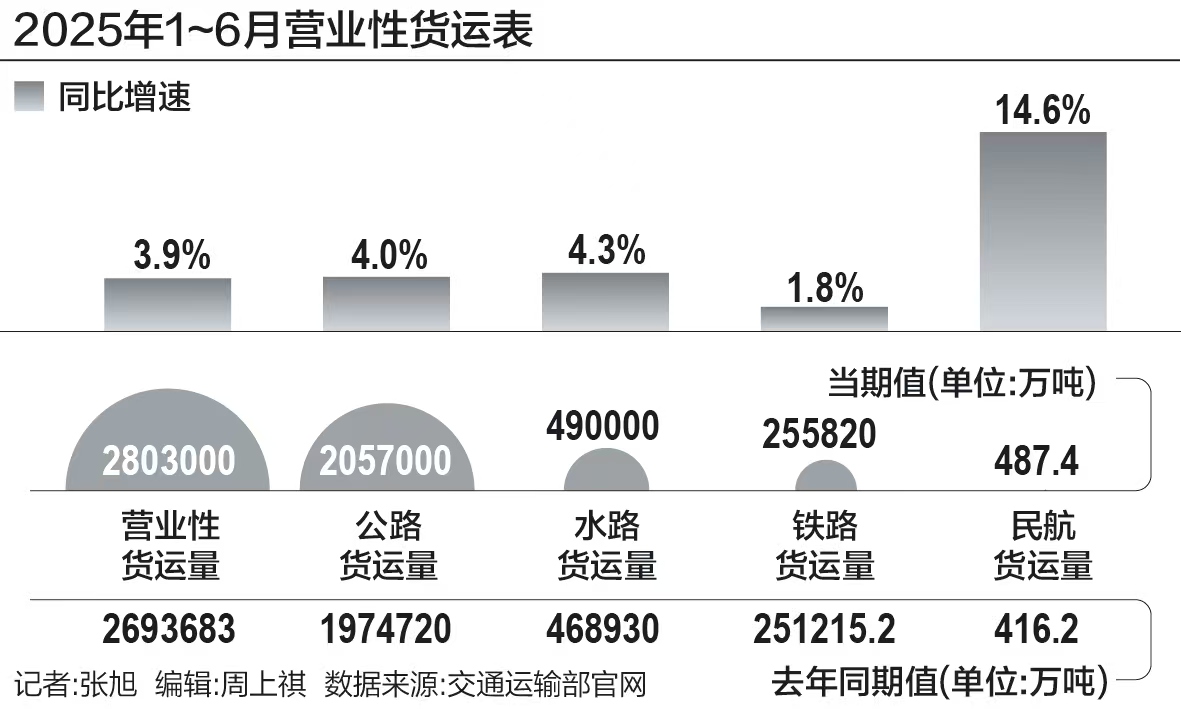
Core Insights - The transportation industry in China has shown steady growth in the first half of 2025, with significant increases in both freight and passenger transport volumes [1][2][4] - The Ministry of Transport emphasizes the need for technological innovation and the development of smart transportation to enhance productivity in the sector [1][10] Freight Transport - The total freight volume reached 28.03 billion tons, marking a year-on-year increase of 3.9% [2][4] - Different modes of freight transport saw varied growth rates: rail (1.8%), road (4.0%), water (4.3%), and civil aviation (14.6%) [2] - International shipping by Chinese companies experienced a notable increase of 9.4% [2] Port Operations - Port cargo throughput reached 8.9 billion tons, with a year-on-year growth of 4.0% [4] - Container throughput was 17 million TEUs, reflecting a growth of 6.9%, with foreign trade containers increasing by 8.9% [4] Passenger Transport - Cross-regional passenger flow amounted to 33.76 billion trips, up 4.2% year-on-year [4] - Civil aviation international passenger volume surged by 28.5% [4] Investment in Transportation Infrastructure - Fixed asset investment in transportation totaled 1.6474 trillion yuan, with significant allocations to rail (355.9 billion), road (1.1291 trillion), water (109.3 billion), and civil aviation (53.1 billion) [6][7] - Various provinces reported achieving over half of their annual investment targets, indicating strong local commitment to infrastructure development [7][12] Strategic Initiatives - The Ministry of Transport plans to accelerate the construction of a comprehensive transportation network and major projects, aiming to support national strategic initiatives [9][10] - Emphasis on reducing costs and improving efficiency in transportation logistics, alongside fostering integration with related industries [10][11] Future Development Plans - Provinces like Shandong and Jiangsu are actively planning for future transportation projects, focusing on high-quality development and technological advancements [12][13] - The push for a unified and open transportation market is seen as essential for enhancing cooperation and supporting the Belt and Road Initiative [11][12]