
债牛行情

Search documents
【财经分析】债市震荡不改较乐观预期 “每调买机”策略仍获关注
Xin Hua Cai Jing· 2025-05-26 13:31
Core Viewpoint - The bond market is currently experiencing a phase of cautious sentiment and narrow fluctuations, influenced by recent interest rate cuts and government bond supply dynamics [2][3][4]. Group 1: Market Dynamics - Despite recent deposit rate cuts, the bond market has not reacted positively, as these cuts are viewed as a continuation of earlier rate reduction actions [2][3]. - From May 19 to May 23, the bond market showed a mixed performance, with the 10-year government bond yield rising by 1 basis point to 1.69%, while the 3-year bond yield fell by 1 basis point to 1.49% [2]. - The issuance of long-term government bonds has been weak, with a notable decline in the bid-to-cover ratio for recent auctions, indicating reduced enthusiasm in the primary market [2][3]. Group 2: Supply and Demand Imbalance - There is a significant mismatch between the growth rates of government bonds and bank liabilities, with government bond growth increasing from 17.0% to 20.7%, while bank liabilities only rose from 6.3% to 7.4% [3]. - The pressure on banks to absorb new government bond supply is expected to increase, leading to a potential reduction in their demand for bonds in the secondary market [3][4]. Group 3: Future Outlook - The supply pressure in the bond market is likely to ease in June and July, with a projected increase in government bond maturities and a slowdown in new bond issuance [4]. - Analysts anticipate that the net issuance of government bonds will decrease significantly in the second half of the year, which could improve the supply-demand dynamics in the bond market [4]. - There is a possibility of a "bond bull" market re-emerging, driven by stable demand for fixed-income assets and a potential decline in interest rates [5].
债牛红利兑现,银行一季度投资收益贡献近12%营收
Di Yi Cai Jing· 2025-05-06 12:46
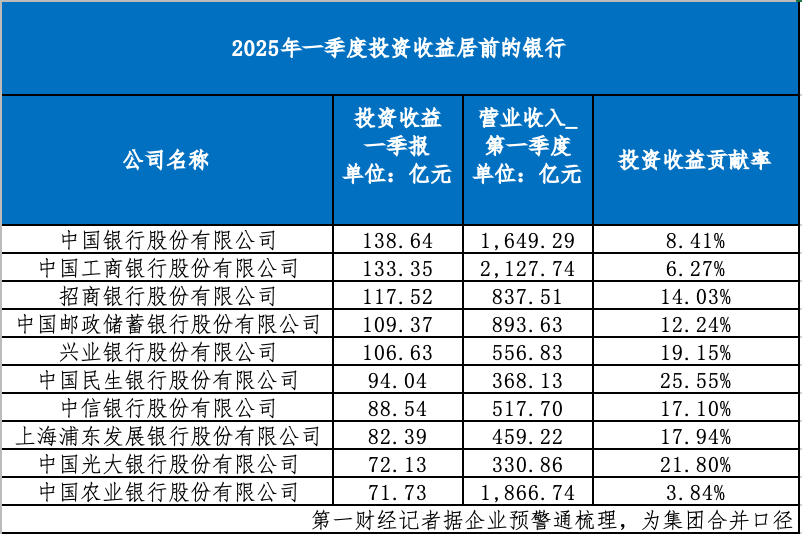
Core Viewpoint - The banking sector has experienced significant growth in investment income in Q1 2025, despite overall revenue pressure, with investment income contributing 11.86% to total revenue, up from 9.2% year-on-year [1][2]. Group 1: Investment Income Growth - In Q1 2025, 100 banks reported a total investment income of 176.29 billion yuan, a substantial increase from 140.4 billion yuan in the same period last year [2][4]. - Among the top five banks by investment income are Bank of China, Industrial and Commercial Bank of China, China Merchants Bank, Postal Savings Bank of China, and Industrial Bank, with respective incomes of 13.86 billion yuan, 13.33 billion yuan, 11.75 billion yuan, 10.94 billion yuan, and 10.66 billion yuan [2][3]. - Approximately 68 out of 100 banks reported an increase in investment income, indicating a growth rate of nearly 70% [3][4]. Group 2: Factors Driving Growth - The growth in investment income is primarily attributed to increased bond market allocations amid a "asset shortage" and narrowing net interest margins [1][6]. - The issuance of government bonds has provided banks with ample opportunities for bond investments, which are considered safe assets [6][9]. - Some banks have realized one-time gains by cashing in on previous floating profits accumulated during the "bond bull" market of 2024 [1][9]. Group 3: Challenges and Market Conditions - The sustainability of the increased investment income is under scrutiny due to potential volatility in the bond market, which may affect future earnings [1][11]. - The yield on 10-year government bonds has fluctuated, impacting the fair value changes of financial assets held by banks [11][12]. - Many banks have reported losses in fair value changes, with a total loss of 42 billion yuan among 38 listed banks, contrasting with a gain of 241.91 billion yuan in the previous year [11][12]. Group 4: Strategic Adjustments - Banks are shifting their investment strategies from "scale-driven" to "refined management" to better navigate the dual challenges of interest margin pressure and bond market volatility [10][13]. - Institutions like Everbright Bank and Shanghai Bank are focusing on enhancing macroeconomic analysis and optimizing investment portfolios to stabilize core trading contributions [13].




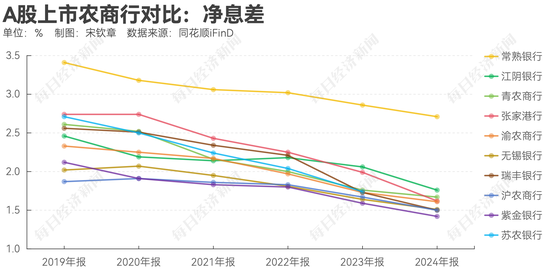
拆解A股上市农商行去年业绩:多家银行投资收益同比翻倍!常熟银行聚焦“小本生意”,2.71%净息差领跑
Mei Ri Jing Ji Xin Wen· 2025-04-27 06:58
Core Insights - The performance of A-share listed rural commercial banks in 2024 shows significant growth, with notable leaders being Chongqing Rural Commercial Bank and Shanghai Rural Commercial Bank, whose revenue and net profit gaps are narrowing [1][2] - Changshu Bank stands out with the highest net interest margin among all rural commercial banks and A-share listed banks, achieving a net interest margin of 2.71% [3][5] - Many rural commercial banks have seen substantial increases in investment income due to favorable market conditions, with some banks reporting over 100% growth in this area [9][12] Group 1: Performance Comparison - Chongqing Rural Commercial Bank achieved approximately 28.3 billion in revenue, while Shanghai Rural Commercial Bank reached about 26.6 billion, with both banks significantly outperforming others [2] - The net profit for Shanghai Rural Commercial Bank and Chongqing Rural Commercial Bank was 12.6 billion and 11.8 billion respectively, indicating a close competition [2] - The revenue gap between the two banks is around 1.5 billion, and the net profit gap is less than 1 billion [2] Group 2: Changshu Bank's Leadership - Changshu Bank's net interest margin of 2.71% is significantly higher than the average of other rural commercial banks, which are generally below 2.0% [3][5] - The bank's loan structure, with 56% of total loans being personal loans, contributes to its leading position in net interest margin [5] - The average interest rate on personal loans for Changshu Bank reached 6.8%, the highest among A-share listed rural commercial banks [6] Group 3: Investment Income Growth - Several rural commercial banks, including Zhangjiagang Bank, Zijin Bank, and Ruifeng Bank, reported investment income growth rates exceeding 100% [9] - Zhangjiagang Bank attributed its investment income increase to a significant expansion in its bond trading account [12] - Chongqing Rural Commercial Bank's investment income growth was driven by improved market analysis and diversified investment strategies [13]
债牛行情助推,券商资管规模逼近5.5万亿;公募基金经理突破4000人 | 券商基金早参
Mei Ri Jing Ji Xin Wen· 2025-04-27 02:38
Group 1 - The scale of securities asset management approaches 5.5 trillion yuan, driven by a bull market in bonds, with a year-on-year growth rate of 3.04% in 2024 [1] - CITIC Securities, as the leading firm in asset management, reported an investment income of 32.486 billion yuan, a significant year-on-year increase of 71.76% [1] - Despite the growth of leading securities firms, nearly half of the securities asset management firms experienced a decline in income, indicating increased industry differentiation [1] Group 2 - The total number of public fund managers has surpassed 4,000, marking a new phase in the industry with an influx of new generation fund managers [2] - The departure of underperforming senior fund managers highlights the intensifying competition within the industry, prompting firms to strengthen their research and investment systems [2] - The transition in fund managers may lead to changes in investment styles, which investors should monitor closely [2] Group 3 - First Capital recently announced the appointment of Qing Meipingcuo and Chen Xingzhu as executive vice president and vice president, respectively, indicating a shift towards a younger and more professional management team [3] - Qing Meipingcuo, at 38 years old, brings extensive financial industry experience, which may enhance market confidence in the company [3] - Chen Xingzhu's nearly 25 years of experience in the investment banking sector is expected to further solidify the company's position in the securities industry [3] Group 4 - Shanxi Securities announced the resignation of two senior executives, which may raise concerns about the stability of the company's management [4] - The resignations were attributed to age, but they could impact investor sentiment and introduce uncertainty in the competitive securities sector [4] - The increasing regulatory scrutiny in the securities industry may exacerbate concerns regarding risk management following such executive changes [4]


