券商资管产品

Search documents
再融资政策优化,资管规模稳步提升
HTSC· 2026-03-16 02:20
Investment Rating - The report maintains an "Overweight" rating for the banking and securities sectors [10] Core Insights - The optimization of refinancing policies is expected to support the development of asset management products, with a long-term upward trend in the capital market [2] - The asset management industry is characterized by stable growth across various segments, including bank wealth management, public funds, insurance asset management, trust, and private equity [17] Summary by Sections Bank Wealth Management - In February, the total number of newly issued wealth management products decreased by 17.8% month-on-month, with a total of 2,243 products issued [3] - The total outstanding scale of bank wealth management products reached 31.67 trillion yuan, a slight increase of 0.10 trillion yuan month-on-month [3][37] - The average yield for wealth management products was 1.70%, down 192 basis points from the previous month [3] Public Funds - In February, the issuance of public funds was 90.6 billion units, a decrease of 25% month-on-month [4] - The total market size of public funds was 36.31 trillion yuan, with a slight increase of 0.03% month-on-month [4] Private Funds - As of the end of January 2026, the total scale of private fund products was 22.44 trillion yuan, with a month-on-month increase of 1.30% [6] - In January, the newly registered scale of private funds was 64.1 billion yuan, a year-on-year increase of 38% [6] Insurance Asset Management - By the end of Q4 2025, the balance of insurance funds reached 38.48 trillion yuan, a year-on-year increase of 16% [7] - The proportion of stock investments in insurance asset management increased by 0.65 percentage points month-on-month [7] Securities Asset Management - As of the end of Q3 2025, the scale of securities asset management was 6.37 trillion yuan, with a quarter-on-quarter increase of 4% [5] - In February, the newly issued scale was 4.574 billion units, a decrease of 42% month-on-month [5] Trust - As of the end of June 2025, the industry asset scale was 32.43 trillion yuan, an increase of 10% from the beginning of 2025 [8] - In February, a total of 933 trust products were issued, amounting to 101.1 billion yuan, a month-on-month decrease of 25% [8]




银行股价复盘:与券商股行情对比及六轮大跌解析
HUAXI Securities· 2026-03-03 14:24
Investment Rating - The industry rating for the banking sector is not explicitly stated in the provided content, but the report suggests a focus on long-term investment opportunities in state-owned banks and high-quality joint-stock banks due to their low valuation and stable performance. Core Insights - The banking sector exhibits a "slow bull" characteristic, with significant valuation adjustment pressures during periods of macroeconomic pessimism, tightening credit environments, and structural risks. The report emphasizes the importance of economic fundamentals, liquidity conditions, asset quality, and policy guidance as key drivers of bank stock performance [1][7]. - Since 2014, the banking index has increased by 86%, with three major corrections accounting for only 19% of the total period, indicating a dominant long-term upward trend [2][18]. Summary by Sections Banking Stock Characteristics - Banking stocks are characterized by high stability in earnings, with a return on equity (ROE) average of 12.2% since 2014, ranking fourth among 32 industries. This stability is attributed to strong regulatory oversight [2][14]. - The volatility of banking profits is significantly lower than that of the broader market indices, with maximum profit growth of 13% and maximum decline of 9% since 2014 [13][14]. Comparison with Brokerage Stocks - Historically, banking stocks tend to initiate market movements earlier than brokerage stocks, with brokerage stocks typically experiencing higher volatility and returns [3][24]. - During specific periods, brokerage stocks have outperformed banking stocks by more than 1.5 times, except during the independent banking bull market from 2016 to 2018 [3][25]. Analysis of Six Major Declines - The report identifies six significant declines in banking stocks since 2005, attributing them to macroeconomic slowdowns, credit contractions, major risk events, regulatory impacts, and external currency pressures [4][59]. - Each decline is characterized by specific triggers, such as the 2008 financial crisis and the 2013 liquidity crunch, which had profound impacts on bank valuations [4][59]. Investment Recommendations - The investment logic for banking stocks revolves around the interplay of economic fundamentals, liquidity, asset quality, and policy direction. The report suggests that the long-term recovery of the banking sector will be driven by economic recovery and valuation corrections from historical lows [7][18]. - Investors are advised to focus on state-owned banks and high-quality joint-stock banks as optimal choices for low-risk capital allocation, while also monitoring economic changes and potential risks [7][18].
金融业大事!11月19日,重要预告!
券商中国· 2025-11-17 13:49
Core Viewpoint - The upcoming 2025 China Securities Asset Management Summit aims to explore new paradigms in the asset management industry amidst significant changes in the capital market, with a focus on enhancing active management capabilities and adapting to passive investment trends [1][2]. Group 1: Event Overview - The 2025 China Securities Asset Management Summit will be held on November 19 at the Shenzhen Convention Center, as part of the 19th Shenzhen International Financial Expo and the 2025 China Financial Institutions Annual Meeting [1]. - The event will feature six forums covering various sectors including securities investment banking, asset management, banking, trust, insurance, and futures, bringing together industry leaders for in-depth discussions [1]. Group 2: Industry Context - The asset management industry is experiencing a significant transformation, with a rebound in the scale of private asset management products by securities companies, reaching 5.73 trillion yuan as of the end of Q3, up from 5.32 trillion yuan in March [1]. - The industry is shifting from scale expansion to quality development, emphasizing the importance of innovative strategies and thought leadership in navigating the evolving market landscape [1]. Group 3: Key Participants and Discussions - Notable speakers at the summit include executives from Century Securities, Oriental Red Asset Management, and Huatai Securities, who will discuss strategies for building differentiated competitive advantages in asset management [2][4]. - Discussions will also focus on the repositioning of securities asset management in the "post-public offering" era and strategies for product layout in a low-interest-rate environment [4].

券商资管产品前三季度业绩出炉!股票型产品领跑!中信资管多只产品排名居前!
私募排排网· 2025-10-20 10:09
Core Insights - The performance of brokerage asset management products in the first three quarters of 2025 shows an average return of approximately 6.11% and a median return of 2.25% across 2669 products [1] - The most numerous category is bond-type products, with 1913 products yielding an average return of 2.51%, while stock-type products, though fewer in number (32), achieved an impressive average return of 23.30% due to strong A-share market performance [1] Summary by Category Stock-type Products - The top three stock-type asset management products for the first three quarters are: 1. CITIC Securities' "CITIC Securities Zhisheng 500 Index Enhanced No. 1" 2. Huabao's "Huahong No. 1" 3. Caida's "Caida Growth No. 6" [2][3] - The leading product, CITIC Securities Zhisheng 500 Index Enhanced No. 1, has a return exceeding ***% [3] Mixed-type Products - The top mixed-type asset management product is from Founder Securities, with the second place held by CITIC Securities [5][10] - There are 359 mixed-type products, with the top 20 yielding returns above ***% [5] FOF Products - The top five FOF products for the first three quarters include: 1. Zheshang's "Wealth Xinhui CSI 1000 and Small Cap Enhanced FOF No. 1" 2. CITIC Securities' "Wealth Selected Index Enhanced No. 1 FOF" [11] - The leading FOF product has a return exceeding ***% [11] Bond-type Products - The top five bond-type asset management products are: 1. First Entrepreneur's "Convertible Bond Flexible Allocation No. 1" 2. Galaxy's "Stable Earnings No. 20" [14][15] - The bond-type category has the highest number of products, totaling 1913, with the top 20 yielding returns above ***% [14]

2025中国资产管理行业观察报告
2025-09-28 14:57
Summary of the Conference Call Industry Overview - The conference call discusses the asset management industry in China, focusing on its overall situation, trends, and regulatory environment as of 2024 and projections for 2025. The estimated total asset management scale is approximately 159.78 trillion yuan, reflecting a year-on-year increase of about 13.27% [6][29][25]. Key Points and Arguments Asset Management Industry Growth - The asset management industry in China has shown robust growth, with various segments experiencing different rates of expansion. The public fund sector leads with a total net value of 32.83 trillion yuan, up 18.93% from the previous year [10][29]. - The bank wealth management products reached a scale of 29.95 trillion yuan, increasing by 11.75% [28][29]. - Trust assets grew to 29.56 trillion yuan, marking a 23.58% increase, while private equity funds saw a slight decline to 19.93 trillion yuan, down 1.92% [28][29]. Regulatory Environment - The regulatory framework for the asset management industry emphasizes risk prevention, standardization, and transformation towards high-quality development. Key policies include the promotion of personal pension systems and the establishment of a comprehensive regulatory framework for private equity funds [7][9][10]. - The "9.24" policy supports stock repurchases and enhances the capital-asset cycle, indicating a shift towards a more supportive regulatory environment for asset management [7]. Trends in Specific Sectors - **Bank Wealth Management**: The market is expected to expand steadily, with a shift towards fixed-income products as cash management products decline [8]. - **Trust Industry**: The trust sector is undergoing a transformation, with a focus on risk management and asset quality improvement. New trust products are primarily asset service trusts [9]. - **Public Funds**: The public fund sector is witnessing a trend towards passive investment strategies, with the number of funds reaching a historical high of 12,367 [10]. - **Insurance Asset Management**: The insurance asset management sector is stable, with a focus on long-term investments and a gradual increase in external funding sources [11]. - **Securities Firms**: The securities asset management sector is stabilizing, with a slight recovery in net income and a focus on public fund qualifications [12]. Investment Performance - The average performance benchmark for newly issued wealth management products has declined from 3.32% in January 2024 to 2.70% by December 2024, indicating a challenging environment for fixed-income products [33]. - Conversely, equity-related wealth management products have seen an increase in performance benchmarks, reflecting a recovery in the stock market [33]. AI Integration - The integration of AI in asset management is gaining attention, with potential applications in investment advisory and operational efficiency. However, there are concerns regarding risks associated with AI, including cybersecurity and data quality [14]. Additional Important Insights - The asset management industry is transitioning from a focus on scale to quality, with an emphasis on optimizing product strategies and enhancing operational efficiency [13][24]. - The overall market dynamics indicate a growing demand for diversified investment products as consumer preferences evolve in response to changing economic conditions [27][29]. This summary encapsulates the key insights from the conference call, highlighting the current state and future outlook of the asset management industry in China.
A股上市公司存款减少超千亿、理财产品增加
21世纪经济报道· 2025-09-18 14:13
Core Viewpoint - The article discusses the trend of "deposit migration" among residents and the shift in investment preferences of listed companies towards higher-yielding financial products due to declining deposit rates and a recovering equity market [1][6]. Group 1: Financial Data and Trends - In August, the central bank reported a significant drop in new resident deposits, totaling 110 billion yuan, down 600 billion yuan year-on-year, while new non-bank deposits increased by 1.18 trillion yuan, up 550 billion yuan year-on-year [1]. - The total subscription amount for listed companies' financial products has decreased to 1.1 trillion yuan over the past year, down 26.17% from the peak of 1.49 trillion yuan in 2022 [1]. - Cash holdings still dominate at over 70%, but their proportion is declining, while the shares of bank wealth management, securities asset management, and trust products are on the rise, with recent proportions of 9.93%, 6.87%, and 2.07% respectively [2]. Group 2: Investment Preferences of Listed Companies - Recent announcements from several listed companies indicate a shift towards wealth management products, with companies like China Resources Sanjiu Pharmaceutical planning to invest up to 10 billion yuan in bank wealth management products [5]. - The investment in wealth management products is primarily from self-owned funds, focusing on structured deposits and bank wealth management, typically with maturities of 6 months to 1 year [6]. - The demand for wealth management products is driven by the need for stable returns and liquidity, especially as companies with stable development seek to optimize their cash management [6]. Group 3: Market Dynamics and Opportunities - The continuous decline in deposit rates has made bank wealth management products more attractive, with average annualized yields for cash management products at 1.32% and fixed-income products showing varying yields [9]. - The investment scale in structured deposits remains the highest among listed companies, totaling approximately 681.12 billion yuan, although it has decreased by around 100 billion yuan year-on-year [10]. - The recovery in corporate profits is expected to lead to an increase in the total scale of funds used for wealth management by listed companies, as profits have begun to rebound in 2023 [12]. Group 4: Institutional Response and Strategy - Asset management institutions are actively positioning themselves in the corporate wealth management market, with several companies regularly promoting their products [12]. - The trend of increasing demand for corporate wealth management presents significant opportunities for banks, securities firms, and trust companies, necessitating a focus on customized, flexible, and transparent product offerings [13]. - The overall market for listed company wealth management is becoming more institutionalized and professional, requiring asset management firms to adapt and enhance their competitive capabilities [13].

存款减少超千亿、理财产品增加,上市公司也在“存款搬家”?
2 1 Shi Ji Jing Ji Bao Dao· 2025-09-18 11:45
Core Insights - The significant decline in new resident deposits and the increase in non-bank deposits in August has sparked discussions about the phenomenon of "deposit migration" in the market [1] - The trend of asset allocation is shifting towards higher-yielding financial products due to declining deposit rates and a recovering equity market [1] - The overall scale of listed companies' financial management has shown a downward trend, with a 26.17% decrease from the peak in 2022 [1][3] Group 1: Financial Management Trends - Listed companies are increasingly investing in financial products, primarily using their own funds, with a focus on structured deposits and bank wealth management products [3] - The demand for corporate financial management is driven by the need for stable returns and liquidity, especially as companies stabilize and experience cash accumulation [3][4] - The proportion of cash holdings remains high at over 70%, but is declining, while the shares of bank wealth management, securities asset management, and trust products are on the rise [1][4] Group 2: Market Dynamics - The decline in deposit rates has heightened the demand for capital preservation and appreciation among companies, leading to a renewed interest in corporate wealth management [4][5] - The implementation of asset management regulations has facilitated the diversification and net value transformation of financial products, offering higher yields and flexibility compared to traditional deposits [4][5] - Companies are increasingly focused on optimizing their capital structure and improving asset return efficiency in response to uncertain operating environments [5] Group 3: Investment Performance - The average annualized yield of cash management products is currently at 1.32%, while fixed-income products have shown varying yields, generally outperforming traditional deposit products [7] - The investment scale in structured deposits remains significant, but has decreased by approximately 100 billion yuan year-on-year [7][8] - As corporate profits begin to recover, the total scale of funds used for financial management by listed companies is expected to improve [8] Group 4: Opportunities for Asset Management Institutions - Asset management institutions are recognizing the growing demand for corporate wealth management and are actively positioning themselves to meet this need [9][10] - Institutions are advised to enhance product customization, flexibility, and transparency to better serve corporate clients [10] - The market for corporate financial management is becoming more institutionalized and professionalized, necessitating asset management institutions to adapt and strengthen their competitive capabilities [10]

股市赚钱效应:存款搬家,券商抢客
经济观察报· 2025-08-16 09:04
Core Viewpoint - The article discusses the recent trend of deposit "migration" from banks to non-bank financial institutions, driven by declining interest rates and the rising performance of the stock market, leading to increased deposits in non-bank financial sectors [1][5]. Group 1: Deposit Migration Trends - Recent data shows a significant increase in non-bank deposits, with a rise of 2.14 trillion yuan year-on-year, while household deposits decreased by 1.1 trillion yuan [4]. - The trend of deposit migration is reflected in the behavior of customers, with many transferring large deposits to banks that offer direct connections to securities investment accounts or investing in funds and other financial products instead of renewing deposits [2][4]. - The capital market's recovery and declining interest rates are identified as primary drivers for the shift of household deposits towards non-bank financial institutions [5]. Group 2: Bank Responses to Deposit Outflows - Banks are under pressure to retain deposits, with retail banking staff being urged to promote gold and interest rate coupons to keep personal deposits [7]. - There is a notable increase in the demand for large time deposit transfers, as investors seek to quickly access funds for stock investments [3]. - Banks are attempting to counteract deposit outflows by increasing corporate loans and encouraging businesses to open accounts for payroll and trade fund settlements [10][11]. Group 3: Impact on Securities Firms - Securities firms are experiencing a surge in client acquisition due to the influx of funds from migrating deposits, leading to increased competition among brokers [13]. - The stock market's performance has made it easier for brokers to meet their client acquisition targets, with many clients actively seeking investment opportunities in high-performing funds [14][15]. - However, the competitive landscape has intensified, with some brokers resorting to commission wars to retain high-net-worth clients, leading to potential risks of client loss [13][17].

股市赚钱效应:存款搬家,券商抢客
Jing Ji Guan Cha Wang· 2025-08-16 08:29
Core Viewpoint - The recent surge in A-shares has led to an increase in the "migration" of deposits from banks to investment products, driven by the desire for higher returns in the capital market [2][4][5]. Group 1: Deposit Migration Trends - A significant number of clients are transferring large deposits to banks that offer direct connections to securities investment accounts, or are choosing to invest in funds and other financial products instead of renewing deposits [2][5]. - The People's Bank of China reported a net increase of 500 billion yuan in RMB deposits in July, but household deposits decreased by 1.1 trillion yuan, indicating a shift towards non-bank financial institutions [4]. - The decline in household deposits is attributed to the capital market's recovery and falling interest rates, which have widened the yield gap between deposits and investment products [4][5]. Group 2: Bank Strategies and Challenges - Banks are under pressure to retain deposits, with retail staff being urged to promote precious metals and other financial products to keep personal clients' funds [5][8]. - The recent stock market rally has intensified the competition for deposits, leading banks to explore corporate accounts to offset the loss of retail deposits [8][9]. - Some banks are struggling to attract corporate deposits as businesses prefer to invest in the stock market rather than keeping funds in low-yielding bank accounts [8][9]. Group 3: Brokerage Firms' Response - Brokerage firms are experiencing increased client acquisition due to the stock market's performance, but this has also led to heightened competition among brokers [9][10]. - Wealth management departments in brokerages are seeing a surge in business, with many employees meeting or exceeding their performance targets due to the influx of client funds into investment products [10][11]. - The competitive environment has prompted some brokers to engage in aggressive tactics, such as commission price wars, to retain high-net-worth clients [9][13].

数看150万亿大资管:险资、公募突破30万亿,信托增速最快
2 1 Shi Ji Jing Ji Bao Dao· 2025-07-31 13:51
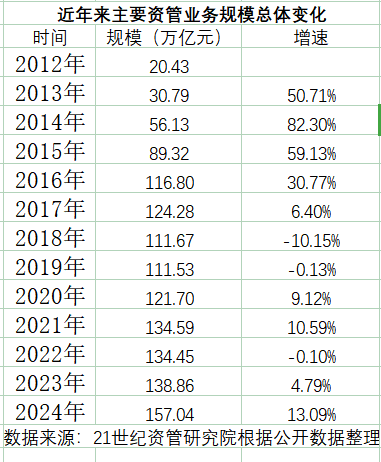
Core Insights - The asset management industry in China is experiencing significant growth, with a total scale reaching 157.04 trillion yuan by the end of 2024, marking a 13.09% increase from the previous year, the highest since the implementation of the new asset management regulations [6][8][12] - The growth is driven by a shift in investor behavior, as lower bank deposit rates and regulatory changes have led to a "financial disintermediation" effect, with substantial inflows into wealth management products, insurance, and public funds [1][6][9] Group 1: Historical Context and Regulatory Changes - The asset management industry has evolved significantly since the introduction of bank wealth management products in 2004, with key milestones including the rise of trust companies and the implementation of the new asset management regulations in 2018 [2][4] - The new regulations aimed to standardize the industry, eliminate shadow banking, and promote transparency, leading to a more compliant and structured asset management environment [2][4][9] Group 2: Growth by Sector - Trust companies saw the highest growth rate at 23.58%, with their scale approaching that of bank wealth management products, which grew by 11.75% [8][12] - Public funds and insurance asset management also experienced significant growth, with increases of 20.39% and 15.08% respectively, indicating a shift in market dynamics [8][12] - By the end of 2024, the asset management scale for various sectors was as follows: insurance at 33.26 trillion yuan (21.18%), public funds at 32.83 trillion yuan (20.91%), bank wealth management at 29.95 trillion yuan (19.07%), and trust at 29.56 trillion yuan (18.82%) [8][12] Group 3: Market Trends and Investor Behavior - The trend of "deposit migration" is evident, with investors moving funds from traditional bank deposits to higher-yielding wealth management products due to declining interest rates [6][9][16] - The asset allocation preferences of investors have shifted, with a notable increase in the proportion of investments in securities and a decrease in non-standard debt investments, reflecting a more cautious approach to risk [30][33] Group 4: Financial Performance and Revenue Trends - The revenue for trust companies increased to 940.36 billion yuan in 2024, although net profits saw a significant decline of 45.52% compared to the previous year, indicating challenges in profitability despite growth in asset scale [40] - Public funds experienced a decline in management fees due to regulatory changes and market conditions, with a notable shift towards passive investment strategies [41] - Bank wealth management products reported a decrease in annualized returns to 2.65% in 2024, highlighting the impact of the low-interest-rate environment on profitability [43]