
光刻胶国产化

Search documents
势银研究 |《光刻胶产业研究报告》
势银芯链· 2025-07-25 03:02
Core Viewpoint - The article summarizes key insights from the "Photoresist Industry Research Report" published by TrendBank, focusing on the photoresist industry chain, application scenarios, industry barriers, and market competition landscape, which aids companies in making informed strategic decisions [2] Key Data - In 2024, China's wafer production capacity is projected to reach 7.5 million pieces per month, representing a year-on-year growth of 13.86% compared to 2023 [3] - The global display panel market size is expected to reach 1.33 trillion yuan in 2024, with an anticipated growth to over 1.4 trillion yuan in 2025, reflecting a year-on-year increase of 6% [4] - From 2019 to 2024, there have been 58 financing events involving photoresist companies in mainland China, with notable large-scale financing [5] Market Size Projections - The market size for semiconductor photoresists in mainland China is projected to be 4.985 billion yuan by 2025 [6] - The market size for display photoresists in mainland China is expected to reach 10.848 billion yuan by 2025 [7] National Policy Support - National policies are empowering the photoresist industry in four major directions: - Tax incentives for integrated circuit enterprises and projects, encouraging the development of materials and components, including photoresists [8] - Import tax incentives for materials like photoresists to reduce costs and promote industry growth [8] - Investment from the National Integrated Circuit Industry Investment Fund, with over 50 billion yuan planned for key material research and industrialization [8] - Special funding exceeding 2 billion yuan for research and innovation in photoresist technology [8]


国内首条,八亿时空百吨级半导体KrF光刻胶树脂双产线建成
势银芯链· 2025-07-24 06:15
Core Viewpoint - The establishment of the first domestic 100-ton semiconductor KrF photoresist resin production line by Eight Billion Space is expected to generate over 100 million yuan in revenue upon reaching full capacity [1][3]. Group 1: Company Overview - Eight Billion Space, a wholly-owned subsidiary of Beijing Eight Billion Space Liquid Crystal Technology Co., Ltd., focuses on semiconductor materials and display panel materials, particularly in photoresist raw materials and photo-sensitive polyimide [5]. - The company has established a comprehensive quality management system covering product development to production control, ensuring the provision of high-quality products and services in the domestic semiconductor materials industry [7]. Group 2: Production Capacity and Plans - Eight Billion Space plans to gradually expand its production capacity based on market conditions, aiming for an annual production capacity of 200-300 tons of high-end photoresist resin within the next five years [2]. - The company has designed two fully autonomous production lines to meet the differentiated needs of the entire industry lifecycle, with expectations of achieving tens of millions in revenue by the second half of 2025 as production capacity is gradually released [3]. Group 3: Production Lines and Technology - The high-flexibility R&D pilot line is designed to meet the "small batch, multiple varieties" R&D iteration and pilot verification needs of domestic photoresist manufacturers and research institutions, enabling rapid switching of different formulations and processes [4]. - The high-capacity mass production line focuses on efficiency and stability, ensuring high consistency between product batches and providing strong material support for the large-scale application of domestic high-end photoresists [4]. Group 4: Product Development and Capabilities - Eight Billion Space has developed multiple technologies for the development of photoresist resins, capable of independently developing KrF and ArF series resins, and has conducted resin procurement verification with several leading companies in the photoresist sector [7]. - The company is also engaged in the synthesis and mass production of electronic-grade monomers and PAG photo acids for KrF, ArF, and PSPI photoresist resins, with capabilities for custom synthesis [10].

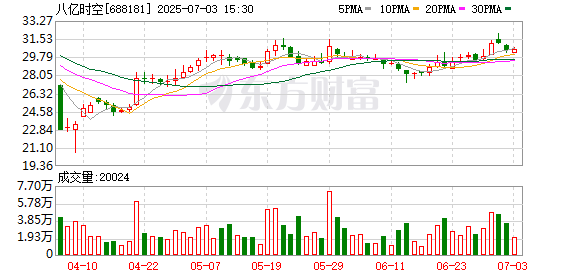
这家公司光刻胶树脂预计下半年收入规模将达千万级丨机构调研
2 1 Shi Ji Jing Ji Bao Dao· 2025-07-03 10:24
Core Viewpoint - The company, a leader in liquid crystal display materials, is expanding into three major industries: display, pharmaceuticals, and semiconductors. It has achieved stable supply of photoresist resin and expects to commence formal mass production in the second half of this year, with projected revenue reaching tens of millions by the second half of 2025 [2][3]. Group 1: Product Development and Revenue Projections - The photoresist resin has achieved stable supply, with expected revenue scale reaching tens of millions in the second half of this year [3][9]. - The company is accelerating the research and certification of polyimide, with multiple products currently undergoing validation testing [9][10]. - The automotive display liquid crystal materials have passed tests from multiple clients, with two products already achieving sales [9][10]. Group 2: Strategic Partnerships and Market Position - The company has established a strategic investment relationship with Xiamen Hengkong, which holds an 11.11% stake in the company, enhancing collaboration with downstream photoresist clients [9][10]. - The company is recognized as one of the leading domestic liquid crystal material providers, successfully entering the semiconductor materials sector, and is expected to grow into a platform-type materials enterprise [12].
艾森股份(688720):差异化布局低国产率赛道 高端新品持续突破放量在即
Xin Lang Cai Jing· 2025-06-18 08:41
Core Viewpoint - The company is implementing a differentiated and high-end development strategy focused on electroplating and photolithography, with significant progress in product testing and upcoming mass production, which is expected to drive continuous growth in performance [1][3]. Electroplating - The company has established a competitive product matrix for electroplating solutions, achieving full category coverage in traditional and advanced packaging fields, and has made breakthroughs in high-end markets [1]. - In the advanced packaging sector, multiple products for electroplating solutions and additives have entered mass production, widely used in Bumping and RDL processes [1]. - The high-purity copper electroplating solution has achieved stable supply to Huada Technology and Tongfu Microelectronics, while the tin-silver electroplating additive has passed stringent certification from Changdian Technology and received small batch orders [1]. - The copper electroplating additive for advanced packaging is currently undergoing batch stability verification, and the 28nm Damascus copper interconnect process copper plating additive is in the final stages of product certification [1]. - The ultra-high purity cobalt-based solution and additives for 5-14nm advanced processes are progressing well in client testing, and the cleaning solution for copper processes in wafer manufacturing has entered the mass production scaling phase [1]. Photolithography - The advanced packaging negative photoresist has covered multiple mainstream packaging factories, with market penetration continuously increasing, and the company plans to enrich product models for full category coverage [2]. - The self-developed positive PSPI photoresist has successfully obtained the first domestic order from a mainstream wafer factory, breaking the long-standing technology monopoly of the US and Japan, and is expected to gradually achieve mass shipments by 2025 [2]. - The company is also developing negative PSPI and high-sensitivity chemical amplification PSPI, with plans to continue advancing product certification in advanced packaging and wafer manufacturers by 2025 [2]. - The wafer ICA chemical amplification photoresist is undergoing successful client validation testing, with some indicators outperforming international benchmark products [2]. - The OLED high-sensitivity photoresist is in client testing for OLED backplane array photolithography processes, and the company has reached a consensus with BOE on future cooperation and strategic planning [2]. - The high-thickness KrF photoresist is currently in the laboratory research phase, aiming to fill domestic gaps [2]. Market Expansion - The company has acquired INOFINE to expand into the Southeast Asian market, further solidifying its leading position in wet electronic chemicals [3]. - INOFINE, established in 2009, is one of the early entrants in the semiconductor wet electronic chemicals business in Malaysia and holds a certain influence in the local market [3]. - From 2025, INOFINE will be included in the company's consolidated financial statements [3]. Financial Projections - The company expects revenues of 600 million, 727 million, and 913 million yuan for the years 2025, 2026, and 2027, respectively, with net profits attributable to the parent company projected at 50 million, 71 million, and 103 million yuan for the same years [3].
光刻胶上游原材料国内企业进展如何?
势银芯链· 2025-05-20 01:55
Core Viewpoint - The global photoresist market is expected to exceed $15 billion by 2025, with China's market share increasing to 35%, highlighting significant growth potential in the industry [2]. Industry Overview - The photoresist industry is a critical component of high-tech materials, encompassing the entire chain from research and development to production and sales [2]. - In the high-end semiconductor photoresist sector, Japanese companies like JSR and Tokyo Ohka dominate with over 85% market share, while domestic production rates are below 5%, indicating a significant technological and market monopoly [2]. Market Dynamics - The advancement in the photoresist industry is driven by downstream demand, where manufacturers' process improvements necessitate technological iterations in photoresists and raw materials [2]. - Domestic manufacturers are increasingly replacing foreign suppliers and expanding production, creating opportunities for photoresist companies [2]. Supply Chain Components - The upstream of the photoresist supply chain includes raw materials such as resins, monomers, photosensitizers, and solvents; the midstream involves the production and synthesis of photoresists based on formulations; and the downstream includes applications in printed circuit boards, LCDs, and IC chips across various industries [2]. Key Raw Materials - Solvents constitute 50%-90% of photoresist composition, essential for dissolving resins and photosensitizers to create a uniform photoresist solution [3][5]. - Photosensitizers, making up 1%-6% of the composition, are crucial for initiating chemical reactions under specific wavelengths of light, altering the solubility of resins during the development process [3][8]. - Resins account for 10%-40% of photoresist, serving as the inert polymer matrix that binds materials together and determines the basic performance of the photoresist after exposure [3]. Market Players - Domestic companies like Yida Co. hold over 40% market share in electronic-grade PM solvents, while other firms like Xilong Science and Jingrui Electric Materials are also making strides in the solvent sector [7]. - The photosensitizer market is dominated by international players such as BASF and IGM Resins, with a trend of production capacity shifting towards China due to patent expirations and increased domestic demand [10]. Product Types and Applications - Different types of photoresists are used for various exposure wavelengths, with global resin supply primarily monopolized by companies like Sumitomo Chemical and Dow Chemical [11]. - Domestic enterprises such as Shengquan Group and Tongcheng New Materials are making significant advancements in photoresist resin production, with some achieving production capacities exceeding 5,000 tons per year [12]. Upcoming Events - The 2025 TrendBank (Fifth) Photoresist Materials Industry Conference will be held from July 8-10 in Hefei, focusing on new applications, current trends, and in-depth discussions on the photoresist supply chain [13].

广信材料(300537) - 300537广信材料投资者关系管理信息2025-016
2025-04-29 13:17
Financial Performance - In 2024, the company achieved a revenue of 518 million CNY, maintaining stable growth year-on-year, but reported a net loss of 32.07 million CNY, primarily due to goodwill impairment and bad debt provisions totaling nearly 80 million CNY [1] - The gross profit margin for sales was 38.02%, an increase of 2.25% compared to the previous year, marking a five-year high [1] - The first quarter of 2025 saw a decline in revenue and net profit, attributed to factors such as customer cost-cutting demands and competition in the photovoltaic battery market [3][5] Market Strategy and Product Development - The company is focusing on expanding its product lines in the photovoltaic adhesive sector, with expectations of significant growth as the market for photovoltaic BC batteries is projected to increase from around 10 GW to over 50 GW in 2025 [7][11] - The company plans to enhance its capabilities in the graphene anti-corrosion coatings market, with small-scale applications already in place and expectations for larger-scale sales starting in Q2 to Q3 of 2025 [2][11] - The company is also prioritizing the development of environmentally friendly coatings, including UV-curable and solvent-free options, to meet diverse customer needs [3][4] Production Capacity and Challenges - The company has recently completed the construction of its Longnan base, which is expected to significantly increase production capacity, with a planned annual output of 9,000 tons of light-sensitive resin [5][21] - The integration of new production lines is anticipated to face challenges during the ramp-up phase, including increased depreciation and operational costs [5][28] - The company is actively working on optimizing its product structure to reduce the proportion of low-margin products during the transition period [5][28] Industry Position and Competitive Landscape - The company remains a leading supplier in the photovoltaic BC battery insulation adhesive market, with a revenue of approximately 50 million CNY in 2024 [7][11] - The global metal packaging coatings market is projected to grow from approximately 3.558 billion USD in 2024 to 4.452 billion USD by 2031, with a CAGR of 3.3% [17][27] - The company is strategically positioned to benefit from the increasing demand for metal packaging coatings, particularly in the food and beverage sector, which is experiencing rapid growth [17][27] Future Outlook - The company anticipates that the second quarter of 2025 will see improved sales performance as new production lines and customers come online [5][11] - The focus for 2025 will be on the growth of metal packaging coatings and industrial anti-corrosion coatings, with expectations for significant market expansion [30][32] - The company is committed to enhancing its research and development capabilities to maintain a competitive edge in the market [29][30]
