
创新型中小企业

Search documents
开市4年北交所已有上市公司282家
Xin Hua Wang· 2025-11-18 07:11
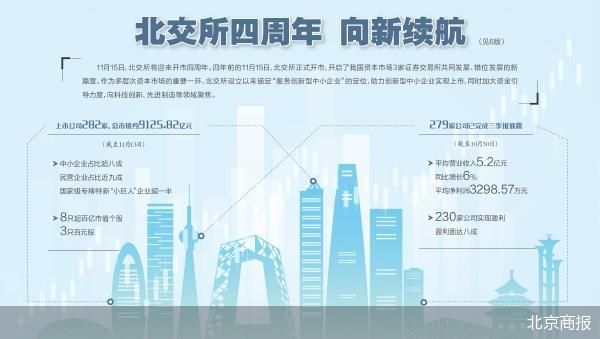
Core Insights - The Beijing Stock Exchange (BSE) currently has 282 listed companies, with over 80% being small and medium-sized enterprises (SMEs) and nearly 90% being private enterprises. More than half of these companies are recognized as national-level specialized and innovative "little giant" enterprises [1] Financial Performance - As of October 30, 279 companies on the BSE have disclosed their Q3 reports, showing an average operating income of 520 million yuan, which represents a year-on-year growth of approximately 6%. The average net profit stands at 32.99 million yuan, with 230 companies reporting profitability [1] Future Plans - The chairman of the BSE, Lu Songbin, indicated that the exchange will further plan the development strategies for the "14th Five-Year Plan" period, focusing on enhancing the construction of the New Third Board market and advancing the service capabilities for innovative SMEs [1]
北交所开市四周年:打造服务创新型中小企业主阵地
Sou Hu Cai Jing· 2025-11-15 06:50
Core Insights - The Beijing Stock Exchange (BSE) has achieved significant milestones in its four years of operation, focusing on serving innovative small and medium-sized enterprises (SMEs) and enhancing market functions [1][2][3] Group 1: Market Performance - As of November 14, 2025, the BSE has 282 listed companies, a threefold increase from 81 at its inception, with over 80% being SMEs and nearly 90% being private enterprises [2] - The average revenue of 279 companies that disclosed their Q3 reports is 5.20 billion, reflecting a year-on-year growth of 6%, while the average net profit stands at 32.99 million [2] - The total market capitalization of listed companies is approximately 900.83 billion, with the top companies being Better Ray (42.04 billion) and Jinbo Biological (27.59 billion) [2] Group 2: Institutional Arrangements - The BSE has established inclusive market access for growth-stage and unprofitable companies, with a focus on balancing regulatory costs for SMEs [3] - The introduction of the "920" code signifies the BSE's transition to an independent code era, enhancing market recognition and attracting quality enterprises [3][4] Group 3: Market Ecosystem - The BSE has issued over 13 trillion in government bonds and supported local government bond issuance exceeding 990 billion, contributing to regional economic development [5] - More than 90% of listed companies have distributed dividends, with over 9.5 million qualified investors participating in the market [6] Group 4: Future Directions - The BSE plans to enhance its functions by improving support for technology innovation and refining its listing review system [7] - The focus will also be on stabilizing the market by improving the quality of listed companies and fostering long-term capital investment [8] - The BSE aims to optimize its product offerings and enhance market services, including the introduction of the North Certificate 50 ETF and after-hours fixed-price trading [9]
北交所开市四周年:282家公司总市值超9000亿元
2 1 Shi Ji Jing Ji Bao Dao· 2025-11-15 02:08
Core Insights - The Beijing Stock Exchange (BSE) officially opened on November 15, 2021, and has since become a key platform for innovative small and medium-sized enterprises (SMEs) in China [1] - As of now, the BSE has 282 listed companies with a total market capitalization exceeding 900 billion yuan, with nearly 80% being SMEs and over 90% being private enterprises [3][4] - The BSE has implemented a precise and inclusive market access mechanism to support growth-stage and unprofitable companies, alongside a practical continuous supervision system [5][6] Market Performance - The BSE has seen significant growth in market scale and activity over the past four years, with 282 listed companies and a total market value of 900.83 billion yuan [3][4] - The average R&D intensity of listed companies on the BSE is 4.5%, surpassing the average level of regulated enterprises [5] - Over 80% of companies reported profitability in the first half of the year, with a median net profit of approximately 15 million yuan [5] Investor Landscape - The number of qualified investors has reached about 9.5 million, with increasing participation from public funds, private equity funds, and qualified foreign institutional investors (QFIIs) [5] - The BSE is preparing to launch the North Exchange 50 ETF, which is expected to attract more diverse investors and enhance market activity [6][7] Future Development Plans - The BSE aims to enhance its service for innovative SMEs by focusing on four key areas: improving functionality, strengthening foundations, providing friendly services, and fostering an open ecosystem [8] - Plans include optimizing listing standards, enhancing the bond market product system, and promoting the issuance of government bonds [9][10] - The BSE will also work on improving market product systems, service mechanisms, and technological systems to better meet market demands [10][11] Collaborative Efforts - The BSE emphasizes collaboration with government departments and market institutions to support the development of innovative SMEs [11] - There is a focus on enhancing cooperation with local government industrial funds and financial institutions to facilitate SME financing [11][12]

北交所开市四周年丨282家公司总市值超9000亿元
2 1 Shi Ji Jing Ji Bao Dao· 2025-11-15 01:06
Core Insights - The Beijing Stock Exchange (BSE) has become a significant platform for innovative small and medium-sized enterprises (SMEs) since its opening on November 15, 2021, with 282 listed companies and a total market capitalization exceeding 900 billion yuan [1][3] - The BSE's inclusive market access mechanism supports growth-stage and unprofitable companies, while its ongoing regulatory framework balances compliance costs for SMEs [1][3] - The introduction of the BSE's specialized indices and trading mechanisms, such as the market-making system, enhances market vitality and operational efficiency [1][3] Market Growth and Structure - As of now, nearly 80% of the listed companies on the BSE are SMEs, with private enterprises making up about 90% and over half classified as national-level "specialized, refined, distinctive, and innovative" small giants [3][4] - The average R&D intensity of listed companies is 4.5%, significantly higher than the average for larger enterprises, with over 80% of companies achieving profitability in the first half of the year, maintaining a median net profit of approximately 15 million yuan [3][4] Investor Engagement - The number of qualified investors has reached around 9.5 million, with increasing participation from public funds, private equity, and qualified foreign institutional investors (QFIIs) [4] - The BSE is actively preparing for the launch of the BSE 50 ETF, which is expected to attract more diverse investors and enhance market liquidity [5] Future Development Plans - The BSE aims to strengthen its support for technological innovation and improve its listing standards and regulatory frameworks to better serve key strategic sectors [6] - Efforts will be made to enhance the quality of listed companies through stringent regulatory mechanisms and to promote long-term capital investment in small and medium-sized stocks [7] - The BSE plans to optimize its product offerings and service systems, including the introduction of new trading mechanisms and digital innovations [8] Collaborative Ecosystem - The BSE emphasizes collaboration with government departments and market institutions to foster a supportive environment for innovative SMEs [9] - There is a focus on enhancing international cooperation and expanding the BSE's global outreach to improve market internationalization [9]

282家公司总市值超9000亿元
2 1 Shi Ji Jing Ji Bao Dao· 2025-11-15 01:04
Core Insights - The Beijing Stock Exchange (BSE) has become a key platform for innovative small and medium-sized enterprises (SMEs) since its opening on November 15, 2021, with 282 listed companies and a total market capitalization exceeding 900 billion yuan [2][3]. Market Overview - As of now, the BSE has 282 listed companies, with a total market capitalization of over 900 billion yuan, where nearly 80% are SMEs and about 90% are private enterprises [3][4]. - The average R&D intensity of listed companies on the BSE is 4.5%, significantly higher than the average for large-scale enterprises [5]. Investor Landscape - The number of qualified investors on the BSE is approximately 9.5 million, with increasing participation from public funds, private equity funds, and qualified foreign institutional investors (QFIIs) [5][6]. Regulatory and Market Mechanisms - The BSE employs a precise and inclusive market access mechanism to support growth-stage and unprofitable companies, alongside a practical continuous supervision system to balance compliance costs for SMEs [2][5]. - Recent initiatives include the launch of the BSE Specialized and Innovative Index and the completion of the "920" code switch, enhancing market investment tools and operational efficiency [2][5]. Future Development Plans - The BSE aims to enhance its service for innovative SMEs by focusing on four key areas: improving functionality, strengthening foundations, providing friendly services, and fostering an open ecosystem [7]. - Plans include optimizing listing standards, enhancing the bond market product system, and promoting the establishment of more public fund products targeting small and medium-sized stocks [8][9]. Collaboration and Ecosystem Building - The BSE emphasizes collaboration with government departments and market institutions to support the financing and development of innovative SMEs [10]. - Efforts will be made to deepen international cooperation and enhance the market's internationalization [10].

北交所开市四周年:“河南团”量质齐升领跑中部地区
He Nan Ri Bao· 2025-11-14 23:32
Core Insights - The Beijing Stock Exchange (BSE) has marked its 4th anniversary, with 13 companies from Henan province listed, leading the central region in total listings and achieving a market capitalization exceeding 35 billion yuan [1][2] - Over 50% of the listed companies in Henan are specialized and innovative enterprises, with 85% being private companies and nearly 90% classified as high-tech [1] - The capital market is facilitating the transformation and upgrading of regional industries, positioning Henan's innovative SMEs as key drivers of high-quality economic development [2] Group 1 - The BSE has provided strong financial momentum for the high-quality development of Henan's regional economy, with a total market value of over 35 billion yuan [1] - Among the 13 listed companies, more than half are recognized as national-level specialized and innovative "little giant" enterprises, indicating a robust innovation ecosystem [1] - The city of Zhengzhou leads with 5 listed companies, followed by Xuchang and Xinxiang with 2 each, showcasing a clear regional innovation hierarchy [1] Group 2 - Nearly half of the BSE-listed companies in Henan reported year-on-year growth in R&D expenses, with investments ranging from over 2 million yuan to 20 million yuan, creating a positive cycle of R&D, transformation, and profitability [1] - There are currently 32 companies in Henan that have completed listing counseling filings, with 6 in the final stages, indicating a strong pipeline for future listings [1] - Companies like Jiachen Intelligent and Haichang Intelligent have received approval for fundraising totaling 712 million yuan, while others are submitting materials across various sectors such as optical communication and industrial gases [1]
从81到282!北交所四周年,总市值破9000亿
Sou Hu Cai Jing· 2025-11-14 00:49
Core Insights - The Beijing Stock Exchange (BSE) has become a vital engine for high-quality economic development in China, marking its fourth anniversary with significant achievements in supporting innovative small and medium-sized enterprises (SMEs) [1][2] Group 1: Market Performance - As of November 15, 2025, the BSE has grown from 81 initial companies to 282 listed firms, with a total market capitalization exceeding 912.67 billion yuan [1] - In the first three quarters of 2025, 279 listed companies reported a combined revenue of 145.07 billion yuan and a net profit of 9.20 billion yuan, with over 80% of companies achieving profitability [2] - The BSE has seen a significant improvement in market liquidity, with a cumulative trading volume of 5.87 trillion yuan and an average daily trading volume of approximately 28.10 billion yuan, reflecting a 128.66% increase compared to the previous year [3] Group 2: Financing and Investment - Over the past four years, the 282 listed companies have raised over 54 billion yuan, averaging nearly 2 billion yuan per company, with over 80% of the funds directed towards green low-carbon initiatives, digital economy, high-end equipment manufacturing, and new materials [2] - The BSE has introduced various special bond types, including technology innovation bonds and green bonds, to support financing for innovative enterprises [2] Group 3: Institutional Innovation and Policy Support - The BSE has established itself as an essential part of China's multi-tiered capital market system, with ongoing institutional innovations enhancing its service capabilities for innovative SMEs [3][7] - The implementation of the "Deep Reform 19 Articles" aims to improve the listing mechanism and enhance market vitality, with a focus on high-quality listings and collaboration with the New Third Board [7][8] Group 4: Future Development and Strategic Focus - The BSE plans to continue enhancing its market functions, solidifying its foundation, and fostering a friendly service environment for innovative SMEs [8] - There is an emphasis on attracting long-term capital, such as public funds and insurance capital, to improve liquidity and support the growth of "specialized, refined, distinctive, and innovative" enterprises [8]
北交所开市这四年
Bei Jing Shang Bao· 2025-11-13 15:58
Core Insights - The Beijing Stock Exchange (BSE) is celebrating its fourth anniversary, having established itself as a key player in the multi-tiered capital market, focusing on serving innovative small and medium-sized enterprises (SMEs) [1][9] - As of November 13, 2023, the BSE has 282 listed companies with a total market capitalization exceeding 900 billion yuan, approaching the 1 trillion yuan mark [3][4] - There are currently 170 companies in the IPO pipeline for the BSE, indicating strong interest and activity in the market [6][7] Market Growth - The BSE has shown significant growth over four years, with the number of listed companies increasing from 81 at inception to 282 today [1][3] - The total market capitalization of listed companies reached approximately 912.58 billion yuan as of November 13, 2023 [3] - The number of new listings has also increased, with 25 new stocks listed in the fourth anniversary year and 20 new stocks listed in 2023 [3] Company Performance - Among the listed companies, Betterray leads with a market capitalization of 41.85 billion yuan, followed by Jinbo Biological at 27.42 billion yuan [3][4] - The average revenue for BSE companies in the third quarter was 520 million yuan, reflecting a year-on-year growth of 6%, with an average net profit of approximately 32.99 million yuan [4][5] - Betterray reported a revenue of about 12.38 billion yuan for the first three quarters of 2023, a 20.6% increase year-on-year, with a net profit of approximately 768 million yuan [5] IPO Pipeline - The BSE has a robust IPO pipeline with 170 companies at various stages of the IPO process, indicating a healthy interest in the exchange [6][7] - The IPO review process has accelerated, with multiple companies receiving approval in recent weeks, showcasing the BSE's efficiency in handling new listings [7][8] Policy Support - The China Securities Regulatory Commission (CSRC) has emphasized the importance of the BSE in supporting innovative SMEs and is committed to its high-quality development [9][10] - Continuous policy support has been provided to enhance the market's functionality and stability, contributing to the BSE's growth [9][10] Future Directions - Future initiatives include the introduction of the North Certificate 50 ETF and the exploration of after-hours fixed-price trading [1][10] - The BSE aims to strengthen its unique characteristics and attract high-quality enterprises by implementing a new securities code system [10][11]
北交所:服务创新型中小企业主阵地建设再上新台阶
Zhong Guo Zheng Quan Bao· 2025-11-02 20:16
Core Insights - The Beijing Stock Exchange (BSE) is focusing on supporting innovative small and medium-sized enterprises (SMEs) and plans to launch the North Exchange 50 ETF to attract passive investment and enhance market vitality [1][5] Group 1: Market Structure and Composition - Over 80% of the 280 listed companies on the BSE are SMEs, with nearly 90% being privately owned, and more than half classified as national-level specialized and innovative "little giant" enterprises [1] - The average R&D intensity of listed companies on the BSE is 4.5%, which is 2.86 percentage points higher than the average for regulated enterprises [1] Group 2: Regulatory and Institutional Enhancements - The China Securities Regulatory Commission (CSRC) emphasizes the need for continuous research on the characteristics and development patterns of innovative SMEs to improve the adaptability of institutional mechanisms and product services [2] - The BSE aims to optimize its listing standards and enhance the listing review system to better support technological innovation and traditional industry transformation [3] Group 3: Financial Support and Investment Attraction - The BSE is working to attract long-term patient capital to support innovative SMEs, addressing the funding gap often referred to as the "valley of death" in technology commercialization [4] - The BSE plans to establish more public fund products focused on investing in small-cap stocks and improve services for various types of funds, including social security and insurance [5] Group 4: Ecosystem Development - The BSE is committed to fostering a collaborative ecosystem by enhancing communication with government departments and financial institutions to better support innovative SMEs [6][7] - The BSE is in a critical phase of establishing a strong regulatory framework to ensure high-quality listings and maintain market integrity [7]
北交所:加快推出北证50ETF
Zhong Guo Zheng Quan Bao· 2025-10-29 21:08
Core Viewpoint - The Beijing Stock Exchange (BSE) aims to enhance its support for innovative small and medium-sized enterprises (SMEs) during the 14th Five-Year Plan period, focusing on optimizing listing standards, improving trading mechanisms, and fostering a favorable investment environment [1][2][3]. Group 1: Market Development and Support for SMEs - The BSE currently has 280 listed companies, with over 80% being SMEs and nearly 90% being private enterprises, including more than half of the national-level specialized and innovative "little giant" companies [1]. - The BSE is committed to creating a supportive environment for growth-stage and unprofitable companies to list, while balancing regulatory costs for SMEs [1][3]. - The introduction of a market-making trading mechanism and the recent launch of the BSE Specialized and Innovative Index are part of the efforts to enhance market accessibility [1]. Group 2: Financial and Investment Strategies - Over 90% of listed companies on the BSE have implemented dividend policies, with nearly 9.5 million qualified investors participating in the market, indicating a strong engagement from public funds, venture capital, and qualified foreign institutional investors (QFII) [2]. - The BSE plans to optimize its listing standards and improve the adaptability and precision of its listing review system, while also enhancing merger and acquisition regulations to attract financial resources to key technology sectors [3]. - The BSE aims to support listed companies in utilizing refinancing, mergers, and stock incentives to strengthen their positions, while also promoting long-term capital investment strategies [3]. Group 3: Collaboration and Internationalization - The BSE will enhance communication mechanisms with various governmental departments to foster the development of specialized and innovative enterprises [4]. - The exchange seeks to strengthen collaboration with financial institutions to support SME financing and actively engage in international market integration [4]. - Efforts will be made to explore and improve cooperation in areas such as enterprises, investors, and products to gradually increase the internationalization of the market [4].